Virginia
Virginia Exonerates Marvin Grimm, Jr. in 1975 Murder Case After 45 Years of Wrongful Incarceration – Innocence Project


The State’s Flawed Case
On March 15, 1976, to satisfy the need for corroboration of the plea, the circuit court heard a summary of the state’s evidence against Mr.Grimm. In addition to testimony from police and Mr. Grimm’s confession, the state presented forensic evidence analyzed by Ms. Burton.
This evidence included Ms. Burton’s lab report with results from microscopic testing of the eight hairs found on Mr. Grimm’s car floorboards and on a child’s sock in the car, as well as on a pea coat found in his apartment. Ms. Burton visually inspected slides made from swabs of the pharynx, epiglottis, esophagus, nasal passage, and oral cavity and a towel recovered from Mr. Grimm’s car that had a stain indicating the presence of what she believed to be sperm. Dr. Fierro, who performed the autopsy, also testified, erroneously, that there was spermatozoa on a “thick white gelatinate material” in C.H.’s mouth.
After hearing this forensic evidence and the testimony from officers who obtained Mr. Grimm’s confession, the circuit court accepted Mr. Grimm’s guilty pleas on all three counts and sentenced him to life in prison on the murder and abduction charges, plus 10 years on the sodomy charge.
New Evidence of Mr. Grimm’s Innocence
After years of post-conviction litigation, in April 2023, attorneys from the Innocence Project and Arnold & Porter submitted a petition for writ of actual innocence before the Virginia Court of Appeals, seeking to vacate Mr. Grimm’s murder conviction based on newly discovered DNA and non-biological evidence.
The Virginia Office of the Attorney General joined the petition. On June 18, 2024, the Virginia Court of Appeals granted the petition, based on the newly discovered evidence, including:
DNA Evidence: In 2011, the Virginia Department of Forensic Science performed DNA analysis of the eight hairs found in Mr. Grimm’s car, a sock in the car, and a peacoat in his apartment that were previously attributed to C.H. Through this testing, C.H. was excluded as the source on six of the eight hairs. Testing on one of the two remaining hairs was inconclusive, and the other lacked sufficient mitochondrial DNA to make a meaningful comparison. Thanks to changes in Virginia law, the two remaining hairs were sent to a private, accredited laboratory that was able to analyze the two remaining hairs. C.H. was excluded as the source of both the hairs, and they were determined to be from different sources.
Post-conviction DNA analysis also eliminated Mr. Grimm as a possible contributor of the genetic material detected in the swabs taken from the epiglottis, esophagus, oral cavity, and non-sperm fractions of the pharynx swabs. Further, examinations by the Virginia Department of Forensic Science and two leading private labs of the white substance that had been collected on swabs found no spermatozoa, disproving the medical examiner’s theory of the case.
Toxicology Report: Dr. Jeffrey Brent, a board-certified medical toxicology
physician with a Ph.D. in biochemistry, reviewed the toxicology reports developed during
the autopsy of C.H. In conducting this review, Dr. Brent considered the quantities of the substances present in C.H.’s system, the amount of food identified in his stomach, and his physical size. When all these factors are taken together, Dr. Brent concluded it was more probable than not that C.H. ingested the alcohol, chlorzoxazone, and acetaminophen found in his system at least 90 to 150 minutes prior to his death. This timeline of events would have made it impossible for Mr. Grimm to have committed the crime, since it was undisputed that he was alone in his apartment within 75 minutes after the mother of the child claimed she had last seen her child walk off alone into the woods.
A Long Fight to Prove Innocence Post-Conviction
The campaign to prove Mr. Grimm’s innocence was fought in the courtroom and the statehouse.
Mr. Grimm initially requested DNA testing in the late 1980s, but faced a number of hurdles. At that time, Virginia law did not allow post-conviction DNA testing, and a writ of innocence for new biological and non-biological evidence was only available to people who went to trial, not those who accepted a guilty plea, as Mr. Grimm did.
Years of lobbying legislators in Virginia, an effort led by former Innocence Project Directors of Policy Michelle Feldman and Rebecca Brown, the Mid-Atlantic Innocence Project and the Innocence Project at the UVA School of Law, led to changes in Virginia law.
Because of their efforts, Virginia permitted access to post-conviction DNA testing, lifted the guilty plea bar for those seeking a writ of innocence for new biological and non-biological evidence, and allowed people accused of crimes to get testing at private, accredited labs. Without these reforms, Mr. Grimm would have been unable to make his case for innocence.
Mr. Grimm’s exoneration took decades of painstaking investigation and litigation by a long list of attorneys at the Innocence Project and Arnold & Porter, in particular Ms. Friedman and former Innocence Project attorney Olga Akselrod. These two lawyers spent a combined two decades working on behalf of Mr. Grimm. Innocence Project’s Senior Staff Attorney Tim Gumkoski also joined Ms. Friedman. More recently, Mr.Neufeld and Innocence Project’s Director of Special Litigation Vanessa Potkint added their expertise to the Innocence Project team. Arnold & Porter collaborated with the IP for many years, led by Partner Jeffrey Horowitz and now retired Partner Glenn Pogust, Senior Attorney Robert Grass, and Senior Associate Angelique Ciliberti.
From 2008 to 2017, the University of Richmond School of Law’s Institute for Actual Innocence, directed by Professor Mary Tate, also supported the legal efforts.
“Working to exonerate Mr. Grimm was truly a team effort involving not only our Arnold & Porter team, but also multiple attorneys over the years from the Innocence Project, and could never have been accomplished without the unwavering support of Marvin’s sisters and entire family.” said Mr. Horowitz.
###
Innocence Project
The Innocence Project works to free the innocent, prevent wrongful convictions, and create fair, compassionate, and equitable systems of justice for everyone. Our work is guided by science and grounded in anti-racism. For more information, please visit www.innocenceproject.org.
Arnold & Porter
Arnold & Porter combines sophisticated regulatory, litigation, and transactional capabilities to resolve clients’ most complex issues. With over 1,000 lawyers practicing in 15 offices worldwide, we offer deep industry experience and an integrated approach that spans more than 40 practice areas. Through multidisciplinary collaboration and focused industry experience, we provide innovative and effective solutions to mitigate risks, address challenges, and achieve successful outcomes.


Gov. Abigail Spanberger speaks at a press conference announcing there is a deal to authorize cannabis sales and put the legislation in the upcoming budget, Tuesday, June 16, 2026, in Richmond, Va. (Mike Kropf/Richmond Times-Dispatch via Getty Images)
Richmond Times-Dispatch via Getty Images
For the last five years, Virginia cannabis has existed in a strange policy gap.
Adults could legally possess it. They could grow it at home. They could gift it. They could consume it. But if they wanted to walk into a licensed adult-use dispensary and buy a tested, labeled product from a regulated business, Virginia still had no legal retail market.
That contradiction has defined the Commonwealth’s cannabis story since 2021, when Virginia became the first state in the South to legalize adult-use possession. The original promise was bigger than decriminalization. It was supposed to be the beginning of a regulated commercial market—one that would move consumers away from the illicit market, create room for small businesses and farmers, and finally give the state an enforceable framework for products already being sold and consumed.
Instead, Virginia legalized the front end of adult use without opening the front door of the industry.
Since then, the state has been caught in political limbo. Retail implementation stalled after the 2021 elections. Republican control of the House slowed the process. Former Gov. Glenn Youngkin later vetoed adult-use retail bills. Operators, investors and would-be applicants watched session after session with the same question: when would Virginia finally stop treating cannabis like something adults could legally have, but not legally buy?
The answer appeared close in 2026. With Gov. Abigail Spanberger in office and Democrats controlling the General Assembly, cannabis advocates expected the retail framework to finally move. Lawmakers sent the governor a bill that would have launched adult-use sales in 2027. Spanberger returned it with amendments, including a later sales date, a lower possession limit than lawmakers proposed, a higher future tax rate and tougher enforcement provisions. The legislature rejected those changes.
Then came the veto.
For many in the industry, Spanberger’s May veto landed as political whiplash. After years of delay, the state had once again stopped short of launching a legal adult-use marketplace. Worse, the veto came from a governor many advocates and operators expected to be more receptive than her predecessor.
For Brett Puffenbarger, CEO of Old Dominion Cannabis, the moment carried personal weight. Puffenbarger has spent nearly a decade in the cannabis industry and saw Virginia’s 2021 legalization as a chance to bring that experience back home.
“I have been in cannabis for almost a decade, and when Virginia first legalized adult use, it looked like an opportunity to build on that career in my home state,” Puffenbarger said via email. “I had been in Florida for years, but I was born and raised in Virginia. We moved back five years ago because we believed the Commonwealth would eventually open a regulated market. Now Old Dominion Cannabis is preparing to compete for cultivation and manufacturing licenses.”
That kind of long-range planning is common in cannabis. It is also risky. Markets can take years to open. Rules can change overnight. A state can legalize possession and still leave businesses waiting for a real path to licensure.
Virginia became a case study in that uncertainty.
The veto seemed to push the market another year down the road. But within weeks, the same framework came back in a different vehicle: the state budget. Spanberger, Sen. Lashrecse Aird and Del. Paul Krizek announced a compromise that would create a regulated adult-use retail market through budget language, with sales beginning July 1, 2027.
That turnabout changed the mood almost immediately.
“When the veto came down, we thought, ‘Here we go again—another year gone,’” said Jody Roun, COO of Old Dominion Cannabis, via email. “To see the conversation turn around this quickly through the budget process was surprising and exciting. For operators who have been planning around a moving target, it finally feels like there is a path.”
The compromise is not the same bill lawmakers originally passed. It reflects concessions to the governor, especially on timing, taxes, possession limits and enforcement. But it also preserves several priorities from legislators and advocates, including a larger retail cap, statewide access and a framework designed to give small businesses, farmers and microbusinesses a chance to participate.
Here are 10 key pieces of the framework Virginia is now poised to put into law:
1. Adult-use retail sales would begin July 1, 2027. The Virginia Cannabis Control Authority would begin accepting license applications on February 1, 2027, giving regulators time to write rules, establish testing standards and build the oversight structure before stores open.
2. Adults 21 and older would have a legal retail channel. Virginia already legalized adult possession and limited home cultivation, but this framework would finally allow consumers to purchase regulated cannabis from licensed retailers.
3. The adult possession limit would increase from one ounce to two ounces. That is less than the 2.5-ounce limit lawmakers originally sought, but higher than the current possession limit.
4. The state would allow up to 350 retail cannabis establishment licenses. Regulators would not be required to issue them all at once, but the cap is designed to create enough access to compete with the illicit market.
5. Localities would not be able to opt out of the market. That matters because local bans in other states have often left consumers with limited legal access and preserved demand for unregulated sellers.
6. Delivery services are expected to be allowed as part of the regulated market. Combined with the retail cap and no local opt-outs, delivery could become an important tool for statewide access, especially in rural areas.
7. The tax structure would start relatively low. Adult-use cannabis would carry a 6% state excise tax at launch, increasing to 8% beginning July 1, 2029. Local governments could add another 1% to 3.5%, in addition to existing retail sales taxes.
8. The Cannabis Control Authority would gain expanded oversight over intoxicating hemp products. The compromise is designed to close Virginia’s 25:1 hemp loophole and move intoxicating hemp regulation away from the Department of Agriculture and Consumer Services and under the cannabis regulator.
9. The framework includes stronger child-safety and advertising rules. It would require child-resistant packaging, ban cartoon advertising and prohibit products shaped like animals, fruits, vehicles or humans.
10. The state would add stronger compliance and enforcement tools. Retailers could face escalating penalties for failing to check IDs, including possible license revocation for repeated underage sales. Stores would also have to be at least 1,000 feet from schools, hospitals, playgrounds and drug treatment facilities, while the CCA could maintain a public licensee registry, create a tip line and audit ownership and financial relationships.
“The cannabis license application cycle goes through peaks and valleys,” said Justin Singer, a partner at Feuerstein Kulick LLP and chair of the firm’s Regulatory Compliance and Licensing practice via phone interview. “We have been in an extended valley for sought-after licenses for some time, and as a result we have seen a tremendous amount of interest in this upcoming application process.”
Put together, the framework signals that Virginia is trying to do more than open stores. It is trying to correct the imbalance created in 2021: legal adults, legal possession, legal home cultivation—but no legal commercial channel for most consumers.
The challenge now is execution.
Cannabis regulators across the country have learned that legal markets do not automatically beat illicit ones. Taxes that are too high, licensing that is too slow, limited access, lack of capital and burdensome rules can all keep consumers in the unregulated market. Virginia’s relatively modest starting excise tax may help. So could the 350-store cap, if the state issues licenses in a way that creates real geographic coverage.
But questions remain. How quickly will cultivation and manufacturing licenses be processed? How much room will there be for independent operators? Will microbusinesses and impact applicants have meaningful access to banking and capital? Will existing medical operators have a first-mover advantage? And can the state build a market that is regulated enough to protect consumers without being so expensive and slow that it recreates the same illicit-market incentives legalization was supposed to solve?
For companies like Old Dominion Cannabis, the answer will determine whether Virginia becomes a real opportunity or simply another tightly controlled market dominated by the best-capitalized players.
Still, after five years of waiting, the significance of this moment is hard to ignore. Virginia is no longer debating whether adults should be allowed to possess cannabis. That question was answered in 2021. The question now is whether the Commonwealth can build a functioning legal industry around that decision.
The budget compromise does not end the work. It starts it.
For operators, the next several months will be about applications, compliance, capital and partnerships. For regulators, it will be about writing rules that can survive contact with the market. For consumers, it could mean finally having a legal way to purchase tested cannabis products in the first Southern state to legalize adult use.
Virginia took the symbolic step five years ago. Now it may finally be taking the commercial one.

RICHMOND, Va. — Jerrod Buford first picked up a paintbrush as a kid, never imagining that same creative outlet would carry him through his darkest days in prison.
Buford, who grew up in Williamsburg, was convicted and arrested as a young man and spent almost a decade behind bars. During that time, he struggled deeply.
“Turning to drugs and alcohol to kind of shadow over emotions,” Buford said. “Looking for acceptance, approval. Not just from my parents, but from friends, from, you name it. I mean, I tried to commit suicide, I don’t even know how many times,” Buford said.
WTVR
It was inside prison walls that art became more than a hobby.
“Throughout my prison time, I learned, the freedom that I desired, I’ve always had it. I got, I found it, in a box,” Buford said.
More than three years after his release, Buford continues to advocate for art as a tool for healing. He describes his work as a gift he feels called to share.
“I received a blessing from God that just allowed me to display what he’s given me,” Buford said.
For Buford, creating art is also a way of processing his past.
“That’s what art has done for me. It’s given me the ability to look at parts of my life, all parts of my life, and find the good and the negative, learn from the negative,” Buford said.
He shares his story and artwork with a wide audience through social media, including live sessions on TikTok, and holds art classes with new communities.
The Story Cafe
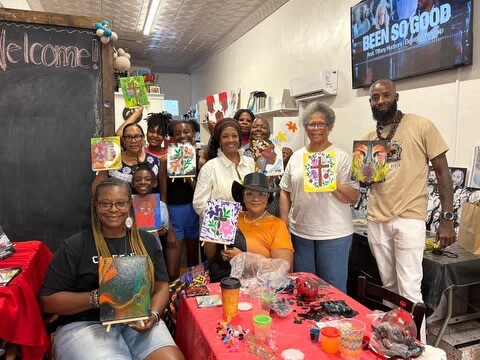
Buford said his mission is to help others find their own path toward healing — whatever form that takes.
“What I strive to do is guide this person to just create, man. Don’t care what people think about your creation, you just need to get it out,” Buford said. “Whether it’s with art, addressing your mental health, getting your life right — just do it.”
CBS 6 is committed to sharing community voices on this important topic. Email your thoughts to the CBS 6 Newsroom.
📲: CONNECT WITH US
Blue Sky | Facebook | Instagram | X | Threads | TikTok | YouTube

This story was initially reported by a journalist and has been converted to this platform with the assistance of AI. Our editorial team verifies all reporting on all platforms for fairness and accuracy. To learn more about how we use AI in our newsroom, click here.

Lovingston, VA (7News) — Good Morning Washington interviews Amanda Beckwith of Virginia Distillery Company- one of the contributing distilleries to the Virginia Spirits Board’s 250th Celebration Trio Pack, a special, exclusive release created to commemorate America’s upcoming 250th anniversary. This limited-edition package features a curated collection of a rum, a gin, and a whiskey, all crafted from scratch by distillers in Virginia to celebrate the rich history and current state of distilling within the Commonwealth.
Beckwith elaborates on VA Distillery Company’s role in the project, noting her focus on Virginia-grown grain to make the bottle of unique whiskey that is included in the Trio Pack. It is also worth noting that the Trio Packs themselves were bottled and produced right here at Virginia Distilling Company!
American single malts are the newest official category of American whiskey, distilled from one grain and from a single distillery. Virginia Distillery Co specializes in this new category of whiskey and crafted their contribution to the Trio Pack with this very specialty. Given the limited remaining availability of the Trio Pack, its historical value and collectible nature, the message it loud and clear encouraging viewers to grab a pack before they are all gone!
BE THE FIRST TO COMMENT
21+ Please drink responsibly, this content is sponsored by Virginia Distillery Company.
-

 Detroit, MI12 minutes ago
Metro Detroit weather forecast, June 26, 2026 — 4 p.m. Update
-

 San Francisco, CA22 minutes ago
Newlyweds celebrate Pride-themed weddings inside SF City Hall as parade preparations underway
-

 Dallas, TX26 minutes ago
All Dallas restaurants firing up specials for July 4th and America’s 250th
-

 Miami, FL34 minutes ago
Helping Venezuela: State Department deploys Miami-Dade search-and-rescue team
-

 Boston, MA37 minutes ago
Photos: Norway takes on France in high-powered World Cup matchup in Foxborough – The Boston Globe
-

 Denver, CO42 minutes ago
Denver Transplant Games sets Guinness World Record for mos living donors, recipients in one place at one time
-

 Seattle, WA49 minutes ago
How to watch Egypt vs. Iran World Cup match in Seattle
-

 San Diego, CA52 minutes ago
Sharp Coronado Hospital Holds Meet-and-Greet With NASCAR San Diego Weekend

