Texas
How to watch Texas vs. Washington: TV channel, live stream, Sugar Bowl odds, College Football Playoff game


The second College Football Playoff semifinal on New Year’s Day will be hosted at the Sugar Bowl in New Orleans as No. 2 Washington and No. 3 Texas clash Monday in the Big Easy. There will be major changes to the college football landscape in 2024, and both the Longhorns and Huskies have a chance to etch their legacy as they prepare to enter their new conferences.
Each program boasts a proud tradition, including national titles, but neither has ever won a CFP game. (Texas has never even made the field.) In the final year before the playoff expands to 12 teams, both schools have fielded teams with an aura of destiny that now stand just two victories away from the mountaintop. Texas ended Alabama’s 43-game winning streak in nonconference home games earlier this season, and then marched to its first Big 12 title since 2009 in its final year as a conference member before it joins the SEC in 2024.
Washington reached 13 victories for the first time in program history while winning a bitterly competitive Pac-12 in the final season before the league splinters apart. The Big Ten-bound Huskies have won 20 straight games under second-year coach Kalen DeBoer with star quarterback Michael Penix Jr. leading the way.
Three of the five all-time meetings between these schools have come in bowl games, all of which were decided by seven points or less. Considering what we saw from them this season, it would be no surprise if the Huskies and Longhorns play a classic.
Follow along with LIVE UPDATES as Texas battles Washington in the Sugar Bowl College Football Playoff semifinal.
How to watch Sugar Bowl live
Date: Monday, Jan. 1 | Time: 8:45 p.m. ET
Location: Caesars Superdome — New Orleans, Louisiana
TV: ESPN | Live stream: Fubo (Try for free)
For a limited time, new subscribers can save $20 on Fubo’s Pro, Elite and Premier plans.
Texas vs. Washington: Need to know
Legacy game: Penix has cemented his place in Washington lore as he closes in on a second straight season leading the sport in passing yards per game. He was a Heisman Trophy finalist this season and boasts a 24-2 record as UW’s starter. His counterpart, Texas quarterback Quinn Ewers, is building a legacy of his own. The Texas native transferred home after spending the 2021 season at Ohio State and has helped reinvigorate the program under third-year coach Steve Sarkisian. Ewers threw for a career-high 452 yards and matched his personal best with four passing touchdowns in the Big 12 Championship Game victory against Oklahoma State.
Major trench battle: Washington won the Joe Moore Award, given annually to the nation’s top offensive line. The Huskies have allowed only 11 sacks, which is tied for fourth fewest nationally and particularly impressive because of how often UW throws the ball. But the unit will be tested by the Texas defensive front, particularly in the run game. While the Huskies are known for their aerial attack, they keep defenses honest with running back Dillon Johnson, who enters with 1,113 yards rushing and 14 touchdowns. Texas boasts the nation’s No. 3 rushing defense, allowing just 2.87 yards per carry, and the Longhorns have gone seven straight games without allowing an opponent to average 4.0 yards per carry. If the Texas defensive interior is able to contain Washington’s ground game, it could make the Huskies uncomfortably one-dimensional.
Recent matchup: Washington beat Texas 27-20 in last season’s Alamo Bowl, meaning these teams have familiarity with each other. Though some of the personnel have changed for the teams since then, the head coaches, coordinators and starting quarterbacks have not. The Huskies used long drives to build a 27-10 lead, and then held on in the fourth quarter as a Texas team playing without star running backs Bijan Robinson and Roschon Johnson staged a rally that came up short.
Sugar Bowl prediction, picks
Odds via SportsLine consensus
The Texas offense found an unstoppable gear to close the season, piling up a combined 1,190 yards and 106 points in blowouts over Texas Tech and Oklahoma State. If that version of the Longhorns shows up, covering the spread won’t be a problem. Both teams are capable of ripping off huge plays in the passing game, but the Longhorns are better equipped to run the football and contain the run. Pick: Texas -4
Which college football picks can you make with confidence during bowl season? Visit SportsLine to see which teams will win and cover the spread — all from a proven computer model that has returned well over $2,000 in profit over the past seven-plus seasons — and find out.



Texas
Trump takes credit for Toyota moving some truck production from Mexico to Texas: ‘That’s what tariffs do’
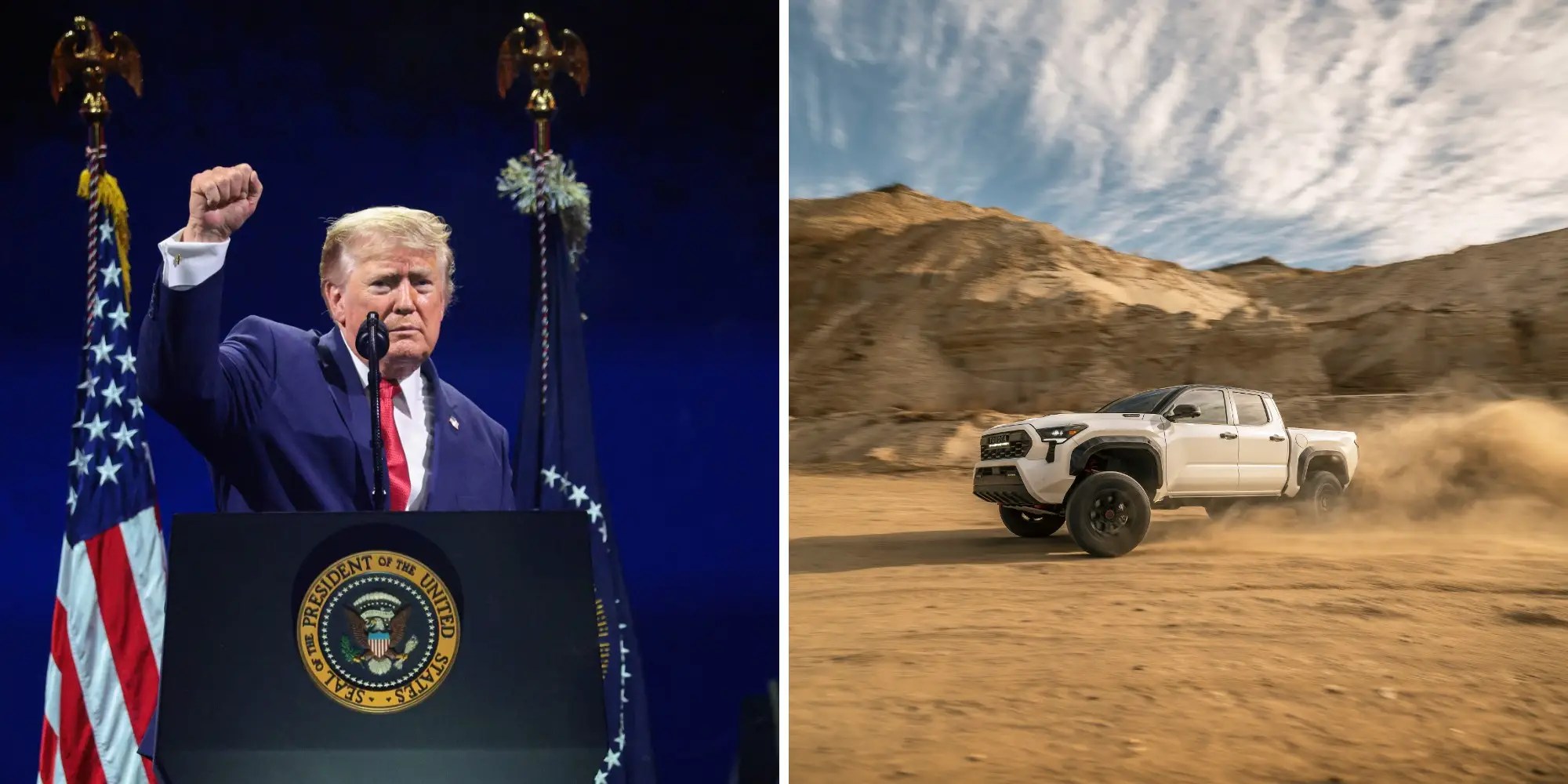
Toyota is planning a $3.6 billion expansion of its Texas truck assembly plant. President Donald Trump took credit for the investment.
On Monday, the automaker announced the multibillion-dollar investment to add a second vehicle assembly line at its San Antonio manufacturing campus to support production of the Tacoma pickup. Toyota said the expansion project would shift some of the midsize truck’s production from its Mexico plants to San Antonio over roughly 4 years. Toyota will still build some Tacoma models and the Corolla in Mexico.
While Toyota did not attribute the expansion to tariffs in its announcement and the company is not fully exiting production in Mexico, Trump said the fresh investment was a sign that his tariffs were working.
“It came over the wires that Toyota is moving out of Mexico into the United States, and building one of the biggest truck and car plants ever built,” Trump said on Tuesday during a visit to Ankara, Turkey. “It’s amazing. That’s what tariffs do, properly used.”
Toyota said the investment will create 2,000 jobs and add 2.5 million square feet to the site, doubling the company’s Texas footprint by 2030.
Toyota

On Monday, Ted Ogawa, president and CEO of Toyota Motor North America, said the investment reflected the company’s “confidence in the region’s workforce, innovation, and long-term growth potential.”
The move gives Trump a high-profile example of a well-recognized company creating manufacturing jobs. His administration has argued that tariffs incentivize companies — particularly automakers — to reshore manufacturing in America and reduce reliance on foreign production.
Toyota’s announcement also comes amid major uncertainty for automakers with plants in North America. The USMCA — the trilateral free trade pact between the US, Canada, and Mexico struck during Trump’s first term — is under review after the US declined to renew the treaty in its current form on July 1. The Trump administration is reportedly pushing to change the agreement so 50% of all automotive parts and manufacturing would happen in the US.
Toyota also nodded to that trade uncertainty in its release, saying it remained committed to operations in all three countries while encouraging “a quick resolution to USMCA” to keep North America globally competitive.
Texas
Supreme Court won’t block Texas from enforcing a law requiring age verification for app downloads

WASHINGTON – The U.S. Supreme Court on Monday declined to block Texas from enforcing a state law that requires apps stores to verify users’ ages and obtain parental consent for minors seeking to download apps or make in-app purchases on mobile phones.
Justice Samuel Alito, in a pair of one-sentence orders, denied petitions by plaintiffs who claim that the Texas App Store Accountability Act violates users’ constitutional rights to free speech.
Last month, a three-judge panel from the 5th U.S. Circuit Court of Appeals ruled that the law can take effect. The panel suspended a district court’s ruling last December that the law is unconstitutional.
The plaintiffs suing to block the law include the Computer & Communications Industry Association and Students Engaged in Advancing Texas. Texas Attorney General Ken Paxton is a defendant in both cases.
Plaintiffs’ lawyers argued that the law impermissibly seeks to limit access to content protected by the First Amendment, including news and educational material.
“Equity and the public interest support relief because protecting First Amendment rights — and parents’ rights to supervise their children as they see fit, not as the government tells them they should — is always in the public interest,” wrote attorneys for Students Engaged in Advancing Texas.
Attorneys from Paxton’s office argued that the law protects children from “dangerous modern products.”
“A child with access to an app store and a mobile device (such as a tablet or smartphone) can potentially download any number of software applications, potentially agreeing to invasions of the child’s privacy and sale of the child’s data and be exposed to any conceivable content without parental consent or even parental knowledge,” they wrote.
Copyright 2026 The Associated Press. All rights reserved. This material may not be published, broadcast, rewritten or redistributed without permission.

A passerby’s curiosity may have saved a life behind a Dallas high school. Police say that around 5:25pm on June 28, a young man followed faint cries coming from a wooded area and discovered a young woman stuck in a steep ravine, mired in mud and sewage after being trapped for days, Fox News reports. Dallas police and fire crews mounted a joint rescue in 104-degree heat, trekking about a quarter-mile over rough ground to reach her. They hauled her out and rushed her to a hospital, where she was treated for severe dehydration, extended sun exposure, and other injuries.
Police did not release the woman’s identity or say how she ended up in the ravine, WFAA reports. In a Facebook post Monday, the Dallas Police Department credited the “collaborative effort” of officers, firefighters, and paramedics whose quick work “saved a young woman who was in desperate need of help.” “The well-being of the Dallas community is not something that’s handled by a single agency,” the department said.”It takes a collaborative effort from multiple teams and organizations working side-by-side to ensure every person’s safety.”
-

 Pennsylvania3 minutes ago
The 11 Most Picturesque Small Towns in Pennsylvania
-

 Rhode Island6 minutes ago
The Must C’s of Rhode Island
-

 South-Carolina11 minutes ago
When is South Carolina’s tax free weekend? Here’s what to know
-

 South Dakota18 minutes ago
150-mile power line to connect substation near Fargo to northeast South Dakota
-

 Tennessee21 minutes ago
When is Tennessee’s tax-free weekend in 2026? Here’s what you need to know
-
Texas26 minutes ago
Trump takes credit for Toyota moving some truck production from Mexico to Texas: ‘That’s what tariffs do’
-

 Utah33 minutes ago
Utah Shutters Boarding School Paris Hilton Says Abused Her
-

 Vermont36 minutes ago
Letter to the Editor | Judy Murphy: In support of Molly Gray

