Politics
Denise Powell Wins Democratic Primary in Key Nebraska House Race


Denise Powell, a political organizer, won the Democratic primary election in a key Nebraska House district, according to The Associated Press.
She will face Brinker Harding, a Republican city councilman, in the general election, a pivotal contest in a battleground district that comes as Democrats try to recapture control of Congress this fall.
Representative Don Bacon, the Republican incumbent in the district and a frequent critic of President Trump, chose not to run for re-election, setting up a high-profile clash for an open seat in Omaha.
Ms. Powell narrowly triumphed in a competitive Democratic primary that centered on an unusual argument: that electing her chief rival, State Senator John Cavanaugh, could make it easier for Republicans to win the White House in 2028.
The argument stemmed from the way Nebraska allocates its electoral votes in presidential elections. Most states follow a winner-take-all approach, but Nebraska gives just two of its votes to the statewide winner, then gives one to the winner of each of its three congressional districts. In recent elections, the Omaha-area district has typically gone blue in presidential contests and awarded its electoral vote accordingly, even as the two other Nebraska congressional districts typically went to the Republican candidate.
That could make a difference in a close presidential contest.
State Republicans have tried to repeal the so-called blue dot system — named for the blue, liberal dot Omaha represents in a sea of Republican red — but Democrats in the State Legislature have been able to block that effort.
Mr. Cavanaugh’s opponents argued that if he won the House primary and left the State Senate, it would mean one fewer vote to keep the blue dot. Mr. Cavanaugh argued that the system was safe, and that Democrats were likely to be elected in other State Senate seats to compensate for his departure.
The argument may have been enough to help Ms. Powell to victory. A super PAC with ties to Republicans also spent against Mr. Cavanaugh.



It pains me to say that most of us are missing the point when it comes to President Trump’s rambling election fraud speech. Which is exactly what he wants.
Within minutes of its airing Thursday night, the internet and pundits were abuzz debating whether voting machines were secure and whether the federal government has a right, or even a duty, to oversee voter rolls (it has neither). Long posts were written condemning voter identification efforts, and more posts written attacking those condemnations.
This, friends, is exactly what the speech was meant to accomplish — myopic bickering.
To be specific, myopic bickering about the past, as a dark future creeps ever closer — like, say, Nov. 3.
The question we should be asking now isn’t whether there is massive fraud in U.S. elections — even the conservative Heritage Foundation has documented only 71 cases of such fraud in California in more than 25 years.
The question is will we allow Trump to sow just enough doubt in the minds of average Americans that what comes next seems inevitable and even necessary?
Trump falsely claimed that he was revealing “an election system so broken and so vulnerable that no one can possibly defend it.”
“This cannot be allowed to continue,” he said.
Those are ominous words, ones we should take seriously.
“This is a very sad thing to be able to say about the president of the United States, but I think it’s quite clear,” said Mindy Romero, director of the Center for Inclusive Democracy, a nonpartisan research facility. “This is about a certain set of political goals, and using this misinformation to achieve those political goals.”
Trump knows that the midterms present a threat to his power and he, and those around him, have been working for years to create a strategy to invalidate our election results just in case they don’t fall in his direction. Whether the overall outcome favors Democrats or Republicans in the midterms, the wins and losses are going to be close, giving him the chance to attack Democratic wins.
On Jan. 6, 2021, Trump learned from the unlikely teacher Mike Pence the difficult lesson that plans work only when people are in place to implement them. As vice president, Pence, you may recall, refused to stop the election certification process that legally, rightfully, fairly allowed Joe Biden to take office.
Since then, Trump has purged dissenters from top roles, instead putting in flat-out sycophants, election deniers and conspiracy theorists — more than one of whom has been associated with the racist Great Replacement theory that Democrats are secretly helping Black and brown people to illegally cross the border in exchange for these folks illegally voting for Democrats, thereby replacing the “true” America of conservative white people.
So the apparatchiks are in place, Soviet-style. There will be no Penceian savior on the inside this time around.
More than one election expert I have spoken to in recent months fear that because there is no one left on the inside to object, we could see post-election turmoil like this: Republicans lose one or both houses of Congress. Trump calls fraud. The Department of Justice or outside lawyers, or both, sue to overturn results. Congress, the Republican one still in place, refuses to seat newly elected Democrats until the court cases are resolved.
A constitutional crisis is at hand. Democrats say they were elected. Republicans won’t let them serve. No one is clear who is in Congress and who isn’t. In effect, the body is frozen and its legitimacy undermined. Into that vacuum, Trump pushes his already great power even further.
As movie-terrible as that sounds, that internal structure is in place and this scenario is far less impossible or even improbable than we could hope.
“What we’re talking about is just misinformation and what could be used as a justification for potentially interfering with seating of elected officials,” Romero said. “Particularly Congress.”
Now, with the internal stuff squared away, Trump’s focus is neutralizing outside dissent. That’s you and me, and that’s what this speech was about. Sowing doubt, tossing seeds of chaos into the soil to see what grows. Letting us know it’s coming, so we as Americans have time to bicker, argue, and tear away at our trust in elections so that by the time we vote, we expect the worst to happen.
“Unfortunately, there are some members of the public that are going to believe what they’re being told and when they hear election results, question it,” said Chad Dunn, legal director of the UCLA Voting Rights Project. “This kind of communication misleads Americans and does a disservice to our democracy.”
Dunn told me he’s “as worried as I’ve been in my life” about the next election.
Trump’s far right is wasting no time on this effort. After Trump’s speech, the Department of Homeland Security sent out a letter to California and three other states claiming California has more than 190,000 non-citizens registered to vote, and demanding the state “confirm their intentions to collaborate with DHS in order to ensure free, fair, and honest elections.”
This is a misleading, erroneous count and does not include the obvious fact that there is no evidence that undocumented people actually voted in any California election in any noticeable numbers.
But it creates that chaos and doubt. California isn’t going to share its voter rolls willingly with the federal government because elections — according to the Constitution — are state affairs. And there is no evidence that the federal government has a better way of vetting citizenship than California does. So it becomes one more point of bickering.
But what Dunn, Romero and other honest elections experts want Americans to know is that our elections are free and fair and all is not lost. Far from it.
The answer to the propaganda and lies is to remain aware of it, remain above it. Spread truth and refute falsehoods.
Dunn said that Americans should demand that any voter fraud be taken to the courts — where it belongs, and where we can determine the validity of the evidence.
“If you’re concerned about this, if you’re inclined to believe the president, demand proof, demand resolution in court at trial with the the showing of evidence,” he said. “And reserve judgment until you see that.”
Romero has her own advice — never underestimate the power of the vote.
“Show up and participate,” she said. “Regardless of how [you’re] going to vote — Democrat, Republican, otherwise — just to show up and participate.”
Because in the end, we only lose democracy if we willingly let it go.
Politics
Major appeals court declares New Jersey AR-15 ban unconstitutional in landmark Second Amendment ruling

NEWYou can now listen to Fox News articles!
A federal appeals court on Friday struck down New Jersey’s ban on semiautomatic rifles and magazines capable of holding more than 10 rounds, prompting the National Rifle Association (NRA) to call the decision a “historic victory” in a case the gun-rights organization has litigated since 2018.
In a sweeping en banc ruling, the Philadelphia-based 3rd U.S. Circuit Court of Appeals held that New Jersey’s assault-firearm and large-capacity magazine restrictions violate the Second Amendment.
The court expanded a lower court’s ruling by declaring the state’s so-called “assault-firearm” ban unconstitutional as it applied to the full class of semiautomatic rifles, not just the AR-15, and also struck down New Jersey’s ban on semiautomatic rifles and its restrictions on magazines capable of holding more than 10 rounds.
DOJ SUES DENVER OVER BAN ON ‘ASSAULT WEAPONS’ AS CITY’S DEM MAYOR SAYS IT ‘WILL NOT BE BULLIED’
The 3rd U.S. Circuit Court of Appeals in Philadelphia held that New Jersey’s assault-firearm and large-capacity magazine restrictions violate the Second Amendment. (Getty Images, File)
“This is an NRA case that we’ve been litigating since 2018, so it’s a monumental win,” Justin Davis, managing director of public affairs for the National Rifle Association, told Fox News Digital.
The NRA celebrated the decision in a statement, calling it a major victory for gun owners nationwide.
“Today marks a historic victory for the NRA, the Second Amendment, and law-abiding Americans,” the organization said.
INSIDE TRUMP’S UNPRECEDENTED BATTLE PLAN TO EXPAND SECOND AMENDMENT RIGHTS THROUGH JUSTICE DEPARTMENT
A male buyer signs paperwork beside an AR-15 rifle with a scope in a gun shop, verifying the purchase in compliance with state regulations. (Svetlana Day via Getty Images, File)
“The Third Circuit has struck down these unconstitutional so-called assault weapons bans and magazine bans in New Jersey, affirming what we’ve always known: the right to keep and bear arms, including commonly-owned rifles and standard-capacity magazines, is fundamental and cannot be infringed by politicians who prioritize control over constitutional freedoms.”
“This ruling protects the rights of millions of responsible gun owners in the Garden State and serves as another benchmark in our efforts to dismantle gun control across the country.”
Writing for the majority, U.S. Circuit Judge Arianna Freeman, a Biden appointee, said the Supreme Court’s Second Amendment decisions in District of Columbia v. Heller, New York State Rifle & Pistol Association v. Bruen and subsequent cases require governments to show modern firearm restrictions are consistent with America’s historical tradition of firearm regulation.
Applying that framework, the court concluded New Jersey failed to meet that burden.
LAWYER WHO BEAT HAWAII GUN LAW CALLS STATE’S RELIANCE ON BLACK CODE ‘DISGRACEFUL’
The NRA celebrated the decision in a statement, calling it a major victory for gun owners nationwide.
The majority held that New Jersey’s ban on semiautomatic rifles violates the Second Amendment and reversed the district court’s decision upholding the state’s ban on magazines capable of holding more than 10 rounds.
The opinion said New Jersey enacted its “assault-firearms law” in 1990, following a California elementary school shooting.
According to the court, the governor at the time described the banned firearms as “guns capable of wholesale destruction” that were “designed to wipe out the greatest number of people in the shortest possible time.”
CLICK HERE TO DOWNLOAD THE FOX NEWS APP
The majority concluded that semiautomatic rifles and magazines capable of holding more than 10 rounds are protected by the Second Amendment and that New Jersey failed to demonstrate the restrictions are consistent with America’s historical tradition of firearm regulation.
Several judges dissented, arguing the banned firearms are unusually dangerous military-style weapons that states have long had authority to regulate and that the decision conflicts with every other federal appeals court to uphold similar state restrictions.
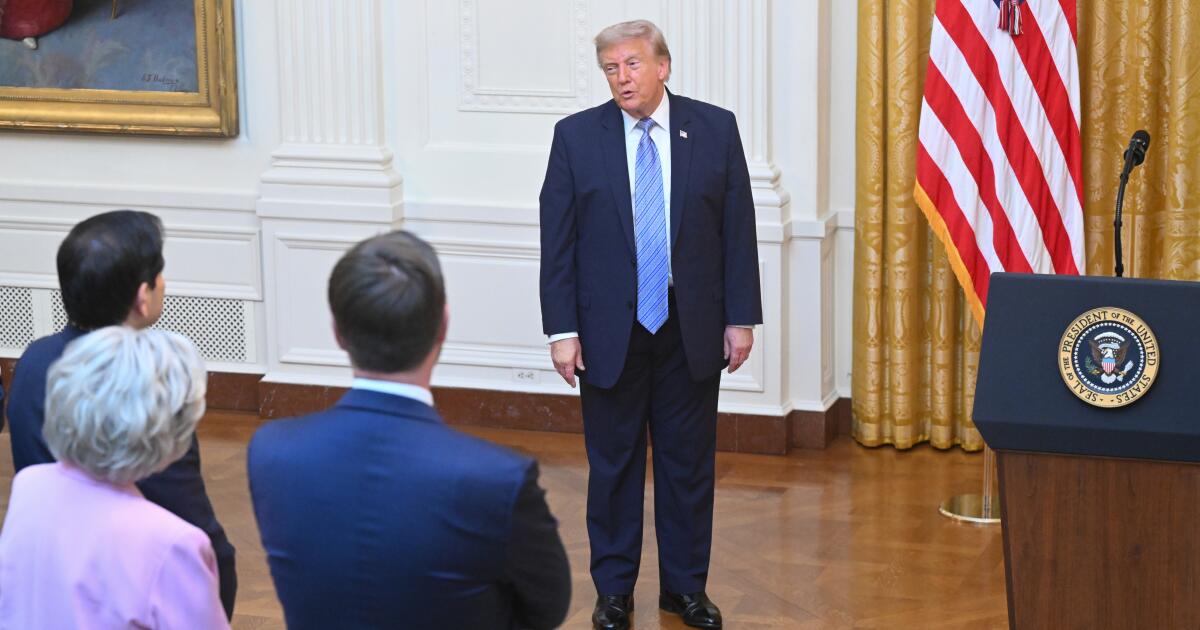
WASHINGTON — President Trump and his allies escalated attacks on U.S. elections on Friday, after the president’s prime-time effort to convince Americans that the nation’s voting systems are fundamentally flawed, and threatened to punish California and other Democratic states that refuse the administration’s demands for voter data.
Homeland Security Secretary Markwayne Mullin threatened local election officials with fines and prison if they don’t turn over voter rolls to federal officials seeking to root out purported illegal voting by noncitizens.
“Try us,” California Gov. Gavin Newsom wrote on X in response to Mullin’s threats. He added that “California has free, fair, and secure elections” and that the state “will fight for them.”
The administration’s threats — made less than four months before the November midterm elections — are a continuation of an aggressive Trump-led campaign to use the federal government to attempt to overhaul the nation’s voting systems and sow public mistrust in elections.
The administration has tried for months to compel Democratic-led states into handing over sensitive voter data to the federal government, but the efforts have run into resistance in courts, in part out of concern for privacy laws. The courts have also reaffirmed in many cases that the Constitution gives states — not the federal government — primary authority over elections.
On Friday, Mullin said his agency has found “as many as” 190,832 possible noncitizens registered to vote in California, along with more in three other Democratic-led states. He said Homeland Security arrived at those numbers by checking the four states’ public voter records.
He vowed to withhold federal election security grants from states until they agree to the administration’s demands, including having their voter registration lists “scrubbed” and their election security systems updated.
“If these states want a grant and they want to be reimbursed to run federal elections, they are going to have to implement security [measures],” Mullin said at a news conference. “We need to make sure that individuals who are legally able to vote are voting.”
Newsom’s office said the state had “no idea” where that claim came from. Sen. Alex Padilla (D-Calif.) questioned the Department of Homeland Security’s methods and said the administration’s allegations were “built on sham numbers that no one should trust.”
“DHS’s lack of transparency also raises serious questions about whether it violated state law to obtain California’s voter registration records and federal privacy law and court rulings barring misuse of federal databases,” Padilla said in a statement.
The administration has not made its methodology public, and the system Mullin’s department has used to check for noncitizens in the past has inaccurately flagged some citizens as noncitizens. Past election reviews have found noncitizen voting is rare.
“There is plenty of reason to be suspicious of the claims from the administration,” said Brendan Fischer, director of strategic investigations at the Campaign Legal Center, “and every reason for voters to have confidence in our elections.”
Mullin’s remarks came the day after Trump delivered a prime-time address about vulnerabilities in the election system, claims that largely were not backed up by the evidence he provided. The White House released a trove of declassified documents that failed to show that any American election had been affected by fraud or foreign interference.
The White House dug in on the strategy Friday morning, deploying agency heads to continue amplifying the idea of election vulnerabilities, even after fact-checks showed most of his claims were exaggerated and had been previously known, investigated or debunked.
“SAVE OUR ELECTIONS,” the White House said on X.
Trump also used his address to pressure Congress to pass legislation that would tighten voting restrictions and could make it harder for millions to register to vote and cast ballots. While hard-line Republicans applauded him, others in the party have rebuffed his request.
Sen. John Cornyn (R-Texas) said Friday that he did not understand why Trump is focusing on a past election when Republicans should focus on what is ahead.
“I think historically the midterms for the party in power are really tough,” Cornyn said. “So, yeah, I am concerned about it. We ought to be talking about things looking forward that our constituents are most concerned about.”
Sen. Bill Cassidy (R-La.) said the nation’s electoral systems are safe, and while he thinks election officials need to be “vigilant,” he said he is more concerned about economic issues ahead of the midterms.
Discussing the legislation ahead of the speech Thursday, Sen. Thom Tillis (R-N.C.) said it would be “impossible” to carry out changes to the nation’s voting laws in time for the midterms.
“The only thing that will occur is an undermining of the integrity of our elections right now,” Tillis said on the Senate floor.
David Becker, the executive director of the Center for Election Innovation and Research, called Mullin’s threats “laughable.”
“There is no significant pool of federal grant money appropriated, so this threat has no teeth for any state. None of them are expecting any significant federal funds for elections,” Becker said.
Mullin told reporters Friday the federal government plans to use public records requests to try to obtain the voter roll information in order to investigate whether noncitizens have voted. Any member of the public can make a public records request; the move signals that the government has few remaining avenues to force the state to turn over voter data.
But Mullin appeared to acknowledge the limitations, saying: “I obviously can’t force the states.” He later threatened to levy fines, penalties or criminal charges against elections officials in states that don’t comply with the government’s demand.
More than a dozen courts have ruled against the Justice Department’s highly unusual demand for state voter rolls. The federal government is not entitled to the data under federal law, Becker said.
He said previous government investigations into noncitizen voting have found that most people flagged against Homeland Security’s database were either citizens or non-citizens who had never registered themselves to vote.
The Trump administration has used a database from an immigration verification system to flag possible noncitizen voters, but election officials have found that method misidentified some voters. Even with citizens mistakenly included in the count, the number of possible ineligible voters was extremely low — in Texas, 0.0001% of voters.
Data indicate that voting by noncitizens is rare. A study of the 2016 election by the Brennan Center for Justice found that officials referred about 30 cases of suspected noncitizen voting for investigation or prosecution. A 2024 review by the American Immigration Council of the right-wing Heritage Foundation‘s database turned up 68 cases of noncitizen voting since the 1980s.
While Trump’s speech prompted warnings from his critics that he could be laying the groundwork to take further steps to interfere with or tighten restrictions on elections, experts said he was running out of moves.
Becker predicted that Trump would not actually attempt to cancel elections or send officers to the polls and that courts would block the president if he declared a national emergency to exert control over elections.
“But I think there are people in the administration, including the president himself, who would like us all to think this is possible,” he said.
Fischer said Trump may be trying to lay the groundwork to dispute the midterm results if he doesn’t like the outcome, but said his powers to do so are limited.
“There’s safeguards and laws in place to protect the freedom to vote,” Fischer said, “and voters should tune out the noise and continue to participate in our democracy.”
-
 Business5 minutes ago
Amazon delivery companies lay off more than 150 people in the San Francisco Bay Area
-
 Entertainment11 minutes ago
Nara Smith says 2-year-old daughter Whimsy’s cancer is in remission
-
 Lifestyle17 minutes ago
One-eyed rescue cat with Long Beach cult following celebrates 15th birthday in style
-
Politics23 minutes ago
Commentary: Trump’s voter fraud speech was bait. Stop biting
-
 Science29 minutes ago
Commentary: The doctor who helped save her is in another state, and telemedicine follow-up is prohibited
-
 Sports35 minutes ago
Commentary: LAFC star Son Heung-Min proves life after the World Cup can offer hope and redemption
-

 World47 minutes ago
Death toll from the two earthquakes that hit Venezuela hits 5,069
-

 News1 hour ago
Where Wildfire Smoke Remains—And What To Do About It

