Science
A Taxidermist Gives Dead Animals a New Life


At 11, Tim Bovard undertook his first taxidermy experiment on a piece of roadkill. He had found an unlucky skunk and improvised its reanimation using an instruction book, much to the alarm of his friends’ parents.
His own parents were unfazed — his father and grandfather were both scientists and outdoorsmen — and soon it was known in their suburban community of Claremont, Calif., that, as Bovard recently recounted: “Dr. Bovard’s son was an animal nut. So when they found the abandoned birds, owls, hawks, kestrels, crows, blue jays, scrub jays, they brought them to me, and I raised them.”
By the time he was a teenager, he was sewing his own clothes, learning to tan leather and taking backpacking trips in the Sierras with his dogs while wearing a full buckskin suit of his own creation. He began apprenticing with a local taxidermist in high school, and then chose to work for him full time through college.
Bovard was always set on his life path, though when he visited friends at college parties, he asked them to stop mentioning what he did instead of going to class, noticing that it gave some people the creeps.
Bovard, still exuberant and energetic at 72, is the last full-time taxidermist at any museum in the United States. He still lives in Claremont, now with his wife, two dogs and “10 and a half cats” (the “half” cat lives mostly outdoors) and wakes most days at 4:30 a.m. to commute to the Natural History Museum of Los Angeles County, where he has worked since 1984. He is responsible for maintaining animal mounts the museum has kept in its collection for more than a century, reworking dioramas that could look more true to life and designing new exhibits.
In past generations, museums dispatched hunting expeditions to acquire their animal collections, but Bovard works only with donations from zoos or offerings from private collections. As when he was a child, roadkill is another option.
Once the skin is on and the glue is dry, he sews the pelt together, hiding his seams.
“Mammal stitching has to be pretty tight,” he said, especially for lions or zebras. “Now, a bear with long hair? It doesn’t matter so much. For birds, feathers cover it all.”
The care and keeping of these forms is a responsibility he takes both seriously and joyfully. Frequently, he skips his commute entirely and sleeps in his office, rolling out a blanket between filing cabinets that carry the records of every animal in the museum’s 111-year-old collection and the “fleshing wheel” he uses to gently remove tissue from hides.
“It wouldn’t be for everybody,” he said with a smile. “But I am known to be slightly different. That’s putting it sort of mildly.”
In fact, he has slept at work for weeks at a time, like when he was revamping the museum’s lion diorama and wanted to adjust furry skin folds and feline facial expressions every few hours during the night as the glue set.
Unlike many taxidermists, Bovard is responsible not only for the animals on display in the museum but also for very element of the dioramas, including every tree, leaf, twig, flower, dusting of snow and body of water. He’s made hundreds of thousands of leaves through a method called vacuum forming — a manufacturing technique where plastic is heated and then shaped around a mold using suction — using leaf molds he created himself from plant matter he harvested on research trips.
To do this exacting work, he has amassed an encyclopedic knowledge of the natural world. He knows, for example, that one key to designing a lifelike raptor is the hooding over the eyes. But he also knows the posture that raptor would take sitting on a tree branch, what kind of tree it would be sitting in, the patterns in which it would have preened its feathers, what kind of prey it might be looking for and how its presence would most likely affect the behavior of every other animal in its radius.
For a restaging of a lion family, he wanted two lionesses to be nuzzling foreheads, the standard greeting in big cats, to capture their sociality. He wanted to create more of a sense of dynamic movement in the scene of jaguars perched atop a box canyon in Sonora, Mexico, for example, by adding some small mammal prey, like javelinas, leaping away from the cats.
“It’s all about directing the eye,” he said, pointing toward the far corner of the painted background.
And then there are all the routine tasks, the things he’ll never stop doing, at least not until he retires, like dusting the museum’s pride of lions, vacuuming elephant ears and polishing all the glass eyes.
When asked about whether retirement is on the horizon, he laughed. He was still sleeping on his office floor as recently as New Years. There’s an orangutan he wants to mount this year, and tens of thousands more leaves to make. “No plans to retire.”



Video released by Chinese state media shows a state-owned aerospace company launching a rocket and recovering part of it on Friday. The successful launch of a reusable rocket was a major step for China toward challenging SpaceX’s satellite internet dominance.
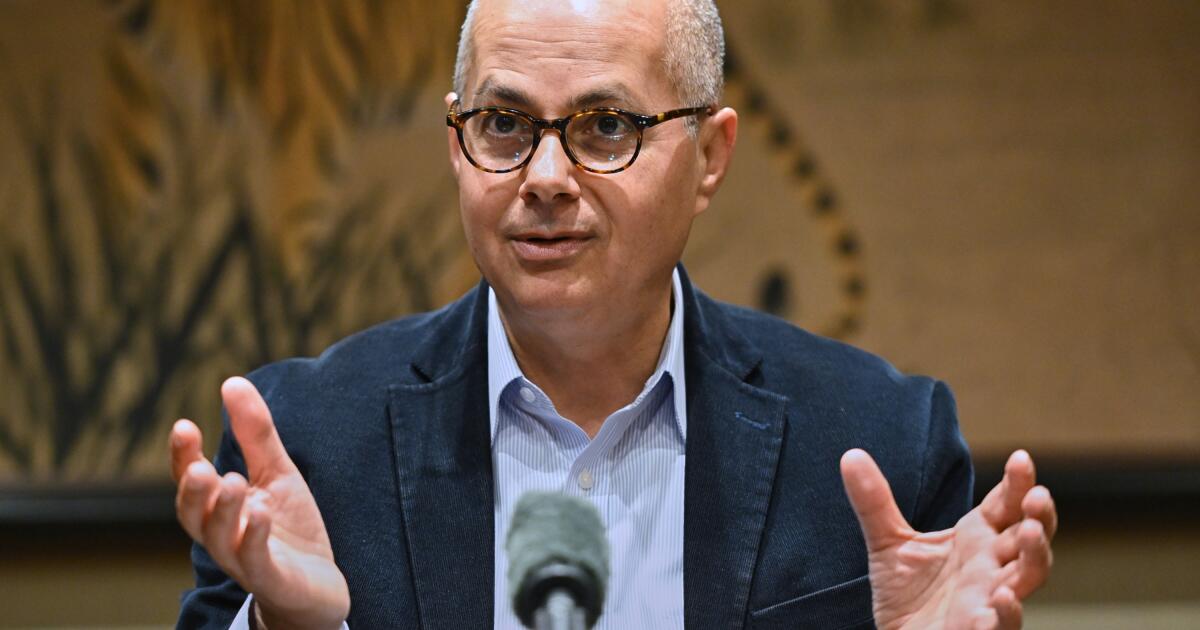
Nobel Prize recipient Omar Yaghi is leaving his role at UC Berkeley to lead the development of a new artificial intelligence institute at Tsinghua University in Beijing, the Chinese university announced.
Yaghi will head the AI Chemistry and Materials Research Institute at Tsinghua, where he was appointed an honorary professor in 2022. Known as AIMATRY (AI × Materials × Chemistry), the new center will focus on material design and synthesis through artificial intelligence, according to a statement from the university.
In 2025, Yaghi shared the Nobel Prize in chemistry with Susumu Kitagawa of Kyoto University and Richard Robson of the University of Melbourne for their development of metal-organic frameworks, a type of super-porous material in which metal ions and carbon-based molecules combine to form crystals with exceptionally large surface areas.
The material has the potential to combat climate change by capturing and storing carbon or other pollutants, and by extracting water from the atmosphere in water-scarce areas. Upon awarding the prize, a member of the Nobel committee likened the technology’s ability to store enormous amounts of stuff in seemingly compact spaces to Hermione Granger’s enchanted handbag in the Harry Potter series.
Yaghi’s Irvine-based company, Atoco, has said it will start taking orders later this year for its technology that harvests water from the air.
A representative for Yaghi said he was not yet available to respond to questions.
China is one of several countries that has been actively recruiting scientists from the U.S., where the Trump administration has slashed science funding, suspended research grants, fired science advisors and tightened immigration restrictions.
“For many, many years, our funding was very competitive; if you worked hard and you were doing good research, you would get funding,” Yaghi said of the U.S. in an interview with Scientific American earlier this year. “The current state is not so encouraging because of the cutting back on grants and support of science by the very agencies that many university researchers rely on.”
Yaghi was born in Jordan to Palestinian refugees, and immigrated to the U.S. when he was 15 to study.
“We’ve learned over and over in human civilization that scholars can move across borders,” Yaghi told the New York Times last year. “This is how knowledge spread and how vast regions of the world lifted themselves out of poverty.”
Science
Trump administration seeks to limit federal funding that doesn’t ‘advance’ presidential policies

A new rule proposed by the White House Office of Management and Budget would fundamentally overhaul the way federal grants are awarded and overseen — a sweeping change that one scientific society said “would all but end the use of scientific merit in the selection of grants and programs across the government.”
Proposed in late May, the rule would give political appointees unprecedented control over federal grants for research, education and infrastructure, and specifies that government funds can only be spent on projects “aligned with administration policies and priorities,” according to a copy of the proposed rule.
The rule would also restrict research topics, limit U.S. scientists’ ability to collaborate with colleagues in other countries and make it easier for the government to suspend or cancel grants at any time.
The changes are intended to improve “transparency, accountability, and oversight for Federal awards” while “ensuring that American tax dollars are not wasted or misused,” according to the White House office.
But critics say that if the rule is implemented, the final sign-off for grants will no longer be in the hands of subject-matter experts within individual agencies, but in those of political appointees.
“This touches all parts of American life,” said Dr. Eric Rafla-Yuan, a psychiatrist who practices at the Veterans Administration and San Diego County’s psychiatric hospital.
“Control of how all of the federal grants and programs are funded will fall under a small group of highly partisan individuals who would have very few limits on how they spend these billions of taxpayer dollars,” said Rafla-Yuan, who also chairs the Committee to Protect Public Mental Health advocacy group. “This touches everyone’s life, even if they don’t realize it.”
OMB published the proposed rule May 29, opening a 45-day comment period that closes July 13.
Opposition to the proposed rule has mobilized multiple sectors of society. Professional groups representing cancer researchers, civil engineers, county governments, medical schools, housing agencies, city and municipal governments, nonprofits and others have publicly expressed concerns about potential consequences.
By midday Thursday, the Federal Register logged nearly 100,000 comments about the proposal, many of them expressing concern.
“I understand the need for oversight, fiscal responsibility, and accountability. That is not the issue,” wrote Jack Feldman, a neuroscientist who holds the David Geffen School of Medicine Chair in Neuroscience at UCLA. “The issue is whether scientific research is to be judged by scientific merit, or whether it can be approved, denied, or terminated according to broad political criteria that may change from one administration to the next.”
Crucially, the rule converts policies governing federal grants from “guidance” into binding regulations that all agencies would be required to follow. It would give political appointees power to override federal agencies’ merit-based reviews and mandate that a political appointee review decisions to ensure that all awards “demonstrably advance the President’s policy priorities.”
The elevation of political appointees in what were previously merit-based decisions has alarmed many scientists.
“The proposed rule changes would all but end the use of scientific merit in the selection of grants and programs across the government,” read a statement from the Planetary Society, a nonprofit dedicated to space research.
Researchers and science groups have also expressed concern about a section of the rule prohibiting the promotion of “theories of disparate-impact liability” — a legal concept that refers to policies that appear neutral but cause disproportionate harm to certain groups.
The section’s vague language and many loopholes could have a chilling effect on any research that studies the effects of a disease, policy or public health intervention on any specific group of people, Rafla-Yuan said.
As an example, he said, “if there’s a specific age range that is at higher risk for suicide, and we want to figure out, well, what’s going on with people that are aged 14 to 19 … we can’t do that under the wording in this rule.”
New restrictions on collaborations with scientists in other countries would hinder opportunities for U.S. researchers and limit innovation, said Joanne Padrón Carney, chief government relations officer for the American Assn. for the Advancement of Science.
“Science is a global enterprise. Especially in biomedical and public health fields, diseases don’t care about borders or government policies,” she said.
California’s congressional delegation sent a letter Wednesday asking OMB to rescind the proposal, outlining concerns about its impact on scientific innovation, U.S. competitiveness and the fiscal stability of local governments, many of which rely on federal grants for local services.
The proposed rule grants the federal government broad powers to suspend or cancel grants for any reason, introducing “unprecedented unpredictability into local governance,” the lawmakers wrote, “leaving vital infrastructure projects unfinished and abandoning vulnerable populations who rely on these services.”
Republican Sen. Susan Collins has also asked the White House to withdraw certain parts of the letter and extend the public comment period, saying the proposed rule as written would “harm small and rural communities, undermine scientific and biomedical research, and conflict with Congress’ control over the federal funding process.”
-

 Delaware2 minutes ago
Heat watches, advisories issued for Delaware. How hot will it get?
-

 Florida8 minutes ago
South Florida scientists studying newborn sea turtles
-

 Georgia14 minutes ago
Georgia twins launch 3D-printed toy business
-

 Hawaii20 minutes ago
Guided tours take visitors into Honouliuli internment camp’s ‘Hell Valley’
-

 Idaho26 minutes ago
Idaho attorneys rebuff DOJ threat to prosecute Secretary of State in voter roll dispute
-

 Illinois32 minutes ago
8 Most Charming Town Squares In Illinois
-

 Indiana38 minutes ago
ACLU of Indiana sues over conditions at Monroe County Jail
-

 Iowa44 minutes ago
Northwest Iowa woman taken to the hospital after rollover

