Texas
ERCOT Warns Texas AI Power Boom May Not Materialize


Texas is planning its grid around an unprecedented wave of AI-driven power demand that the state’s energy regulator says may not fully materialize on projected timelines.
In a recent filing to the Public Utility Commission of Texas, the Electric Reliability Council of Texas (ERCOT) projected statewide power demand could surge to nearly 368 GW by 2032 – more than four times the state’s current peak demand record of 85.5 GW. But the filing also contains an unusual warning from the grid operator itself.
“ERCOT has concerns with using the preliminary load forecast values for the Reliability Assessment and any other transmission and resource adequacy analysis,” the organization wrote in its April 2026 long-term load forecast filing.
The organization added that it may seek adjustments to the forecast based on “actual historical realization rates or other objective, credible, independent information.”
ERCOT has already begun adjusting for realization risk internally. In its 2025 long-term load forecast report, the grid operator said the “average peak consumption per site was 49.8% of the requested MW” and applied that factor to projected non-crypto data center load additions in some planning models.
ERCOT President and CEO Pablo Vegas said the forecast reflects “higher-than-expected future load growth” tied to changing large-load planning dynamics.
Texas has emerged as a hotspot for data center growth, with numerous new projects reshaping the energy market and challenging grid capacity. (Image: Alamy)
Texas Developers Race Ahead of Grid Capacity
Texas has emerged as a key data center market, driven by its abundant land, competitive energy prices, and favorable regulatory environment. This combination has positioned the state as a magnet for hyperscale operators and AI infrastructure investments. The state is estimated to account for around 15% of all data center connectivity in the US.
Recent and proposed AI data center campuses tied to OpenAI, Oracle, Meta, Crusoe, CoreWeave, Soluna, and other hyperscale operators are reshaping Texas grid planning. Developers have proposed large campuses across North Texas, Abilene, West Texas, and the Houston corridor, many requiring hundreds of megawatts of capacity and, in some cases, dedicated onsite generation to bypass interconnection delays. That buildout pushed ERCOT’s non-crypto data center forecast above 228 GW by 2032.
Developers are continuing to pursue Texas aggressively because ERCOT still offers faster timelines and more flexible market structures than many competing regions. Several proposed campuses pair AI infrastructure with onsite gas generation, colocated power assets, or flexible-load arrangements to navigate mounting transmission constraints.
Utilities across the US are grappling with AI-driven electricity growth, but ERCOT’s projections stand apart for both scale and uncertainty. PJM Interconnection, the nation’s largest grid operator, expects summer peak demand to climb above 241 GW over the next 15 years as data centers and electrification expand. ERCOT, by contrast, projects demand potentially reaching nearly 368 GW by 2032, driven largely by proposed non-crypto data center loads. At the same time, the grid operator openly questions how much of that demand will materialize on schedule.
Bigger Than Texas
Similar pressures are emerging elsewhere. In California, CAISO’s latest transmission plan cited “data center load growth” as a driver of major grid upgrades and described interconnection volumes as “unmanageable” before recent queue reforms.
A recent Grid Strategies report reached a similar conclusion nationally, warning that the “data center portion of utility load forecasts is likely overstated by roughly 25 GW” compared with market-based deployment estimates.
Ihab Osman, an independent strategist specializing in data center and other mission-critical infrastructure, said the distinction is less about “real” versus “fake” AI demand and more about “announced versus deliverable demand.”
“A large share of the current AI/data center planned load should be treated as paper megawatts until it is validated through physical gates,” Osman said, citing factors including site control, transmission deliverability, generation availability, turbine and transformer supply, permitting, financing, and credible energization schedules.
Osman said ERCOT’s forecast is best understood as “a stress-test map, not as a fait accompli build map.”
Separating ’Paper Megawatts’ From Real Demand
The filing shows Texas regulators and grid planners struggling to distinguish operating AI infrastructure from a rapidly expanding pipeline of proposed projects.
“The vast majority” of ERCOT’s projected load growth comes from submissions provided by transmission and distribution utilities, according to the filing. Those requests include hyperscale AI campuses, GPU clusters, and other large industrial loads seeking future grid capacity reservations.
Alison Silverstein, a former senior adviser to the chairman of the Federal Energy Regulatory Commission, said “a large proportion” of projects in ERCOT’s large-load interconnection queue have already been canceled, particularly among smaller developers facing long interconnection delays and high turbine and transformer costs.
Forecasts Collide With Physical Infrastructure Limits
ERCOT has also signaled that many projects may not materialize on the timelines shaping transmission planning.
The grid operator said summer 2026 peak demand is likely to land between roughly 90.5 GW and 98 GW – far below the preliminary 112 GW figure embedded in the long-term forecast. ERCOT said it appears “unlikely” that new large-load projects and existing site expansions will ramp quickly enough to push demand that high this year.
The filing suggests uncertainty around AI-related load growth is beginning to influence broader infrastructure planning assumptions. By 2032, ERCOT projects non-crypto data centers reaching 228 GW of demand, compared with just 9 GW from cryptocurrency mining and roughly 3 GW each from hydrogen/e-fuels and oil-and-gas-related industrial growth.
The move also suggests the regulator is no longer simply forecasting AI-driven growth, but also working to determine how much of the proposed boom can actually be financed, supplied, interconnected, and energized before utilities commit billions to long-lived infrastructure.

Texas
Phoenix Merchant Partners and Texas Capital Alternative Asset Management Form Strategic Relationship

Phoenix Merchant Partners, an independent alternative asset manager, and Texas Capital Alternative Asset Management (TCAAM), a wholly owned subsidiary of Texas Capital Bancshares, formed a strategic relationship to provide customized capital solutions and direct lending to the core middle market across a diverse range of industries.
The relationship integrates the corporate and investment banking coverage network of Texas Capital with the structuring, underwriting and multi-cycle portfolio management expertise of Phoenix. Capitalizing on this powerful combination, Phoenix will launch its first vehicle, Spurstone Credit, in Q3/26. Structured as a perpetual-life, non-traded closed-end credit fund, Spurstone will be headquartered in Dallas, Texas.
Spurstone has already attracted interest from a group of anchor institutional investors. The vehicle’s investment mandate will focus primarily on delivering senior secured financing solutions to core middle-market businesses with annual revenues between $100 million and $1 billion that are currently underserved in private credit.
“As the only full-service financial services firm headquartered in Texas, we continuously look for ways to serve the needs of companies and their owners, both in Texas and in our industries of focus across the country. Working with Phoenix expands and accelerates our ability to offer proprietary private credit financing solutions to deserving clients. The Phoenix team shares our disciplined approach to asset structuring, capital preservation and portfolio management, as well as our passion for providing exceptional client service and delivering comprehensive solutions,” Daniel Hoverman, head of corporate and investment banking at Texas Capital and president of TCAAM, said.
The vehicle’s strategy is designed to address a critical structural liquidity gap for non-sponsored, family-owned and founder-led mid-market enterprises requiring flexible, non-dilutive senior capital to fund organic growth, strategic acquisitions and balance sheet optimizations.
“Proprietary origination remains the single biggest differentiator in the private credit landscape,” Art Mbanefo, founder and CEO of Phoenix, said. “Working with TCAAM unlocks unparalleled access to high-quality, founder-owned businesses across Texas and other economic centers like California, New York and Illinois. Together, we are bridging the liquidity gap for exceptional middle-market companies.”
Spurstone will be advised by a newly formed, Phoenix-sponsored registered investment adviser, Ryestone Advisors, which is currently applying for registration with the U.S. Securities and Exchange Commission. TCAAM will be a minority economic investor in Spurstone’s investment adviser.
Texas
Texas man admits embezzling $3.2 million to pay student loans, fuel online gambling, prosecutors say

A Texas man who siphoned off millions from his employer to wipe out tens of thousands in student loan debt and bankroll extensive online gambling has pleaded guilty to federal embezzlement charges, prosecutors said.
Mitchell David Slentz, 34, of Kyle, pleaded guilty in federal court to embezzling more than $3.2 million from Austin Freight Systems, according to the U.S. Attorney’s Office for the Western District of Texas.
Financial oversight role detailed
Prosecutors said Slentz held broad responsibility for Austin Freight Systems’ finances, managing accounting operations, overseeing financial reports and internal controls, and handling vendor payment requests submitted to JPMorgan Chase.
Between October 2023 and March 2025, Slentz executed 147 fraudulent payments, diverting $3,277,937.35 into his personal accounts via interstate wire transfers. He used part of the stolen money to make two student loan payments — $25,000 and $33,887. He also gambled heavily on an online platform, depositing and winning more than $1 million, the U.S. Attorney’s Office said.
Charges and court proceedings
Slentz was charged on May 14, appeared on June 8, and pleaded guilty Monday to wire fraud and engaging in monetary transactions with criminally derived proceeds.
A federal judge will determine Slentz’s sentence based on U.S. Sentencing Guidelines and statutory factors.
Investigation led by the FBI task force
The FBI Austin White Collar Crime Task Force handled the investigation.
CBS News Texas will provide updates as more information becomes available.

Tuesday morning is off to another warm start, with temperatures in the 70s. Expect another day with breezy winds, hot temperatures and Saharan dust in the sky. Most of the dust will move out of North Texas by Wednesday.
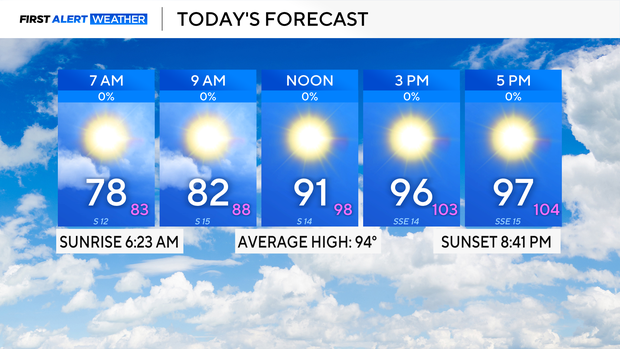
Temperatures on Tuesday afternoon will feel like triple digits, and this trend will continue into the Fourth of July weekend. Because dew points will drop slightly toward the end of the workweek, high temperatures should finally reach the 100° mark by Saturday.
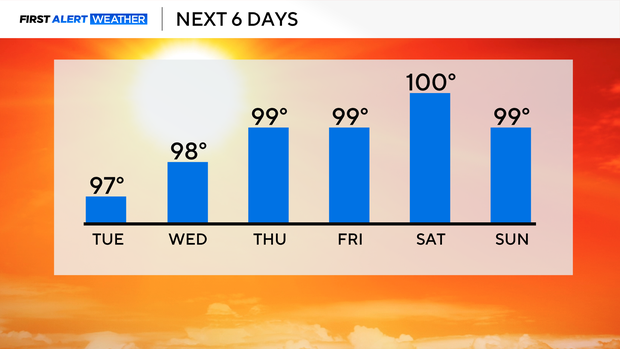
There’s just a slim 10% chance of showers in the forecast for Friday and Saturday, with slightly better rain chances on Sunday and Monday at 20%. Until then, temperatures will continue to heat up, and the feel-like temperatures will be at 100°+ each day. Stay cool.

-

 Wisconsin11 seconds ago
9-year-old drowns at western Wisconsin water park, sheriff says
-

 West Virginia5 minutes ago
Save Women’s Sports Act now the law of the land – WV MetroNews
-

 Wyoming12 minutes ago
Young bull moose captured wandering Laramie, relocated by Game and Fish
-

 Crypto15 minutes ago
Webinar: Crypto and public pensions—risks, rewards, and fiduciary duties
-

 Finance20 minutes ago
Wednesday’s Campaign Round-Up, 7.1.26: Justices help GOP with campaign finance ruling
-

 Fitness27 minutes ago
I’ve been doing the bird dog exercise instead of planks to improve my core strength – it’s even better for beginners
-

 Movie Reviews35 minutes ago
Neil’s Movie Reviews
-

 World45 minutes ago
Russia Approved Secret China Military Training At Top Level: Reuters

