South
'Record' fundraising haul by GOP Senate candidate in blue-leaning Southwest state

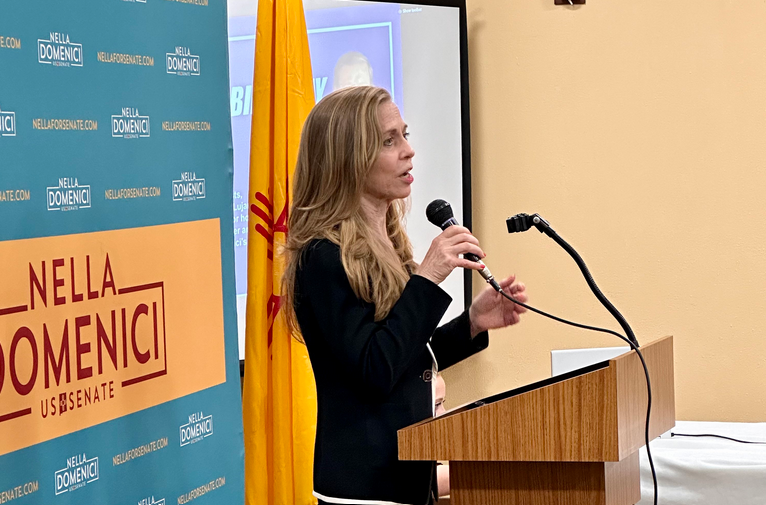
EXCLUSIVE — As she aims to become the first Republican in New Mexico to win a Senate election in more than two decades, Nella Domenici is shattering records.
Domenici’s campaign reports that the candidate hauled in $2.9 million during the April-June second quarter of 2024 fundraising, which they said was “the largest fundraising quarter of any U.S. Senate candidate in New Mexico political history.”
The money was raised by both Domenici’s Senate campaign and its associated joint fundraising committees. The figures were shared first with Fox News on Friday.
It has been 22 years since a Republican has won in the one-time swing state that now leans blue. The last GOP politician to win was Sen. Pete Domenici, Nella’s father, who in 2002 was re-elected to a sixth six-year term.
DAUGHTER OF NEW MEXICO’S LAST REPUBLICAN SENATOR RUNNING FOR FATHER’S OLD SEAT
Republican Senate candidate Nella Domenici campaigns in Carlsbad, New Mexico, on May 14. (Domenici campaign)
Fast-forward to the present day, and his daughter aims to end the losing streak.
The momentum is growing, the movement is building, and our state is ready for new leadership,” the candidate said in a statement. “New Mexico is at a tipping point and I’m grateful to all of those who are rallying behind our campaign to demand more for our state and our nation.”
The candidate’s haul is more than double the $1.25 million she brought in during the first quarter of 2024 fundraising. Domenici’s campaign said they entered July with more than $2 million in cash on hand.
CLICK HERE TO GET THE FOX NEWS APP
Domenici is using her powerful political brand and ample name recognition in New Mexico as she challenges Democrat Sen. Martin Heinrich, who is running in November for a third six-year term.
Heinrich hauled in $1.5 million during the first three months of the year but has yet to announce his second-quarter fundraising.
Sen. Martin Heinrich, D-N.M. (Anna Moneymaker/Getty Images/File)
In her race against Heinrich, Domenici is also showcasing her résumé. She has decades of experience in the finance industry at Bridgewater Associates, where she served as chief financial officer, Credit Suisse and Citadel Investment group.
In recent cycles, New Mexico, which was once a general election battleground, has shifted to the left and is no longer considered a crucial swing state.
Heinrich won re-election in 2018, which was a blue-wave cycle, by more than 30 points. President Biden carried the state by 10 points in 2020.
But with the turmoil surrounding Biden in the wake of his disastrous performance in his debate last month with former President Trump, which has fueled calls from within his own party for the president to end his re-election bid, the GOP sees an opportunity to expand the map in New Mexico and a couple of other states.
Internal Democratic polling conducted post-debate suggests a tightening political climate in New Mexico.
Get the latest updates from the 2024 campaign trail, exclusive interviews and more at our Fox News.



(Editor’s Note: As part of the preparation for training camp, this series will introduce 25 players who are new to the Cowboys’ roster, rookies and veterans alike. We’ll continue with outside linebacker Tyrus Wheat.)
The 2026 season will mark a homecoming for Wheat, who is now back in Dallas for his second stint with the Cowboys. As an undrafted free agent out of Mississippi State, Wheat signed with the Cowboys in 2023 on the practice squad before quickly being signed to the active roster a few months afterwards.
In his rookie season, Wheat saw a majority of his snaps come on special teams with 197, and only 31 snaps on defense. That would flip in his second season, with 165 snaps on defense and 46 on special teams. Through two years, Wheat played in 20 games and tallied 18 tackles and half a sack before spending a year with the Lions in 2025.
As is true across all levels of football, you can never have enough pass rushers. Wheat gives the Cowboys another pass rusher, who has the added ability to be able to help out on special teams as well as a blocker on kickoffs.
As for how much he’ll be in the defensive rotation, that’ll have to be something he earns in training camp. The Cowboys have some younger pass rushers ahead of him now like Donovan Ezeiruaku and first-round pick Malachi Lawrence, so there’ll need to be some proving done. That said, Wheat is also coming off his best year yet with the Lions. Will it be enough to find a role in the pass rush rotation? Oxnard will give us a good idea of that.
- Wheat played a vital special teams role for the Lions last season, tallying 11 special teams tackles which was the third-most for Detroit in 2025. He played a career-high 215 special teams snaps in order to get to that point.
- Wheat’s one and only season away from the Cowboys thus far in his career saw him play in 15 games for the Lions, where he also tallied a career-high 15 tackles and 1.5 sacks despite only playing 66 defensive snaps.
- After wearing 91 in his first stint with Dallas, Wheat returns to the Cowboys wearing 90 now, which was last worn by defensive tackle Solomon Thomas.

This is the eighth edition of Miami Hurricanes on SI’s breakdown of each team on the 2026-27 Miami Hurricanes football schedule.
Miami, to this point, is coming off its biggest test of the year against Pitt. Now they will turn their attention to Bill Belichick and what he has accomplished to this point in his second season as a college football head coach.
North Carolina should be better than last season after a disappointing 4-8 2025 outcome. However, the Hurricanes also understand that this is the ideal trap game before they head on the road to face Notre Dame in one of the biggest games of the season, which could hold massive playoff implications.
Miami can’t look forward. All eyes will be on what the new season and another fun home game against a rising contender.
Here’s everything you need to know about UNC and its 2026 unit.
The Offense
Petrino03 | USA TODAY Network via Reuters Connect
Thursday 17, 2014
After coming off one of the worst offensive outputs in the country last season, Belichick knew that he needed to make a move quickly. It started with hiring veteran coach Bobby Petrino as the teams offensive coordinator.
It won’t be the 126th ranked offense, but how much better could it get with Petrino making the calls? The Tar Heels will also have a new quarterback under center, but so far, no one knows who exactly it will be.
The most talented player in the quarterback room is Travis Burges. A 6-foot-4 freshman dual-threat quarterback with unlimited potential, but they also went into the transfer portal and landed some experience in former Wisconsin QB, Billy Edwards Jr., is expected to start, but the change could be made halfway through the season if things don’t work.
Two new starting receivers also entered from the transfer portal, but the consistency in the room was provided by Jordan Shipp. Last season, he led the team in receiving yards (671) and touchdowns (6), even with how bad the team was at scoring.
UNC’s rushing attack was also highlighted by returning sophomore Demon June. He rushed for nearly 500 yards in his limited snaps, averaging 5.5 yards a carry with two touchdowns.
Defense
Defense should be the calling card of the Tar Heels next season, led by their star pass rusher, Melkart Abou-Jaoude. The 6-foot-5, 260-pound rusher totaled 10.5 sacks and 47 tackles last season. Another year learning under Belichick would likely push him to be a first or second round pick in the 2027 Class, one that the Canes are paying close attention to.
Moreover, some familarity will be on the sideline and a likely starter during his freshman year in Keton Dopson, the former Miami Hurricanes commit. He reclassifed to the 2026 class, and flipped his commitment knowing that there is a better chance to get on the field quicker at UNC than the depth that he would have had to wait behind at least for this season.
UNC’s secondary is one of the more sound groups in the country compared to the rest of its roster. However, their linebacking core who rack up tackles, are transfers who have to learn the Belichick system.
Schedule
Schedule-wise, this game is the biggest trap game of the season for the Canes. If Miami finds its way past Pitt, it will be 7-0, and this game stands between the Canes and a rematch with the Fighting Irish.
This is the perfect time for Belichick to get his first signature win against a returning program like Miami, which puts a ton of pressure on the Canes to get the job done. However, the Canes can’t afford it, knowing what is coming next.
Moreover, this is the perfect chance for Darian Mensah to have a better game than last season’s outing against the Tar Heels. His one touchdown performance was one of his weaker games of the season, but it could be a step for him to get control of the Heisman conversation.
Outlook
MIami will be favored in this game, similar to how it will be for the rest of the season. UNC will give the Canes one of the better defensive matchups this season that will also test the offense.
Miami’s history against UNC in the Mario Cristobal era has shown it can have a high-flying offense but has to avoid self-inflicted wounds.
The Game
Date: October 31
Time: TBA
TV: TBA
Location: Hard Rock Stadium
Series History: UNC leads 16-11
Last Meeting: 2023
The Team
The Coach: Bill Belichick
Offensive Coordinator: Bobby Petrino
Defensive Coordinator: Steve Belichick
2025 Record: 4-8
2025 Rankings: 126th Total Offense, 70th Total Defense
Players to Watch: Melkart Abou-Jaoude, R-Sr, EDGE
Top Newcomer: C.J. Sadler, WR, Freshman
Biggest Question: How will Belichick adjust in his second year as a college football head coach?
The School
Location: Chapel Hill, North Carolina
Founded: 1789
Enrollment: 32,099
Nickname: Tar Heels
Colors: Power Blue and White
Mascot (Symbols): Rameses the Live Ram
The Program
Last Win in the Series: 2023
Last ACC Title: 1980
National Championships: NA
Playoff Appearances: NA
Last missed bowl season: 2025
Heisman Trophies: NA
The Schedule
October 31, Time TBA, Pitt Panthers @ Miami Hurricanes
This is the eighth story in Miami Hurricanes on SI’s early preview series of all 12 regular-season opponents for Miami football in 2026.
Follow all social media platforms to stay up to date with everything Miami Hurricanes- Twitter, Facebook, Instagram, Youtube, and BlueSky.
 Add us as a preferred source on Google
Follow
Atlanta, GA
Jermaine Dupri sues Sony Music over alleged $18 million royalty dispute involving So So Def artists

Atlanta music executive Jermaine Dupri and his So So Def companies are suing Sony Music Entertainment, accusing the record label of improperly handling royalty payments tied to a decades-long business relationship.
The lawsuit, filed July 6 and amended July 7 in the U.S. District Court for the Southern District of New York, alleges Sony underpaid, failed to properly report and withheld millions of dollars in royalties connected to recordings by artists including Kris Kross, Xscape, Da Brat and Jagged Edge.
Dupri and So So Def are seeking at least $18 million in damages, along with interest and attorneys’ fees, according to the complaint.
So far, Sony Music Entertainment has not filed a response to the complaint.
According to the lawsuit, Dupri and his companies discovered the alleged royalty issues after a 2025 audit conducted by accounting firm Gelfand, Rennert & Feldman.
According to the complaint, the parties entered a tolling agreement in November 2025 after So So Def raised concerns about approximately $18 million in allegedly unpaid royalties.
The complaint alleges Sony engaged in a pattern of financial reporting problems, including underreporting royalties, failing to report certain royalties, changing royalty statements years later, using incorrect royalty rates and improperly withholding payments.
The lawsuit also alleges Sony improperly used unrecouped balances, money a label claims is still owed from previous expenses, to offset royalty payments that should have been paid.
Kris Kross royalty dispute
One of the largest claims in the lawsuit involves Kris Kross, the Atlanta rap duo known for the 1992 hit “Jump.”
The complaint alleges Sony failed to properly report producer and override royalties from Kris Kross’ first two albums, Totally Krossed Out and Da Bomb.
According to the lawsuit, Sony did not provide royalty statements for those projects until 2023, and Dupri’s companies claim they are owed more than $2.2 million related to those recordings.
The complaint also alleges Sony later produced statements showing more than $33 million in foreign sales connected to Kris Kross royalty accounts and maintained those royalties in a separate accounting system that So So Def did not know existed.
Claims involving Xscape, Da Brat and Jagged Edge
The lawsuit also details royalty disputes involving several other artists connected to Dupri and So So Def. Dupri claims So So Def is owed more than $10 million in interest on unpaid royalties tied to Xscape, Kris Kross and Da Brat projects.
For Xscape, the complaint alleges Sony underreported producer royalties from the group’s 1993 album “Hummin’ Comin’ at ‘Cha” and owes more than $960,000 related to that project.
The lawsuit also alleges Sony underreported production-share royalties by more than $144,000 through incorrect calculations and underreported producer royalties from Xscape’s album “Off the Hook” by more than $22,000.
For Da Brat, the complaint alleges Sony underreported producer royalties from her 1994 album Funkdafied and owes more than $1 million related to that recording. The lawsuit also alleges additional royalties may be owed from her album “Anuthatantrum,” though damages have not been determined.
The lawsuit alleges Sony began reporting previously unreported royalties connected to Jagged Edge’s 1997 album “The Jagged Era” in statements issued in 2023. The complaint claims those statements only covered royalties dating back to 2007, leaving earlier royalties unaccounted for.
Dispute over Sony’s royalty practices
The complaint challenges Sony’s handling of unrecouped balances.
The lawsuit cites an Xscape account that showed an unrecouped balance of about $1.53 million as of 2020. Dupri’s companies allege Sony withheld more than $1 million in royalties generated between 2020 and 2024 because of that balance.
The plaintiffs argue those balances should have been forgiven under Sony Music’s 2021 Artists Forward Legacy Unrecouped Balance Program.
The lawsuit alleges Sony’s failure to apply the program resulted in approximately $1 million in payments that were not made. The complaint also identifies potential royalty issues involving artists and projects connected to So So Def, including: Mariah Carey, Usher, Bow Wow, Bone Crusher, Anthony Hamilton and more.
Dupri and his companies are seeking compensatory damages, interest, attorneys’ fees and a jury trial.
-

 Los Angeles, Ca3 minutes ago
Waymo video could determine charges after teens’ bizarre California ride
-
Detroit, MI21 minutes ago
DPD investigating after human remains found in home on Detroit’s west side
-

 San Francisco, CA36 minutes ago
Bay Area Teen Waymo Riders Nabbed For Allegedly Shooting Projectiles From Robotaxi
-
Dallas, TX41 minutes ago
Role Call: Tyrus Wheat looking to make most of second stint with Cowboys
-

 Miami, FL48 minutes ago
2026 Miami Football Early Opponent Preview, Game 8: North Carolina
-

 Boston, MA51 minutes ago
Boston sues social media companies over ‘addictive’ features, joining nationwide litigation
-

 Denver, CO56 minutes ago
Peyton Watson landing spots: Could Nuggets star actually leave Denver?
-

 Seattle, WA1 hour ago
14-year-old dies in Seattle e-bike crash at Colonnade Park after losing control on steep stairs – MyNorthwest.com

