Louisiana
More Bad News: 2005 vs 2024 Hurricane Seasons in Pictures


Lafayette, LA (KPEL News) – The majority of Louisiana residents, and even Americans, remember the hurricane season of 2005. A record 27 named storms formed that year, and 7 of them made landfall. The two hurricanes the jump to the minds of Louisiana residents are Katrina and Rita. That year, all the conditions were ripe for such an active season, and all those ingredients being mixed together just right proved disastrous.
Warm water fuels hurricanes. The warmer the water and the deeper it runs, the more gas there is to fuel the engine. Add low wind sheer to that recipe, and those tropical cyclones grow strong and big. Right now, the water in the Atlantic Basin and especially in the Gulf of Mexico are warmer going into hurricane season 2024 than they were in 2005. A La Nina pattern typically provides less wind sheer. That’s really bad news for Louisiana and Texas.
Katrina made landfall near the Louisiana/Mississippi line in August of 2005 with the third lowest pressure on record for a landfalling hurricane. The storm devastated New Orleans not only because of its strength, but also because the levees protecting the city broke and caused catastrophic flooding.
Rita came onshore on the Louisiana/Texas border between Sabine Pass and Johnson’s Bayou, decimating the coastal areas of Cameron Parish and causing devastation to communities further north and east. While Rita doesn’t get the recognition that Katrina does, it’s central pressure dropped 5 millibars lower than its predecessor. Most homes and businesses in Cameron Parish were completely washed away by storm surge and winds.
The National Oceanic and Atmospheric Association (NOAA) is predicting its most severe season to date for 2024, and they have made that prediction based on the forecast factors that drive hurricane formation: water temperature and wind sheer.
A side by side view, developed by Yale Climate Connections, of the conditions that existed in 2005 and the conditions they are looking at for the current forecast is frightening.
Yale Climate Connections
They explain, in their writeup about hurricane season, why warm water in this particular area is concerning.
Although record-setting sea surface temperatures alone don’t guarantee a busy hurricane season, they do strongly influence it, especially when the abnormal warmth coincides with the tropical belt known as the Main Development Region, or MDR, the area where 85% of Category 3, 4, and 5 hurricanes form. When considered alongside a developing La Niña — the periodic cooling of the equatorial Pacific that reduces storm-busting Atlantic wind shear — the unprecedented ocean heat is driving up seasonal hurricane outlooks higher than ever before.
The data certainly backs up NOAA’s prediction for 17 to 25 total named storms (storms with winds of 39 mph or higher), 8 to 13 hurricanes (winds of 74 mph or higher), and 4 to 7 of those will become major hurricanes (category 3, 4 or 5; with winds of 111 mph or higher).
Read More: NOAA Releases ‘Severe’ 2024 Hurricane Season Forecast for LA, TX
Preparation and planning is key. No one has a crystal ball or knows if Louisiana or Texas will take a hit this year. Those of us who have lived through storms over the last few decades understand that it only takes one to make it a bad season.
2024 Hurricane Names
LIST: 10 Deadliest Louisiana Hurricanes
Gallery Credit: Rob Kirkpatrick



Is Louisiana home to the smallest church in the world? Apparently so
Madonna Chapel in Louisiana was featured in “Ripley’s Believe It or Not” as the world’s smallest Chapel. Built in 1903, it measures only 81 square feet.
The Louisiana Supreme Court granted a stay early Friday morning to keep Republican Attorney General Liz Murrill from being arrested on felony charges handed down by a New Orleans grand jury July 2.
Though the Supreme Court didn’t dismiss the case against Murrill, it did pause the process and signaled in its ruling that the attorney general “is likely to succeed on the merits of a motion to quash this indictment on either a legal basis or due to apparent procedural irregularities.”
Murrill responded with a statement at 6:53 a.m. July 3.
“I’m grateful to the Louisiana Supreme Court for swiftly issuing a stay in this matter,” she said. “I hope this political witch hunt is not a harbinger of things to come, but I fear that it is. Neither the grand jury investigation law nor the public intimidation law was intended to be used as a political weapon by a rogue, biased, vindictive special prosecutor, judge and grand jury. I hope the Legislature in the future will ensure this cannot happen again.”
The grand jury returned a 16-count indictment charging Murrill with malfeasance and intimidation in the latest chapter of an ongoing feud between Murrill and Democratic city leaders.
The charges stem from letters Murrill sent to city officials, among them Mayor Helena Moreno, in May saying they risked losing their elected positions if they tried to overturn legislative action that eliminated a New Orleans criminal clerk’s elected office.
Republican Gov. Jeff Landry, who also has a fractious relationship with New Orleans city leaders, called the grand jury a “kangaroo court” and promised to pardon Murrill.
Special prosecutor Laurie White responded to Landry during a news conference after the grand jury returned its indictment, saying, “Good; let’s get her convicted and then he can pardon her.”
“We’re very interested in elected officials in New Orleans not being intimidated or threatened,” White told reporters. “It’s going to be very simple; very open and shut.”
Orleans Criminal District Judge Leon Roche had issued a warrant for Murrill’s arrest, setting bond at $400,000, but the Supreme Court stay halted that warrant.
Ironically, Murrill secured an indictment for former Orleans Parish Sheriff Susan Hutson earlier this year in the same courthouse.
Greg Hilburn covers state politics for the USA TODAY Network of Louisiana. Follow him on Twitter @GregHilburn1.

WOODWORTH, La. (KALB) – The Louisiana Department of Wildlife and Fisheries is reminding boaters to stay safe and never operate a vessel while impaired as the Fourth of July weekend draws crowds to the state’s lakes and rivers.
The department is participating in Operation Dry Water, a nationwide campaign focused on stopping impaired boating. Since its launch in 2009, the campaign has removed nearly 8,000 impaired operators from waterways across the country.
“Fourth of July weekend, this is a nationwide campaign that all your local, state and federal law enforcement participate in on your local waterways,” said Sgt. Jesse Davis with LDWF. “It’s just to make sure that we’re raising awareness and enforcement towards drinking alcohol and using drugs while you’re on the water.”

Wildlife officials said drinking and operating a boat can be just as dangerous as drinking and driving a car. They are encouraging anyone who plans to consume alcohol to designate a sober operator.
“At the end of the day, everybody wants to go home. Everybody wants to have a good time. It’s the Fourth of July. You can have a good time. Just get somebody to drive. Be responsible. Have somebody sober,” said Cpl. Ryan Durand with LDWF.

Officials are also recommending that boaters wear a life jacket while on the water. While adults are not required to wear one at all times, officials said a life jacket could save a life in an emergency.
“The most recent statistics on that are 87% of people that are involved in a recreational boating incident that they drown — fatality-wise — it’s 87% of those crashes involve that,” Durand said. “When you’re in a boat, you’re not always required by law to wear that personal flotation device, but it’s always a very good measure to have that on in case something happens.”
Click here to report a typo. Please provide the title of the article in your email.
Copyright 2026 KALB. All rights reserved.

The Fourth of July holiday usually brings to mind fireworks and hot dogs, patriotic t-shirts and hot weather.
But as American marks her 250th birthday, it can also be a time to learn something about the origins of our nation. KATC sat down with a couple of historians from South Louisiana Community College to get a history lesson: SoLAcc Humanities Chair Sarah Senette and Steven Schwamenfeld, PhD., Associate Professor of Humanities and Communication.
If you’d like to hear all their answers, scroll down; we’ve put together a video of their unedited responses to our questions.
We learned a lot. For instance – did you know that Louisiana, and in particular the Acadians, were pivotal in the course of the Revolutionary War?
“The war would not have been won without Louisiana. It’s not just the foreign aid that comes with France and Spain. That is very important. The war would not have been won without that alone, but without the participation of Louisianans specifically. I don’t think the American Revolution at least would have ended w hen it did,” says SoLAcc Humanities Chair Sarah Senette.
The French and Spanish – both of whom controlled what is now Louisiana at one time – both held bitter resentments against the British following the French and Indian War. And, the Acadians – who had just been expelled from their homes by the British in 1755 – had a personal score to settle and were ready to fight, she said.
“But you also had people like the Cajuns, I guess we to call them the Acadians then, who were exiled as a byproduct of the French and Indian War, who were living in Louisiana at that time. And they are passionate about fighting against the English. And in f act, (00;03;38;40: it’s one of the only times in Cajun history where you really see active participation from the Cajuns, in the military campaign. In fact, Galvez, the governor of Louisiana, he actually writes about them in one of his letters. And he says the Acadian men in particular, remember the past injustices of the English. So it was personal for them,” Senette says.
Another person with Louisiana ties who played a pivotal role in the war was Galvez – Bernardo de Galvez, who was colonial governor of Spanish Louisiana and Cuba, and later Viceroy of New Spain. He led the Gulf Campaign of the war – which many people have never heard of.
“This is a very heroic campaign. So they have all the Spanish ships that are out in the Gulf, and they want to do a siege against Pensacola. But it’s a little bit problematic because there’s another fort that’s more of a supply for the smaller fort , Fort George, and a little bit inland and so they can’t siege against Pensacola because it will just go on indefinitely. But they have to take Pensacola because it’s going to cut off the back entrance to, for supplies that keep the British from coming around to the western side of the American Revolution. So they must take Pensacola,” Senette says.
“Famously, Galvez says, who’s with me? And everyone’s like, nobody. No, we’re not doing it. And it’s because it’s dangerous. The British are smart. They know that this is really the only way to effectively win. So they have cannons on either side. It’s going to be very treacherous. And so famously, Galvez says, fine, I’ll do it myself. “ Yo solo ” I alone am going to, you know, lead this campaign. And actually it goes on his coat of arms later when he becomes, I think, the viceroy for all of Latin America, he is elevated into the upper aristocracy for this. But, so he takes it and he does lead the campaign i n this, you know, long, drawn out battle which ultimately determines the course of the American Revolution. So he is someone that is almost never talked about as a great military commander. But he was, and he’s quite heroic, even by his own account. So I feel like we should be very proud of. Yes, we should be very proud of his contributions. He was only about mid 30s, I think he was about 37 maybe by the time that happens. But so he was a young man doing all this,” she continues.
In recent years, more historians have begun studying this aspect of the war, she added.
“When you talk about the American Revolution, you hear about the northern front, you hear about the southern front, maybe you know the Navy, but you you don’t hear about the Gulf front. What is that? Right: Louisiana? I thought they were Spanish, but no, actually, Louisiana is deeply involved in this war,” she says.
Many Louisiana folks are familiar with Joseph Broussard dit Beausoleil, the guerrilla fighter who teamed up with indigenous people to resist the British up in Acadie. His son was a hero of the Revolutionary War; he fought under Galvez.
“It ’ s just a little slice of their of Cajun history. By the time you’re talking about the American Revolution, you have approximately 2,000, Acadians in Louisiana, and that’s men, women and children. And that would be the larger end of that number. So perhaps just a few hundred [Cajuns] are actually actively fighting in the American Revolution. So the Acadians are completely disinterested in fighting in the Civil War, right? They don’t get truly passionate about another war until World War Two. So this is a very odd moment in Cajun history, but one that when you know what the British did to the Acadians makes perfect sense,” she adds.
But it wasn’t just the Acadians who fought in the War on the side of the colonies, she adds.
“So you have Choctaw who were, you know, strong French allies, the Native Americans, you know, the French, you have the Spanish, you have the African militia, which was, which was an all African American, troop that gained its freedom under the French during something called the Natchez Revolt. They fight in the American Revolution on behalf of America, as part of the Spanish campaign. I mean, le gens de couleur libres, free men of color.
“So it it’s funny because when people think about ‘what did an American soldier look like,’ right? I mean, I’m, I’m guilty of this. I think, like, oh, it’s John Adams and he’s got a big mug of cider and you’re just ready for that. But really, you think about a lot of the important points in the Revolutionary War. They might have been speaking Spanish. They might have been speaking French. These are every different kind of phenotype. People looking completely not at all like I think what most Americans would think of when they think of the important American soldier. And there were women, by the way, that we can’t know those numbers because they’re women, obviously had to go in disguise. But there were women who were wounded in the American Revolution. And when they were defrocked, it became known that they were in fact not young boys. And there have been some estimates that it could be, you know, maybe as much as a couple hundred women possibly, that secretly fought in the American Revolution.”
We learned a lot about the political landscape and military details from Schwamenfeld. John Adams argued that there were three political factions in the colonies leading up to the war.
“America was evenly divided, between patriots, loyal active loyalists and the indifferent. In practice, probably the percentage of loyalists was somewhat lower than that. Probably not a full third of the population. Probably something more like 20% or less. The problem that the British had was that they’re not the majority anywhere. Loyalists do not form a majority of the population anywhere. So they became, in a sense, a source of weakness for the British. The British hoped that loyalists would come flocking to the colors. That the revolution was led by a sort of cabal, conspiracy of extremists. And as soon as soldiers showed up, people would come out of the woodwork, to declare their loyalty to the king and ask for the army’s protection. That really didn’t happen. Instead, the loyalist minority had to be protected. The British had to divide their own forces, to protect loyalists from the larger number of colonists who were actively engaged in revolutionary activities and support for the revolution,” Shwamenfeld said.
“Now, usually the numbers are 40%, in favor of the revolution. Actively. 40%. More or less on the fence and 20%, actively loyal. Initially, the British actually did not want to recru it loyalist soldiers because they wanted to prevent civil war. They just wanted to kind of, reestablish order, come in and do a police action. Didn’t didn’t work out that way,” he says. “They found organized patriot resistance and the Patriots in the majority. Later in the war, after France and Spain, entered an alliance, with the French entering a formal alliance with the Americans. British became desperate for manpower. They had to commit more of their troops to the defense of the home islands. And then they activel y recruited loyalists and perhaps as many as 20,000, Americans did serve in British forces. In in loyalist regiments, during the war. But again, that’s much smaller number than served in Patriot militias and in the Continental Army.”
The French and the Spanish were pivotal, he says – with the French looking for an opportunity for pay-back.
“It’s hard to overstate the significance of the French and Spanish contributions. Even before the French formally recognized the United States as independent and basically entered into alliance, the French were secretly providing the Americans with muskets, with ammunition, and even with cannon, which had the emblem of the French monarchy scratched off,” Shwamenfeld says. “A very high proportion of American colonies did own firearms, probably a higher proportion among the population than anywhere else on Earth. But those were all manufactured in England, and in Europe. So the Americans were very short of weapons. And they began to come from both France and Spain, before any official recognition. Of course, the American uprising was a great opportunity for France and Spain, especially France, to get just plain old revenge on Great Britain. For the events of the previous war, Seven Years War with the Americans called the French and Indian War, in which the French were essentially driven from the North American continent. Now they had an opportunity to stir up some serious trouble, within Britain’s own empire.”
The French and the Spanish got their revenge, eventually.
“The American Revolution would have gone on much longer. Much, much longer if France and Spain had not actively supplied the rebels. The 13 colonies were very large. British Navy was the largest in the world, so they could always blockade successfully the American coastline. But the British Army was by no means the largest in the world, which is why they ultimately had to recruit loyalists and more.
The war’s hero, George Washington, had a strategy most don’t realize.
“Despite multiple defeats, Washington preserved his army in most general engagements. He certainly never wanted a decisive victory until the very end. It’s only the final campaign of the war that Washington actually chooses full strategic goal, destroys a British army in the field, causes its surrender. Until that point, he basically just kept the army going,” Schwamenfeld said.
In addition to being a military commander, he had to be capable of political maneuvers as well.
“He fully understood the precariousness, of his position. That there were officers in his army who were actually plotting against him to take control, to actually take control of the Army, to convince Congress to remove him from command. This did not spur him to take unnecessary risks, to try to gain spectacular victories in the field that might actually end up with the army being exposed. So he showed tremendous self – control. It was, in many ways, his greatest characteristic. He was able to curb his own desire t o try to gain, glory in a single tactical engagement, and instead pursue this consistent strategy of of caution and maintaining the army, intact,” Schwamenfeld says.
Some facts about Washington’s army probably aren’t palpable to some. He wanted a long-term, professional, trained militia.
“It should be said that Washington kept corporal punishment in the Continental Army, to help maintain those European standards. He did. It’s not something that we necessarily want to talk about, but it was. The American soldiers were flogged during the Revolutionary War. In the regular army. It should also be said that the Continental Army was the only American army to be integrated. And this was true of the regular regiments rather than the militia regiments. Washington was looking for soldiers to fill up his army and maintain and stick with it, for months and years at a time. And so African Americans served side by side with white soldiers in the Continental Army. Something that would end pretty much with the Revolutionary War and would not be seen again until the Korean War,” Schwamenfeld says.
Here’s the video:
Full Responses
-
 Lifestyle4 minutes ago
L.A. Affairs: He wanted L.A. I wanted New York. A panic attack changed everything
-
 Politics8 minutes ago
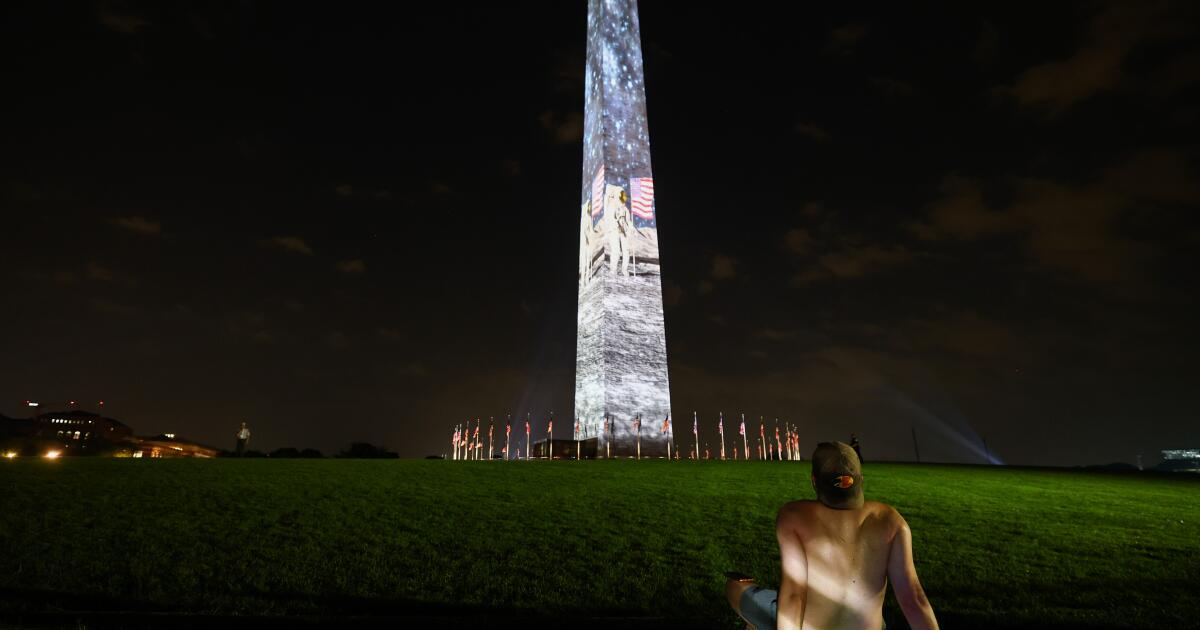
Trump refashions America’s 250th as a celebration of himself
-
 Sports23 minutes ago
How Dodgers’ Max Muncy, vying for his third All-Star selection, continues to evolve
-

 World35 minutes ago
Germany’s Merz defends NATO spending after Trump calls it ‘ridiculous’
-
 News58 minutes ago
Oregon ER doctors win a ‘David and Goliath’ battle against a national company
-

 Videos2 hours ago
Iran gets ready for Khamenei’s funeral • FRANCE 24 English
-

 Los Angeles, Ca2 hours ago
2 arrested after 3 LASD deputies injured during East L.A. World Cup celebration
-

 Detroit, MI3 hours ago
Ex-girlfriend in custody after Taylor man found fatally stabbed, police say

