Northeast
New York assemblyman tries to confront Tom Homan over arrest of Columbia University anti-Israel activist
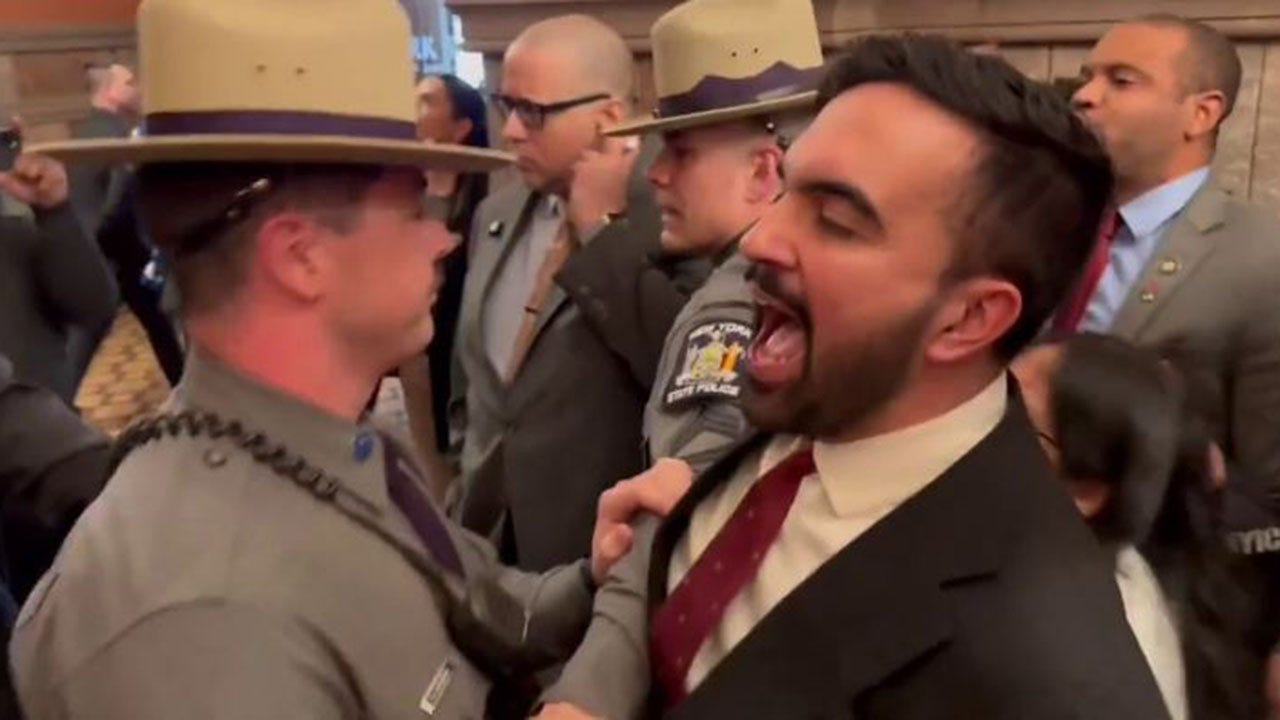
A New York state elected official was seen Wednesday appearing to attempt to get past police while shouting at border czar Tom Homan, who was in the state capital to call out Democrats over their illegal immigration policies.
Assembly member and New York City mayoral candidate Zohran Mamdani was seen in Albany shouting at Homan over the Trump administration’s crackdown on illegal immigration and the recent detention of Mahmoud Khalil, a Columbia University student and anti-Israel activist.
Video footage posted online shows Mamdani trying to get past New York State police troopers while shouting at Homan.
ICE AGENTS ARREST ANTI-ISRAEL ACTIVIST WHO LED PROTESTS ON COLUMBIA UNIVERSITY FOR MONTHS
New York state Assembly member Zohran Mamdani is seen shouting toward border czar Tom Homan in Albany on Wednesday. (Assemblymember Zohran K. Mamdani/X)
“How many more New Yorkers will you detain? How many more New Yorkers without charge?” he shouted. “Do you believe in the First Amendment, Tom Homan?”
Fox News Digital has reached out to the White House.
In a post on X, Mamdani said he confronted Homan, who visited Albany to “do Trump’s bidding — push for mass deportations, carry out the assault on working class New Yorkers, and justify the unjustifiable detention of legal permanent resident and father-to-be, Mahmoud Khalil.”
“Under Trump’s watch, we are seeing the erosion of the fundamental rights that make us American, including the right to peacefully protest injustice and speak freely about our beliefs,” Mamdani said in a statement provided by his campaign to Fox News Digital. “Meanwhile, [New York City Mayor] Eric Adams is standing idly by, because he knows as long as he kisses Trump’s ring, he can avoid legal accountability. New Yorkers deserve a leader who will stand up for our Constitutional rights against advancing authoritarianism.”
Khalil, a Palestinian raised in Syria and a permanent U.S. resident, was arrested by U.S. Immigration and Customs Enforcement (ICE) agents at his university-owned apartment on Saturday and told they were revoking his green card and student visa, according to Khalil’s attorney, Amy Greer.
Columbia University student and anti-Israel activist Mahmoud Khalil played a major role in the protests against Israel at Columbia and met with university officials on behalf of Columbia University Apartheid Divest, a group of student groups urging the university to divest from Israel. (Ted Shaffrey/AP Photo | Barry Williams/New York Daily News/Tribune News Service via Getty Images)
Khalil played a major role in the protests against Israel at Columbia University and met with university officials on behalf of Columbia University Apartheid Divest, a group of student groups urging the university to divest from Israel, according to CNN.
President Donald Trump announced Khalil’s arrest on Monday, and Secretary of State Marco Rubio said that the administration would revoke the green cards of any Hamas supporters in the U.S. and deport them.
FEDERAL AGENCIES TO REVIEW COLUMBIA UNIVERSITY’S CONTRACTS, GRANTS AFTER ‘FAILURE’ TO PROTECT JEWISH STUDENTS
Mamdani said border czar Tom Homan smirked when confronted. (Alex Brandon/AP Photo)
“Following my previously signed executive orders, ICE proudly apprehended and detained Mahmoud Khalil, a radical foreign pro-Hamas Student on the campus of Columbia University,” Trump posted Monday on Truth Social. “This is the first arrest of many to come.”
Homan planned to stand with state Republican lawmakers fighting to repeal the state’s Green Light law, which is being legally challenged by the Trump administration. The law, also known as the Driver’s License Act, allows illegal immigrants to obtain a driver’s license.
Mamdani said Homan smirked when confronted.
“Because there is no answer from taking a man from his pregnant wife who is due to deliver their newborn in a month,” he said, noting that Khalil told Columbia University officials that he feared for his life.
“The cowardice that is on display across our city and our state is unacceptable,” he added. “New Yorkers are looking to us. They are looking to their leaders for courage and for conviction, and what they are finding instead is collaboration.”
Fox News Digital’s Diana Stancy contributed to this report.
Read the full article from Here

Maine
He’s been to every town in Maine, mostly for something to say. | Column
Several years ago, Jeff Hewett was at a dinner party when the subject of obituaries came up. He realized, other than being “an avid Red Sox fan” — as he’d seen in so many posthumous biographies — he wasn’t going to have much to say in his.
He didn’t have kids and worked the same job for most of his career. Another dinner guest reminded him that he could say he’s a cribbage player, but again, so are most Maine men, he said. Hewett needed something more.
An eighth-generation Mainer who’s proud of his roots, he decided he was going to visit every incorporated town and city in the state — 454, by his count — and, unlike most people who claim to have “been everywhere,” he would take a picture to prove it.
Hewett, 64, who lives in Cape Elizabeth, is easing into retirement from a 38-year career in printing sales that started at the Times Record in Brunswick and, in 2019, was relocated to the South Portland plant that prints the Portland Press Herald, now owned by the Maine Trust for Local News.
In embarking on his quest, Hewett didn’t map out a route to take through the state or choose a certain time or place to start. He just happened to be on Isle au Haut in the fall of 2018, on his annual hiking trip with a group of friends, when — remembering his obituary idea — he realized he probably wasn’t going to make it out to the remote island off the Midcoast again anytime soon. So, he found the town hall and asked his buddy to take a picture of him.
When they got back to the mainland, he realized he could check off Blue Hill while he was there, and Belfast, too.
“It started the ball rolling,” he said.
Every photo after the first one has been a selfie. Not that he hasn’t had plenty of company on his travels. There’s been his neighbor and frequent cribbage opponent Mike Drinan, who gave him a ride on his boat to Chebeague and Long islands in Casco Bay. Client-turned-friend Janet Acker did the same to Swan’s Island, off Bass Harbor. One of his hiking buddies, Ron Morrison, stuck around after a trip to make a few stops by Bangor and has accompanied Hewett elsewhere.
He’s gone by himself at times. Once, after returning from the Sugarloaf area, he realized he’d missed a town. So, one Saturday, he drove back up to New Vineyard, took a photo and went home.
“Some of them were just random. ‘Hey, we’re in Lyman; let’s find the town office,’” he said.
Most of the time, he’s been accompanied by his wife, Mary, whom he met on a blind date, though she knew him from his days bartending in the Old Port, he says, and “wanted nothing to do with me.” Their 30th anniversary is in September.
He says she partly comes along for the free lunch, the quality of which can vary depending on where they are. (They were pleasantly surprised by burgers they had in the Penobscot County town of Lincoln.)
She’s also told him that she likes just standing back and watching him talk to the people he meets wherever they are, whether it’s someone working at a town office — where he takes all his selfies, if the town has one — or giving him directions when the GPS leads to the middle of nowhere. (His car has never broken down, but he’s gotten lost plenty.)
Hewett often explains what he’s up to, which sparks a conversation. He remembers telling a woman working in a town office in northern Maine — in Allagash, he thinks — that he had come a long way to see her that day, from the Cumberland County town of Cape Elizabeth. Oh, she said, I’m from South Portland.
“Being in the business I’m in, you wind up having a connection everywhere,” he said.
He was staying with friends in Houlton when they ran into a man introduced to Hewett as Don Douglas, a member of the Maine Baseball Hall of Fame. He asked Douglas if he knew fellow hall-of-famer Bob Curry from his neck of the woods. Ah, yes, he said, the crafty left-hander.
“People know people,” Hewett said.
His “gift of gab” has helped him get rides from strangers on islands, when boats have dropped him too far from the town office to walk. There was the harbormaster on Chebeague, and the woman on Swan’s in an old Subaru, who offered to show him and his wife the prettiest beach on the island, then left them in her driveway while she went to have lunch with her brother. He flagged down a pickup truck for a ride back to his friend’s boat. When he told her what happened, she said she knew the house he was talking about; that woman was probably one of the Rockefellers.
The same skill for conversation has been essential to his career, as a liaison between commercial printing clients from all over New England and newspaper production staff. It’s also what landed him the job as the de facto tour guide for the South Portland printing plant, being one of few people who can both explain how the process works and entertain a crowd.
His travels have given him something to talk about with people back at home, too. At least a couple times a week, he said, a place he’s been will come up in conversation, when he’s asking someone where they’re from or talking about their Maine vacation. If you’re going to Washington County, he’ll tell you, Eastport has more going on than Lubec. If you’re thinking about visiting Vinalhaven, he’ll suggest you get on the ferry to North Haven instead.
Hewett outside the Quonset hut that serves as Passadumkeag’s town office. (Courtesy of Jeff Hewett)He’ll give you an assessment of the town office there, too, from the utilitarian Quonset huts in places like Passadumkeag and the unimpressive sign on a flagpole in Ripley to the stately Queen Anne-style town hall in New Gloucester and the quaint, white clapboard building in Bowerbank on Sebec Lake.
He can show you. He’s got all the photos on his phone and in a searchable gallery on a website that his brother made for him. Flipping through them shows his thick gray hair and beard getting lighter over the six-year span. Sometimes, he’s in sunglasses or a baseball cap, others a winter hat. In the one in front of the Medford town office, he thinks he looks like a lobsterman who just returned from sea, though his tan is actually from driving with the top down on the 2006 Porsche Boxster he bought in 2020 to improve his cruising.
Hewett after a long drive to Medford. (Courtesy of Jeff Hewett)“Do I look like I’ve had a hard day there, or what?” he said.
A few of the photos are at the signs for town lines, when he couldn’t find a municipal office, like in the Washington County town of Vanceboro. Border patrol agents there couldn’t help him either; they all live in Calais, they told him.
His final stop, at Frye Island in September of 2024, didn’t fail to deliver a tale worth recounting. He and his friend were sitting at a cafe by the ferry landing when a public works crew showed up. The dock plate was broken, and cars — like the one they decided to take over — wouldn’t be able to board the boat to Raymond until it was fixed. Fortunately, a few hours later, they were back on the mainland, his mission accomplished.
Hewett has taken plenty of day trips since then, but in more random directions now that he doesn’t have a destination to check off — to Bath in search of an electric fry pan or Parsonsfield just to go for a ride.
Although he knows about the Boothbay Harbor couple who’s been to every Maine post office, he hasn’t heard of anyone else who’s visited every town.
As he cuts back on his work week, he plans to start tackling the state’s 28 or so plantations, most in far-flung places. He’s looking forward to revisiting Aroostook County and to his first trip to Matinicus, an island 20 miles out to sea.
It will give him something to do with his newfound free time, and something else to say.
Massachusetts
Healey doubles down on early college: ‘For too long, money’s been a barrier’ – The Boston Globe
“We want to make sure that all students have access to a great college experience, if they so choose, and we also know that for too long, money’s been a barrier,” Healey told the Globe in an interview this week. “We know from studies that students who’ve done early college have a greater persistence rate, that is staying in college once they start.”
The state says the program is working so far, with about 66 percent of early college graduates immediately enrolling in higher education after high school, and about 82 percent of students returning for a second year. Students from middle-income as well as wealthy families can also participate in the program at no cost.
Proponents of the state’s early college program say exposing teenagers, especially first-generation and low-income students, to college campuses and coursework in high school helps build confidence and increases the likelihood they will go on to pursue higher education.
“It has proven to be a really productive way of creating a bridge for students, many of whom are from communities in which they may not have envisioned themselves as college material,” said David Silva, Salem State University’s provost. “It raises the level of conscious awareness that college is an option.”
In January, Healey announced an additional $8.2 million for early college grants to support dozens of new partnerships between high schools and colleges. The state’s fiscal 2026 budget included over $14 million for early college, which supports programs with more than 75 high schools, as of last fall. The governor hopes to double the number of participating students to 20,000 by 2028.
High school students from all grades and income levels participate in the program, which includes transportation to and from the participating college campuses, as well as support services such as tutoring and advising. Some high school teachers are also trained to support professors teaching the classes.
“I want all students in the state to have access,” Healey said.
Early college dovetails with other efforts in the state to let students graduate in three years, resulting in quicker, less expensive degrees. The state’s board of higher education recently voted to allow colleges and universities to begin experimenting with innovative degree offerings, which has prompted a heated debate over whether bachelor’s degrees should be condensed.
To Healey, it’s an enticing opportunity for pragmatic students who are interested in pursuing college but wary of the price tag, and said she is prepared to push colleges to experiment. A three-year path might not work for every discipline, but Healey sees ample opportunity for colleges to rethink the length of many degree offerings.
“We attract students from all over the world and all over the country,” Healey said. “Imagine if we can innovate and be the first to really make a three-year degree something that you can do — imagine the numbers we’re going to recruit and draw to Massachusetts to take advantage of that in our schools.”
Combining early college with a three-year degree could theoretically cut the cost of a bachelor’s degree by up to 75 percent if a student graduated high school with two years’ worth of credit.
Several students told the Globe it was a seamless transition from early college to four-year programs at public universities in Massachusetts.
Sebastian Rivera, a first-generation college student from Lowell, is working on his bachelor’s degree at the University of Massachusetts Lowell after his high school guidance counselor informed him he was on track to graduate with 23 college credits.
A typical bachelor’s degree requires 120 credits. Realizing he could save a whole year’s worth of tuition was “really a game-changer,” Rivera said.
“That was super powerful to know that I belong in higher education and I have the confidence to tackle this because I was able to do college in high school,” Rivera said.
Gianna McColley wasn’t sure she was going to pursue higher education after high school because of the rising costs. She enrolled at Whittier Regional Vocational Technical High School in Haverhill, so she would have workforce skills “no matter what.” But experiencing college courses as a teenager made her realize that a bachelor’s degree was within reach if she could walk away with debt-free.
She graduated high school in 2023 with an associate’s degree in psychology before enrolling at Salem State University. McColley is now on a Fubright grant in Spain after graduating with her bachelor’s degree in two years, having studied abroad in Spain and Mexico. McColley said it was at times exhausting and stressful to commit to such a heavy academic load in high school, but said her efforts paid off when she saw how easy it was to transfer her credits to Salem State.
“It’s just a really amazing opportunity,” McColley said. “If there is something offered through your high school I don’t think there is a reason not to take advantage.”
Not all educators are sure the early college program is the best use of state resources.
Nancy Niemi, president of Framingham State University, is skeptical about plans to grow the program and is concerned about the lack of a “strategic plan or framework for helping us figure out, as a Commonwealth,” the best path forward.
“Early College is the Wild West still, across the country and across the Commonwealth,” Niemi said.
She isn’t convinced that high schoolers are developmentally ready for college coursework, and she worries about the cost for Framingham State as the program grows. The state reimburses colleges $180 per credit for early college programs, and institutions must cover any remaining balance for support services, including advising on academic work and possible career trajectories.
“I cannot afford the Early College Program I have,” Niemi said. “Our director’s time is constantly split, thinking about how am I going to get this next dollar? All of that makes me very worried about putting a lot of hope into early college programs.”
Other educators and many students seem optimistic about the state’s efforts to reduce college costs.
Early college has broadened Salem High School students’ “horizons of what they feel like they’re even capable of doing,” said Meghan Grosskopf Sousa, director of Salem High School’s College and Career Center.
The program allows students “to really jump start their college career and for their families to save potentially a year of college tuition and fees without ever even touching their financial aid availability,” said David Crane, dean of the College of Continuing Studies at Bridgewater State University.
Bridgewater has about 360 students in its early college program, and an additional 90 dual enrollment students, Crane said. Dual enrollment students also earn college credit in high school, but they may have to pay for the credits and must work out the logistics on their own.
Edward Coelho, a senior at Framingham High School, expects to graduate with six college credits and is waiting to hear back from his three top schools: Amherst College, Emmanuel College, and Boston University.
Coelho, the son of Brazilian immigrants, said he has already learned from “fantastic professors” through the early college program. His parents have ingrained in him that “education is our gateway to a greater path,” and he is eager to pursue a bachelor’s degree in biology.
Coelho volunteers with younger students, weighing whether they could benefit from college. He believes three-year degree offerings would lead to “a great rise in people trying to get their bachelor’s degree.”
“A lot of kids don’t know if they can succeed in college and they don’t know what they want to do,” Coelho said. “I know a lot of kids who are struggling now, and they’re very scared if they go to college, it’ll be a waste of money, a waste of time.”
Hilary Burns can be reached at hilary.burns@globe.com. Follow her @Hilarysburns.
New Hampshire
Bill requiring NH voters to consider school tax caps clears House
Republicans in the New Hampshire House have passed a bill to require local voters to consider capping school property taxes every two years. The proposal, which cleared the House along near party lines Wednesday, is the latest in a series of efforts by Republican leaders to curb growth in local school spending.
Under the bill, voters across New Hampshire would weigh in at every November election on whether to block increases in school spending by capping local tax increases and SAU administrative spending.
Before the House adopted the plan, its lead sponsor, Weare Republican Rep. Ross Berry, argued that the more people vote on a tax cap, the better local spending decisions would reflect the will of people.
“The ultimate form of local control is allowing the most voters to opine on the issue,” Berry said.
But critics of the proposal, including Londonderry Republican Rep. Kristine Perez, said the policy’s bottom line objective is less about maximizing voters’ participation than reducing school distinct spending, regardless of local circumstances.
“Putting a cap on the school portion of property taxes is just another way of saying ‘cutting school budgets,’ ” Perez said.
GOP leaders in the House have for the past few years pushed policies aimed at limiting local local property tax increases by giving voters new tools to curb government spending. But voters have largely rejected these.
After the vote, House Majority Leader Jason Osbornse said this policy will be different.
“Today we delivered. If school boards want to jack up your property taxes, they’re going to have to convince voters at the ballot box, not outlast them in a gymnasium at midnight,” Osborne said.
But Megan Tuttle, who leads NH-NEA, the state’s largest teachers union, said this bill would only harm schools that are already under strain due to rising healthcare and special education costs.
“Instead of fixing our state’s broken public education funding system, these politicians are pushing yet another attempt to implement arbitrary school budget caps that will make it very difficult for school districts that are already underfunded,” she said.
The bill now moves the New Hampshire Senate. Republican leaders there have been leery of past efforts by the House to impose caps on local school spending.
Behind the headlines you read on our website, there’s a dedicated team of journalists working hard to bring you local news you can trust. On any given day, that can look like:
- • Reporters hustling to track down sources, get the facts and hold powerful officials accountable
- • Producers coordinating interviews with people who offer perspectives that go beyond soundbites
- • Editors carefully vetting our stories to make sure they’re accurate, fair and easy to follow
I believe that journalists, when we do our jobs well, can play a crucial role in connecting people and making communities stronger. But we can’t do this work without you.
Your donations, in any amount, can help keep independent journalism vibrant in New Hampshire — and accessible to everyone, no paywall required.
Sincerely,
Dan Barrick
News Director
-
Massachusetts1 week agoMassachusetts man awaits word from family in Iran after attacks
-
Detroit, MI6 days agoU.S. Postal Service could run out of money within a year
-
Miami, FL1 week agoCity of Miami celebrates reopening of Flagler Street as part of beautification project
-
Pennsylvania7 days agoPa. man found guilty of raping teen girl who he took to Mexico
-
Sports1 week agoKeith Olbermann under fire for calling Lou Holtz a ‘scumbag’ after legendary coach’s death
-
Michigan3 days agoOperation BBQ Relief helping with Southwest Michigan tornado recovery
-
Culture1 week agoTry This Quiz on the Real Locations in These Magical and Mysterious Novels
-
Virginia1 week agoGiants will hold 2026 training camp in West Virginia