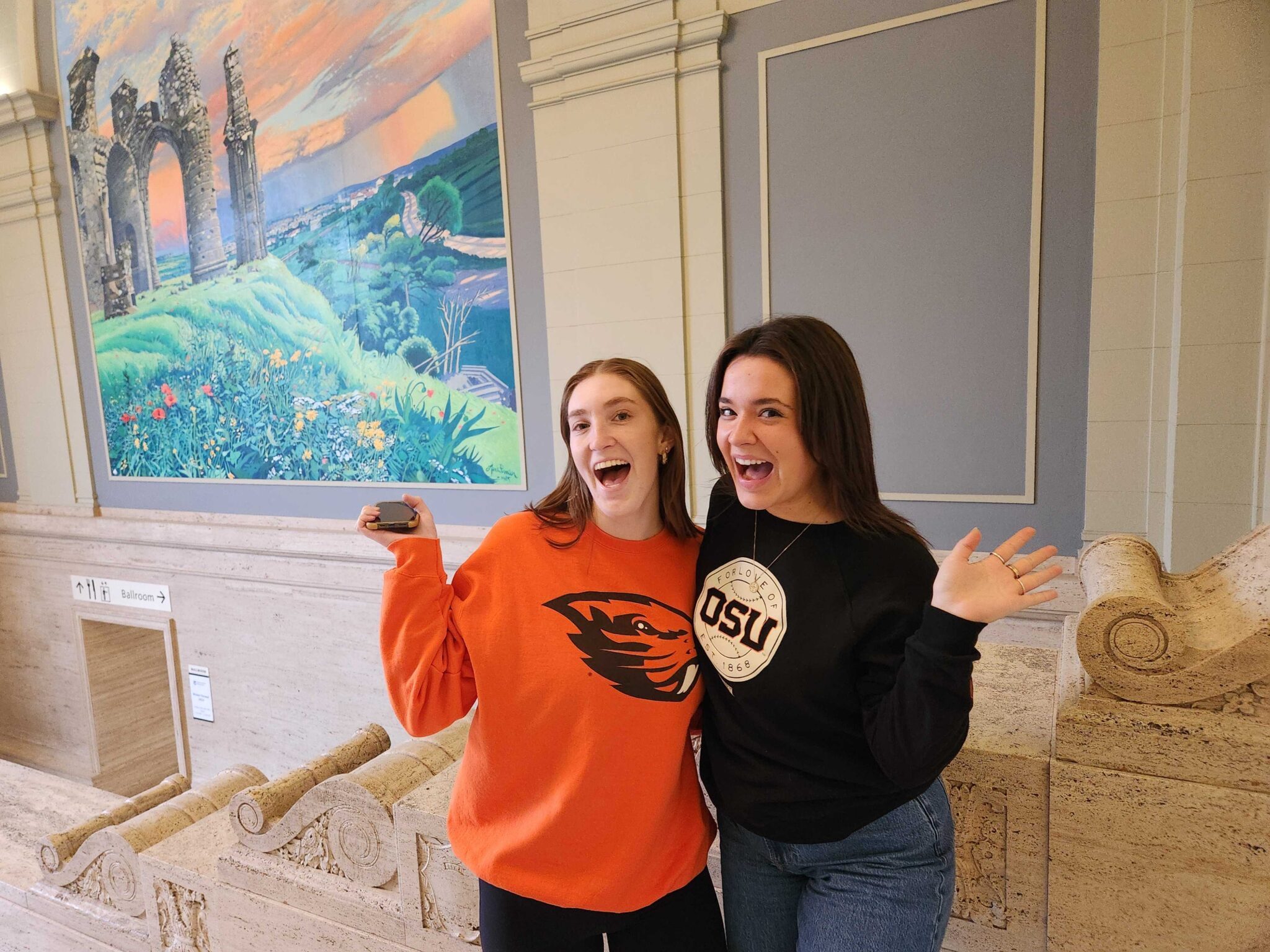
CORVALLIS, Ore. — Kennedy Cole, a college junior studying accounting, knew she wanted to attend school outside her native Nevada to expand her choices, meet new people, and explore different places.
Emma Nichols, a sophomore majoring in vocal performance, chose a school close to her home in Corvallis, Oregon.
The two friends, Oregon State University tour ambassadors who guide prospective students and families around campus, both think they made the right decision.
Cole said it was scary and tough to be at a school where many first-year students already knew one another or had gone to local high schools, but she found most students were friendly. Nichols said one of the exciting aspects of Oregon State’s campus is the ability to meet “out-of-state students and international ones from a different culture.”
But while they both have scholarships, there’s a big difference in their base tuition.
The university charges an estimated $13,800 in tuition and fees for in-state undergraduates in the 2023-24 academic year and about $36,600 for nonresidents.
At a time when school budgets are tightening and college enrollment is decreasing, state universities are increasingly turning to nonresident students to boost their revenues.
In 47 states, public research universities increased the proportion of out-of-state undergraduate students they admitted between 2002 and 2022, according to an analysis of federal education data done for Stateline by University of Wisconsin-Madison education professor Nicholas Hillman.
In those two decades, the percentage of out-of-state undergraduate students at those universities rose steadily from a nationwide average of 18 percent to 28 percent, Hillman found. Public research schools are generally large state universities that receive significant grants for research.
“Universities that have broad access missions have the least revenue stream,” Hillman said in an interview. Any shift in public funding “affects them more. Slots are being given away to people paying higher tuition. Politically, this is such a hot potato. Legislators are getting interested in this.”
While the funding boosts universities, critics worry that in-state students are being shut out. To minimize that, some states limit the number of out-of-state students.
Aaron Klein, a senior fellow at the Washington, D.C.-based Brookings Institution, a centrist think tank, wrote a report on out-of-state enrollment in 2022.
In an interview with Stateline, Klein said: “The ability to go to a high-quality school near where you grew up is being taken away for many kids through a complex process in which public universities are swapping in-state students for out-of-state. In the end, society is no better educated, and student debt rises substantially.”
In Oregon, the average percentage of undergraduate students from out of state rose from 23 percent to 47 percent at the state’s public research universities, according to Hillman’s analysis.
At Oregon State University, 63 percent of undergraduate students are nonresidents, according to Jon Boeckenstedt, vice provost of enrollment management, who has written extensively on the subject. The percentage drops to about half when including graduate students, he said. But Boeckenstedt also said virtually no Oregonian applicant who is qualified is denied a place at his campus. The university’s acceptance rate for first-year applicants in 2022-23 was nearly 83 percent, according to data provided by the school to the U.S. Department of Education.
“Up until about 2019 or 2020, we had sort of an informal, trustee-mandated ratio of two-thirds resident, one-third nonresident balance,” he said in an interview in his office on the lush Oregon State campus.
“But if you manage to that ratio, and resident enrollment falls by 100 [students], you need to purposely exclude out-of-state residents who want to come here and bring their out-of-state tuition dollars,” Boeckenstedt said. “And so I said, ‘Let’s think about this differently.’”
Shift toward out-of-state students
The trend toward admitting more out-of-state students started as far back as the 1980s, when state legislatures and governors began reducing funding for higher education, said Ozan Jaquette, an associate professor of higher education at the UCLA Graduate School of Education & Information Studies who has studied nonresident enrollment at public universities. He added that the trend has accelerated over the past decade.
“Once states said, ‘Hey, you can make your own money,’ the public universities that could, said, ‘We are going to dramatically increase nonresident enrollment because they pay higher tuition,’” he said.
Up until the end of the last decade, the move toward out-of-state recruitment mostly applied to flagship state universities, Jaquette said, as they had the widespread name recognition to attract students from other places. But now, he said, it has trickled down to the next tier of public colleges, as budgets get tighter and more nonresidents apply.
Some universities that recruit out-of-state students tend to focus on private high school students, since their families often can afford to pay higher tuition, he said. But some recruiting lately has expanded to public high schools, usually in affluent suburbs, or areas where there are few public state universities and pockets of affluent students all competing for the in-state slots. It’s easier, sometimes, to get in at a university in another state.
“The only viable route [to increase the budgets] is nonresident enrollment,” he said of schools with declining state funding. “If you are not Stanford or Princeton, there are limits to how much donation and endowment you have and there are limits to research funding.”
Some schools also recruit internationally.
Arizona State University spotlights the fact that it is the top public university choice for international students, according to an Institute of International Education’s Open Doors report. Nearly 18,000 international students studied at the school in the 2022-23 school year, according to Open Doors data. The research institution tracks U.S. students studying abroad and international students coming to the United States.
About two hours south at the University of Arizona in Tucson, current undergraduate enrollment is 50 percent students from the state, 45.2 percent from out of state and 4.5 percent international, for about a nearly even split between residents and nonresidents, Kasandra Urquidez, the school’s chief enrollment officer, wrote in an email.
While University of Arizona enrollment for undergraduate state residents dropped 4.6 percent over the last decade, from 19,206 to 18,323, nonresident undergraduates have risen 41 percent, from 10,244 to 14,478, according to figures provided by Urquidez. Arizona resident tuition for undergraduates is $13,200 and nonresident tuition is $39,600, she said.
“As a state university, non-resident enrollment … provides university revenue and decreased state funding causes the university to seek alternative forms of revenue,” she wrote in the email.
She added that Arizona does not limit spots for residents: “We are very dedicated to the citizens of our state and would never turn away a qualifying resident for a non-resident.”
Chanah Tanioka is a senior of Japanese descent from Hawaii studying pre-med at Oregon State University. She’s the first of her family to go to college and said she looked at public universities all over the country, but chose Oregon State because it felt more welcoming to someone of her heritage than some schools in the Midwest or Southeast.
She also had a close family friend who attended the school and now lives in nearby Salem. Tanioka has scholarships that make it possible for her to afford the steeper tuition and recommends that students from other places who want to attend a big public university check out its culture before going.
Tanioka belongs to the Hawai’i Club on campus, which helps make her feel at home. She said one jarring thing about going to school on the mainland is the lack of understanding of her native Hawaiian Pidgin vernacular, in which “Are you pau with your food?” means “Are you finished?”
Some states seek limits
While many public universities have embraced nonresident enrollment in recent years, some states have quotas or laws that are aimed at putting in-state residents first.
In North Carolina, five state schools — including the University of North Carolina-Chapel Hill and North Carolina State University — have an 18 percent cap. Seven have a 25 percent cap, two have a 35 percent cap, and one, Elizabeth City State University, has a 50 percent cap. Historically Black colleges and universities, known as HBCUs, and schools that had declining in-state enrollment were granted the higher caps.
In Texas, state law mandates that high school students graduating in the top 10 percent of their class (except the top 6% for the University of Texas at Austin applicants) are automatically admitted to any public Texas university.
That can effectively limit the number of non-Texas students at those schools. Out-of-state enrollment in Texas public universities grew only 1 percentage point over the past decade, from 6 percent to 7 percent, according to Hillman’s research.
The University of California Board of Regents, under pressure from state lawmakers alarmed at the high percentage of nonresident students attending California universities, in 2017 adopted a new policy to limit nonresident enrollment. The board settled on 18 percent at five campuses; on four other campuses that already had exceeded that percentage, enrollment would be capped at their 2017-2018 levels.
The legislature then worked to appropriate more money to make up for the revenue hit the California campuses would take by admitting fewer higher-paying nonresident students.
The deal directed $31 million in state funding to the universities in 2022-23, and grew to $61 million in 2023-24, and is expected to increase to $92 million in 2024-25, according to Justin Tran, spokesperson for California state Sen. John Laird, a Democrat and chair of the Senate Budget Subcommittee on Education, who was instrumental in the actions. That is aimed at reducing nonresident enrollment to 18% of the undergraduate student body, replacing about 900 nonresidents with Californians annually, Tran wrote in an email.
Oregon lawmakers also are concerned about the number of nonresident students attending state universities. State Rep. John Lively, a Democrat and chair of the House Committee on Higher Education, wrote in an email that the lower ratio of Oregon students to nonresidents is something that deserves a “hard look” to see what role cost plays in that calculation.
He also suggested that people from elsewhere who go to school in Oregon may enhance the state’s economy by staying after graduation to work.
“It’s also a goal of mine to attract new students and decrease the barrier that cost of higher education creates on individuals and families hoping to make a future here in Oregon,” he wrote.
This story was originally published by Stateline, which like the New Hampshire Bulletin is part of States Newsroom, a nonprofit news network supported by grants and a coalition of donors as a 501c(3) public charity.