Northeast
MSNBC host Katy Tur demands: ‘Is this fair’ after judge fines Trump, bans him from business in New York

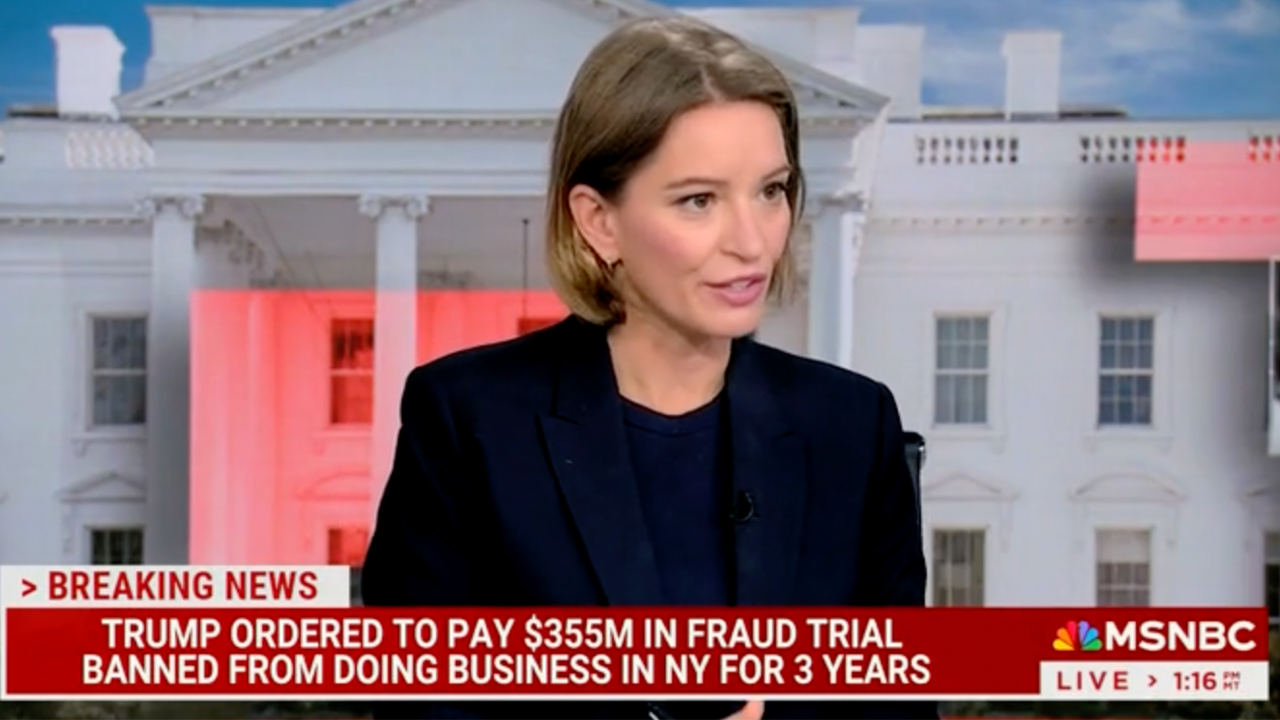
MSNBC host Katy Tur recently questioned if it was “fair” that former President Trump was ordered to pay almost $355 million in damages and be barred from his business in New York by a judge Friday in a civil fraud case brought by New York Attorney General Letitia James.
During a segment of “MSNBC Reports” on Friday, Tur mentioned that in the 70-year existence of the legal rule Judge Arthur Engoron used on Trump, it was never used against someone who has yet to be proven of doing harm to any individual or entity with their practices.
Trump’s main defense in the case is his argument that banks and his insurers weren’t harmed by his business practices – a point Tur floated during the broadcast while probing the strength of Engoron’s decision.
ERIC TRUMP CONDEMNS NY ‘SET-UP’: MY FATHER BUILT NYC SKYLINE AND THIS IS HIS THANKS
MSNBC anchor Katy Tur wondered on Friday if it was “fair” that former President Trump was barred from his business in New York for three years by Judge Arthur Engoron.
She wondered if the use of the statute in the Trump case was truly fair to the former president, suggesting that if Trump’s argument was true, this was the first time the statute was used this way in 150 cases.
The host began by explaining Engoron’s decision here, noting that the statute does not require a prosecutor “to show that anybody was hurt by your practices – there’s nobody you defrauded specifically.” So, Engoron was within legal scope with the ruling.
However, she went on to explain that – after looking back at how the statute was used – “there was no case where there was a ban on doing business where there wasn’t harm shown.”
As part of Engoron’s ruling, Trump has been barred from running his businesses within the state for three years.
Tur continued: “So, even though the threshold is harm shown, in the past, it has only been used to ban someone doing business when it’s been shown that somebody was hurt. Say you’re selling cosmetics that are poisoning you; there’s somebody that was hurt there, the cosmetics company gets banned.”
She then asked, “Is this fair to go after Donald Trump like this in this environment, is my question?”
MSNBC legal correspondent Lisa Rubin agreed that Tur’s assessment of the statute is “true” but then punted to former New York Assistant Attorney General Tristan Snell for more analysis.
TRUMP BLASTS ‘CLUBHOUSE POLITICIAN’ JUDGE AFTER BEING FINED $350M, DEFENDS THE ‘GREAT COMPANY’ HE BUILT
New York Judge Arthur Engoron ruled that former President Trump must pay over $350 million in damages to the state of New York as the result of his civil fraud trial. (Fox News)
Tur invited him to speak, asking once again, “So tell me, is it fair?”
Snell, who used the statute to prosecute Trump for fraud with Trump University, clarified, “The legal standard is whether there was a tendency to deceive. That’s what it is, and the legislature in New York made a public policy choice to say that that was an important weapon for the A.G.’s office to have to vindicate the public good in this situation.”
Tur followed up, saying, “And it seems like what Judge Engoron found was there was intention – not just a tendency – there was intention to deceive,” a point which Snell noted was more than Engoron needed to punish Trump.
MSNBC contributor Suzanne Craig attempted to bolster the case against Trump, stating, “I think, too, the interesting thing about victims is, there were victims here, and they were the banks. They’re just not the most popular victims in society.”
The host countered with Trump’s defense, noting his point that the banks “don’t feel like they lost.”
Still, Craig insisted, “They still did, and that’s the conclusion, and that’s where we’re at today.”
CLICK TO GET THE FOX NEWS APP
Read the full article from Here


In a stunning, franchise-shaking move, the Celtics reached an agreement Wednesday to trade Jaylen Brown to the Philadelphia 76ers, according to a report from ESPN’s Shams Charania.
In return, Boston reportedly will receive nine-time All-Star wing Paul George, two first-round picks and two second-round picks.
Brown had been the subject of rampant trade rumors in recent weeks, with Charania reporting earlier Wednesday that the Celtics were “strongly shopping” their longest-tenured player following a failed attempt to trade him and two draft picks for Giannis Antetokounmpo.
But the 76ers, who ended the Celtics’ 2022-26 season by upsetting them in the first round of the NBA playoffs, had not been mentioned as a potential suitor for Brown. He’ll now join the likes of Joel Embiid, Tyrese Maxey and VJ Edgecombe on a talented Philadelphia roster, while the oft-injured George heads to Boston.
Shipping out Brown splits up one of the NBA’s most talented and successful duos. The tandem of Jayson Tatum and Brown led Boston to five Eastern Conference finals, two NBA Finals and one championship since they joined forces in 2017.
Brown, the 2024 NBA Finals MVP, played most of this season without his longtime co-star, and he thrived, averaging 28.7 points, 6.9 rebounds and 5.1 assists — a stat line matched in Celtics history only by Larry Bird and John Havlicek — while Tatum recovered from Achilles surgery. Brown made second-team All-NBA and finished sixth in MVP voting, and the underdog Celtics far exceeded preseason expectations, posting the second-best record in the East (56-26) and the league’s fourth-best net rating.
But questions about Brown’s future began swirling after Boston blew a 3-1 series lead against seventh-seeded Philly, losing three straight — including Game 7 at home, which Tatum missed due to knee stiffness — to suffer their earliest postseason exit since 2021.
Brown, who was a minus-57 over the final three losses, made headlines after the series when he insisted that this was his “favorite season” despite Boston’s poor finish. Basketball Hall of Famer Tracy McGrady, a mentor of Brown’s, did the same when he said on his podcast that Brown had “frustration (that) lies deeply within the (Celtics) organization.”
Celtics president of basketball operations Brad Stevens said in his end-of-season news conference that Brown had expressed no such feelings to him. But Stevens admitted Boston needed to improve its roster to compete with the NBA’s elite teams (New York, San Antonio, Oklahoma City, etc.). A month later, after the Milwaukee Bucks rejected Boston’s bid for Antetokounmpo, Stevens said he wouldn’t “predict the future” when asked whether Brown would remain with the Celtics.
“Jaylen Brown is a big part of us,” Stevens said last Tuesday. “I’m never going to predict the future, but every indication, everything that I think about over the past few years has been building around those guys, right? So obviously, you never know.
“But at the same time, the one thing I want to make very clear is how valued he’s always been. He’s been amazing. He’s been an amazing teammate, a great person to be around. And whether that run ends 10 years from now when he retires, or before, there’s a lot to celebrate. We have a great relationship, an open relationship where we talk about everything. But I don’t want to predict the future.”
George has enjoyed a long and decorated career across stints with the Indiana Pacers, Oklahoma City Thunder, Los Angeles Clippers and 76ers. Over his 16 seasons, he’s averaged 20.5 points, 6.2 rebounds, 3.7 assists and 1.7 steals per game while shooting 44.0% from the field and 38.4% from 3-point range.
The 36-year-old is well past his prime, however, and has struggled to stay on the court, suiting up for more than 60 games just once in the last seven seasons. He played in 37 games this season, missing time for both injuries and a 25-game suspension for violating the NBA’s anti-drug policy.
George did give the Sixers strong minutes during their playoff series against Boston, making 55.0% of his 3-pointers across the seven games. Still, he’s a substantial downgrade from both the Celtics’ original target, two-time NBA MVP Antetokounmpo, and Brown, who is six years younger.
The Celtics will inherit the final two years of George’s contract. He’s set to make $54.1 million this coming season, then has a $56.6 million player option for 2026-27. It was not immediately clear whether Boston plans to move forward with George or flip him in a subsequent trade.
This trade marks the third time in the last four offseasons that the Celtics made major changes to their roster. Ahead of the 2023-24 season, they shipped out Marcus Smart, Robert Williams III and Malcolm Brogdon in trades for Kristaps Porzingis and Jrue Holiday — deals that helped push their Tatum/Brown-led core over the championship hump after years of near misses. Last summer, the Celtics traded Porzingis and Holiday and lost Al Horford and Luke Kornet in free agency to escape the prohibitive second apron of the NBA’s luxury tax. (A subsequent series of in-season trades pushed Boston out of the tax entirely.)
Parting ways with Brown is the boldest swing yet for Stevens.
The 29-year-old (30 in October) was Boston’s longest-tenured player, having joined the C’s as the No. 3 overall pick in the 2016 NBA Draft. He ranks 10th on the franchise’s all-time scoring list — one spot behind Tatum and two behind Bill Russell — and is coming off the best season of his career. Among active players, only Stephen Curry, Draymond Green, Devin Booker, Nikola Jokic and Antetokounmpo have appeared in more games without changing teams.
Brown, whose No. 7 likely will hang in the TD Garden rafters one day, also built a strong connection with the Boston community through his 7uice Foundation, Boston XChange initiative and other philanthropic efforts.
“I love Boston,” he said in a May 6 Twitch stream. “If it were up to me, I would play in Boston for the next 10 years.”
Brown was set to become eligible for a two-year, $140 million contract extension with the Celtics next month. His current deal, which runs through the 2028-29 season, was the richest in NBA history when he signed it in 2023 (five years, $304 million). He is set to make $57.1 million this coming season.


Forgotten frontier: How Pittsburgh shaped America’s July 4th
We take you inside Fort Pitt Museum’s “Pittsburgh’s Revolution” exhibit to show how a frontier fort became a key in America’s path to independence.
Pittsburgh’s Fourth of July traditions are rooted in centuries of American history, and Fort Pitt Museum sits at the heart of that story.
Located in Point State Park at the confluence of the city’s three rivers, the museum traces western Pennsylvania’s pivotal role in the French and Indian War, the American Revolution and the early expansion of the United States.
An exhibit you don’t want to miss
Inside, the “Pittsburgh’s Revolution” exhibit spotlights how this frontier outpost helped shape the Revolutionary War and the push for independence. Rare artifacts, detailed maps and personal stories walk visitors through a time when control of Fort Pitt meant control of the West, giving colonists a crucial foothold in the struggle against British rule. The exhibit also emphasizes the diverse communities at the Point, including soldiers, Indigenous nations, traders and settlers, whose lives intersected in ways that still echo in Pittsburgh’s identity today.
For modern visitors, the museum offers an immersive experience that connects familiar July 4 images with the realities of life on the 18th‑century frontier. Families can explore galleries that explain how supplies moved through Pittsburgh to support the Continental Army, how diplomacy unfolded with Native nations, and how everyday people navigated a world in conflict. It turns Independence Day from a single date on the calendar into an ongoing story that started along these rivers and radiated outward.
As America marks the 250th anniversary of the Declaration of Independence, Fort Pitt’s “Fourth at the Fort” programming brings that history into the present with flag ceremonies, living history encampments and hands‑on activities in Point State Park.
For Pittsburghers looking to go beyond fireworks, a visit to Fort Pitt Museum offers a reminder that Independence Day here is not only about celebration, but about standing on the ground where American history was made.
This article by Gabby Sartori was created with the assistance of Artificial Intelligence (AI). Journalists were involved in every step of the information gathering, review, editing and publishing process. Learn more.

Immigrant advocates in Connecticut are calling on state leaders to prepare for the possible loss of legal protections for thousands of people after the U.S. Supreme Court ruled that the Trump administration can move forward with ending Temporary Protected Status, or TPS, for Haitians and Syrians.
TPS is a federal program that allows people from countries facing war, natural disasters or other extraordinary conditions to live and work legally in the United States. The Trump administration has argued that conditions in some countries have improved enough that the protections are no longer necessary.
For organizations that work with immigrants, however, the ruling has triggered fear and uncertainty.
“The Haitian community, in particular, is reeling,” said Maggie Mitchell-Salem, executive director of Integrated Refugee and Immigrant Services, commonly known as IRIS.
Mitchell-Salem said the number of Syrians affected by the decision is much smaller than the number of Haitians nationwide, but she argued that the impact goes beyond statistics. Her organization has led resettlement efforts for Syrian refugees in Connecticut since the federal government offered TPS status amid the Syrian civil war in 2012.
“Numbers don’t matter,” she said. “A single person being impacted by inhumane racist immigration policies is a person who’s impacted, and we should care.”
A community preparing for uncertainty
Mitchell-Salem said immigrant advocacy groups and local officials are already discussing how to help families who could face difficult decisions if the Trump administration decides to end TPS protections.
Among the biggest concerns are families that could be separated if parents lose their legal status or face deportation.
“We’re working with municipalities, with any community leaders that we can, who are coming up with plans on what to do to help individuals here,” she said.
She urged families whose immigration status may be at risk to create preparedness plans and designate trusted relatives or friends who could care for children if necessary.
“The state of Connecticut has one on their website,” she said. “We urge everyone who has a family situation that is no longer stable to fill that out.”
Looking to Massachusetts as a model
Mitchell-Salem said Connecticut should consider following the example set by Massachusetts leaders, who responded to the Supreme Court ruling by holding a press conference, reassuring TPS holders of their rights, announcing legal clinics and creating an emergency response fund.
“What I think is beautiful about what Massachusetts did is that it signaled you are valued, you are part of our community, and we care about you,” she said. “For that, I would love to see Connecticut do something similar.”
At the same time, she cautioned that there are limits to what states can do if federal protections ultimately end.
“I think the state of Connecticut is right to really think about what remedies are truly possible,” Mitchell-Salem said.
Warning against scams
Mitchell-Salem said one of her organization’s biggest concerns is that desperate immigrants could become targets for fraud.
“What we’re most concerned about is that because people will be so desperate that there are those that will take advantage of them,” she said.
IRIS has been posting information in English, Haitian Creole and Arabic warning immigrants that there are “no magic solutions” and encouraging them to seek advice only from trusted legal organizations and immigration attorneys.
A call to action
Mitchell-Salem said the Supreme Court’s decision should prompt action not only from government officials but also from the public.
“Flood congressional phone banks, call Congress every single day, tell them what you think,” she said. “Get your friends in states that are less blue than Connecticut to do the same.”
She said public pressure has altered the course of other administration policies and could again influence federal immigration decisions.
“This isn’t an issue that’s just a blip that’s going to go away,” Mitchell-Salem said.
-

 Politics20 seconds ago
Coalition of 25 states sues Trump admin over Medicaid work rule designed to prevent fraud
-

 Health5 minutes ago
West Nile virus detected in southern state as health officials warn residents about mosquitoes
-

 Sports12 minutes ago
USA World Cup star Folarin Balogun receives controversial red card during Round of 32 match
-

 Technology15 minutes ago
A missing kitten rode under a car hood. AI brought her home
-
 Business20 minutes ago
As Trump reports $2.2 billion in 2025 income, ethics experts raise alarms
-
 Entertainment27 minutes ago
Danny Glover reveals Alzheimer’s diagnosis, says family has his back
-

 Lifestyle30 minutes ago
François-Henri Bennahmias to Launch New Luxury Swiss Watch Brand N3W5
-
 Politics35 minutes ago
Bill to ban sex offenders from running for office fails in California senate committee

