Northeast
Massachusetts police clued in to wealthy family's mansion murders with three sheets of paper and chilling note

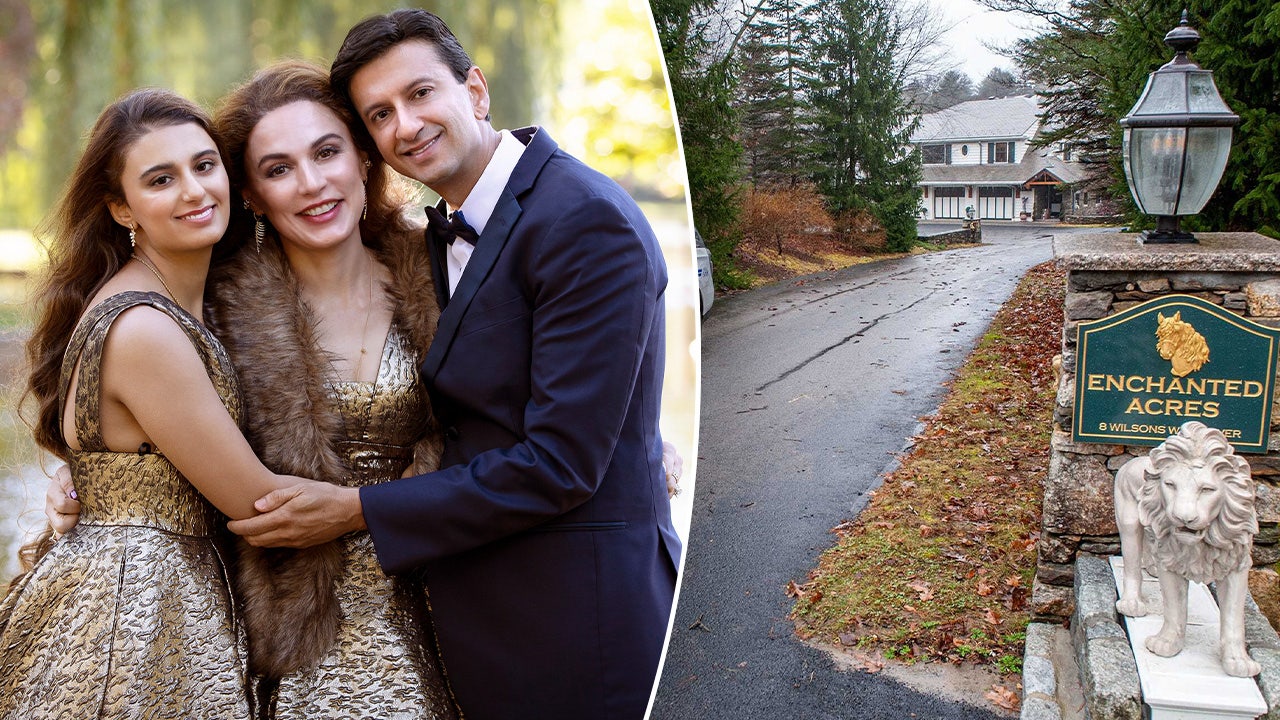
Grisly new details emerged this week in the murder-suicide of a seemingly wealthy Massachussetts family who were all found shot to death late last year in their sprawling $4 million mansion, according to a new report.
Rakesh “Rick” Kamal, 57, fatally shot his wife, Teena, 54, and their 18-year-old daughter, Arianna, as they slept in their beds three days after Christmas. He then climbed into a bathtub and turned the gun on himself, the Boston Globe reported.
While appearing affluent to outsiders, the Kamals were hopelessly buried in debt – and were scheduled for eviction from their 11-bedroom Dover mansion nestled on five acres the day of the slayings.
FLORIDA FIREFIGHTER KILLS WIFE IN MURDER-SUICIDE AFTER OMINOUS FACEBOOK POST
Rakesh Kamal, 57, (right) shot his wife, Teena, 54, and their 18-year-old daughter, Arianna, before turning the gun on himself in their Dover, Massachusetts, mansion. (Paula Swift Photography/ USA TODAY NETWORK)
Responding to a 911 call, police entered the residence on Dec. 28 and found a typed note addressed to the person who was scheduled to pick up the keys, according to the local newspaper’s account of a 63-page police report.
“Please note,” it read. “Before entering call the Police to first check three bedrooms on the second floor. Each room will be marked by a white sheet of paper.”
Police found each of the bodies behind those demarcated doors.
UTAH FATHER OF 6 KILLS WIFE IN MURDER-SUICIDE AFTER CRYPTIC FACEBOOK POST
Rakesh Kamal, 57, (right) shot his wife, Teena, 54, and their 18-year-old daughter, Arianna, before turning the gun on himself in their Dover, Massachusetts, mansion. (Paula Swift Photography)
The calculated killings shocked relatives and convulsed the wealthy local community.
Neighbors in Dover – a suburb of Boston – knew Rick Kamal as a wealthy entrepreneur and dedicated father.
FOLLOW THE FOX TRUE CRIME TEAM ON X
But beneath their veneer of wealth, the family were drowning in debt and stress.
Rick – who had filed for bankruptcy and been served with a foreclosure notice three months before the killings – owed his brother Manoj $150,000. The sibling had given his brother the loans in a string of $5,000 increments, according to the Globe.
MASSACHUSETTS RAPE SUSPECT WANTED FOR DECADES-OLD CRIMES CAPTURED AFTER POLICE CHASE IN LOS ANGELES
Police investigating the murder-suicide of the Kamal family. (Suzanne Kreiter/The Boston Globe via Getty Images)
The broke businessman was also given money by his mother, and he eventually sank her bank account to nearly nothing.
Aware of their mounting financial pressures, Teena recently told Manoj that she wanted to “drive their family off a cliff due to the recent stress they were under,” according to the report.
SIGN UP TO GET THE TRUE CRIME NEWSLETTER
Manoj – who found the bodies and called police – told investigators that his brother had spun a web of deceit for years on end.
“[Manoj] thinks every conversation he has had with Rakesh the past five years was a lie,” his wife’s sister told police.
CALIFORNIA MAN WHO WENT BY ALIAS FOR 40 YEARS ARRESTED IN WOMAN’S MURDER
Rakesh “Rick” Kamal fatally shot his daughter Arianna, 18, and his wife, Teena, before turning the gun on himself Dec. 28.
Marybeth Bisson, the developer of the Kamals’ enormous home, also financed its sale to the family.
She told investigators that Rick had begun concocting excuses for missing mortgage payments and pleaded with her not to discuss the situation with his wife.
On Dec. 23, five days before the killings, a fax was sent to the company holding Teena’s $1.25 million life insurance policy to add Manoj as a beneficiary.
The Globe reported that the Kamals FaceTimed with relatives in India on Christmas Day and that there was nothing out of the ordinary about the exchange.
CLICK HERE FOR MORE TRUE CRIME FROM FOX NEWS
Aerial view of the Kamal family’s Dover, Massachusetts mansion, where the father killed his wife and daughter before turning the gun on himself. (Google Street View)
Rick texted his brother the following day to cancel a scheduled get-together. He also texted Arianna’s boyfriend to nix his upcoming visit to the family.
The boyfriend told police that Arianna had confided some of her family’s troubles to him, hinting at one point that Teena wanted to leave her father but that they seemed to be on the mend.
At the same time, Rick was in regular communication with his home’s developer to discuss his departure.
After not hearing from his brother for several days, Manoj went to the home, known as “Enchanted Acres,” and called 911.
The Kamals bought the mansion for just under $4 million, according to records. The Zillow estimate for the 20,000-square-foot compound is nearly $7 million.
Read the full article from Here


Cambridge Police are investigating a fatal shooting near the intersection of Broadway and Norfolk Street early Saturday morning.
Around 5:30 a.m., Cambridge Emergency Communications received a call for a person laying on the ground near the intersection of Broadway and Norfolk Street. Officers were dispatched to the area, and Paramedics from the Cambridge Fire department declared the person dead on scene. The victim had an apparent gunshot wound, according to Cambridge police.
There were not many details initially released, but an active investigation is underway by the Cambridge police, Middlesex District Attorney’s office and Massachusetts State Police detectives assigned to the Middlesex District Attorney’s office.
Additional information will be shared when it becomes available.
Police are asking anyone with information surrounding this incident to contact the Cambridge police department at (617) 349-3300.

250 years in, and America is still a work in progress. Many American poets have written hymns and howls, declarations and outcries for this country that brims with so many people, and so many hopes, from all over the world.
“I Hear America Singing,” Walt Whitman wrote, in the 1850s.
“…the varied carols I hear,
Those of mechanics, each one singing his as it should be blithe and strong,
The carpenter singing his as he measures his plank or beam,
…The delicious singing of the mother, or of the young wife at work, or of the girl sewing or washing,
Each singing what belongs to him or her and to none else…”
Emma Lazarus’ “The New Colossus” was inscribed on the Statue of Liberty’s pedestal in 1903. It’s a poem in praise of immigrants who were cast out from other lands and found safe harbor in America.
“Give me your tired, your poor,” wrote Emma Lazarus.
“… your huddled masses yearning to breathe free,
The wretched refuse of your teeming shore.
Send these, the homeless, tempest-tost to me,
I lift my lamp beside the golden door!”
But Langston Hughes’ 1949 poem, “Freedom,” reminds us that many Black American families did not sail to America under the flame of a welcoming lamp, but were captive, shackled, to be sold into bondage. After the Emancipation Proclamation, many still endured segregation, bigotry and the constant threat of racist violence.
“I tire so of hearing people say, let things take their course,” wrote Langston Hughes.
“Tomorrow is another day.
I do not need my freedom when I’m dead.
I cannot live on tomorrow’s bread.”
This week, as the U.S. Supreme Court upheld birthright citizenship, you might read Shirley Geok-lin Lim’s 2017 poem, “Learning to Love America,” about how immigrants make America their own as they start families here.
“…because to have a son is to have a country,” she writes.
“…because my son will bury me here
because countries are in our blood and we bleed them”
The America great poets see is imperfect, unsettled, and unfinished, even after 250 years. Lawrence Ferlinghetti wrote in 1958 these words that still ring out:
“…I am waiting
for a rebirth of wonder
and I am waiting for someone
to really discover America”
Copyright 2026 NPR


South Jersey Schools Plan for Cellphone Ban
Statewide NJ cellphone ban begins; South Jersey schools pilot lockers, pouches & backpacks.
“This sucks. There is no other way to explain it. I joined a club. A club that shouldn’t exist. The worst club that a parent could ever be a part of. The club where I have to bury my child,” Mike Shevlin said on Facebook after his 3-year old son tragically died after drowning in the family pool.
The devastating death of Elijah Shevlin in Washington Township has rocked the community. On June 27, Elijah was found unresponsive by his parents in the family pool. He died on July 3.
According to Mike Shevlin’s page, the father started compressions immediately after finding his son face down and motionless in the pool.
First responders arrived quickly, and Elijah was transferred to the Children’s Hospital of Philadelphia. His brain had swollen to the point that nothing could be done to save his life.
Elijah’s mother, Sandra Shevlin, posted on Facebook, describing her son as an angel.
“I’m forever broken. I love you with all my heart, my sweet angel boy. You were too good for this earth,” she said.
Elijah is survived by his parents and his two siblings, his twin Ella and 6-year-old Mickey. The family decided on organ donation.
“Somewhere in this country, a phone is about to ring. On one end of the phone is a doctor. And on the other end is a parent who’s going to hear that an organ is waiting to save their child,” Mike said on Facebook. “And knowing that a few other Dads out there never have to feel the pain I feel can bring me some closure.”
Peter Del Borrello III, Washington Township Council president, sent out a statement to the community calling for strength and support for the family.
“Together, let us wrap out arms around them and remind them that an entire community stands beside them. This is our opportunity to show Mike, Sandi, Ella, and Mickey that they have an entire town behind them – not just today, but in the difficult days, weeks, and months ahead.”
Elijah’s parents have spent their lives dedicated to the Washington Township community. Mike Shevlin is a veteran and police officer for the Camden County Police Department. Sandi Shevlin is a first-grade elementary school teacher.
Elijah’s family has opened a GoFundMe to support the family during these difficult times and has raised over $65,000 in donations.
Community members have also organized a lemonade and baked goods stand, with all proceeds going to the family. The stand will be open on July 5 from 1 to 4 p.m. at 30 Longwood Drive in Sicklerville.
Mia Boykin is an education/watchdog reporter with the Courier-Post, Burlington County Times and The Daily Journal. Email: mboykin@gannettnj.com. Please consider a digital subscription.
-

 Michigan1 minute ago
3 dead after vehicle collides with semitruck on Interstate 94 in Wayne County, Michigan State Police say
-

 Massachusetts6 minutes ago
One dead in Cambridge shooting
-

 Minnesota13 minutes ago
One of two charged in Montevideo, Minnesota, drive-by shooting pleads guilty
-

 Mississippi16 minutes ago
10 Nicest Small Towns In Mississippi
-
 Missouri21 minutes ago
KCFD: 1 adult, 1 child, a dog displaced after a house fire in the 3800 block of Myrtle Avenue
-

 Montana28 minutes ago
The Face Behind Kalispell Montana Hidden Gems – Flathead Beacon
-

 Nebraska31 minutes ago
Nebraska basketball lands commitment from top in-state player
-

 Nevada36 minutes ago
Primm Valley Casino not open after recent ownership change

