

Sign up for the Today newsletter
Get everything you need to know to start your day, delivered right to your inbox every morning.

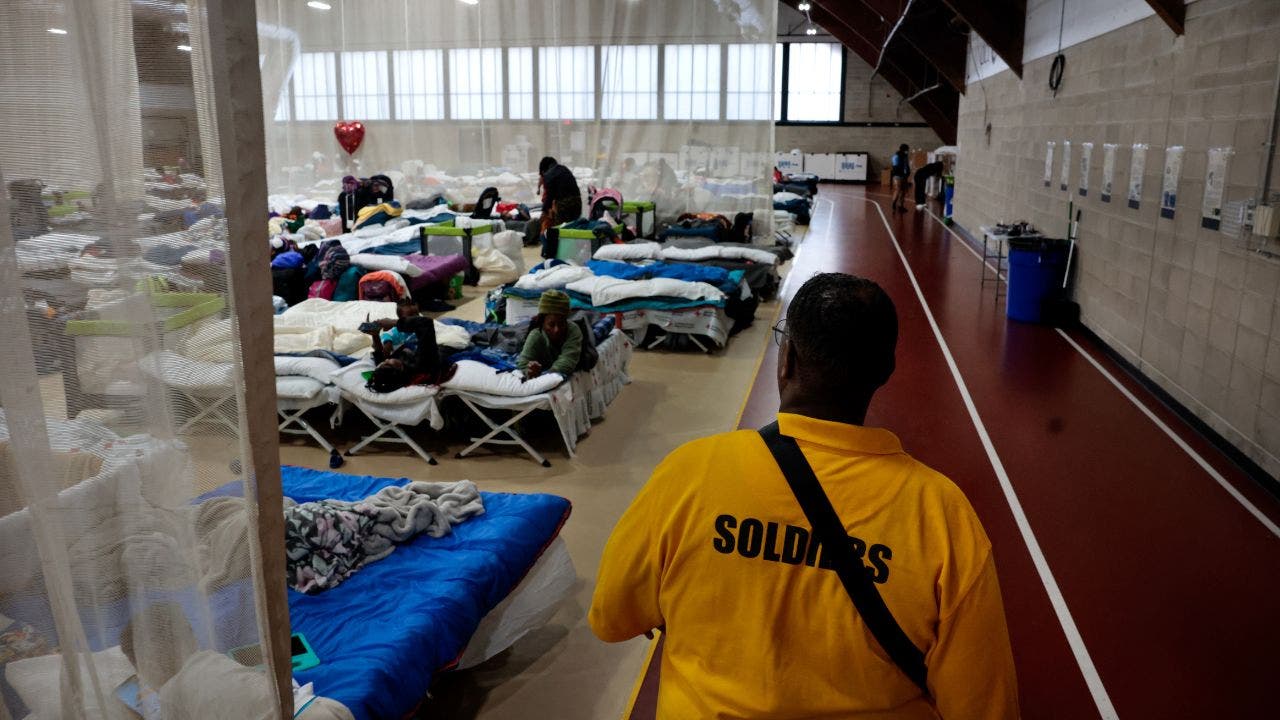
A former migrant shelter director in Massachusetts described the chaos he saw under the state’s right-to-shelter laws, saying that the influx of illegal immigrants has clogged the state’s infrastructure and that there is virtually no vetting for the surge of border crossers.
Massachusetts spent nearly $1.1 billion of taxpayers’ money this fiscal year to house and feed migrants streaming into the state, often in hotels that have been converted to shelters. However, taxpayers have at times found themselves boxed out of shelters as immigrants have crowded the system and taken priority, said Jon Fetherston, who acted as a migrant shelter director at the Marlborough Holiday Inn between November 2023 and July of last year.
Under its right-to-shelter law, established in 1983, the state must provide housing for displaced families and pregnant women. In 2023, the state’s shelters reached their capacity of 7,500 enrolled families – yet migrants continue to use Massachusetts’ programs.
Fetherston previously detailed the repeated violent incidents and mistreatment of children he saw during his tenure – and decried a lack of consequences for their perpetrators.
CHILD RAPE AND VIOLENT INCIDENTS REPORTED AT MASSACHUSETTS MIGRANT SHELTERS, FORMER FACILITY DIRECTOR SAYS
Illegal immigrants line the floors of a terminal at Boston Logan Airport as Massachusetts’ shelters are overrun. (WBZ)
In light of a man from the Dominican Republic, who was accused of possessing an AR-15 and $1 million worth of fentanyl in a state-subsidized room last month in Revere, Fetherston explained the vetting process – or lack thereof – in an interview with Fox News Digital.
Leonardo Andujar Sanchez, 28, was arrested on Dec. 27 after his girlfriend called Revere police to report that he had drugs and a long, black gun hidden under a pink suitcase in their hotel room. The woman told police that she had been living at the Quality Inn for three months and that she and Sanchez had obtained the room through a refugee program.
“I worked in that shelter for a very limited time,” Fetherston told Fox News Digital. “You can’t hide an AR-15 in that room. You cannot hide drugs in that room. The rooms are not big… the case manager there should have been standing up… there should have been red flags… to say ‘Hey, listen, this guy’s not attending those meetings. This guy is blowing off housekeeping.’”
DEM MASSACHUSETTS GOVERNOR NOW WANTS TO LIMIT ILLEGALS IN CRIME-RIDDEN MIGRANT SHELTERS
Meshach Little of Northill Wilkston Security Firm walks the perimeter of the main living area at the state’s emergency overflow shelter for migrants at the Melnea A. Cass Recreational Complex. (Craig F. Walker/The Boston Globe via Getty Images)
Fetherston said that the incident was just another example of a lack of security and vetting at the state’s strained migrant facilities.
The Executive Office of Housing and Livable Communities, which oversees the state’s shelter program, told Fox News Digital that it has security guards at every facility and conducts warrant checks every 30 days. However, Fetherston did not see that activity during his tenure.
“I will tell you that all the shelters that I’ve either worked in and volunteered [at] do have a form of security. But… it’s really basically somebody sitting at the desk – no better than you would have in a corporate office park… it’s certainly not the level of security that you need in these shelters… I never saw anybody come in and do a warrant check.”
Staff at the shelters were primarily chosen because of the languages they spoke rather than any kind of experience, he said.
ILLEGAL IMMIGRANT WITH $1M WORTH OF DRUGS, GUNS GIVEN FREE HOUSING COURTESY OF BLUE STATE TAXPAYERS: OFFICIALS
Boston Mayor Michelle Wu and Massachusetts Gov. Maura Healey, right, visit the Melnea A. Cass Recreational Complex, which was being used to house more than 300 immigrants. (John Tlumacki/The Boston Globe via Getty Images)
“You hire people just because they can speak the language that you need, being either Haitian or, you know, Portuguese or Spanish. So you’re not necessarily hiring a qualified caseworker or mental health advocate or somebody who’s been experienced in navigating these things, because those people don’t exist,” he said.
“A lot of times… the case managers became sympathetic to their fellow countrymen when they taught them how to navigate the system and not always in the most ethical ways. And that’s where the chaos came down.”
Meanwhile, he said, there was “a tremendous amount of domestic violence… a tremendous amount of violence towards children [and] a tremendous amount of violence towards other countrymen.”
Fetherston said residents’ alleged friends and relatives would constantly cycle through the facility where he worked. Despite policies about residents coming through security, staffing was stretched so thin that actually keeping track of who was coming in and out was near impossible.
ICE ARRESTS 3 ILLEGAL IMMIGRANTS IN MASS.: 2 CHARGED WITH CHILD RAPE, 1 CONVICTED OF SAME CRIME IN BRAZIL
Pictured are items allegedly found in Leonardo Andujar Sanchez’s possession when he was arrested at a Revere, Massachusetts, migrant shelter on Dec. 27. (ERO Boston)
“[The Revere arrest] touch[es] the hot point [for me] from day three, maybe, of me being in the shelter,” Fetherston said. “‘Who’s that?… I didn’t check them in. I didn’t see them when they came in. Who were they?… How did this guy get past?’ ‘Well, that’s so-and-so’s uncle.’”
Oftentimes, he said, families would “disappear” – housekeeping would report that a family had not been in their room for three or four days. He would get calls about residents showing up at the facility, and they would never arrive, or a person whose ID did not match at all would show up.
Since a ruling handed down by the Supreme Court in November of last year, after Fetherston left the shelter, shelters are not allowed to ask families for identification or documents when they are applying for its short-term shelter program.
This distinction, he said, makes Democratic Gov. Maura Healey’s recent call to further vet emergency shelter residents to ensure that they are in the U.S. legally, with rare exceptions, impossible.
“I believe these changes are appropriate and needed to ensure the long-term sustainability of the state shelter system in a way that aligns with the original intent of the law,” Healey said in a statement. “In addition, these proposed changes will allow us to continue to ensure the safety of our system, support cities and towns in addressing the needs of unhoused families in their communities and put us on the path toward a more fiscally sustainable shelter system.”
“She can say she will increase vetting, but how do you vet someone who has no ID? She also wants migrants to self-identify if they have committed crimes in the past – that’s not going to happen,” Fetherston said.
DEM GOVERNOR THREATENS TO USE ‘EVERY TOOL’ TO FIGHT BACK AGAINST TRUMP-ERA DEPORTATIONS
Massachusetts Gov. Maura Healey held a press conference announcing significant action related to the state’s emergency shelter system. (Photo by Jonathan Wiggs/The Boston Globe via Getty Images)
“She is saying this now, in an attempt to get [this] out of the news, and then have someone to blame when the reform doesn’t happen,” Fetherston said.
Healey’s office could not be reached for comment at press time.
Fetherston said he has had to turn away American citizens who had fallen on hard times amid the chaos at the state’s migrant shelters.
“I would have veterans walk up to the shelter, [saying] ‘I am a Vietnam veteran, I just need a room for tonight.’ And I would say, ‘I’m sorry. This is for migrants. All the public is not allowed. This is for migrants only,’” he recalled.
“I wasn’t always able to find, you know, a homeless veteran a place on a cold night. But we’ve got migrants,” he continued. “And once again, I don’t blame them living in a shelter where everything’s free for three free meals, free dry cleaning, free Ubers, has a roof over your head, free health care. And I’m sending a decorated veteran out into the cold. At least half a dozen times I had to do that.”
He also said that, although there are technically limitations to how long one can stay in the state’s shelters, they are not always enforced, and spots for citizens in need are not made available.
“You can’t blame the people who stepped up and tried to do their job. You have to blame the system and the person running the system for not putting checks and balances,” Fetherston said. “The governor had no plan and she just wanted to get these shelters open… Nobody specializes in this – Massachusetts is the only state in the entire nation that has the right to shelter. So it’s fair to say, well, they didn’t have qualified people. Well, nobody’s qualified for this because nobody’s ever had to experience this.”
Read the full article from Here


Concert Reviews
Goose at Leader Bank Pavilion, Boston, July 1, 2026.
I discovered the fan spritzing water at 7:07 p.m., as the “feels like” temp hit 102. It stood near a semicircle of coed porta-potties at the back of Boston’s Leader Bank Pavilion, and we gathered round it like wallowing water buffalo at a flooded rice paddy.
Still, despite the temperature, the weather was not the hottest thing in Boston last night. Goose was on fire.
Night 2 of their “Big Modern!” Boston run saw mostly old favorites. All fat funky jams and spectacle, it veered into the frantic — primal guitar and crowd whoops. You could’ve charged for the light-show alone. They made a case for frontman/Berklee alum Rick Mitarotonda as one of the great lead jam guitarists working today.
Now, sometimes the most selfless gift a band can give fans on a new album tour is to not play much off the new album. I’m thinking of how heartbroken my dad was when Neil Young indulgently played 2003’s “Greendale” in full. With costumed actors. Before most fans had the album (if they bought it).
As for Goose, I’m not a big fan of their slick, heavily produced (overproduced?) “Big Modern!,” released last month. The record gives big “I said we’re not a jam band, Mom!” vibes. Whether it’s a new direction, a lark, something to get out of their system, or a Bob Dylan-esque random venture into new territory, a la “Saved,” only time will tell.
But unlike Neil Young, Goose selflessly delivered the hits. They played just one song off the new album — the title track. For the record, they played only one “Big Modern!” song on night 1 in Boston: “Torero.”
Live, the artists’ DNA remains. Those funky, meaty jams, Mitarotonda’s smooth vocals and raw guitar that feels at all times begging to be let off the leash to run wild, howling — until it inevitably does.
Sorry, Goose. You’re a jam band. You cannot fight animal-nature.
When the powers of lead guitarist/vocalist Mitarotonda, multi-instrumentalist Peter Anspach — both natives of Wilton, Conn. — combine with bassist Trevor Weekz and Bedford, Mass. native drummer Cotter Ellis, jams get electric.
When that electricity combines with the Jedi-level mastery of their brilliant lighting production team, including lighting designer Andrew Goedde — it feels otherworldly. By the end of the night, my camera roll looked like a kaleidoscope.

The Connecticut quartet took stage at 7:39 p.m. Anspach, typically the one to address the crowd, walked on stage with: “Alright, Boston let’s do this. Drink your water tonight, man. It’s f—ing hot.”
They launched into a fiery “Iguana Song” with red and green lights which turned to green and blue, then epic white and red strobes as Mitarotonda’s guitar let out primal screams, and Cotter thwacked. The crowd got on their feet and never sat down.
“Iguana” reached two peaks and ended with all of us cattle-lowing “Goooooooooose” in the way that Springsteen’s fans shout “Bruuuuuuuuuuce.” (We’re not booing.)
The smell of weed poured over me by 7:42. Yes, by God, in the age of ubiquitous vapes and pre-packaged candy edibles, a few old-souls brought skunky old-school pot. The smell immediately took me back to childhood days at Great Woods. (Single tear in eye.)
Next: fan favorite “Royal” as a blue balloon was tossed in the crowd. Things slowed down a bit with “It Burns Within,” before launching into “Wisteria Lane” with Anspach playing both guitar and keys simultaneously, and lights shooting like UFO beams before breaking into greens and purples.
The highlight of the night, though, was an incendiary version of “Electric Avenue” — a 1982 Eddy Grant song that’s become a repertoire staple — that had the whole crowd singing, then shouting as Mitarotonda’s lightning-fast fingerpicking became frantic.
Then Ellis took lead vocals on a funky “Draconian Meter Maid,” a Swimmer song Ellis apparently brought to the band when he joined in ’24. It ended in a cacophony of electric sound, warped beats building into a frenzy before slowing to almost a full halt as bands of orange and green light waved like seaweed in water. As it built back up to the frenzy, the crowd lost it, whooping and screaming, dancing in aisles.
Next came a bluegrassy hoedown “Flodown” to end set 1 around 9:06 p.m., with the “feels-like” temp a balmy 93 degrees.
Intermission saw guys sticking heads under outdoor bathroom sink faucets, wiping faces down with paper towels, holding sweating beer cans to foreheads.
Set 2 kicked off at 9:35 p.m. with the only song they’d play off “Big Modern!” all night: the title track. The set started off spacier, adding to a slow trippy feel. It was now fully dark, and the lights popped even more, hazy light beams illuminating mist and smoke in the air.
“Creatures,” had a sway-in-the-aisle feel, ending with some goosebumps-inducing vocals from Mitarotonda, as lights turned aqua blue. “Jive II” was pure funk that proved they’re a jam-beast at heart. Set 2 ended with “Jive Lee,” but they quickly returned for an encore with “Doobie Song,” a pure reggae tune played for the first time in a year, which Anspach said was dedicated to their crew.
The mellow song was a beautiful way to bring everyone down off the mind-melting jams. It reminded me of how the Grateful Dead capped nights with a lullaby, “We Bid You Goodnight” as a chamomile tea for the mind.
They capped with “Give It Time,” under a hushed aqua light, ending around 11 p.m. Mitarotonda sang, “Go ahead, give it hell.”
They did.

After 13 songs in more than three hours, they delivered something for every type of Goose fan in Boston last night — and every type of Goose fan was there.
There were the “Big Modern!” fans— one dude in a bright yellow and pink jumpsuit, to match the album colors. Young couples in Dead & Co shirts, gray-haired dads with polo shirts, khaki shorts and Keens drinking next to classic wooks. A white-haired grandmother-type in a long floral dress swayed next to a pack of teens with glitter on their faces.
I spotted half a dozen Celtics jerseys with “Walton” on the back, an homage to Boston Biggest Deadhead. Grateful Dead-themed Red Sox jerseys — some with Garcia on the backs — peppered the crowd. A man in Lululemon. A young girl with hand-made patchwork overalls. Bearded hippies with decades-old Neil Young tees.
All of us here to happily dance in the 100-degree heat for hours of fiery jams.
Like it or not Goose, you’re a jam band. It’s coiled in your DNA. Your cells ring with it. You can put out as many bubblegum-slick albums as you want. Blood always tells.
Lauren Daley is a freelance culture writer. She can be reached at [email protected]. She tweets @laurendaley1, and Instagrams at @laurendaley1. Read more stories on Facebook here.

Get everything you need to know to start your day, delivered right to your inbox every morning.

“Mayor of Kingstown” has wrapped up filming its fifth and final season in Pittsburgh.
Since the Paramount+ show began filming in western Pennsylvania in 2022, the Pittsburgh Film Office says it has injected over $325 million into the local economy and created over 10,000 jobs. In total, the show has had 457 shoot days in the Pittsburgh area.
“We look forward to seeing your work on the screen and thank you for several years of dedication to the region,” the Pittsburgh Film Office wrote in a Facebook post.
Production of the show’s fifth and final eight-episode season began in March. According to Paramount+, the new season follows what happens when an FBI agent described as a “dedicated lawman” arrives in Kingstown and “threatens to disrupt the tenuous balance of power.”
Jeremy Renner, who stars as Mike McLusky, marked the end of the show in an Instagram post, saying he was “filled with gratitude.”
“I am so very thankful for all of your support over the years—it has given my stride and purpose in my recovery and love in my heart,” Renner wrote. “Thank you cast and crew for carrying me through when necessary.”
Renner broke dozens of bones and underwent multiple surgeries after he was involved in an accident involving a 7-ton snowplow on New Year’s Day in 2023. He has said that returning to the set of “Mayor of Kingstown” for Season 3 helped him cope.
The release date for Season 5 hasn’t been announced yet.

An 85-year-old priest has died after he crashed his car into a tree in West Hartford on Wednesday afternoon, police said.
Police received a report that a car went into the woods near Simsbury Road and Tumblebrook Lane around 2:41 p.m. The West Hartford Police Department responded, along with the West Hartford Fire Department and AMR medical personnel.
The driver, later identified as 85-year-old Terence Kristofak, of West Hartford, was the car’s only occupant. Firefighters extricated him from the car before he was taken to a hospital with serious, life-threatening injuries, police said. He was later pronounced dead at the hospital.
Kristofak served as a Passionist priest at the Holy Family Passionist Retreat Center, according to a Facebook post from the church.
“Father Terry had been visiting family and was on his way home at the time of the accident,” the church wrote. “We are filled with grief at the loss of such a kind, loving, and faithful friend. His presence touched the lives of so many, and his passing is a tremendous loss to our community.”
Simsbury Road was closed in both directions between King Edward Road and North Main Street while crews responded. The road has since reopened.
West Hartford police’s traffic division is investigating the crash.
The scene of the crash.
Anyone with information about the crash is asked to contact the West Hartford Police Department at 860-523-5203 or submit an anonymous tip by calling 860-570-8969 or emailing whpdtips@westhartfordct.gov.


Film Review: “looky loo: PART II” – MediaMikes


US Resumes Dollar Transfers to Iraq, NYT Reports


She Ate High-Protein Ice Cream Daily and Lost 193 Lbs—Her Keys to Success

House Democrats accuse Trump of ‘hijacking’ America’s 250th birthday for his own gain


Tesla driver faces manslaughter charges over Texas crash that killed a woman inside her home


Six Kurdish fighters killed in IRGC ambush as clashes spread across western Iran


Sanctuary county refused 615 ICE transfer requests, turned over just 11 illegal immigrants, records show


Mystery parasite leaves Americans battling ‘explosive’ illness as CDC investigates

