Northeast
Liberty bellwethers: Five Pennsylvania counties to watch on election night

Pennsylvania is once again likely the closest-watched state on election night, as the commonwealth’s 19 electoral votes are poised to swing the election one way or another.
Five counties — Bucks, Northampton, Erie, Centre and Luzerne — out of 67 are likely the ones that will tell the tale of whether former President Donald Trump or Vice President Kamala Harris will win the 2024 presidential election.
BUCKS COUNTY – COUNTY SEAT: DOYLESTOWN
Bucks County made national headlines last week after the RNC and the Trump campaign took legal action against county officials after lines for “on-demand” voting were truncated prior to the stated closing time.
A judge ultimately allowed Bucks voters involved in the process until Friday to cast their early ballots. Bucks is also known as one major county where voters typically split their votes.
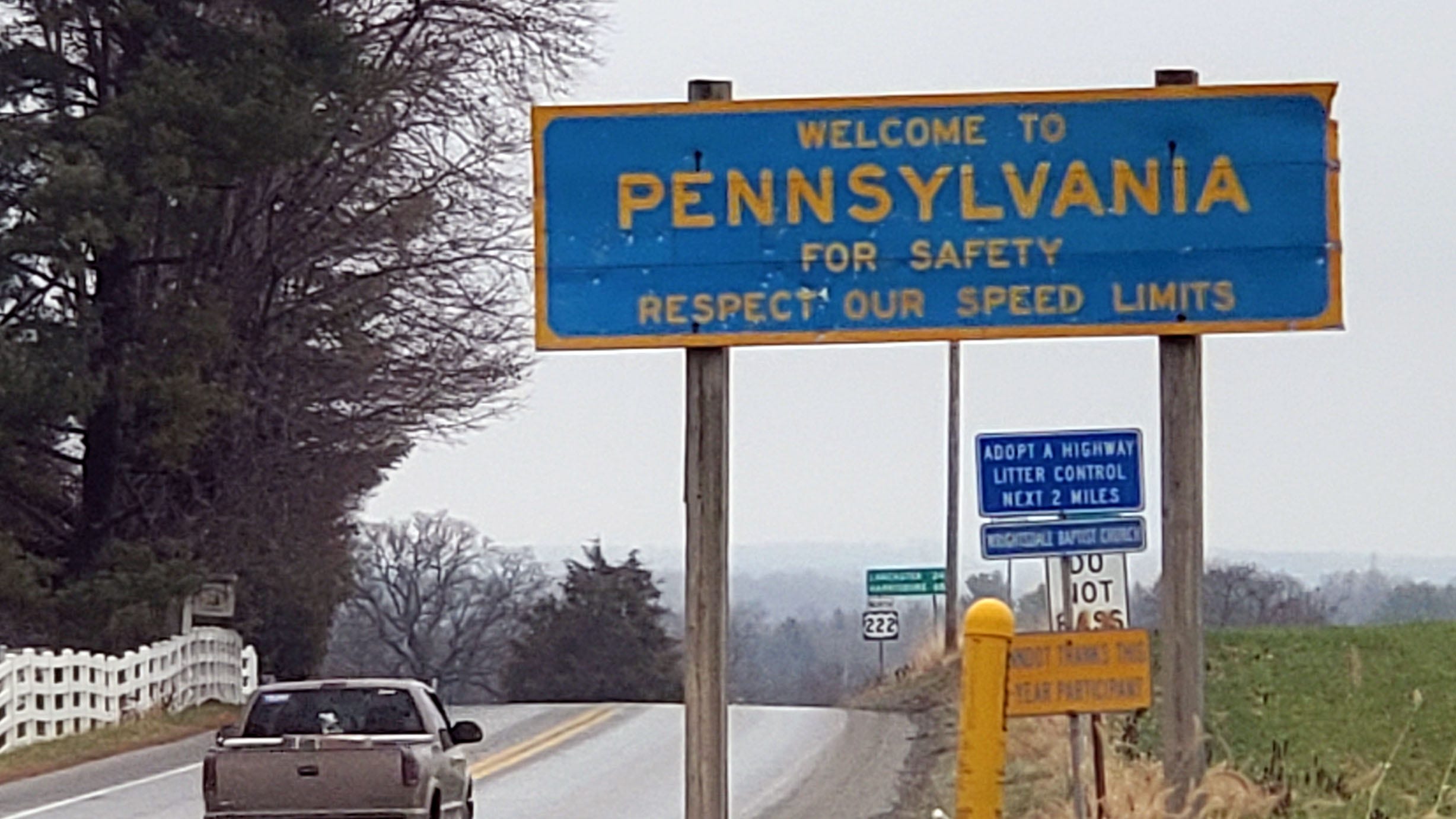
A Pennsylvania welcome sign greets drivers on US-222 entering Peach Bottom, Pa., from Maryland, 2022. (Charlie Creitz)
Rep. Brian Fitzpatrick and his late brother, Rep. Mike Fitzpatrick, both Republicans, enjoyed consistent-but-close wins in the county, while national and gubernatorial results are often a mixed bag. Brian was re-elected in 2020 just as Biden won the county.
The county also flipped to a GOP voter registration advantage this cycle, with the Philadelphia Inquirer reporting the Republicans enjoy just under a 1,000-registrant majority.
While Trump lost all of Philadelphia’s once-Republican collar counties — Delaware, Chester, Montgomery and Bucks — in 2016, only the latter appears in play this cycle.
NORTHAMPTON COUNTY – COUNTY SEAT: EASTON
Bordering Bucks, Lehigh and Northampton counties geopolitically unite to form the key, postindustrial Lehigh Valley region. The congressional seat currently held by Rep. Susan Wild, a Democrat, is always a tight contest.
While Lehigh typically remains in Democrat hands due to Pennsylvania’s third-largest city — Allentown — as its anchor, neighboring Northampton County surprised everyone when Trump took it in 2016.
CRISSCROSSING PA TO REGISTER VOTERS, SCOTT PRESLER SEEKS TO FLIP KEY COUNTIES RED
The Moravian Star shines on South Mountain above the Ofc. Philip J. Fahy Memorial Bridge in Bethlehem, Pa. (Charles Creitz)
Northampton’s Republican Party leader, Andrew Azan III, said in a recent interview he is very optimistic again this year, and said there was recently a “waitlist” for Trump yard signs.
ERIE COUNTY – COUNTY SEAT: ERIE
Far to the west, Erie sticks up into the great lakes like a thumb, and its electorate could put their collective thumb on the scale for either candidate.
Erie GOP chair Tom Eddy recently said that Erie is “unique… in the fact it’s able to pick the winners.” Trump won Erie County and the election in 2016, and Biden won in 2020.
Eddy called the county “Little Pennsylvania” — as it has a bit of every piece of the state within its bounds: an urban area, agricultural lands and industry.
LUZERNE COUNTY – COUNTY SEAT: WILKES-BARRE
Meanwhile, in Luzerne County, anchored by Wilkes-Barre and Hazleton, Republicans recently shocked observers in September by becoming a majority there.
The union-heavy county neighboring Biden’s Lackawanna went for Trump in 2016 and 2020 despite its then-Democratic bent.
“We’d all like to thank the Democrats and the Democratic platform because they’re the ones that really inspired people to leave the party and become Republicans,” Luzerne County GOP 119th District Chairman T.J. Fitzgerald said.
Early Vote Action leader Scott Presler, who has crisscrossed Pennsylvania to register Republican voters, previously said it was a major feat ahead of an expectedly close election.
PENNSYLVANIA LEADERS TALK ‘EXCITING’ GROUND GAME ON BOTH SIDES, AS GOP SEEKS TO UNDO DEM GAINS
A Harris-Walz supporter arrives in Wilkes-Barre in a campaign-logo-emblazoned police-style vehicle. (Charlie Creitz)
When Fox News Digital covered a weekend of Presler’s work in red counties like Lancaster and Dauphin, he also identified Bucks, Luzerne and Centre as those most ripe for Republicans’ picking.
CENTRE COUNTY – COUNTY SEAT: BELLEFONTE
Centre County is the rare blue dot in the middle of northwestern Pennsylvania’s forested expanse. Much of the county reflects the Republicanism of neighboring Clinton, Huntingdon and Blair — but the presence of Penn State University in State College skews it Democratic.
Of the approximately 110,000 voters there, 41.2% are Democrats and 40.3% are Republicans. Prior to the Nittany Lions’ blowout of Kent State in September, however, Presler and volunteers registered tailgaters to vote and encountered students who were fervently pro-Trump.
State Sen. Cris Dush, a Republican who represents Centre and six other neighboring counties, said the prospect of flipping the blue enclave is “actually getting very exciting.”
Dush said one of them — rural Clinton County — was solidly Democratic until the Trump era and recently went “over 3-1 Republican.”
PSU (Gregory Fisher via Getty Images)
Centre may have a shot at the red column this year in part because Gen Z is suddenly battling a rough economy for young hires.
While Pennsylvania industry faces hurdles in regulation and more, Dush commented, the most regrettable outsourcing has been among those young voters.
“The fact that they’re putting such restrictions on the development of businesses in the northern tier and western Pennsylvania: There’s not a state in the United States that doesn’t have a Steelers bar in it, and that’s because working-class kids have become our best export. I want them back,” he said.
Read the full article from Here


“They were truly the unrelenting voices of their time, and made sure that this was something that happened because they knew it was important,” Jess Motyl-Szary, director of Rhode Island Pride, said in an interview on Thursday.
The 1976 pride march came after local Bicentennial Committee organizers “refused meeting space for the group of community members hosting the Congress of People with Gay Concerns,” according to research by Matthew Lawrence and published on the Providence Public Library’s website.
“Calling themselves Toward a Gayer Bicentennial Committee, the group sued the official Bicentennial Committee and won the right to assemble at the Old State House, where about 30 people met in June 1976 to discuss civil rights concerns,” according to Lawrence.
But the contingent also had to fight to join the Bicentennial Parade after they were initially denied the right to do so by officials who pointed to the state’s anti-sodomy law at the time, according to Motyl-Szary.
The 76ers “knew that being a part of an existing parade meant there was a little bit of safety there, because it was an existing infrastructure,” Motyl-Szary said.
“But it also meant that there was a much higher visibility for them to be able to be out there, be proud, and show other people who might not have been out that there is a safe space for them,” Motyl-Szary said.
With the assistance of the American Civil Liberties Union, they won the right to march, she said.
“It wasn’t safe to be out in the ’70s,” Motyl-Szary said. “Incredibly great people marched. Some had to march with paper bags on their heads because there were no legal protections to protect their jobs, their home, their families, but [it was] still incredibly brave to go out there, create visibility, and create this organization.
“Being here 50 years later, and being a part of their legacy has been so incredible,” she said.
A lot has changed for LGBTQIA+ Rhode Islanders in the decades since, Motyl-Szary said.
“But the closeness of it still feels relevant because we’re seeing these continued attacks in our community, and a very real resurgence of attacks on the LGBTQIA+ community, especially our trans brothers, sisters, and siblings,” Motyl-Szary said.

Since returning to office last year, the Trump Administration has taken aim at transgender rights across the country, especially after President Donald Trump signed an executive order recognizing two sexes, male and female. Among other actions, Trump has often sought to tie adherence to the order with federal funding requirements, and the administration has also attempted to gather private medical records from hospitals that provided gender-affirming care to transgender children and teens.
Reflecting on what pride means to her right now, Motyl-Szary said pride festivities are new to at least somebody every year.
“Someone is coming and getting to feel this embrace, this huge hug of their community for the first time every year,” she said. “And in a time like this, when our community is being told that we are hated by the rest of our community, by the rest of our country, when we are told we should hate ourselves, coming out and celebrating ourselves, loving ourselves, loving each other is so incredibly important. Our community creates the space that we need.”
Motyl-Szary said she also believes that “queer joy is resistance.”
“There is a real need for us to have a space and a celebration of who we are and to remind ourselves that we are worthy of love and that we are worthy of being a part of a community that gathers, celebrates, and fights for ourselves and our rights,” she said.
Rhode Island Pride kicks off on Friday night with the “Golden Anniversary Eve” party from 6 to 8 p.m. at the 195 District Park in Providence, Motyl-Szary said.
Festivities continue at the park on Saturday with yoga at 10 a.m. and PrideFest entertainment beginning at 11 a.m., alongside approximately 260 vendors, she said. A rally at 2 p.m. will focus on “what’s happening, get people motivated to be involved in [the] community to speak up and be an activist in whatever way is right for their path of activism,” Motyl-Szary said.
The Illuminated Night Parade steps off at 7:30 p.m. at Washington and Empire streets before moving through downtown Providence, according to organizers.
Christopher Gavin can be reached at christopher.gavin@globe.com.

SHELBURNE — Norman Rockwell lived for a time in suburban New York City and died and was buried in the Berkshires of Massachusetts. But for 14 years in between, the artist spent perhaps the most prolific period of his career in Vermont creating his best-known works.
That’s how Shelburne Museum curator Carolyn Bauer sees it — and how the museum’s latest exhibition treats the artist.
“Norman Rockwell: At Home in Vermont,” which opens June 20 and runs through Oct. 25, displays 40 of the 175 covers Rockwell famously created for The Saturday Evening Post magazine during his time in Vermont between 1939 and 1953.
Also on display are prints of “The Four Freedoms,” maybe his most famed works of all, which represent American ideals spelled out by President Franklin D. Roosevelt in 1941. Paintings in the exhibition include “The Young Lady with the Shiner” and “The Tattoo Artist,” both whimsical, recognizable pieces used as covers for The Saturday Evening Post.
“It’s very accessible work and approachable,” Bauer said.
The display features the three paintings that inspired the exhibition, given to the Shelburne Museum by Rock of Ages, the Barre granite quarry and monument maker. Those Rockwell paintings filled a significant gap in the museum’s art collection, which includes works by Claude Monet, Edgar Degas, Grandma Moses and Andrew Wyeth but, until recently, none by Rockwell, perhaps the best-known artist to have lived here.
“It feels like a homecoming in many regards,” Bauer said.
Moving to southern VT, finding ‘the every American’
The exhibition frames Rockwell’s time in Vermont around the tenor of the times in America. As the Great Depression was ending, World War II was looming and the nation was growing more urban and industrialized, much of the public was yearning for greater simplicity, Bauer said.
Rockwell was among them, leaving New Rochelle north of New York City for the quietude of Arlington in southern Vermont.
He was not alone. Contemporary artists including Mead Schaeffer, John Atherton and Gene Pelham would settle in Arlington too, creating what Bauer termed “the golden illustrator days” in Vermont.
Rockwell’s art, as the 152-page hardcover catalogue accompanying the exhibition notes, shows “how Vermont itself came to embody American ideals in the national imagination.”
Rockwell and his fellow Arlington artists used each other as models in their creations. “They really would work collaboratively,” Bauer said.
Pelham’s daughter, Melinda, is shown in the exhibition in two works: “The Babysitter,” a painting of a girl holding a crying baby that’s on loan from The Fleming Museum at the University of Vermont and an admission submission Rockwell sent to Kellogg’s of a girl clutching a cereal-laden spoon to her mouth.
Doctors, mail deliverers and shopkeepers from Arlington populated his work. Bauer said Rockwell usually gave models $5 and a can of Coca-Cola.
“He was recycling and using just about everybody in town,” Bauer said. That included himself: Rockwell added his own visage to the multiple faces in “The Gossip,” which shows him lashing out at a woman who’s started the rumor-mongering.
Bauer said Rockwell wanted to cultivate a sense of place by using Vermonters known for their austere self-reliance at the forefront of his work. He also found “the every American” ideal in town, Bauer said, though his art reflected a pronounced lack of diversity.
In later work, Rockwell would confront race and segregation as the Civil Rights Movement swept the U.S.
“He was progressive,” Bauer said.
Inspired by paintings donated by Rock of Ages
“Norman Rockwell: At Home in Vermont” was inspired by the 2025 museum acquisition of a trio of Rockwell works that once hung in the Barre offices of Rock of Ages. The granite company contacted the museum asking if it could donate the paintings, Bauer said, prompting staffers to wonder momentarily, “Is this real?”
Rockwell created advertisements for Rock of Ages and gave the paintings upon which the ads were based to the company. “Kneeling Girl” from 1955, making its debut at the Shelburne Museum, takes place in front of a gravestone engraved with the name Newton.
Rock of Ages donated two versions of 1963 work “The Craftsman,” a muted draft and a more luminous final version that were first displayed at the museum last year. They depict Rock of Ages stonecutter George Seivwright working in the shadow of a memorial bearing the name “Norwell,” a portmanteau of Rockwell’s first and last names.
Bauer called the paintings “incredible works of art that were circulated widely” in ads, brochures and pamphlets touting Rock of Ages and its world-famous Vermont granite. Though Rockwell had left Vermont for Massachusetts by the time he created those paintings, they do what Rockwell had done when he lived in Arlington — show the nation and the world what Vermont and Vermonters are capable of.
“We are just eager for our visitors to see these paintings,” Bauer said.
If you go
WHAT: “Norman Rockwell: At Home in Vermont”
WHEN: June 20 through Oct. 25
WHERE: Pizzagalli Center for Art and Education, Shelburne Museum
INFORMATION: $8-$25 museum admission; free under age 5 and for active military and Shelburne Museum members. shelburnemuseum.org
Contact Brent Hallenbeck at bhallenbeck@burlingtonfreepress.com.

“It’s been 53 years. I’ve been waiting that long.” “It’s been a very long time, a long time coming. And I’m so excited that my Knicks finally brought a championship home.” “Let’s go Knicks.” “I had to wake up at six o’clock.” “Knicks in five.” “Let’s go, Knicks.” “Let’s go, Knicks!” “We just moved to D.C. a few years ago, but we’re so happy to be back in New York, celebrating. Once we won we were like — we’re absolutely coming home. So, we had to bring Chester with us. I mean, he’s the biggest puppy Knicks fan there is. Chester, can you say Knicks in 5? Knicks in five.” “I got hurt a couple weeks ago, but this is the first time they’ve been to the finals since I was a year old. And so to be able to be here, this is a once-in-a-lifetime thing.” “My man’s out here with a boot and a Josh Hart jersey. My man’s got heart.” “It feels so overwhelming but overwhelming in a good way, where, like, I want to be — I want to, like, shoot some balls. I want to, like, just vibe with everyone because everyone’s here for one purpose, and that’s celebrating the Knicks.” “This has been like a uniting situation for New Yorkers, and I just can’t wait to feel the love from everybody.” “I think it’s a great equalizer, right? It brings everyone together. It doesn’t matter if you make $900,000 a year, if you make $50,000 a year. You’re united because of the Knicks.” “So often when this city comes together, it is because we are forced to by a moment of tragedy or adversity. What a gift it is to be brought together by pure, unfiltered joy.” “Most importantly, thank you to the fans. I’m not going to lie though, y’all all are some pretty hard critics, but we appreciate it. At least I do, appreciate it a lot.”
-

 Rhode Island4 minutes ago
Rhode Island Pride turns 50 this weekend: ‘Queer joy is resistance’ – The Boston Globe
-
South-Carolina7 minutes ago
87-year-old South Carolina businessman says he has no plans to retire
-

 South Dakota12 minutes ago
South Dakota sends poetry to the America250 time capsule
-

 Tennessee19 minutes ago
Inside Tennessee 4×100 relay’s NCAA title, outlasting four botched exchanges
-

 Texas21 minutes ago
Flu sickens some 160 troops at Lackland Air Force Base in Texas
-

 Utah27 minutes ago
San Juan County assessor resigns after allegations of being ‘unfit’ for office
-

 Vermont34 minutes ago
Norman Rockwell finally gets his day in new Shelburne Museum exhibit
-

 Virginia37 minutes ago
Motorcoach failed to slow for traffic in Virginia work zone before crash that killed 5 from Western Mass., NTSB says – The Boston Globe


