Connect with us

Northeast

HHS' Civil Rights Office finds Maine in violation of Title IX for allowing biological males in women's sports

Published

on

HHS' Civil Rights Office finds Maine in violation of Title IX for allowing biological males in women's sports

The U.S. Department of Health and Human Services (HHS) Office for Civil Rights (OCR) announced on Monday that the Maine Department of Education, the Maine Principals’ Association and Greely High School are all in violation of Title IX. 

The Trump administration expanded its Title IX investigation into Maine last week, citing violations of President Trump’s executive order stating biological males are not allowed to compete in women’s sports in educational and athletic institutions. 

The Maine Principals’ Association, which is the governing body of high school athletics in the state, and Greely High School were both added to the list of Maine institutions HHS was investigating. The OCR also announced last month it was investigating the Maine Department of Education “based on information that Maine intends to defy” Trump’s executive order. 

US President Donald Trump speaks in the Oval Office of the White House in Washington, DC. (Chris Kleponis/CNP/Bloomberg via Getty Images)

Advertisement

Four days after that announcement, HHS issued a “Notice of Violation.”

Now, the OCR’s determination letter to the three entities is offering them an opportunity to “voluntarily commit within 10 days to resolve the matter through a signed agreement or risk referral to the U.S. Department of Justice for appropriate action.”

This comes after the investigation from the OCR found all three entities are obligated to comply with Title IX and violated Title IX. 

HHS EXPANDS TITLE IX PROBE IN MAINE TO INCLUDE STATE ASSOCIATION GOVERNING ATHLETICS, EMBATTLED HIGH SCHOOL

“The Maine Department of Education may not shirk its obligations under Federal law by ceding control of its extracurricular activities, programs, and services to the Maine Principals’ Association,” Anthony Archeval, Acting Director of the OCR at HHS, said in a press release. “We hope the Maine Department of Education, the Maine Principals’ Association, and Greely High School will work with us to come to an agreement that restores fairness in women’s sports.”  

Advertisement

Trump’s Executive Order 14201, better known as “Keeping Men out of Women’s Sports,” was signed to “protect female student athletes, in the women’s category, from having to ‘compete with or against or having to appear unclothed before males.’” In turn, the executive order also mandated each federal department to “review grants to education programs and, where appropriate, rescind funding to programs that fail to comply with the policy established in this order.”

That’s exactly what happened in Maine, as the state’s Department of Education received nearly $1 million from HHS sub-agencies alone, which Maine House Republicans said in a press release this past week.

Maine State Rep. Laurel Libby is sounding the alarm over the state’s defiance of President Donald Trump’s Executive Order demanding an end to biological males competing in women’s sports. (Getty/Maine House of Representatives)

Republican legislators in Maine called on Gov. Janet Mills, a Democrat, to comply with Trump’s executive order with millions in federal funding for K-12 schools being threatened as a result of not doing so. 

“If Maine Democrats continue to double down on allowing biological males to participate in girls’ sports, our students stand to lose hundreds of millions of dollars of federal funding. Gov. [Janet] Mills and legislative Democrats have a renewed opportunity to do the right thing, to ensure restored funding and a fair and level playing field for Maine girls,” state Rep. Laurel Libby, R–Auburn, said this past Thursday. 

Advertisement

Libby became a prominent figure in this Maine debate after posting a Greely High School pole vaulter on social media. The pole vaulter competed as recently as June 2024 as a biological male, and ended up winning a state championship as a woman. 

Democrats in the Maine state legislature censured Libby for the post, which showed the athlete competing as a male, while next to an image of the athlete winning the women’s pole-vaulting competition in the Maine Class B indoor championship in February. 

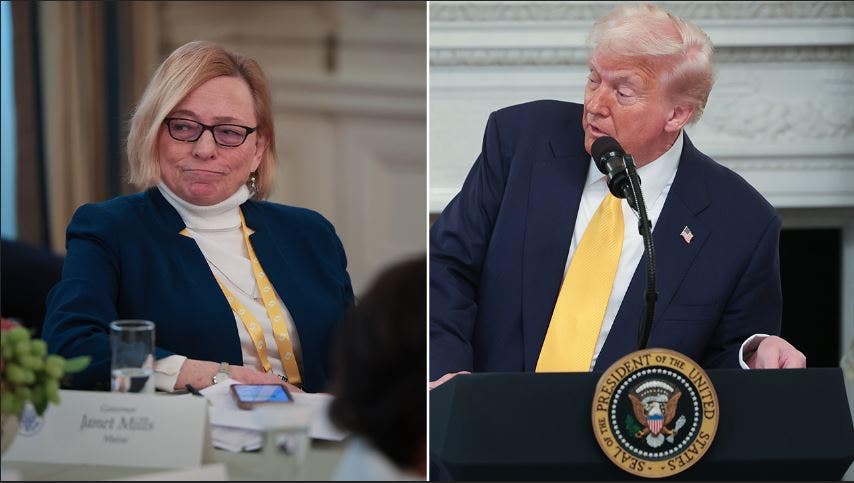
Trump called out Maine shortly after Libby’s post began to stir up debate. Trump had a public argument with Gov. Mills at the White House, where he threatened state funding if Maine didn’t “clean that up.” Mills replied that she would see Trump “in court.”

Maine Gov. Janet Mills and President Donald Trump at the White House on Friday. (Getty Images)

Advertisement

Mills, in congruence with the Maine Principals’ Association, argues that Trump’s executive order conflicts with Maine’s current Human Rights law. As a result, following the executive order would defy state law, which currently allows athletic participation based on the person’s stated gender identity.

“No President – Republican or Democrat – can withhold federal funding authorized and appropriated by Congress and paid for by Maine taxpayers in an attempt to coerce someone into compliance with his will,” Mills said in a statement when the HHS initially announced its investigation. “It is a violation of our Constitution and of our laws, which I took an oath to uphold.”

Fox News’ Alec Schemmel contributed to this report.

Follow Fox News Digital’s sports coverage on X, and subscribe to the Fox News Sports Huddle newsletter.

Advertisement


Read the full article from Here

Continue Reading
Click to comment

Leave a Reply

Your email address will not be published. Required fields are marked *

This site uses Akismet to reduce spam. Learn how your comment data is processed.

Pittsburg, PA

Highbrow vs. lowbrow: Pittsburgh Opera fronts fat jokes in season-ending comedy, ‘Falstaff’

Published

on

Highbrow vs. lowbrow: Pittsburgh Opera fronts fat jokes in season-ending comedy, ‘Falstaff’


Source link

Continue Reading

Connecticut

Looney announces he will not seek reelection; names his chosen successors

Published

on

Looney announces he will not seek reelection; names his chosen successors


HARTFORD, Conn. (WTNH) — State Sen. Martin Looney, the longest serving Senate president in Connecticut’s history, announced Saturday that he will not seek reelection to another term in office.

“Serving the people of Connecticut in the General Assembly for 46 years has been the great privilege of my public life,” Looney said in a statement.

Looney announced his decision to a private meeting of the Senate’s Democratic office on Saturday afternoon, shortly before the chamber convened for a rare weekend session to approve adjustments to the state budget. 

Raised in New Haven to parents who immigrated from Ireland, Looney has served in the legislature since 1981. He held a seat in the state House for 12 years before being elected to the Senate in 1992. In 2003, his colleagues elected him majority leader and then Senate president pro tempore a dozen years later. 

Advertisement

Technically, the role of President pro tempore is to preside over the State Senate in the absence of the lieutenant governor. Practically, the role is the Senate’s prime leadership position and one of the most powerful public offices in the state. The Senate president wields immense influence over which bills are put up for votes, which senators receive desirable committee postings and which policies are prioritized by the caucus in each year’s legislative session.

From his perch atop the upper chamber, Looney has consistently preached and advanced an agenda firmly aligned with his party’s progressive wing. 

“I was raised by New Deal Democratic immigrant parents and believe to my core that enlightened public policy can deliver positive transformation when government takes its obligations seriously,” Looney said.

In his years as the Senate’s top leader, Looney shepherded the passage of Connecticut’s $15 minimum wage law, helped establish paid family and medical leave, fought for tax relief for the working poor and negotiated a landmark budget framework that has defined the last decade of legislative debate over state spending. 

The long arc of Looney’s career as a state lawmaker spans across the administrations of six governors: O’Neill, Weicker, Rowland, Rell, Malloy and Lamont. Throughout that time, he has variously played the role of ally, leader among the opposition and intraparty counterweight – always working to nudge Democrats in a more progressive direction.

Advertisement

His reputation as a labor-aligned man of the left made him at times the subject of Republican scorn, but those political disagreements were always accompanied by deep respect on the other side of the aisle. 

“Marty Looney is one of the finest public servants I have ever met,” John McKinney, a retired state senator who led the Republican minority opposite Looney for eight years, said. “Marty never made it about himself. He wasn’t flashy or bombastic. He was always about policy and trying to make life better for his constituents and the people of Connecticut. When Marty rose to speak, you listened. Marty also cared deeply about the institution and protected it at every opportunity. And when it came to using the levers of power, whether as a Committee Chairman, Majority Leader or Senate President, no one did it better.”

Gov. Ned Lamont, a moderate Democrat who has occasionally found himself at odds with the more progressive Looney, echoed that sentiment.

“I am grateful for the service of Marty Looney, who has been a steady, principled voice in the Connecticut General Assembly for working families and the kind of patient, serious legislating that produces lasting results,” Lamont said.

The governor also noted another one of Looney’s most endearing qualities: a near encyclopedic knowledge of history.

Advertisement

“Marty and I would sit down to work through policy and inevitably find ourselves deep in a discussion about American history,” Lamont said. “We shared a particular appreciation for Calvin Coolidge, or ‘Silent Cal’ – a man who understood that not every moment required a speech.”

Looney’s impact on state politics extends far beyond the ornate halls of the Senate chamber. In New Haven, he has been a defining force in city politics, sitting near the center of a multigenerational tapestry of political alliances often rooted in family and lifelong relationships. Looney allies and friends dot the Elm City’s political landscape.

Vincent Mauro Jr., a longtime Looney aide and confidant, serves as chair of New Haven’s Democratic Town Committee. Dominic Balletto Jr., another Looney ally, served as state Democratic Party chairman. State Rep. Alphonse Paolillo Jr., a contemporary and longtime friend of Mauro’s, served on the Board of Alders before heading to Hartford.

Paolillo has Looney’s support to succeed him in the Senate. State Sen. Bob Duff, the current majority leader and second-in-command Democrat, has Looney’s support to be the next Senate president.

Looney’s announcement was accompanied by a reassurance that commemorations of his service would not slow down the final few days of the legislative session. Lawmakers will conclude their business on Wednesday at the strike of midnight. The speeches and ovations that typically accompany the retirement of a longtime legislator will be postponed until the end of the month, after the session is over. 

Advertisement

Stay with News 8 for updates.


Source link

Continue Reading

Maine

Maine fishermen’s bodies are breaking down. Where’s the help? | Opinion

Published

on

Maine fishermen’s bodies are breaking down. Where’s the help? | Opinion


Chris Payne of Cumberland is a graduate student at the University of New England.

Commercial fishing in Maine is breaking the people who sustain it.

Four out of five fishermen report overuse injuries — torn shoulders, damaged knees, chronic back pain — from work that hasn’t fundamentally changed in generations. Most don’t retire from the job. Their bodies give out first.

We know how to reduce that damage. What’s missing is consistent federal support. This isn’t an abstract policy debate — it’s being decided right now in the federal budget process.

Advertisement

Maine already has organizations doing the work. Groups like the Maine Coast Fishermen’s Association and Fishing Partnership Support Services provide injury prevention training, early access to physical therapy and practical equipment changes that reduce strain before injuries become permanent. They also address mental health and addiction — a critical need in a profession where chronic pain often leads to self-medication.

These programs are not theoretical. They are working. But they operate in a funding gap that federal policy has long promised to close and repeatedly failed to.

The urgency is growing. The administration’s proposed fiscal year 2026 budget would eliminate Maine Sea Grant and cut the National Oceanic and Atmospheric Administration by roughly one-third. That comes just months after the administration abruptly terminated Maine’s Sea Grant program in January 2025 — later partially reversed after intense pushback — following a political dispute that had nothing to do with fisheries, safety or workforce development.

Programs like Sea Grant do more than fund research. They support the training, safety systems and local partnerships that keep fishermen on the water longer and in better health. In 2023, Maine Sea Grant generated roughly $15 in economic activity for every federal dollar invested. Eliminating it is not cost savings. It is economic contraction.

Congress already has tools to address this. The FISH Wellness Act would expand existing fishing safety grants, add behavioral health support and remove cost-match requirements that currently exclude many small operators. These are practical, bipartisan solutions built on programs that already exist.

Advertisement

What they lack is stable funding and sustained attention.

That instability has real consequences. Without consistent investment in training and safety, fishermen enter one of the most physically demanding jobs in America without the support systems common in other industries. Injuries accumulate. Careers shorten. Knowledge leaves the water faster than it can be replaced.

This is not a niche issue. Commercial fishing is a cornerstone of Maine’s coastal economy and identity. The people doing that work are not asking for special treatment. They are asking for the same basic infrastructure other industries expect as standard: training, health support and a viable path into the profession that does not depend on physical sacrifice.

Maine’s congressional delegation has shown it can fight when funding is threatened. It helped restore Sea Grant once. But reacting after the fact is not enough.

In the months ahead, Congress will decide whether programs like Sea Grant survive and whether legislation like the FISH Wellness Act moves forward. Those decisions will determine whether fishermen get the training, health support and safety infrastructure that other industries expect as standard — or continue working until their bodies give out.

Advertisement

That makes this a test of priorities. Will Maine’s delegation push for sustained funding for fishing safety and workforce development before more cuts take hold? And will candidates seeking to represent Maine commit to making that funding permanent, not discretionary?

Fishing communities cannot rebuild their workforce or protect their health one budget fight at a time. If Maine wants a future on the water, Congress needs to fund it — deliberately and as policy.


Source link

Advertisement
Continue Reading
Advertisement

Trending