News
With her signature stiff arm and red lip, Ilona Maher rules Olympic rugby and TikTok


Ilona Maher celebrates the U.S. women’s rugby sevens win over Australia for the bronze medal in Paris on Tuesday.
Cameron Spencer/Getty Images
hide caption
toggle caption
Cameron Spencer/Getty Images
NPR is in Paris for the 2024 Summer Olympics. For more of our coverage from the games head to our latest updates.
Ilona Maher is hard to miss.
The U.S. women’s rugby sevens center has emerged as one of the stars of this year’s Olympic Games, whether she’s charging down the pitch in red lipstick or goofing around on TikTok with her teammates.
Maher helped Team USA win its first-ever medal in women’s rugby on Tuesday, defeating Australia in nail-biting fashion. Afterward, she spoke emotionally about the importance of growing the sport.
“We wanted to do this to show what rugby could be in America,” Maher said. “We say in rugby a lot that we want to ‘pass the jersey.’ … I think today really made the jersey better so that other young girls can grow up wanting to play rugby, wanting to be professionals, wanting to live the life we live where we travel the world and go to the Olympics.”
The 27-year-old Vermont native has been an athlete to watch — both on and off the playing field — since the 2021 Tokyo Olympics, when she charmed the world with her honest review of the controversial cardboard beds, blunt takes on the Olympic Village social scene and other behind-the-scenes looks at the highly-restricted pandemic-era Games.

Maher’s social media star has only grown in the years since. She’s used the platform to bring attention to women’s rugby and spread messages of body positivity, including popularizing the hashtag #beastbeautybrains (her sister Olivia, by the way, is the creator of #girldinner).
Just days into the Paris Olympics, Maher officially became the most-followed rugby player on Instagram with 1.4 million followers, a number that’s since grown to 2 million. She has 1.9 million and counting on TikTok.
So far, Maher has fangirled over Snoop Dogg, converted retired NFL player Jason Kelce into a U.S. women’s rugby hype man (a la Flavor Flav), tested the beds again and posted about looking for love at the Olympic Villa in a spoof of the reality show Love Island.
She’s also clapped back at negative comments about her weight and muscular stature (“every day I get called masculine, I get called manly” she said in one 2022 TikTok).
In a now-viral video response posted earlier this month, 5-foot, 10-inch Maher, who holds a degree in nursing, pointed out that BMI is a flawed measurement, especially for athletes.
“I do have a BMI of 30. I am considered overweight,” she concluded. “But alas. I’m going to the Olympics, and you’re not.”
In another much-liked TikTok, posted from Paris, Maher encouraged people to take note of all the different body types of the athletes competing in the Olympics.
“All body types are worthy, from the smallest gymnast to the tallest volleyball player or rugby player to a shotputter and a sprinter,” she said. “All body types are beautiful and can do amazing things, so truly see yourself in these athletes and know that you can do it too.”
Maher’s videos have racked up hundreds of thousands of likes and admiring comments from grateful viewers who credit her with getting them interested in the Olympics and women’s rugby.
After Tuesday’s win, Maher acknowledged that social media does come with added pressure to perform, something she said she talked about with her sports psychologist “at least every day” leading up to the Olympics.
“I want to show people that I can be good at social media and I can do a lot of social media but also be a very good rugby player,” she said. “And that was important to me.”
The rise of Ilona Maher

Ilona Maher, pictured in an April 2024 portrait, has dominated the Paris Olympics on the pitch and on social media.
Mike Coppola/Getty Images North America
hide caption
toggle caption
Mike Coppola/Getty Images North America
Maher was an all-around athlete at Burlington High School, where she played hockey, basketball and softball. While her dad was a college rugby player, she didn’t check out the sport until age 17.
“My senior year I just wasn’t really that into softball anymore, so I looked at some things and saw that there was a local rugby team at South Burlington High School,” Maher told Vermont Public in 2018. “My dad’s played rugby for a while … and so I tried rugby and found I was pretty good at it, and it just kind of started to roll from there.”
Maher played rugby at Norwich University for a year before being recruited to Quinnipiac University. There, she won three championships in the National Intercollegiate Rugby Association (NIRA) and was named to NIRA’s All-American team all three years.
In 2017, she received the MA Sorensen Award, which is given to the nation’s top collegiate women’s rugby player.

Maher, who also holds a master’s degree in business administration and management from DeVry University, was selected for the U.S. national rugby team before she graduated from college.
She made her debut at a Women’s SVNS tournament in Paris in 2018 and has competed in the Rugby World Cups in 2018 and 2022 — as well as, of course, two Olympics. Rugby sevens, which made its Olympic debut in 2016, is made up of seven players playing two seven-minute halves, as opposed to 15 players playing 40-minute halves.
Maher has turned heads for her aggressive playing style, including her high-speed runs and stiff arm. She’s recently been compared to Baltimore Ravens running back Derrick Henry, who in turn shouted her out.
One thing that makes Maher even more distinct on the pitch is her signature red lip. She told “CBS Mornings” this week that she wears lipstick while playing to “stick it to the man.”
“It doesn’t take away from your athletic ability if you wear makeup,” Maher said, adding, “I feel that I can be a beast and can play this very physical, aggressive sport while also keeping my femininity while I do it.”
The rise of U.S. women’s rugby
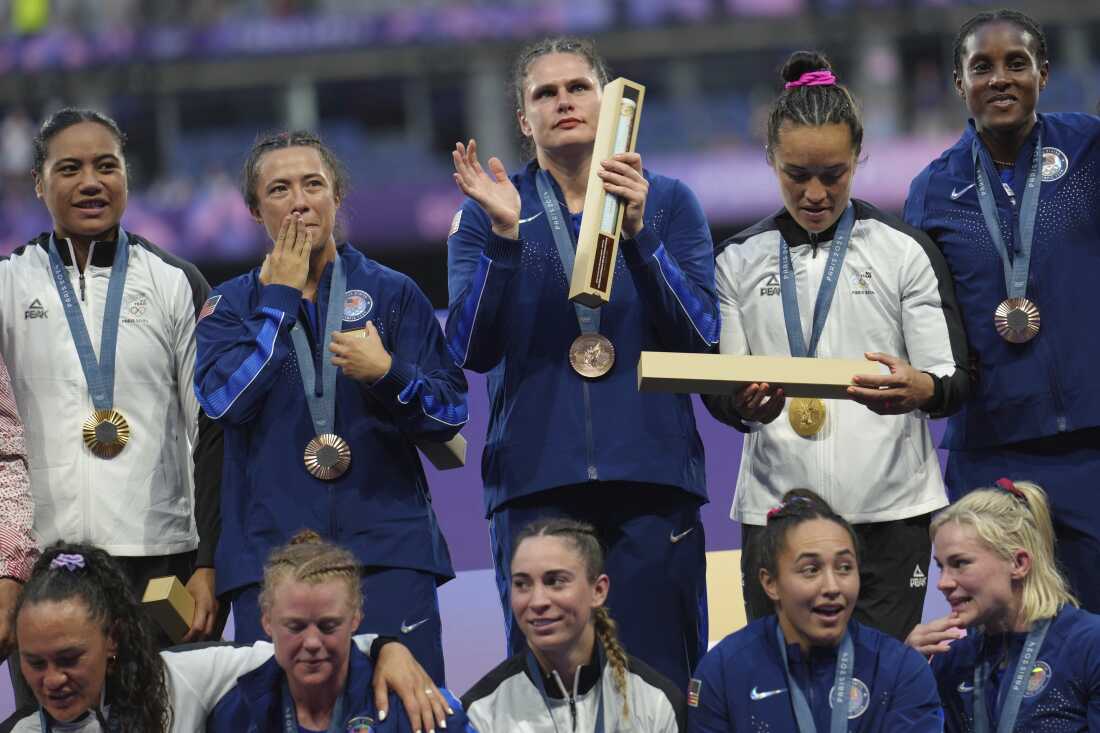
Team members for the United States — including Maher in the center of the top row — and New Zealand pose at the medal presentation ceremony for the Rugby Sevens in Saint-Denis, France on Tuesday.
Tsvangirayi Mukwazhi/AP
hide caption
toggle caption
Tsvangirayi Mukwazhi/AP
Maher has spoken about using TikTok to have fun and promote her sport — both to potential viewers and future players.
“I think it just doesn’t get the attention it deserves,” she told Vermont Public in 2021, adding that she and her team are working to get more girls interested in rugby.
“Because we have some of the best athletes in the U.S.,” Maher added. “And if we could get people really into rugby, I think we could be a powerhouse in the world.”
Women’s rugby has grown increasingly popular worldwide and in the U.S., with the consultancy Elite Rugby Scholars saying in 2022 that participation levels had doubled “each year for the past five years.”

The USA Rugby Women’s Premier League, founded in 2009, is the top annual American women’s rugby union competition (as opposed to rugby sevens, which is what Maher plays) — but the players are not paid.
The sport took its first step towards professionalism in April of this year when Women’s Elite Rugby (WER) announced it would hold its inaugural season in 2025.
WER is planning between six and eight teams with roughly 30 players each and bankrolled by private investment, according to ESPN. On Wednesday, it announced its first three cities: Boston, Chicago and Denver.
And American women’s rugby dominance at the Olympics seems poised to draw even more support — financial and otherwise — for the sport at home.
Just after Team USA’s win on Tuesday, American businesswoman Michele Kang — who owns the Washington Spirit as well as soccer clubs in France and England — announced she would donate $4 million to the U.S. Women’s Rugby Sevens team over the next four years, to help “grow the support and provide improved resources to its players and coaching staff” ahead of the 2028 summer Olympics.
In a statement, Kang described 2024 as a “banner year for women’s sports with record-breaking attendance and viewership,” including rugby. She highlighted a few key players, Maher among them.
“This Eagles team, led by players like Ilona Maher and co-captains Lauren Doyle and Naya Tapper, has captivated millions of new fans, bringing unprecedented attention to the sport,” she wrote. “As corporate sponsors and broadcast networks increasingly see the value and enthusiasm for women’s sports, now is the moment to unlock the full potential of these incredible female athletes and inspire generations to come.”
NPR’s Juana Summers contributed reporting from Paris.

News
Trump says proof of his allegations that vandals cut Reflecting Pool paint will be provided in court

Washington — President Trump on Monday said proof will be provided in court of his allegations that vandals “cut” a massive slit in the Lincoln Memorial Reflecting Pool, which he claims is the reason the paint is peeling on the recently renovated but algae-plagued project.
In an exchange with CBS News senior White House correspondent Ed O’Keefe, Mr. Trump insisted that vandals, rather than questionable craftsmanship, are responsible for the enduring problems following the $14.7 million sealant job. The president claimed vandals cut a 350-foot slit in the pool between the World War II Memorial and the Lincoln Memorial. Five people have been arrested for vandalism related to the Reflecting Pool, and five additional individuals were issued federal citations, according to the U.S. Park Police, although neither the company behind the project nor the U.S. Park Service has said a cut slit was responsible for the peeling.
Asked if he had proof, such as photos or video, that vandals used a knife to cut a massive slit in the pool, Mr. Trump responded: “Well, let’s put it this way, when you have a 350, I think it’s 350, not 250, when you have a 350-foot slit, from one end to the other, you think that’s proof? You think that’s proof?”
O’Keefe noted that reporters had been to the site and found no evidence of a slit.
“Well, you’d have to go see the Parks Department. They’ll show it to you, or see, see the secretary, but I saw it,” Mr. Trump said, likely referencing Interior Secretary Doug Burgum. “They cut it, they cut it very violently. The same thing with the floor, they cut it, and then they lifted it. They pulled it, and that’s what it is.”
After defending the project, the president said, “We also have pictures.”
O’Keefe asked the president for evidence of his claims.
“Yeah, at the right time you’ll see it,” Mr. Trump said. “You’ll see it in court. You’ll see it in court, but all you have to do is call the Parks Department, call the Department of Interior.”
The president also suggested someone may have placed fertilizer in the water to create the algae that teams have been attempting to clear.
“If you put fertilizer in the water, you get algae, but somebody said they might have put fertilizer, they did something to create the algae,” the president said, again without providing evidence for his claims.
CBS News has reached out to the National Park Service and the Department of the Interior. So far, there’s been no response.
Atlantic Industrial Coatings, which received a no-bid contract to install the sealant on the floor of the Reflecting Pool, told CBS News there are “some areas” that “require repairs.”
“These areas are a very small part of the massive 7-acre project, and do not indicate a failure of the liner,” the company said. “These repairs can not be made until the pool is drained. As soon as it’s feasible for the park, the pool will be drained and AIC will be back to make those needed repairs as part of the warranty.”

new video loaded: The Rise of Deadly Trucks and S.U.V.s
By Michael H. Keller, Danielle Ivory, Irineo Cabreros, Eli Murray, Gabriel Blanco and Joey Sendaydiego
June 22, 2026

Demonstrators hold a sign saying “PROTECT MINORITY VOTING RIGHTS” outside the U.S. Supreme Court in Washington, D.C., in 2025.
Jemal Countess/Getty Images for Legal Defense Fund
hide caption
toggle caption
Jemal Countess/Getty Images for Legal Defense Fund
By declining to take up a lower court ruling, the U.S. Supreme Court has dealt another blow to the Voting Rights Act.
The court announced Monday that it will not review an Arkansas-based lawsuit, leaving in place a 2025 appeals panel ruling that ends a long-used tool for protecting minority voters from discrimination under the landmark law in seven mainly Midwestern states.
That ruling found that in the states covered by the 8th U.S. Circuit Court of Appeals — Arkansas, Iowa, Minnesota, Missouri, Nebraska, North Dakota and South Dakota — private individuals and groups do not have the right to sue to enforce what’s known as Section 208 of the Voting Rights Act, which generally allows voters with a disability or inability to read or write to get help with voting from a person of their choice.
The Supreme Court’s move comes almost two months after its conservative supermajority issued a major ruling that further weakened the Voting Rights Act, setting off a groundswell in redistricting across the country.


In May, shortly after that undermining of Section 2 protections against racial discrimination in redistricting, the high court decided not to weigh in on what the legal world calls a “private right of action,” sending back to lower courts two cases brought by Black voters in Mississippi and Native American voters in North Dakota.
For decades, enforcement of these sections of the Voting Rights Act has mainly been driven by lawsuits by private individuals and groups.
But after conservative Justice Neil Gorsuch issued a single-paragraph opinion in 2021 questioning a private right of action, Republican officials in multiple states have raised a novel legal argument: Only the U.S. attorney general, they contend, has the right to bring lawsuits under these parts of the Voting Rights Act.
Such an interpretation of the law is likely to lead to a dramatic decline in voting rights lawsuits because of the Justice Department’s limited resources and shifting priorities under different presidential administrations.

The case that the justices decided not to take up was brought by the immigrant advocacy group Arkansas United, which has provided Spanish-language interpreters at polling sites to assist voters with limited English proficiency. The group challenged an Arkansas law that bans a person who is not a poll worker from helping more than six voters cast ballots. In 2022, a federal judge ruled that the state law violates Section 208 of the Voting Rights Act. But after GOP state officials appealed, an 8th Circuit panel found last year that private groups, like Arkansas United, do not have the right to bring this kind of lawsuit.
So far, the 8th Circuit — which also found that there is no private right of action under Section 2 — is the only federal appeals court to break with decades of precedent on this legal issue.
Edited by Benjamin Swasey
-
 Milwaukee, WI4 minutes ago
Milwaukee residents react to Giannis Antetokounmpo’s legacy before trade goes through
-

 Atlanta, GA11 minutes ago
Summerhill residents oppose plan to move Atlanta Olympic cauldron, citing community history and legacy
-

 Minneapolis, MN14 minutes ago
3 injured in north Minneapolis shooting, no arrests made
-

 Indianapolis, IN19 minutes ago
Dry Tuesday before rain and storms return | June 23, 2026
-

 Pittsburg, PA26 minutes ago
Pittsburgh among best U.S. cities in 2026 rankings. Here’s why
-

 Augusta, GA29 minutes ago
Former pho restaurant to become Evans medical cannabis dispensary
-

 Washington, D.C34 minutes ago
Now streaming: ’51st State’ documentary on a young activist’s fight for DC statehood – WTOP News
-

 Cleveland, OH41 minutes ago
Cleveland man dies after fatal shooting at gas station

