Midwest
Tim Walz has ties to Muslim cleric with antisemitic views, gave state funding to his group: report

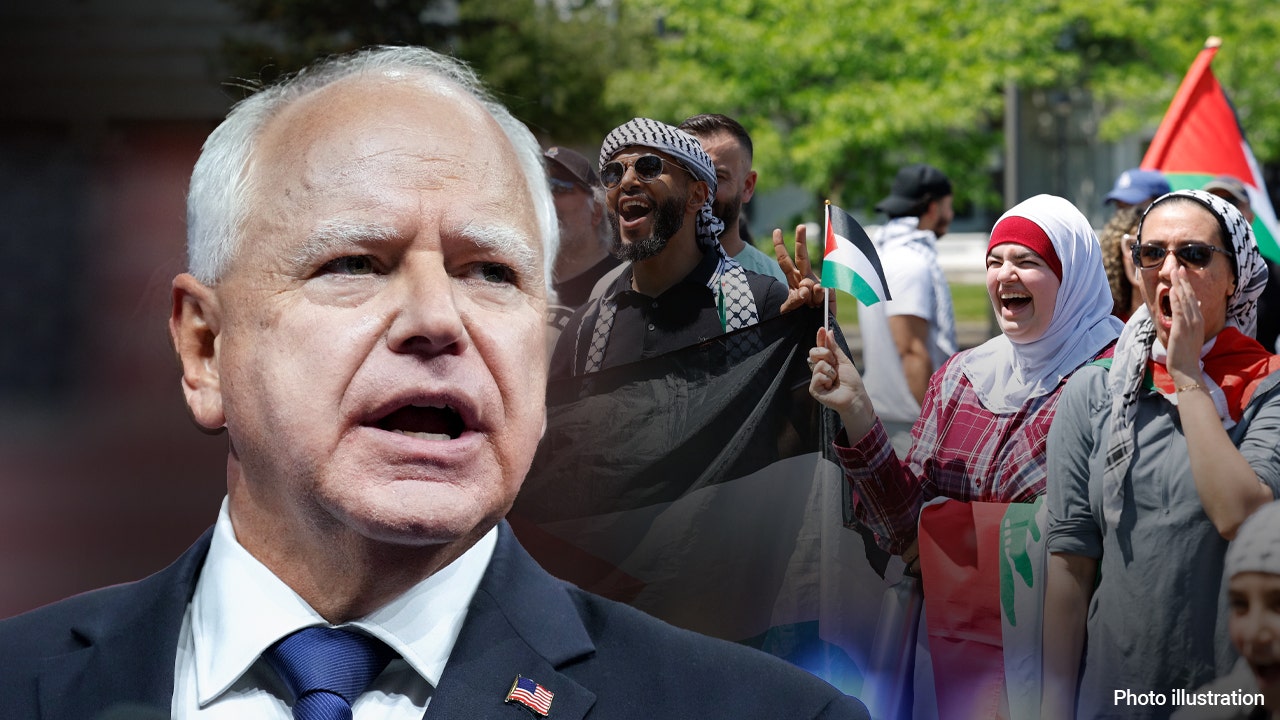
Minnesota Gov. Tim Walz has reported ties to a Muslim cleric who praised Adolf Hitler online and commended the Islamic terrorist group Hamas for the attacks against innocent Israelis on Oct. 7.
In the last few years, Imam Asad Zaman has used his Facebook page to share official Hamas press releases, blog posts from antisemitic sites and a 2015 link to a pro-Hitler film, “The Greatest Story Never Told.” Released in 2013, the propaganda film is antisemitic and popular among fringe groups, according to the Anti-Defamation League.
Walz’s administration has also donated over $100,000 to Zaman’s group, Muslim American Society of Minnesota, according to state records reviewed by the Washington Examiner. Federal prosecutors have described the Muslim American Society as “founded as the overt arm of the Muslim Brotherhood in the U.S.,” according to court records, the outlet first reported.
ISRAEL ISSUES MESSAGE TO LEBANESE CITIZENS AMID REPORTS OF POTENTIAL PREEMPTIVE STRIKE ON HEZBOLLAH
Minnesota Gov. Tim Walz speaks during a campaign event in Detroit on Wednesday. Vice President Kamala Harris and her newly selected running mate are campaigning across the country this week. (Andrew Harnik/Getty Images)
Designated a terrorist group by the United Arab Emirates in 2014, the Muslim group faced criticism in 2019 when a video emerged of children at a Philadelphia chapter event calling for Jews to be killed.
In reaction to Rep. Katie Porter, D-Calif., condemning the Oct. 7 attack a day later, Zaman asked if she would “reaffirm the right of Palestinians to defend themselves.” Zaman’s Muslim group in a statement on Oct. 7 declared it “reaffirms its unwavering support for the Palestinian people in their struggle against the Israeli occupation.”
In May 2023, Zaman attended a mosque security meeting with Walz’s gubernatorial office.
EXPECT IRAN’S RESPONSE TO EXTEND BEYOND THE MIDDLE EAST: ROBERT GREENWAY
Social media posts reviewed by the Examiner also indicate Zaman participated in a Ramadan event hosted by Walz in May 2019. A recent Washington Free Beacon report also reported Walz’s appearance at a 2019 event with an antisemitic scholar who supports terrorism against Israel.
VANCE FIRES BACK AT ‘DISGUSTING’ CNN ANCHOR SUGGESTING HIS MILITARY SERVICE WAS EMBELLISHED AMID WALZ DISPUTE
Minnesota Gov. Tim Walz waited several days to call in the National Guard as riots destroyed Minneapolis in 2020. (Getty Images)
Zaman, originally from Bangladesh, expressed solidarity with Palestinians for the Hamas-initiated Oct. 7 terrorist attacks on Israelis. He also shared a Palestinian flag image on Facebook in support of a post criticizing the Biden-Harris administration for its stance on Israel.
The imam reportedly participated in a May 2020 event with Walz to advocate for peaceful protests during the Black Lives Matter riots in Minnesota following George Floyd’s death. Previously, in April 2019, Zaman delivered an invocation at Walz’s state address and had called for an end to a government shutdown alongside Walz in January 2019, the Washington Examiner first reported.
The Harris-Walz campaign did not respond to Fox News Digital’s request for comment by press deadline.
Read the full article from Here



A.J. Hinch on Tigers win vs Yankees: ‘Gutsy’ game by Keider Montero
Manager A.J. Hinch on Detroit Tigers win vs Yankees in New York on Wednesday, July 1: ‘Gutsy’ game by Keider Montero
ARLINGTON, TX – The Texas Rangers pounded Detroit Tigers starter Framber Valdez and then kept the onslaught going against the Tigers bullpen in a 10-4 victory at Globe Life Field on Thursday, July 2.
The Rangers scored five runs off Valdez in five innings – and it would have been far worse but the Tigers played some great defense behind him.
Meanwhile, Texas starting pitcher Nathan Eovaldi looked like he was going to have a no-hitter, retiring the first nine Tigers and not giving up a hit until the fifth.
Then, everything switched. Colt Keith, who broke up the no-no, and Hao-Yu Lee homered off Eovaldi, as the Tigers tried to come back. The Tigers (37-50) had several chances late against the bullpen of the Rangers (45-43), but they couldn’t get the big hit at the big moment, stranding five runners in the sixth and seventh innings.
At the plate: Cold start in Texas heat for Tigers
Eovaldi came into the game with wins in his last three starts.
Make it four.
Eovaldi baffled the Tigers early, striking seven of the first nine Tigers. It was a masterful start of the game for someone who came into the game with a season-high of nine strikeouts. Eovaldi’s no-hitter lasted into the fifth inning until Keith hammered an 0-2 cutter for his sixth homer of the year.
That seemed to loosen things up for the Tigers. Zach McKinstry slapped a single. Then, Lee blasted a ball to left field. Alejandro Osuna, the Rangers left fielder, jumped up at the wall and appeared to rob it. But he couldn’t hold onto it, as Lee had a two-run homer.
Suddenly, the Tigers cut the Rangers lead to 5-3.
The Tigers loaded the bases in the sixth, but right-handed reliever Peyton Gray struck out Lee.
The Tigers threatened again in the seventh, putting two on but couldn’t score.
On the mound: Defense helps out Framber Valdez
The Rangers came out swinging against Valdez. And they didn’t miss many. Only three in fact.
Valdez gave up five hits in the first two innings, not to mention a walk with the bases loaded, a sacrifice fly and a homer by Elias Díaz.
It would have been far worse, but Kerry Carpenter came to the rescue with his defense. In the first inning, the Rangers had runners on first and second when catcher Kyle Higashioka drilled a ball into the right-center gap – 102.2 mph off the bat. It looked like two runs. Easy.
But Carpenter played it perfectly. He broke on the ball, sprinting full speed toward the wall, covered a country mile (OK, maybe it just looked that way), reached out at the last second with his backhand and snagged the ball, just as he reached the warning track.
It was a fantastic play, stranding two runners and saving two runs.
Then, the Rangers stranded two more in the second inning.
So, even though Texas had a 3-0 second-inning lead, it could have been far worse.
Then, Carpenter made another fine play in the third inning. He ran up on a blooper, fielded the ball and threw out a runner at second, preventing another big inning.
In fact, the Tigers’ defense was great all around. There was McKinstry, diving for a line shot followed by Lee making a great play at second. And Kevin McGonigle had a fantastic play at third.
Right-hander Beau Brieske, who was called up on Wednesday when Will Vest was placed on the injured list, pitched the sixth. He gave up a monster homer to Josh Smith, who pounced on a first-pitch fastball.
Then, the Rangers put up three more runs against lefty Drew Sommers, who didn’t record an out.
Next up: Taking a break for soccer
The Tigers are off on Friday because of a World Cup game across the way at AT&T Stadium in Arlington, with Australia –.which had a vocal contingent of fans in the Globe Life stands Thursday – facing Egypt in the Round of 32 in the afternoon.
The Tigers’ series vs. the Rangers resumes Saturday (4:05 p.m., Detroit SportsNet) with right-hander Jack Flaherty (1-8, 4.97) on the mound for the Tigers, while right-hander Kumar Rocker (2-6, 3.83) will start for the Rangers.
The game will be played indoors, much to the chagrin of Hinch.
“I think our players should have to play outside in Texas one time in their career, so they know what it was like,” Hinch said before the game. “There’s nothing like coming here in the middle of the summer. Now we have a nice little push roof to keep everybody cool.”
The Rangers played outdoors in Arlington from 1972 (when they moved to Texas from Washington) to 2019, when Globe Life Field opened.
Contact Jeff Seidel at jseidel@freepress.com or follow him @seideljeff.

Video circulating this week shows masked federal agents in Milwaukee arresting people. City leaders say the face coverings violate a city ordinance — but whether federal agents are required to follow local ordinances is a legal question that may ultimately be decided by a federal judge.
RELATED | Father with no criminal record detained by ICE on Milwaukee’s south side, family says
Local attorney Russell Jones said the answer depends on the specific ordinance and what federal authorities are doing.
“The issue becomes whether or not the local ordinances interfere with the operations of the federal officers acting under federal law. If it does, federal law will supersede it. Right, it’s the supremacy clause of the Constitution. If it doesn’t interfere with their operations, then typically they will follow those ordinances. So that’s really the question: do the ordinances interfere with the legitimate operations of the federal agency?” Jones explained.
For the past week, masked federal agents have been seen in Wisconsin arresting people they say are in the country illegally.
Watch: Do federal agents have to follow Milwaukee’s face covering and park ordinances?
Do federal agents have to follow Milwaukee’s face covering and park ordinances?
Galo Suarez described one encounter.
“They broke our side window, and they told us that if we didn’t comply, we would face several heavy consequences,” Suarez said.
Images have also surfaced of what appear to be federal agents in Milwaukee County parks.
Federal agents wearing masks and being in county parks, according to city and county leaders, are against local ordinances.
Milwaukee’s city ordinance prohibits law enforcement officers from wearing face coverings. A Milwaukee County ordinance prohibits any law enforcement agency from using a park as a staging area without a permit.
When asked whether a resolution to the legal question was possible now, Jones said it likely falls to the courts.
“That’s a question that eventually probably some federal judge will answer,” Jones said.
Before the city’s face covering ordinance was passed, City Attorney Evan Goyke wrote in a memo that “it is legal and enforceable.”
Enforcement of the ordinance would fall to Milwaukee Police, who earlier this week said they have “requested a formal written legal opinion from the city attorney’s office regarding the ordinance’s applicability and enforceability.” TMJ4 News reached out to Goyke on this and is waiting to hear back.
ICE has already stated it “will not abide by unconstitutional bans,” noting that “ICE officers wear face coverings for one reason: to protect themselves and their families from real-world threats including agitators.”
Jones said the practical challenge of enforcing a local ordinance against federal officers adds another layer of complexity.
“Enforcing a local ordinance right is typically done with an arrest or issuing a ticket, and certainly arresting ICE officers would interfere with their operations,” Jones added. “Ultimately, a federal judge will decide if these ordinances interfere with federal operations, and if they do, they will be superseded by federal law, and if they don’t, then ICE would likely have to follow them.”
This story was reported on-air by Jenna Rae and has been converted to this platform with the assistance of AI. Our editorial team verifies all reporting on all platforms for fairness and accuracy.
Let’s talk:
Hey there! At TMJ4 News, we’re all about listening to our audience and tackling the stuff that really matters to you. Got a story idea, tip, or just want to chat about this piece? Hit us up using the form below. For more ways to get in touch, head over to tmj4.com/tips.
It’s about time to watch on your time. Stream local news and weather 24/7 by searching for “TMJ4” on your device.
Available for download on Roku, Apple TV, Amazon Fire TV, and more.
Report a typo or error // Submit a news tip

As we approach America’s 250th birthday, patriotism is running high. Minnesota has a long history with a deep sense of patriotism. In the 1860s as the county was divided over slavery, young Minnesota men stepped up and volunteered to defend and fight for the principles the United States was established on. Local author and historian Hampton Smith tells the stories of patriotism through letters written by soldiers. FOX 9’s Randy Meier has more.
-
 Lifestyle5 minutes ago
To be or not to be a parent : It’s Been a Minute
-

 Technology17 minutes ago
Sony’s PlayStation disc factory is already being repurposed
-

 World20 minutes ago
Couple publicly caned after alleged TikTok kiss sparks outrage in Indonesia
-

 Politics25 minutes ago
WATCH: Controversial SCOTUS decision strikes a divide among lawmakers
-

 Health32 minutes ago
Big Medicare change slashes weight-loss drug costs for eligible seniors
-

 Sports34 minutes ago
VAR denies Croatia’s game-tying goal as Cristiano Ronaldo leads Portugal to Round of 16
-

 Technology40 minutes ago
New sodium-ion battery could reshape grid storage
-
 Business47 minutes ago
Home insurer surcharges for wildfires is legal, judge rules

