Ohio
Education advocates want voters to decide on DEI ban in Ohio colleges, universities

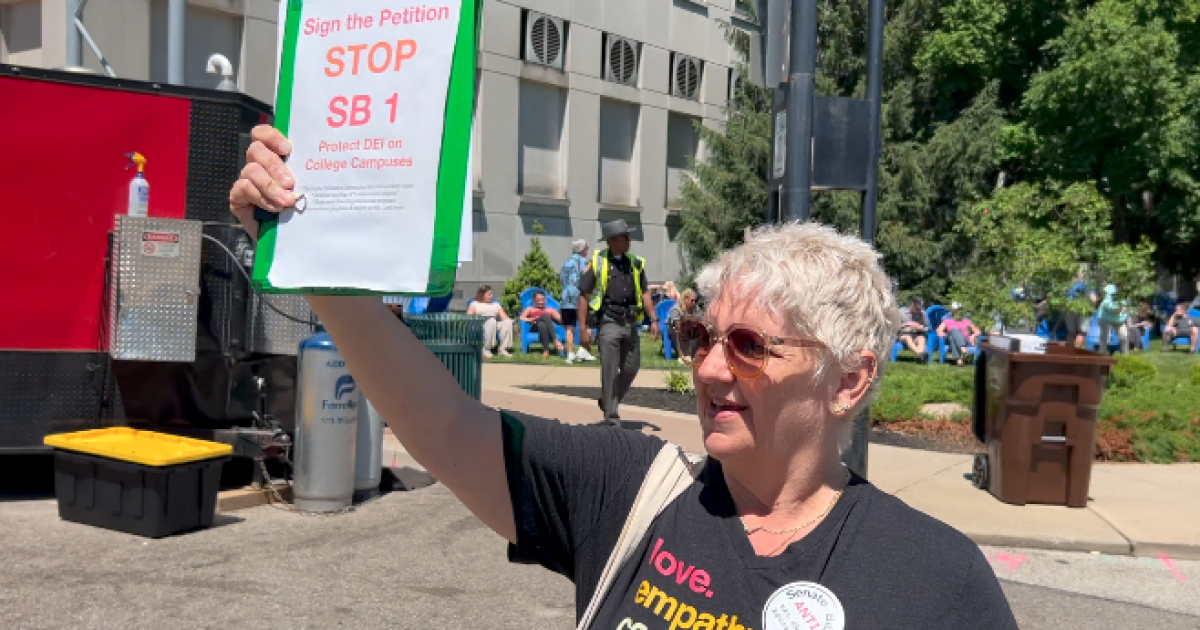
CINCINNATI — Education advocates were out in the Cincinnati streets Monday trying to push back against Senate Bill 1 (SB 1), which would ban diversity, equity and inclusion (DEI) in state colleges and universities.
“It is a way to erode public higher education in Ohio. So the bill is designed to eliminate programs and services that are based on identity groups,” said Kate Durso, the southwest regional captain advocating against SB 1.
SB 1, or the “Ohio Higher Education Act,” was signed into law by Gov. Mike DeWine on March 28. The law goes into effect on June 27.
Facebook: Ohio Senate Republicans
The law bans DEI from trainings, orientations, offices, positions or new institutional scholarships at state colleges or universities. Other policies in the Ohio Higher Education Act include a required American civics literacy course, prohibiting full-time university faculty from striking and automatically eliminating any university degree program that awards fewer than five degrees per year on a three-year rolling average.
SB 1’s text states that the law is meant to support “intellectual diversity” at state colleges and universities.
In February, WCPO 9 reported on SB 1 after the state’s Senate passed the legislation. One Republican senator explained why supporters are cracking down on DEI on college campuses.
“Rather than fostering equality, DEI enforces racial divisions, prioritizes group identity over individual merit and creates (the) very discrimination it claims to be fighting,” said state Sen. Andrew Brenner (R-District 19).
Watch to learn more about how advocates are challenging SB 1 and what it means for Ohio’s higher education landscape:
Volunteers look for support to fight Ohio’s ban on DEI at state colleges
An excerpt from SB 1 describes how teachers are expected to enable free thought and discussion under this legislation:
“Affirm and declare that faculty and staff shall allow and encourage students to reach their own conclusions about all controversial beliefs or policies and shall not seek to indoctrinate any social, political, or religious point of view;”
Senate Bill 1
I met with Kate Durso and her team of volunteers, who disagree with the lawmakers behind SB 1.
WCPO 9 News

“I would say that this bill, in fact, does not promote more inclusive conversation. It actually creates boundaries and barriers against civil discourse,” Durso said.
A member of Durso’s volunteer team told me that SB 1 is pushing her away from her home state.
“Yeah, I graduated from UC, University of Cincinnati, in 2023, and I’m pursuing law school now. And this bill, SB 1, was one of the reasons that I’m not staying in my hometown of Cincinnati for law school; it just scares me too much,” Erin Tedtman said.

WCPO 9 News
Now, she is one of the local advocates in an initiative to move the law to a ballot issue this fall.
Advocates sent a referendum petition to Attorney General Dave Yost’s office in April. That process required 1,000 signatures. Once the AG’s office approved the first part of the referendum, the volunteers’ efforts expanded. The volunteers have to collect 250,000 signatures across at least 44 of Ohio’s 88 counties, as Durso explained. Their deadline is June 25.
“We need to hit a certain percentage within each of those counties based on the 2022 gubernatorial election,” Durso said.
The volunteer captain said that her team and others across Ohio are trying for as many signatures as possible, because some may be marked invalid, which could occur even with a slight mistake.
“If someone accidentally writes their first and last name in the same box instead of following the directions on the form or includes the wrong address,” Durso said.
As a lifelong educator, Durso told me this is her way of advocating for students and staff she works with.






For the second straight year, Ohio State and Texas will stage one of the most anticipated college football games of the season early on when the Buckeyes travel to Austin on Sept. 12 in Week 2. Last year, Ohio State was able to dictate the game with its defense and won a huge matchup that boosted the Buckeyes’ résumé and likely kept Texas out of the College Football Playoff.
The same could be true in 2026, according to Fox College Football’s Joel Klatt. While appearing on his own podcast, Klatt took some time to talk about the massive collision between what should be two top-five teams when the two kick things off. He believes the winner will be in good shape, but that the loser could have an uphill climb to get into the CFP.
“The loser of this game is behind the eight-ball. Ryan Day and Steve Sarkisian know exactly how important that game was to their teams and their programs a year ago,” Klatt said. “Look at what Ohio State was able to do. They had eight new starters on defense. They generated a ton of confidence — a ton of confidence in their brand new quarterback, Julian Sayin, and their new defensive coordinator, Matt Patricia. Based on what they were able to do and how they controlled the game against Texas at home early last year.
Klatt then went on to talk about this year and the difference in teams, but also how difficult the schedules are after the titanic collision at Darrell K Royal-Texas Memorial Stadium.
“You’re going to have experienced guys — this is not Arch (Manning) in his first real experience as a starter,” continued Klatt. “This is not Julian Sayin, and his first time as a real starter. Now you’ve got incumbent quarterbacks. There’s loads of expectations. These two teams are going to start in the top five; there’s no doubt. Look at these schedules, they have remaining. Ohio State — remaining big games on the schedule after traveling to Texas. They’ve got to go on the road to Iowa, Indiana, and USC in their schedule next year, and they’ve got home games against Oregon and Michigan. That’s not easy. Same can be said for Texas. Check this out — Texas’ remaining big games, they’ve got road games at Tennessee, Missouri, LSU, and Texas A&M — that one to finish out the year. They’ve got home games against Florida and Ole Miss. Not going to be easy there, and obviously the big one, the neutral in Red River against Oklahoma. So, a loss in this game, each of these teams are going to be fighting uphill, and you’re talking about major brands that do not expect to miss the playoffs.”
We’ve been saying much the same if you’ve followed us here on Buckeyes Wire. In fact, Ohio State hasn’t lost more than two regular-season games since the 2011 season, and if they drop the game at Texas, well — it’s not like the talent isn’t there to go on a run — but with that schedule, the team could be potentially better than last year and miss out on some really big goals if a bounce or break doesn’t go the Buckeyes way.
Either way, Klatt is right. There is a lot on the line even so early in the season because of what’s ahead for both of these teams, even in a world of a 12-team College Football Playoff.
Contact/Follow us @BuckeyesWire on X (formerly Twitter) and like our page on Facebook to follow ongoing coverage of Ohio State news, notes, and opinion. Follow Phil Harrison on X.
Ohio
NECIC to host community visioning session for Mansfield’s north end in partnership with Heritage Ohio

MANSFIELD — The North End Community Improvement Collaborative, Inc. (NECIC) will host a Community Visioning Session in partnership with Heritage Ohio, Inc. on Tuesday, July 28 at 6 p.m. at the United Steelworkers Hall, located at 376 West Longview Avenue in Mansfield.
The public is invited to attend and share input on the future of Mansfield’s North End, with a focus on strengthening neighborhood revitalization efforts and identifying opportunities for continued growth and investment.
The session is part of an upcoming visit from Heritage Ohio’s Downtown Assessment Resource Team, also known as D.A.R.T. The visit is designed to help communities explore next steps for revitalization and introduce the key building blocks of a successful long term revitalization effort: organization, promotion, design, and economic vitality.
NECIC reached out to Heritage Ohio as part of its ongoing work to support revitalization in the North End, especially near the corner of Springmill Street and Bowman Street, where NECIC has been focusing recent revitalization efforts.
Since joining the organization in early 2025, NECIC President & CEO Matthew Benko- Scruggs has placed a strong focus on revitalization near the corner of Springmill Street and Bowman Street.
This work has included the organization’s move back into the neighborhood, continued investment in the area, and community centered efforts such as the Springmill Spring Cleanup event.
During the Community Visioning Session, residents, business owners, stakeholders, and other community members will have the opportunity to learn more about Heritage Ohio, the revitalization process, and ways they can help shape the future of the North End.
“We want this process to be rooted in the voices of the people who live, work, and invest in the North End,” said Benko-Scruggs. “This session is an opportunity for the community to share ideas and help guide what revitalization can look like in our neighborhood.”
Heritage Ohio, Inc. is a statewide nonprofit organization that supports the development, redevelopment, and improvement of downtowns and neighborhood districts throughout Ohio through technical assistance, training, networking, and advocacy.
Community members are encouraged to attend and take part in the conversation.
For more information, contact Director of Community Organizing Emily Schwan at 419-
522-1611, ext. 109 or Emily@necic-ohio.org.

A grand jury in Franklin County, Ohio, indicted nine people suspected of being involved in a human trafficking ring, officials said.
Ohio Attorney General Andy Wilson said in a news release on Monday that the nine people were indicted on a combined 42 felony charges in connection with the human trafficking investigation. Marcus Gant, Magon Smith, Raymond Valentine, Aimee Fabin, John W. Gibson II, Malik Jackson, Kayla Wheeler, Jeremy Lindsey, and Mackenzie Fitzpatrick face a variety of charges, including engaging in a pattern of corrupt activity. All nine are in custody.
The news release said they are accused of using narcotics to coerce women into commercial sex work at the Econo Lodge on North Wilson Road. The suspects then laundered money through Valentine Floral on Eakin Road, officials said. The alleged crimes took place between April 2025 and January 2026.
Some of those charged face trafficking in persons, compelling prostitution and promoting prostitution charges. Of the nine, Gant faces the most charges. The 37-year-old from Columbus faces 11 different counts related to the human trafficking investigation.
The Central Ohio Human Trafficking Task Force led that investigation, the news release added.
According to Monday’s news release, the Franklin County Prosecutor’s Office has taken previous legal action against the Econo Lodge. Officials said a lawsuit was filed earlier this year against the owner of a hotel, who was accused of “neglecting to address repeated drug and violent activity on the property.” A settlement was reached.
People can report human trafficking in Ohio by calling 844-END-OHHT, texting “ENDOHHT” to 847411, downloading the END OHHT app or submitting information online.
-

 Massachusetts4 minutes ago
Editorial: Want to end poverty in Mass.? Don’t drive away wealthy
-

 Minnesota10 minutes ago
Minnesota conviction review unit demise dashes hopes of some incarcerated people, their families
-

 Mississippi16 minutes ago
Mississippi teen accused of killing elderly couple had worked for them before shooting: family
-
Missouri22 minutes ago
Missouri Lottery Mega Millions, Pick 3 winning numbers for July 14, 2026
-
Montana28 minutes ago
Montana Lottery Mega Millions, Big Sky Bonus results for July 14, 2026
-

 Nebraska34 minutes ago
Nebraska wants data centers to come clean about water usage
-

 Nevada40 minutes ago
Federal lawsuit alleges years of sexual abuse inside Nevada juvenile detention facilities
-

 New Hampshire46 minutes ago
Missing Berlin Motorcyclist Found Dead After Route 2 Crash: New Hampshire State Police Roundup

