Midwest
Nebraska fisherman reels in new fish species in state: 'Bright orange with turquoise'

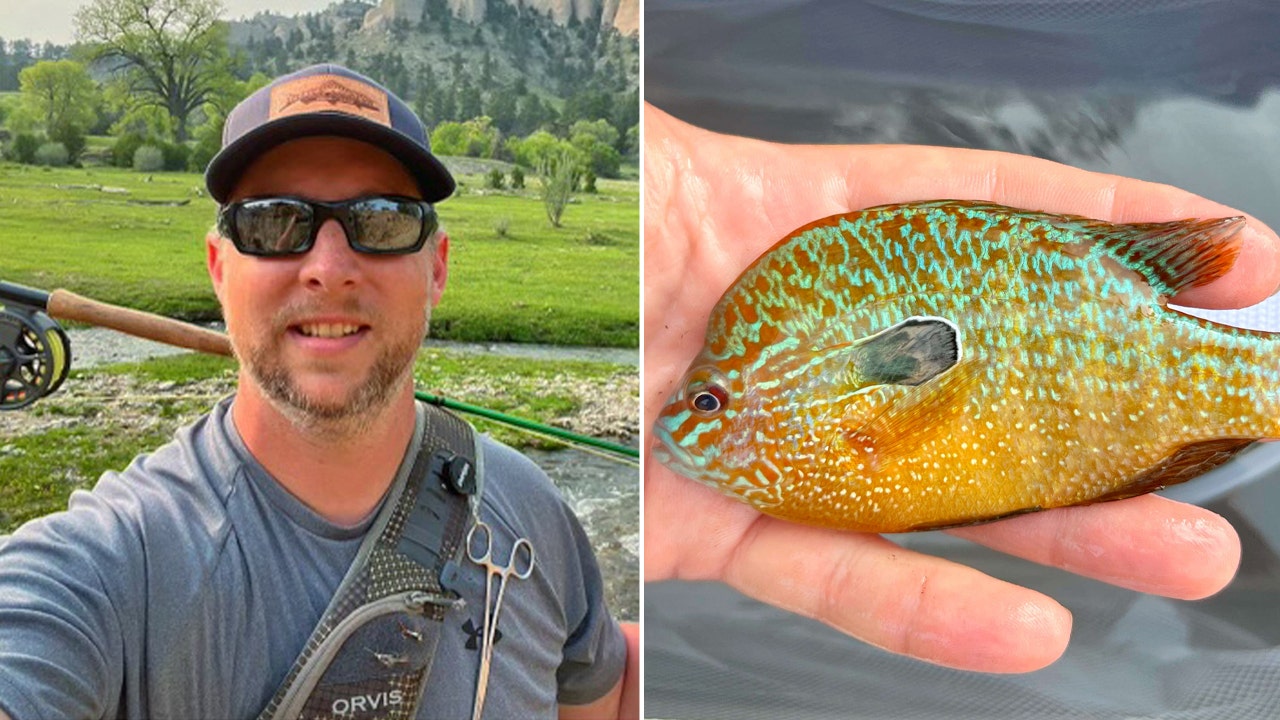
A new fish species has been recorded in Nebraska after a fisherman reeled in the colorful creature.
“We hear about new species in Nebraska from time to time, but most of them are unwanted, invasive species,” Daryl Bauer, Fisheries Outreach program manager of the state’s Game & Parks Commission, told Fox News Digital.
“I get reports almost every year of aquarium fish that were illegally released in our waters and then found dead or even caught by anglers.”
NEW FISH SPECIES WITH HUMAN-LIKE TEETH NAMED AFTER POPULAR MOVIE VILLAIN
But last week, Bauer got a call from his friend Scott Buss, an avid angler who caught a 5¼-inch, 2-oz. longear sunfish.
It’s a bright orange fish with turquoise markings that is native to Kansas.
This longear sunfish was caught by Scott Buss in the Little Blue River in Nebraska. (Nebraska Game & Parks Commission)
“This was the first time in all my career I had ever heard of a longear sunfish in Nebraska,” Bauer said.
“They are beautiful fish and I was thrilled to get a message from Scott Buss and then see his photo. It got even better when he was able to bring the fish to show me.”
ELUSIVE AND ‘HIDEOUS’ FISH STUNS VIEWERS AFTER INSTAGRAM POST GOES VIRAL: ‘NEW FEAR UNLOCKED’
The catch was made with a rod and reel and a nightcrawler worm.
“I do a lot of fishing and a lot of multi-species fishing, so I like to catch a little bit of everything,” Buss of Norfolk, Nebraska, told Fox News Digital.
Scott Buss, pictured here, said he knew he’d caught something special when he pulled the bright and colorful sunfish out of the water. (Scott Buss)
“I certainly wasn’t specifically fishing for the sunfish, but I was using a small hook and small bait, which gives you a chance to catch a lot of different stuff than just your typical catfish.”
Buss said he was floating around a piece of worm, a small hook and a bobber when he got a bite and pulled the fish from the river.
NEW FISH SPECIES WITH HUMAN-LIKE TEETH NAMED AFTER POPULAR MOVIE VILLAIN
“Immediately, I said, ‘Whoa, that’s different,’” Buss said.
“It’s a very cool-looking fish. I looked at it and said, ‘That’s a longear,’ and I knew it hadn’t been officially documented here. So, I kind of struggled with what to do.”
Buss was the first person to catch this species of fish in Nebraska. (iStock )
Buss kept the potential record-setting fish in an aerated bait cooler and brought it to the commission office, where it was officially documented and recognized as the first state record for the species in Nebraska.
“By far the most exciting thing about the fish was that none [of these] have ever been caught in Nebraska before, and how beautiful it was,” Bauer said.
For more Lifestyle articles, visit www.foxnews.com/lifestyle
“You just never know what you’re going to catch,” Buss said of his fish.
“An old 50-inch muskie, a 10-pound walleye or 2-ounce sunfish. It’s all exciting.”
Daryl Bauer, Fisheries Outreach program manager for the Nebraska Game & Parks Commission (not photographed with longear sunfish), said this was the first time in his entire career that he has heard and seen a longear sunfish. (Nebraska Game & Parks Commission)
Buss reeled in his longear from the Little Blue River, which is a typical eastern Nebraska prairie stream, Bauer said.
“[It’s a] relatively shallow, sandy, muddy bottom with some rock and gravel, lots of woody debris,” Bauer added.
“Right now, mid-summer, flows are low,” he said. “Typical fish species in the Little Blue would be channel and flathead catfish, a variety of minnows and suckers, some sunfish like bluegills, green sunfish and orange spotted sunfish, but no longears.”
Longears are like typical sunfish, but have not been documented in Nebraska before this. Bauer believes the longear swam up from Kansas during the high flow in the Little Blue River. (Scott Buss; Nebraska Game & Parks Commission)
Bauer said that earlier this year there were some periods of high flow in the Little Blue River and during those times a longear sunfish might have made its way up from Kansas.
Longears are typical sunfish, a lot like bluegills that are common in waters all across Nebraska and often the very first fish young anglers catch, Bauer said.
They readily bite on small hooks, bobbers and worms.
When it comes to the sport he loves, Buss offered some clear advice.
“Just go fishing,” he said. “Get out outside and have some fun because you never know what you might catch.”
Read the full article from Here


Looking to explore Wisconsin this summer? The state is full of lakefront beaches, forests, rivers, bluffs, waterfalls and more.
These pockets of nature span several state counties and can make for great road trips. Here are eight hidden gems across Wisconsin for nature-lovers to enjoy while the weather is warm:
This state park is home to Wisconsin’s largest waterfall, Big Manitou Falls. It is accompanied by Little Manitou, a smaller cascade. Around every bend in the trail, there’s opportunity to get right next to a waterfall or rumbling rapid.
The park is on the Black River within Pattison State Park in Douglas County.
For a full Wisconsin waterfall experience, visit waterfalls at Copper Falls, 90 miles east, and Pattison State Park, 15 miles southwest.
On the northern tip of Wisconsin’s Bayfield peninsula 22 islands sit in Lake Superior. Most of the islands are part of Ashland County.
It’s known for its mainland sea caves, which you can visit with a kayak. Also accessible (exclusively) by kayak or boat, there are campsites on 18 of the 21 islands. Visitors can go on cruises for tours of lighthouses, sea caves and more.
Stretching across Vernon and Crawford counties, this region’s forested hills and winding rivers make it unique from other Wisconsin landscapes. Its 125-mile stretch starts near Wilton, winds through La Farge and Ontario and ends at Wauzeka.
It’s beautiful year-round, but canoeing or kayaking the Kickapoo River during the summer can make for great memories. Wildcat Mountain State Park and Kickapoo Valley Reserve trails are also great places to explore.
There are private cabins with large porches to enjoy the view of hills, but the area isn’t as touristy as some other Wisconsin summer spots.
This scenic byway spans 3,000 miles along the Mississippi river across several states. The Wisconsin stretch goes through small towns like Stockholm, Pepin and Alma, which have wineries and natural attractions to visit along a road trip. For a nature break, there’s hiking at Perrot State Park in Trempealeau County and Maiden Rock State Natural Area in Pepin County. To grab a bite or drink, get pizza on a farm at the Stone Barn and go wine tasting at Villa Bellezza and Danzinger.
Bluff-top camping along the Mississippi River
There are campsites in Wyalusing State Park near Bagley and Nelson Dewey State Park near Cassville that sit on bluffs above the Mississippi River. The campgrounds tend to fill quickly, so stay vigilant about any snatch-able sites, or keep it on your radar for a few months down the line.
Wyalusing sites are car-camping sites and have limited privacy, but they have great views, looking directly out on the Wisconsin and Mississippi rivers.
The four walk-in sites at Nelson Dewey State Park have a great view of the Mississippi with better privacy between sites. Below the bluff, trains whizz past.
Lakeside camping in the Northwoods
The Chequamegon-Nicolet National Forest and the Northern Highland-American Legion State Forest protect over 1.75 million forest acres and thousands of lakes. There are dozens of small campgrounds – many on lakes – at both parks. You could even backcountry camp off the North Country Trail on national forest land and off the Ice Age Trail.
Chequamegon-Nicolet National Forest encompasses 1.5 million acres and crosses 11 counties, including Ashland, Bayfield, Sawyer and Price counties. It’s just south of Lake Superior’s shores. Northern Highland-American Legion State Forest reaches Iron, Oneida and Vilas counties.
Some extra gems here are Laura Lake, Bagley Rapids and Crystal Lake.
On the way to Door County, the Ridges is a nature preserve in Baileys Harbor. It was Wisconsin’s first land trust, and today has lots of boardwalks, typical of this area of Lake Michigan.
The Kettle Moraine State Forest
Lakes, pines, prairies and glacial landforms can all be found in the Kettle Moraine. Dozens of forested campsites stretch through the woods, with plenty of privacy and space.
Its most famous trail is the Ice Age, which travels through 30 counties. More than 600 miles of it can be hiked, according to the Wisconsin Department of Natural Resources, but 30 miles are in the northern unit of the Kettle Moraine grounds. It’s meant to be hiked by foot but has branches for mountain biking and horseback riding.
The forest is divided into six units, which hit Fond Du Lac, Jefferson, Sheboygan, Walworth, Washington and Waukesha counties.
Contact Elena Metinidis at emetinidis@usatodayco.com.

Detroit — The Tigers will get pitcher Jack Flaherty back in the starting rotation for a start in the series finale against the Houston Astros on Sunday, manager AJ Hinch confirmed on Saturday.
Flaherty, who has been on the 15-day injured list since June 13 with a strain of the peroneal tendons in his left foot/ankle, will get back on the active roster with a yet-to-be-announced move on Sunday morning, as it’s the first day he’s eligible to come back from the IL.
“He’s good to go for tomorrow,” Hinch said. “We can’t make it official until the morning. But yeah, we’re fully expecting him to be good to go.”
Flaherty completed a rehab assignment with Double-A Erie on Tuesday, throwing 5⅔ innings of two-run ball with seven strikeouts.
That outing and the lack of any hang-ups in the days since have Flaherty on the precipice of his return. Hinch was hopeful that Flaherty could make his return on Sunday, and a few days earlier he recalled some words of motivation he gave the pitcher in a postgame handshake line.
“I told him, I was standing in the high-five line yesterday, that we’re getting closer, closer to him being back,” Hinch said. “So, he’s definitely the right amount of being agitated and wanting to pitch.”
With Flaherty back in the mix, Hinch is unsure if Detroit will stick with a six-man pitching rotation of Tarik Skubal, Framber Valdez, Casey Mize, Troy Melton, Keider Montero and Flaherty or take it back down to five. The latter option likely requires Montero to move into a bullpen role.
As of Saturday, the inflection point on any decision will be the series opener against the Texas Rangers on Thursday.
The plan is for Flaherty to pitch the finale against Houston. Detroit then travels to New York for a three-game series against the Yankees where it’s set up for Mize, Skubal and Melton to pitch Monday through Wednesday.
That Thursday opener against the Rangers, where Hinch will make a call between Valdez and Montero, sits in an odd pocket of the schedule, too, as the two teams are off on Friday before completing a three-game series over the weekend. That’s because there’s a Round of 32 game in the FIFA World Cup taking place in Arlington, Texas, that afternoon.
And with a day off the following Monday, Detroit has two days of rest in a four-day span after coming off a 14-game stretch without an off day.
“We’ll have a decision to make on Thursday, going to Texas,” Hinch said. “We can bring Framber back on regular rest. We could put Keider in there, do the six man. We’re kind of considering all of our options. Going with Jack coming in tomorrow kind of creates that decision for the back end of that. Then we have two off days surrounding the weekend. It’s really weird with the World Cup. We have that weird mid-series off day. So we’ll see.”
Hinch shares updates on Perez, Báez
The timeline for Wenceel Perez and Javier Báez to rejoin the active roster remains murky, though both are progressing in recovering from their respective injuries, Hinch said.
Perez, who suffered a fractured orbital bone on his left side after a resistance band under tension released and hit him the face last week, is on the 60-day injured list. Hinch shared that things are going slow in Perez’s recovery as all parties are basically waiting for the fracture to heal and Perez’s vision to be fully restored.
Perez is back in Detroit, but is otherwise laying low on any sort of rehab until the injury itself subsides enough.
“There’s a little bit of unknown on how long this can take but given — I mean, it’s like two-sided,” Hinch said. “You want everybody to know he’s safe and out of harm’s way. He’s just mending slowly in that. And the swelling, the vision, not disrupting the healing of the orbital bone, it’s a lot more sensitive than just getting hit in the face.”
Báez is getting back to some physical activity after taking some prolonged rest, which came as a result of his sprained right ankle not responding well to earlier rehab.
Báez has been on the IL since late April and got moved to the 60-day IL on June 11.
And despite the need for serious ramping up, Báez’s return to some light physical activity is a welcome sign for Hinch and Co. for an injury they worried could be much more serious.
“He’s doing well and going to continue on with his rehab and getting back into baseball stuff. There’s jump tests, there’s running, there’s the hitting, again,” Hinch said. “So the good news is he’s not shut down. That’s what our fear was. The continual delay is it has just been a complicated injury.”
Andrew Graham is a freelance writer.

Penelope the corpse flower is in bloom at Milwaukee’s Mitchell Park Domes.
Penelope, which last bloomed in 2024, will be open and stinking for the next 24-48 hours. This rare and very large flower only booms every couple of years; when it does, it emits a powerful – and disgusting – odor.
“Typically they only bloom once every six to eight years, ” said Amanda Garchow, horticulturist at the Domes. “Penelope’s a little different in our case; this is her second bloom in two years, so it’s extra exciting for us because it’s a rare event that’s she’s blooming so soon.”
The ephemeral nature of this plant and its experience has gathered somewhat of a cult following, according to Bryan Connolly, botanist and associate professor of biology at Eastern Connecticut State University, who once had someone visit his greenhouse with a corpse flower tattoo on his leg.
Below, with some help from Connolly and Garchow, we answer questions about this fascinating plant.
What exactly is a corpse flower?
The corpse flower, also known as a Amorphophallus titanum to scientists and “titan arum” to fans of David Attenborough’s “The Private Life of Plants,” is a flowering plant native to rainforests on the Indonesian island of Sumatra. It is known for its putrid smell, often compared to the scent of rotting flesh, and for only blooming for 24-48 hours every couple years.
Why does it take so long to bloom?
It needs to accumulate enough nutrients. The corpse plant starts as a seed or, if it’s already bloomed, an underground tuber-like corm (think potato). Both produce a really large leaf, which can be up to 15 feet tall.
“There’s no stem when it’s not flowering, and so it has a petiole, which is part of the leaf that looks kind of like a stem, but it’s not a stem,” Connolly explained. “They can get very large, like bigger than your thigh around.”
The leaf generates sugar – food for the plant – and stores it in the underground corm.
After a year, the leaf dies, and the tuber rests for four months. Then it produces a new leaf and repeats the cycle until the tuber becomes large enough. This takes about seven to 10 years for a new seed and three to four years for a corm that’s bloomed before.
The corm of a corpse flower is the largest of any flowering plant. According to Connolly, the biggest one has been up to 200 pounds, but they’re typically more like 60 pounds.
Why the rotting meat smell?
To attract pollinators. After years of tuber growing, the tuber eventually produces a spike, formally known as a spadix, of flowers wrapped in a specialized leaf called a spathe. Female and male flowers grow in a ring at the bottom of the spadix. This stage is called an inflorescence, which is a group of flowers.
The corpse flower is the world’s largest unbranched inflorescence or group of flowers.
Eventually, as the spathe opens, the spadix heats up to about 99 degrees F and the flowers begin to emit pulses of powerful odor to attract insects, like carrion beetles or fruit flies, that typically eat or lay their eggs on rotten meat. These insects pollinate the flowers at the base of the plant.
Are there benefits to being pollinated by insects like fruit flies and carrion beetles instead of more common pollinators like bees?
Not really.
According Connolly, it may be related to the plant’s native environment. Corpse plants can be miles apart in a rainforest, and since they bloom infrequently they can only be pollinated and reproduce every few years. Because of that, it could be advantageous to seek pollinators that are willing to travel long distances between plants.
What makes it smell so bad?
Chemists have isolated identified over 40 compounds that make up the odor released by the plant. Some of the chemicals include two that smell like garlic (dimethyl trisulfide and disulfide), one that smells like sulfur (methanethiol), one that smells like citrus (limonene), one that smells like feces (idole), and one that smells like urine (phenylalanin).
Why should I care?
There is inherent intrigue to a smelly plant named Penelope. But also, corpse flowers are an endangered species due to loss of habitat, climate change and encroachment from invasive species. Garchow said that it’s estimated there are only 800 left in the wild.
Additionally, these plants are difficult to conserve via seed preservation because their seeds aren’t viable after drying.
Therefore, they must be conserved in living collections in gardens, research labs or greenhouses and conservatories like the Domes.
Since they can’t self-pollinate, despite having both male and female flowers, they must be pollinated by another plant. Different research labs and greenhouses often rely on sending stored pollen to each other to keep these plant lines going.
“I’m really thankful that we have this giant, smelly, weird plant that, you know, kind of brings botany to the public,” said Connolly with a smile. “And just the conservation of plants and of the species in general.”
The Domes will have extended hours on Saturday and Sunday to accommodate visitors who want to see the corpse flower in bloom, though the smell will mostly fade by Sunday. Stop by to see Penelope, support important conservation work and acquire a unique, albeit smelly, experience.
The Dome, 524 S. Layton Blvd., will host extending hours for this event, from 8 a.m. to 4 p.m. both days. Admission is $10 for adults ($9 for residents), $6.50 for ages 3-12 and free for children younger than 2. Due to road construction and the closure of the 27th Street bridge, the Milwaukee Domes Alliance suggests using GPS to plot a route. Directions and more information, including specific discounts, are available at www.MilwaukeeDomes.org.
Reach Donnisa Edmonds at DEdmonds@usatodayco.com.
-

 Utah4 minutes ago
Eight fires sparked by lightning overnight near Utah border, growing Jones Fire billowing smoke
-

 Vermont11 minutes ago
Rockwell was ‘At Home in Vermont’ – VTDigger
-

 Washington13 minutes ago
The Washington Capitals Select Tyus Sparks | Washington Capitals
-

 Virginia13 minutes ago
Southwest, Central Virginia Weather | 6 p.m. – June 27, 2026
-

 Wisconsin26 minutes ago
These natural attractions in Wisconsin are worth a visit this summer
-

 West Virginia28 minutes ago
History Made: WVU Has Two First-Team All-Americans in the Same Season
-

 Wyoming34 minutes ago
Wyoming Cultural Trust Fund awards $529K in grants, including several Fremont County projects
-

 Crypto41 minutes ago
Sharplink Breaks 8-Month ETH Drought With Silent $18M Buy Through FalconX

