Illinois
USC men come unraveled in blowout loss to Illinois

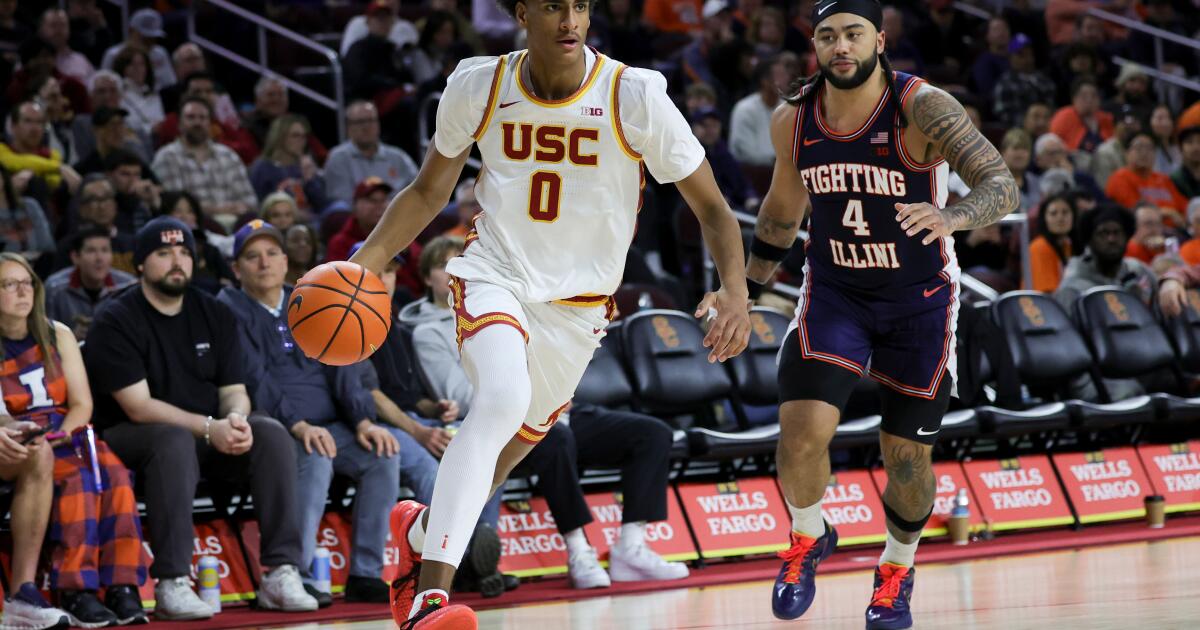
Alijah Arenas sank into a folding chair, his face buried in a towel, his breathing heavy.
For the last few days, smack dab in the middle of his long-awaited breakthrough at USC, Arenas was sick. He’d spent the last few days worn down and missed practice Tuesday, leaving his status for Wednesday night’s critical game with No. 10 Illinois uncertain until a few hours before. But the Trojans star freshman refused to sit out, resolving instead to tough it out against a true Big Ten contender, even if he wasn’t at 100%.
“That takes real courage,” USC forward Jacob Cofie said.
Indeed, it was a noble effort, albeit one that meant little by the time Arenas collapsed into the bench, breathless, midway through the first half Wednesday. By that point, Illinois was already rolling, well on their way to a 101-65 victory that left USC gasping for air.
“It’s pretty simple,” USC coach Eric Musselman said. “We were not good enough tonight. We’ve got to get better in all aspects.”
The blowout loss would mark not only the biggest margin of defeat for the Trojans in two seasons under Musselman but also the first time USC (18-8 overall, 7-8 in the Big Ten) has given up more than 100 points in a game since 2019. It was the sort of performance, Musselman said, that should make “every player, person, coaches in the program look in the mirror.”
That it came with USC clinging to the edge of the NCAA tournament bubble only added insult to injury. Those hopes hang on how USC handles its business through the final five games of its regular season, a stretch that includes just one top-25 team and two matchups with its reeling crosstown rival, UCLA.
But at no point Wednesday night did the Trojans look like a team that could make some noise come March. Part of that diminished firepower was on account of its star freshman’s illness, as Arenas looked nothing like the player who came alive over the last two weeks. He could muster just eight points in 18 minutes. At one point, he even appeared to tweak his injured knee, forcing him to sit for a long stretch.
“It’s been the way our season has gone,” Musselman said.
His questionable health, though, couldn’t explain why USC was walloped on the boards, losing the rebounding battle, 41-30, why it managed just a single fast-break point or why it shot a paltry 25% inside the arc.
Illinois (22-5, 13-3) exploited every one of those weaknesses Wednesday as it extended its lead in front as a sea of blue-and-orange faithful roared back and forth on either side of USC’s home arena. When the buzzer mercifully sounded, the box score made no bones about the fact the Trojans had been outworked and outclassed in almost every facet of the game.
“I feel like we made them look good today,” Cofie said.
Cofie led USC with 14 points, while Ezra Ausar had 11. But no other Trojans player scored in double digits.
While Arenas struggled, Illinois own star freshman, Keaton Wagler, was held mostly in check. He scored 10 and added four assists.
As it turned out, Illinois didn’t need him.
The Illini kept pouring it on until the final minute, when Illinois’ big man Tomislav Ivisic threw down an alley-oop to push Illinois into triple digits. The crowd, filled with mostly Illini fans, roared with delight.
There wasn’t much of that for the home fans to enjoy Wednesday. Illinois bolted an early 15-3 lead as USC stumbled out of the gate, turning the ball over four times in the first six minutes and missing seven of its first eight shots.
Alijah Arenas watches from the bench during the second half.
(Ryan Sun / Associated Press)
With its dynamic freshman depleted from flu and another starter, Chad Baker-Mazara, still out due to injury, USC struggled to find a consistent source of offense.
Just one of the Trojans’ five starters (Cofie) had more than a single made shot in the first half. Arenas, who’d scored at least 24 in each of his last three, opened one for six, before picking up an early second foul and heading to the bench.
Illinois, meanwhile, had no issue raining shots from long range in the first half, or speeding past USC through the lane, for that matter. While the Trojans tried to find their footing, the Illini built a 22-point halftime lead with little resistance.
It only got uglier from there, leaving the Trojans’ tournament hopes in a tenuous place and their frustrated head coach with his own head in his hands.

Illinois
Illinois Democrats face backlash after blaming Trump in Chicago cross-burning case | Fox News Video

‘Outnumbered’ reacts to Illinois Gov. JB Pritzker and Chicago Mayor Brandon Johnson blaming President Donald Trump for a cross-burning incident in Grant Park.
Illinois Democratic leaders Governor JB Pritzker and Chicago Mayor Brandon Johnson are slammed for weaponizing a Chicago cross burning incident by blaming former President Trump. Despite the suspect, Murlin Lue, admitting his motive was to protest Trump, not racism, Pritzker and Johnson doubled down. Critics, including Illinois GOP State Rep. Chris Miller, accuse them of playing politics and fostering division rather than seeking truth.

ROCKFORD, Ill. (WIFR) – November ballots will feature a repeat of top billing in the race for governor. Illinoisans can once again choose between Governor JB Pritzker or Darren Bailey to lead the Land of Lincoln.
But beside their spots, new names will appear for voters.
The Democratic and Republican candidates for governor picked new running mates for their rematch. With Lieutenant Governor Julianna Stratton running for U.S. Senate, Pritzker picked Christian Mitchell to join his ticket. On the Republican side, Aaron Del Mar joins Bailey, who previously ran with Stephanie Trussell in 2022.
Mitchell and Del Mar spoke Thursday with WIFR on what inspires them to run, their campaign priorities and ideas to improve the Rockford region.
Backgrounds
Starting with the Democratic ticket, Mitchell joins the race as a former state representative from Chicago as well as a deputy governor with the Pritzker administration.
“Before anything else, I’m Debbie’s son, and I’m James’s grandson,” Mitchell introduced. “They’re the ones who really instilled in me the value of hard work and made sure that I was going to have a very bright future.”
Mitchell sees the role of lieutenant governor as a partner to the state’s executive.
“I’m really lucky to be running with somebody who I respect, and who I think is the best governor in the nation… Governor JB Pritzker,” he said.. “My first thing is going to be supporting his agenda, which right now is all about lowering costs and raising wages.”
On the Republican side, Del Mar hails from suburban Chicago and considers his first priority to be raising his family.
“I wanted nothing to do with politics, did not want to be involved — wanted just to raise my kids and work my job,“ said Del Mar. He described his start in public service as something he ”kind of got pulled into.”
The Republican worked his way from a city council member in Palatine, at 29-years-old, to co-chair of the Illinois GOP. Although he says he “wanted nothing to do with being on” Bailey’s campaign, Del Mar sees strength in unity — offering a Chicago area perspective alongside Bailey’s southern Illinois roots.
“How about everybody in the state of Illinois, regardless of where you come from, has a seat at the table. If you’re from a southeast farming community, or you’re from the city of Chicago, where I grew up, everybody has a stake in the game.”
Priorities
Mitchell points to economic development as his focus for the gubernatorial campaign.
“I see vacancies on State Street in Chicago. I see vacancies on Main Street in Belleville and Alton and in Carbondale,” he recounted. “I want to make sure that we’ve got the kind of amenities and economic development, that kind of affordability, that allow us to make sure that folks want to stay in the towns that they’re born in if they want to.”
The Democratic candidate also eyes long-term planning for the state, including an “Illinois 2050 Plan.”
“How do we have the kind of educational undergirding that means that no matter where you’re from, you have a chance to have one of those jobs, whether it’s in new agriculture technology and new farming techniques or biotech, quantum.”
When asked how to achieve these priorities, Mitchell turned to investing in public education, retaining residents with better wages and improving health care.
“Making sure that we are able to protect our health care system, so that folks aren’t going broke when they get sick, that’s another big way that we can make an impact.”
Del Mar outlined a cost-of-living focus as central to his campaign.
“You wanna succeed, you do the basics really well, and the basics are affordability,” he contended.
The Republican repeatedly highlighted the state’s property taxes — reportedly the highest in the nation — as an issue to tackle. He suggested redirecting Illinois’s budget as one measure to ease the burden on homeowners.
“Number one is fully funding the state’s portion of local taxes, because that will offer people property tax relief.” Del Mar clarified this wouldn’t mean redirecting funds for public education.
“We’re looking at how we fund schools, how we make sure to empower teachers to have the best educational outcomes that we can have here in Illinois, regardless of what your zip code is, regardless of what your parents do for a living or how much money they make,” added Del Mar.
Reflecting on Rockford
Each candidate provided their vision for boosting the Rockford region.
For Mitchell, improvements continue with infrastructure funding, building on the state’s roughly $500 million investment in the area.
“The things that we have already worked on, through the capital plan that I helped lead as deputy governor, that the governor signed and is implementing, are already having benefits that the people of Rockford can see.”
The Democrat also pointed to the Chicago Rockford International Airport as an opportunity.
“Investing in that regional airport where we’ve already helped with a matching grant to get additional funds, that helps build out the economy,” said Mitchell. “There’s so much that’s happening there that it is really good for the economy and bringing more people back to Rockford.”
Del Mar shared his local priority as supporting unionization in the area.
“Union families deserve to be able to have a livable wage, and that’s something that’s important to Darren and I,” said Del Mar. He mentioned pensions were another item that a Republican executive wouldn’t touch for the public and private sector unions.
“I know that area up there has strong union backbone,” described Del Mar. “We want to make sure they know that they’re not going to have a bigger supporter in the governor’s mansion than Darren and I.”
Election Day
When asked for thoughts on their opponent, Mitchell criticized the Bailey campaign as a “repacking” of his 2022 run.
“The only record that they have to run on is extremism,” he exclaimed.
The Republican candidate also reflected on records, pointing to Pritzker’s years in office.
“Why are we underfunding education? Why are property taxes at all-time high? Why are businesses leaving?” asked Del Mar.
Voters can decide on who will lead Illinois November 3. Early voting starts September 24, with applications for voting by mail opening August 5.
Extended Interviews
Copyright 2026 WIFR. All rights reserved.

ROCHESTER, Minn. (FOX 9) – A man from Illinois is facing felony charges after police say he took part in a scheme that convinced a Rochester resident to hand over thousands of dollars in cash and nearly fell for a gold bar handoff.
Rochester phone scam
What we know:
According to a criminal complaint filed in Olmsted County District Court, police say the victim was contacted by phone and told he was under investigation for a crime. The caller convinced him to deliver $30,000 in cash to a man he met in person on June 17, 2026.
The victim was then pressured to arrange a second delivery — this time, 10 one-ounce gold bars — on June 23, 2026. Detectives worked with the victim to set up a controlled delivery using fake gold bars and a GPS tracker.
Charges state that the plan was for the victim to meet whoever arrived to pick up the package, while officers watched nearby. Surveillance officers saw a white SUV with Illinois plates circling the parking lot at 2711 Commerce Drive NW in Rochester.
The complaint states a man, later identified as Kiranbhai Kanubhai Vasava, got out, met the victim, gave the password and took the package. Officers followed the car as it left the scene. Detectives stop suspects and recover cash
Why you should care:
Police stopped the SUV near Eyota and searched it, finding $50,000 in cash, several cell phones, bank checks with Vasava’s name, and packaging materials similar to those used for the fake gold bars. The package with the GPS tracker and fake gold was missing, but officers later found the GPS device torn apart on the side of the highway.
The second man in the car, Hemendrasinh Pravinsinh Dabhi, told police he got a call from India about a package but claimed he knew nothing about it, saying, “he just drives.” Vasava also denied knowing what was happening.
Kiranbhai Vasava linked to Wisconsin case
The backstory:
The complaint states detectives linked Vasava to another similar case in Stevens Point, Wisconsin, where a bank customer was convinced to hand over $50,000 in cash to a driver in a white Honda SUV. Video from that incident showed Vasava receiving the package.
Police say this type of swindle involves convincing victims they are under investigation and must pay money or hand over valuables to clear their name. Detectives say the investigation involved coordination between local police and law enforcement in Wisconsin.
The Source: Criminal charges filed in Olmsted County Court.
-
 News27 minutes ago
A day after Alito’s testy response to Sotomayor’s dissent, court says it was a ‘misunderstanding’
-

 Los Angeles, Ca2 hours ago
Watch Project Angel Food's 'Lead with Love' telethon on KTLA
-

 Detroit, MI2 hours ago
Metro Detroit weather forecast, June 26, 2026 — 4 p.m. Update
-

 San Francisco, CA2 hours ago
Newlyweds celebrate Pride-themed weddings inside SF City Hall as parade preparations underway
-

 Dallas, TX2 hours ago
All Dallas restaurants firing up specials for July 4th and America’s 250th
-

 Miami, FL2 hours ago
Helping Venezuela: State Department deploys Miami-Dade search-and-rescue team
-

 Boston, MA3 hours ago
Photos: Norway takes on France in high-powered World Cup matchup in Foxborough – The Boston Globe
-

 Denver, CO3 hours ago
Denver Transplant Games sets Guinness World Record for mos living donors, recipients in one place at one time

