Midwest
Bodycam video reveals chaotic scene of deputy fatally shooting Sonya Massey, who called 911 for help

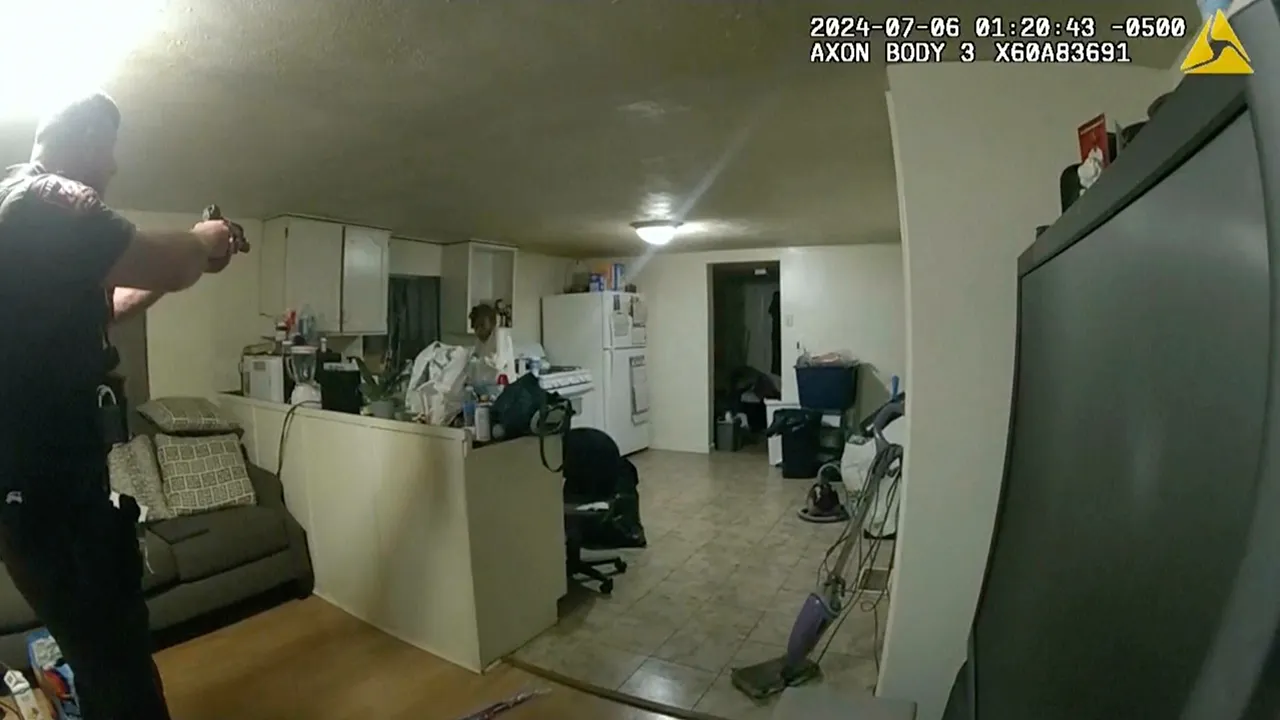
Sonya Massey ducked and apologized to an Illinois sheriff’s deputy seconds before he shot the Black woman three times in her home, with one fatal blow to the head, as seen in body camera video released Monday.
An Illinois grand jury indicted former Sangamon County Sheriff’s Deputy Sean Grayson, 30, who is white, last week. He has pleaded not guilty to charges of first-degree murder, aggravated battery with a firearm and official misconduct.
US POSTAL SERVICE LETTER CARRIER SHOT IN CHICAGO, OFFICIALS SAY
The video confirmed prosecutors’ earlier account of the tense moment when Grayson yelled from across a counter at Massey to set down a pot of hot water. He then threatened to shoot her, Massey ducked, briefly rose, and Grayson fired his pistol at her.
Authorities said Massey, 36, had called 911 earlier to report a suspected prowler. The video shows the two deputies responded just before 1 a.m. on July 6 at her home in Springfield, 200 miles (322 kilometers) southwest of Chicago. They first walked around the house and found a black SUV with broken windows in the driveway.
It took Massey three minutes to open the door after the deputies knocked, and she immediately said, “Don’t hurt me.”
She seemed confused as they spoke at the door, and she repeated that she needed help, referenced God and told them she didn’t know who owned the car.
Inside the house, deputies seemed exasperated as she sat on her couch and went through her purse as they asked for identification to complete a report before leaving. Then Grayson pointed out a pot sitting on a flame on the stove.
“We don’t need a fire while we’re here,” he said.
In this image taken from body camera video released by Illinois State Police on Monday, July 22, 2024, former Sangamon County Sheriff’s Deputy Sean Grayson, left, points his gun at Sonya Massey, who called 911 for help, before shooting and killing her inside her home in Springfield, Ill., July 6, 2024. (Illinois State Police via AP)
Massey immediately got up and went to the stove, moving the pot near a sink. She and Grayson seemed to share a laugh over her pan of “steaming hot water” before she unexpectedly said, “I rebuke you in the name of Jesus.”
“You better (expletive) not or I swear to God I’ll (expletive) shoot you in your (expletive) face.” He then pulled his 9mm pistol and demanded she drop the pot.
Massey said, “OK, I’m sorry.” In Grayson’s body camera footage, he pointed his weapon at her. She ducked and raised her hands.
Grayson was still in the living room, facing Massey and separated by a counter dividing the living room and kitchen. Prosecutors have said the separation allowed Grayson both “distance and relative cover” from Massey and the pot of hot water.
After Grayson shot her, Grayson discouraged his partner from grabbing a medical kit to save her.
“You can go get it, but that’s a headshot,” he said. “There’s nothing you can do, man.”
He added: “What else do we do? I’m not taking hot (expletive) boiling water to the (expletive) face”
Noting that Massey was still breathing, he relented and said he would get his kit, too. The other deputy said, “We can at least try to stop the bleeding.”
Grayson told responding police, “She had boiling water and came at me, with boiling water. She said she was going to rebuke me in the name of Jesus and came at me with boiling water.”
During a Monday afternoon news conference, the family’s lawyer, civil rights attorney Ben Crump, called Grayson’s “revisionist” justification “disingenuous.”
“She needed a helping hand. She did not need a bullet to her face,” Crump said of Massey.
Asked why Massey told Grayson, “I rebuke you in the name of Jesus,” Crump said she had undergone treatment for mental health issues. He noted that she invoked God’s name from the beginning of the encounter and asked for her Bible after the deputies stepped inside.
During Massey’s funeral on Friday, Crump said the video, which he and the family had already viewed, would “shock the conscience of America.”
Massey’s father, James Wilburn, demanded the county court system be completely open with its investigation and prosecution and transparent with the public.
“The only time I will see my baby again is when I leave this world,” Wilburn said. “And I don’t ever want anybody else in the United States to join this league.”
Grayson, who was fired last week, is being held in the Sangamon County Jail without bond. If convicted, he faces prison sentences of 45 years to life for murder, 6 to 30 years for battery and 2 to 5 years for misconduct.
His lawyer, Daniel Fultz, declined to comment Monday.
In a statement, President Joe Biden said he and first lady Jill Biden were praying for Massey’s family “as they face this unthinkable and senseless loss.”
“When we call for help, all of us as Americans – regardless of who we are or where we live – should be able to do so without fearing for our lives,” Biden said. “Sonya’s death at the hands of a responding officer reminds us that all too often Black Americans face fears for their safety in ways many of the rest of us do not.”
Massey’s death is the latest example of Black people killed in recent years by police in their homes.
In May, a Hispanic Florida sheriff’s deputy shot and killed Roger Fortson, when the Air Force senior airman opened the door of his home in Fort Walton Beach armed with a handgun pointed down. The deputy, Eddie Duran, was fired.
In 2019, a white Fort Worth, Texas, officer fatally shot Atatiana Jefferson through a rear window of her home after responding to a nonemergency call reporting that Jefferson’s front door was open. Aaron Dean, the former officer, was convicted of manslaughter and sentenced to nearly 12 years in prison.
In 2018, a white Dallas police officer fatally shot Botham Jean, who was unarmed, after mistaking his apartment for her own. Amber Guyger, the former officer, was convicted of murder and was sentenced to 10 years in prison.
Crump has represented families in each case as part of his effort to force accountability for the killings of Black people at the hands of police. Crump also has represented relatives of Earl Moore, a Springfield man who died after he was strapped face down on a stretcher in December 2022. Two emergency medical professionals face murder charges in that case.
Read the full article from Here


Detroit — The Tigers will get pitcher Jack Flaherty back in the starting rotation for a start in the series finale against the Houston Astros on Sunday, manager AJ Hinch confirmed on Saturday.
Flaherty, who has been on the 15-day injured list since June 13 with a strain of the peroneal tendons in his left foot/ankle, will get back on the active roster with a yet-to-be-announced move on Sunday morning, as it’s the first day he’s eligible to come back from the IL.
“He’s good to go for tomorrow,” Hinch said. “We can’t make it official until the morning. But yeah, we’re fully expecting him to be good to go.”
Flaherty completed a rehab assignment with Double-A Erie on Tuesday, throwing 5⅔ innings of two-run ball with seven strikeouts.
That outing and the lack of any hang-ups in the days since have Flaherty on the precipice of his return. Hinch was hopeful that Flaherty could make his return on Sunday, and a few days earlier he recalled some words of motivation he gave the pitcher in a postgame handshake line.
“I told him, I was standing in the high-five line yesterday, that we’re getting closer, closer to him being back,” Hinch said. “So, he’s definitely the right amount of being agitated and wanting to pitch.”
With Flaherty back in the mix, Hinch is unsure if Detroit will stick with a six-man pitching rotation of Tarik Skubal, Framber Valdez, Casey Mize, Troy Melton, Keider Montero and Flaherty or take it back down to five. The latter option likely requires Montero to move into a bullpen role.
As of Saturday, the inflection point on any decision will be the series opener against the Texas Rangers on Thursday.
The plan is for Flaherty to pitch the finale against Houston. Detroit then travels to New York for a three-game series against the Yankees where it’s set up for Mize, Skubal and Melton to pitch Monday through Wednesday.
That Thursday opener against the Rangers, where Hinch will make a call between Valdez and Montero, sits in an odd pocket of the schedule, too, as the two teams are off on Friday before completing a three-game series over the weekend. That’s because there’s a Round of 32 game in the FIFA World Cup taking place in Arlington, Texas, that afternoon.
And with a day off the following Monday, Detroit has two days of rest in a four-day span after coming off a 14-game stretch without an off day.
“We’ll have a decision to make on Thursday, going to Texas,” Hinch said. “We can bring Framber back on regular rest. We could put Keider in there, do the six man. We’re kind of considering all of our options. Going with Jack coming in tomorrow kind of creates that decision for the back end of that. Then we have two off days surrounding the weekend. It’s really weird with the World Cup. We have that weird mid-series off day. So we’ll see.”
Hinch shares updates on Perez, Báez
The timeline for Wenceel Perez and Javier Báez to rejoin the active roster remains murky, though both are progressing in recovering from their respective injuries, Hinch said.
Perez, who suffered a fractured orbital bone on his left side after a resistance band under tension released and hit him the face last week, is on the 60-day injured list. Hinch shared that things are going slow in Perez’s recovery as all parties are basically waiting for the fracture to heal and Perez’s vision to be fully restored.
Perez is back in Detroit, but is otherwise laying low on any sort of rehab until the injury itself subsides enough.
“There’s a little bit of unknown on how long this can take but given — I mean, it’s like two-sided,” Hinch said. “You want everybody to know he’s safe and out of harm’s way. He’s just mending slowly in that. And the swelling, the vision, not disrupting the healing of the orbital bone, it’s a lot more sensitive than just getting hit in the face.”
Báez is getting back to some physical activity after taking some prolonged rest, which came as a result of his sprained right ankle not responding well to earlier rehab.
Báez has been on the IL since late April and got moved to the 60-day IL on June 11.
And despite the need for serious ramping up, Báez’s return to some light physical activity is a welcome sign for Hinch and Co. for an injury they worried could be much more serious.
“He’s doing well and going to continue on with his rehab and getting back into baseball stuff. There’s jump tests, there’s running, there’s the hitting, again,” Hinch said. “So the good news is he’s not shut down. That’s what our fear was. The continual delay is it has just been a complicated injury.”
Andrew Graham is a freelance writer.

Penelope the corpse flower is in bloom at Milwaukee’s Mitchell Park Domes.
Penelope, which last bloomed in 2024, will be open and stinking for the next 24-48 hours. This rare and very large flower only booms every couple of years; when it does, it emits a powerful – and disgusting – odor.
“Typically they only bloom once every six to eight years, ” said Amanda Garchow, horticulturist at the Domes. “Penelope’s a little different in our case; this is her second bloom in two years, so it’s extra exciting for us because it’s a rare event that’s she’s blooming so soon.”
The ephemeral nature of this plant and its experience has gathered somewhat of a cult following, according to Bryan Connolly, botanist and associate professor of biology at Eastern Connecticut State University, who once had someone visit his greenhouse with a corpse flower tattoo on his leg.
Below, with some help from Connolly and Garchow, we answer questions about this fascinating plant.
What exactly is a corpse flower?
The corpse flower, also known as a Amorphophallus titanum to scientists and “titan arum” to fans of David Attenborough’s “The Private Life of Plants,” is a flowering plant native to rainforests on the Indonesian island of Sumatra. It is known for its putrid smell, often compared to the scent of rotting flesh, and for only blooming for 24-48 hours every couple years.
Why does it take so long to bloom?
It needs to accumulate enough nutrients. The corpse plant starts as a seed or, if it’s already bloomed, an underground tuber-like corm (think potato). Both produce a really large leaf, which can be up to 15 feet tall.
“There’s no stem when it’s not flowering, and so it has a petiole, which is part of the leaf that looks kind of like a stem, but it’s not a stem,” Connolly explained. “They can get very large, like bigger than your thigh around.”
The leaf generates sugar – food for the plant – and stores it in the underground corm.
After a year, the leaf dies, and the tuber rests for four months. Then it produces a new leaf and repeats the cycle until the tuber becomes large enough. This takes about seven to 10 years for a new seed and three to four years for a corm that’s bloomed before.
The corm of a corpse flower is the largest of any flowering plant. According to Connolly, the biggest one has been up to 200 pounds, but they’re typically more like 60 pounds.
Why the rotting meat smell?
To attract pollinators. After years of tuber growing, the tuber eventually produces a spike, formally known as a spadix, of flowers wrapped in a specialized leaf called a spathe. Female and male flowers grow in a ring at the bottom of the spadix. This stage is called an inflorescence, which is a group of flowers.
The corpse flower is the world’s largest unbranched inflorescence or group of flowers.
Eventually, as the spathe opens, the spadix heats up to about 99 degrees F and the flowers begin to emit pulses of powerful odor to attract insects, like carrion beetles or fruit flies, that typically eat or lay their eggs on rotten meat. These insects pollinate the flowers at the base of the plant.
Are there benefits to being pollinated by insects like fruit flies and carrion beetles instead of more common pollinators like bees?
Not really.
According Connolly, it may be related to the plant’s native environment. Corpse plants can be miles apart in a rainforest, and since they bloom infrequently they can only be pollinated and reproduce every few years. Because of that, it could be advantageous to seek pollinators that are willing to travel long distances between plants.
What makes it smell so bad?
Chemists have isolated identified over 40 compounds that make up the odor released by the plant. Some of the chemicals include two that smell like garlic (dimethyl trisulfide and disulfide), one that smells like sulfur (methanethiol), one that smells like citrus (limonene), one that smells like feces (idole), and one that smells like urine (phenylalanin).
Why should I care?
There is inherent intrigue to a smelly plant named Penelope. But also, corpse flowers are an endangered species due to loss of habitat, climate change and encroachment from invasive species. Garchow said that it’s estimated there are only 800 left in the wild.
Additionally, these plants are difficult to conserve via seed preservation because their seeds aren’t viable after drying.
Therefore, they must be conserved in living collections in gardens, research labs or greenhouses and conservatories like the Domes.
Since they can’t self-pollinate, despite having both male and female flowers, they must be pollinated by another plant. Different research labs and greenhouses often rely on sending stored pollen to each other to keep these plant lines going.
“I’m really thankful that we have this giant, smelly, weird plant that, you know, kind of brings botany to the public,” said Connolly with a smile. “And just the conservation of plants and of the species in general.”
The Domes will have extended hours on Saturday and Sunday to accommodate visitors who want to see the corpse flower in bloom, though the smell will mostly fade by Sunday. Stop by to see Penelope, support important conservation work and acquire a unique, albeit smelly, experience.
The Dome, 524 S. Layton Blvd., will host extending hours for this event, from 8 a.m. to 4 p.m. both days. Admission is $10 for adults ($9 for residents), $6.50 for ages 3-12 and free for children younger than 2. Due to road construction and the closure of the 27th Street bridge, the Milwaukee Domes Alliance suggests using GPS to plot a route. Directions and more information, including specific discounts, are available at www.MilwaukeeDomes.org.
Reach Donnisa Edmonds at DEdmonds@usatodayco.com.

A shooting in north Minneapolis injured two men on Friday night.
Minneapolis police said officers responded around 9:30 p.m. Friday after multiple reports of gunfire near Lowry Avenue North and North Logan Avenue.Police said they found two men with gunshot wounds outside a home.
Officers said both men were outside when the gunfire started and a nearby hospital treated both men for non-life-threatening injuries.
Police are still investigating. Officers said no arrests have been made.
This is a developing story; check back for updates.
-

 Los Angeles, Ca26 minutes ago
About 20 detained after armed suspect call sparks LAPD response in Koreatown
-

 Detroit, MI44 minutes ago
With Jack Flaherty returning, AJ Hinch ponders Tigers’ starting rotation
-
 San Francisco, CA56 minutes ago
Serving up a slice of Palestine at Old Jerusalem in the Mission District
-

 Dallas, TX59 minutes ago
All-day restaurant and patio coming to Dallas’ Knox and more top stories
-

 Miami, FL1 hour ago
Bugtopia takes center stage at Zoo Miami
-

 Boston, MA1 hour ago
What JJ Peterka Will Add to the Bruins’ Roster, ‘He’s Got an Elite Shot’ | Boston Bruins
-

 Denver, CO1 hour ago
This Boulder farm dinner serves up midsummer Slavic vibes with James Beard-worthy fare
-

 Videos1 hour ago
Destruction in Venezuela after deadly earthquakes | BBC News

