Lifestyle
These viral L.A. 'head spas' will show you what's been hiding in your scalp (Ew!)

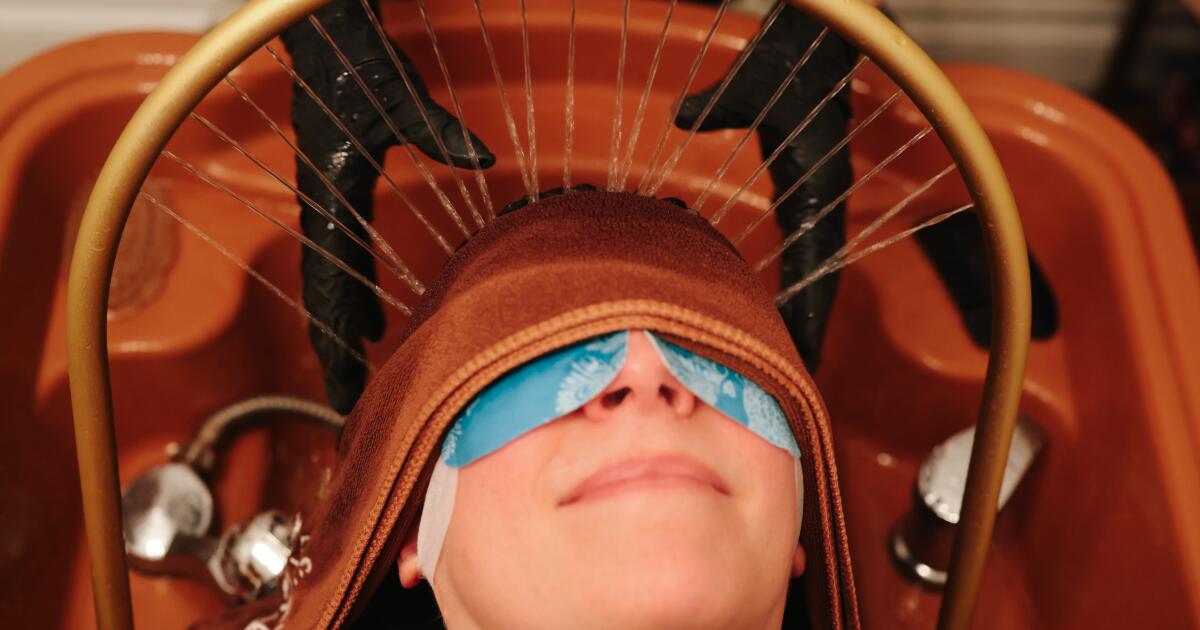
I’ve never given much thought to my scalp. Aside from the occasional subconscious scritch-scratch or vigorous shampooing, it’s kind of just … there. A necessary but often-overlooked cranium cover.
But the humble scalp is the focus of an increasingly popular wellness trend: elaborate Chinese and Japanese-inspired treatments at so-called head spas. At these businesses, visitors receive a scalp analysis followed by head and neck massages and repeated deep cleanses. Ogling the inner workings of the scalp, an otherwise forgotten body part — and addressing its needs through blissful hydrotherapy treatments — has driven the hashtag #headspa to draw attention on Tiktok for more than a year now. In one viral video of an L.A.-area head spa, a towel-clad influencer claims it will “change your life.”
I was intrigued. Which is how I came to find myself sitting in a salon chair at Cai Xiang Ge, or “CXG,” in San Gabriel, with a practitioner weaving a tiny digital camera through my hair. I faced a 250-times-magnified view of my scalp on a nearby screen. And what I saw resembled an eerie underwater kelp forest, with dark, swaying stalks growing out of a glistening, spongy field dotted with red patches. It looked like something out of a sci-fi film. Ew.
Deborah Vankin undergoes a scalp exam to determine the direction of her treatment at Cai Xiang Ge head spa.
The process was embarrassingly revealing. Turns out I have an oily scalp with bits of dandruff, CXG owner Ning Chen told me. “And see these red parts? You’re not getting enough sleep. Stress,” she said.
But there’s also a strange delight in examining your dirty scalp up close. As humans, we are nothing if not fascinated by our own bodies, whether that’s picking a scab, prodding a canker sore or popping a pimple. (You know you’ve done it.) The shock factor of scalp treatments is integral to its appeal, according to Sara Hallajian, a Santa Monica-based trichologist and hair loss and scalp specialist at Âme Salon.
“It’s about: ‘Oh, let’s look at your dandruff up close and how dirty your scalp is before and how clean after,’ because it’s not something you see with the naked eye,” Hallajian said.
After my scalp’s close-up, Chen led me into a dimly lighted room with multiple spa beds and traditional Chinese harp music. Birds chirped on the soundtrack as I changed into a robe and reclined on the bed. On one end was a shampoo basin, at the other a foot bath, filled with warm water steeped with Chinese herbs. It was early February, and I generally appreciate rituals around renewal this time of year, cliche as it may seem.
The $135 Royal Treatment scratched that itch. For 90 minutes, CXG’s Alyssa Nevins repeatedly scrubbed my scalp and washed my hair as part of a six-step process. The aromatherapy head massage was a dry one, in which Nevins rubbed tingly feeling tea tree oil into my scalp and then applied an electronic, cephalopod-like device, its multiple arms whirling away tension. That was followed by four shampooings, each with a head and neck massage.
The highlight: Nevins left me lying there for 10 minutes with a circular, waterfall-like device bathing my head and neck in herb-treated water. I wore a heated eye mask, my head was tilted backward and my face was immersed in plumes of steam. Thin jets of water massaged my neck and shoulders. It was heavenly; I nearly fell asleep. I also got a hydrating, collagen-boosting facial, an herbal hair steam and a conditioning hair masque.
Deborah Vankin receives a hydrating, collagen-boosting facial during her 90-minute Chinese scalp treatment at Cai Xiang Ge.
(Dania Maxwell / Los Angeles Times)
The experience ended in the salon, with tea and sweets and an “antihair loss treatment.” Nevins sprayed an herbal serum all over my scalp. She then used a high frequency scalp therapy device to disinfect my pores, a treatment the spa said would fortify hair follicles.
Head spas claim that scalp treatments promote circulation and detoxify, calm and hydrate skin, all of which help prevent dandruff, itchiness, dryness, inflammation and hair loss. I wasn’t sure whether that was true or not, but it sure beats injecting my own plasma into my scalp at $1,500 per session, another recently en vogue beauty treatment aimed at promoting hair growth.
Tea and light snacks are offered after the cleanse, and before the blowout, at Cai Xiang Ge.
(Dania Maxwell / Los Angeles Times)
The claims that head spas make are “fundamentally correct,” said Dr. Carolyn Goh, a dermatologist at UCLA Health. “A deep clean and massage can help with circulation and reduce inflammation. My first recommendation to anyone suffering from hair loss is to make your scalp clean. But if you have psoriasis or eczema, it’s not going to help. I’d also caution if you’re sensitive and using essential oils — you can develop an allergy.”
The treatment stimulates acupressure points in the head, particularly one called bai hui, where the so-called meridians meet, according to Dr. Ka-Kit Hui, director of the UCLA Health Center for East-West Medicine. “That may help people with insomnia, anxiety, headaches. It’s costly, but it’s relaxing.”
Scalp treatments have been an integral part of wellness culture for centuries in many parts of Asia, including in China, Japan, Vietnam and Korea.
In China, head spas are so common that “there’s one on every street,” Chen said. They caught on here in L.A. around 2020 and have proliferated in the last year and a half. Now, Chen says, there are about two dozen in the L.A. area, with “about four new ones opening nearby in the past two months alone.” Most of them are in San Gabriel, Temple City, Arcadia and Rosemead — hubs for Asian communities. In addition to CXG, other popular local head spas include Yang Si Guan in San Gabriel, Tou Dao Tang in Temple City and M Head Spa in Rosemead, all of which have opened within the last year and a half.
Cai Xiang Ge owner Ning Chen at the front desk of her head spa.
(Dania Maxwell / Los Angeles Times)
Chen said her head spa helped kick off the trend in L.A. when CXG opened in mid-2021. CXG plans to expand into Beverly Hills within the next year.
Like many head spas, CXG serves one-timers as well as members who visit weekly or biweekly to relax and maintain scalp health. Chen’s clientele was initially 70% Asian and 30% non-Asian; by summer 2023, it was the opposite, which she said is due to social media promotion.
Videos of Chinese scalp treatments on social media are popular among seekers of ASMR — autonomous sensory meridian response — in which certain sounds promote tingling, goosebumps and other relaxing sensations.
In person, the ASMR experience is even more pronounced. Throughout the treatment, there are the sounds of repeated brush swooshes, shampoo lathering and sloshing water. This was especially evident at Tou Dao Tang when I visited.
Tou Dao Tang originated in China, where it has more than 9,000 locations. But in fall 2022, the company launched its first U.S. outlet in Temple City. It has plans to expand into Glendale later this year. Openings are also in the works for Tustin, Las Vegas, San Francisco and New York.
“It’s the new thing,” manager Hannah Lin says of scalp treatment’s growing popularity. “And people want to try the new thing.”
My scalp analysis, conducted by Tou Dao Tang’s Sherry Zhu, again suggested oily skin, dandruff and sleep deprivation as well as a possible nutrition deficiency, Zhu said. The latter was suggested by a few pale-colored hairs.
The subsequent $108 Classic Scalp treatment was a five-step process. It was especially massage-oriented, with repeated scalp kneading, hair combing and cleansing over 90 minutes, and involved five teas, or “herbal soups,” each infused with different organic herbs. The rounds of tea-washing focused, respectively, on detoxification, rejuvenation and stress relief, nourishment and calming, repairing PH balance and hair loss prevention.
These treatments have become so essential for some patrons of Tou Dao Tang that members often keep their own combs and brushes at the spa, labeled with their names, for practitioners to use when they visit.
Deborah Vankin receives a Chinese scalp treatment from Tou Dao Tang head spa.
(Dania Maxwell / Los Angeles Times)
A close-up of Deborah Vankin’s squeaky clean scalp after her treatment at Cai Xiang Ge.
(Dania Maxwell / Los Angeles Times)
Deborah Vankin after her Cai Xiang Ge treatment, which ended with a blowout and styling.
(Dania Maxwell / Los Angeles Times)
“In China, the head spa is so popular,” Lin said. “We wanted to bring it to the U.S. and let people know about our culture.”
The head spas I visited were very different experiences. CXG’s environs were especially luxurious, complete with multicolored lights, aromatherapy and a warm foot bath, while Tou Dao Tang’s home-brewed, organic “tea bath” washings felt more down to earth. They both left me feeling squeaky clean and relaxed — so much so that at Tou Dao Tang, I accidentally floated out the door without paying. (I called back later and took care of the bill.)
After both treatments, my hair was shiny and extra-soft for days.
Needless to say, the itch I had for a feeling of renewal was sufficiently scratched.



Inside the World Cup Cultural Exchange
Getty Images/Getty Images
hide caption
toggle caption
Getty Images/Getty Images
What does America look like to visitors?
We’re finding out in real time as fans and athletes from all over the world visit the United States for World Cup matches across the country. From Ranch dressing, to the wonders of all-you-can-eat buffets, tourists are getting a taste of all the USA has to offer, but how do we square the warm welcome for the World Cup with the United States’ recent stances on immigration? Brittany is joined by immigration reporter Jasmine Garsd, and NPR reporter Juliana Kim to find out.
Want more global perspectives on culture? Check out these episodes:
How often do you think about the American Empire?
Make life harder (and better): Learn another language.
Support Public Media. Join NPR Plus.
Follow Brittany on Instagram: @bmluse
For handpicked podcast recommendations every week, subscribe to NPR’s Pod Club newsletter at npr.org/podclub.
This episode was produced by Liam McBain and Corey Antonio Rose. It was edited by Neena Pathak. Our Supervising Producer is Cher Vincent. Our Executive Producer is Barton Girdwood. Our VP of Programming is Yolanda Sangweni.


In central London’s Waterloo Place, a life-size statue that emerged overnight in late April has been creating a stir. When I visited a few weeks after it was erected, local authorities had already set up protective barriers around it.
The installation — signed by the famed street artist Banksy — depicts a man in a suit hoisting a flag as he strides over a precipice. As he marches on, the flag blows backward to cover his face, leaving him unaware he’s only a step away from a perilous fall.
Set among grand monuments celebrating Britain’s past, the “flag man” takes on a particular visual irony at a time when the country — and much of the world — is debating its path forward.
Like many viewers there, I found myself wondering whether this statue is Banksy’s warning about the consequences of uncritical nationalism, or simply a reflection on human shortsightedness. Or, perhaps, it is just prompting us to ponder a broader question: What happens when devotion to a symbol prevents us from seeing what lies ahead?
Whatever the message, the work feels remarkably attuned to the current moment.
For more Far-Flung Postcards, click here.
-

 Fitness2 minutes ago
6 Best Exercise Bikes (2026): Trainer Approved | Fortune
-

 Movie Reviews10 minutes ago
Sender
-
World20 minutes ago
Bereaved South Koreans try AI-generated videos of deceased loved ones
-

 News25 minutes ago
How a Nation of Immigrants Traces Its Roots
-

 Health47 minutes ago
What Is Retatrutide? Dr. Dubrow Calls It the Most Powerful Weight-Loss Drug
-
Lifestyle1 hour ago
How World Cup fans reflect America back at us : It’s Been a Minute
-

 Technology1 hour ago
Apple’s entry-level MacBook Pro could be up for a redesign
-

 World1 hour ago
Khamenei body in cold storage as feared Basij mobilizes ahead of historic Iran funeral

