News
Mike Johnson calls for Epstein files and ICE memos gives deportation guidance: Morning Rundown


Donald Trump brushes off his supporters’ interest in the Jeffrey Epstein case, and House Speaker Mike Johnson speaks out. An ICE memo details how officials can deport immigrants to third countries. And Grok, the Elon Musk-owned AI chatbot, debuts two so-called “companions.”
Here’s what to know today.
Trump’s supporters won’t quit talking about Jeffrey Epstein
Donald Trump responded to mounting criticism of his administration’s handling of Jeffrey Epstein’s case, saying yesterday that he doesn’t understand the buzz. “He’s dead for a long time,” the president said when asked about frustration from his supporters. “He was never a big factor in terms of life. I don’t understand why the Jeffrey Epstein case would be of interest to anybody.”
Earlier in the day, Trump said Attorney General Pam Bondi should release “whatever she thinks is credible” on Epstein, while Bondi herself declined to answer questions about the issue. Though some have called for her to resign, Bondi was defiant during a press conference. “I’m going to be here as long as the president wants me to be here,” she said.
This is Morning Rundown, a weekday newsletter to start your day. Sign up here to get it in your inbox.
Meanwhile, House Speaker Mike Johnson showed a rare break from Trump by joining other conservatives in calling for the release of documents. The administration “should put everything out there and let the people decide,” he told conservative commentator Benny Johnson yesterday. Reps. Marjorie Taylor Greene, Lauren Boebert and John Kennedy are among those who have also called out the Trump administration.
The uproar about the Trump administration’s handling of the Epstein case comes after the Justice Department and FBI released a memo last week saying they found no evidence that the late financier had kept an “incriminating ‘client list’” or evidence that would lead to the prosecution of third parties. Conspiracy theories that “Epstein didn’t kill himself” began to spread almost immediately after Epstein’s 2019 death in a New York City jail as he awaited trial on sex trafficking charges.
Trump also took to Truth Social last Saturday to urge people to move on. If he thought his words would put an end to things, he was wrong. Data from Google shows that searches for Epstein spiked after Trump posted. It was also notable that the post, on the president’s own social network, received many frustrated responses from supporters.
Data from Google shows that searches for Epstein spiked after Trump posted. It was also notable that the post, on the president’s own social network, received many frustrated responses from supporters.
Trump has used conspiracy theories for political gain since before he ran for president, like when he stoked false claims that Barack Obama’s birth certificate was fake. During his most recent presidential campaign, Trump said he would have “no problem” looking into an Epstein client list. And once he took office, Trump appointed people who have also promoted conspiracy theories to senior positions in his administration.
But now, Trump is bearing the brunt of those same conspiracies in an inescapable viral commotion.
Read the full story here.
More politics news:
- Republicans in Congress are racing to pass a $9.4 billion spending cuts package before a Friday deadline.
- Former DNC chair Jaime Harrison is back in the political arena with a new podcast. He spoke with NBC News about why one of his first guests will be Hunter Biden.
- Texas Gov. Greg Abbott said the focus of a special legislative session starting next week would shift to flood relief, but his agenda shows lawmakers will be considering more than flood-related measures.
ICE restarts third country deportations with little notice
The Department of Homeland Security resumed third country deportation flights on Tuesday by deporting five immigrant detainees, all from different countries, to the small nation of Eswatini in Southern Africa. The resumption of third country deportations comes as ICE put out new guidance that its employees are allowed in certain circumstances to deport migrants to countries that are not their own in as little as six hours — and without assurances from the third country that they “will not be persecuted or tortured.”
But “in all other cases” where the U.S. has not received those assurances, ICE must follow certain procedures, including that officials must give immigrants a removal notice in a language the person understands and which tells them where the government intends to deport them. Read the full story here.
More immigration news:
- The Pentagon ordered the removal of half of the 4,000 National Guard troops who were mobilized in response to immigration protests in Los Angeles.
- New ICE guidance requires that people who entered the U.S. without legal authorization remain in immigration detention as they fight deportation proceedings in court — meaning they can’t get bond hearings and could potentially be detained for months or years.
- Immigration authorities want landlords to turn over leases and other information on their tenants, signaling a potential new front in the Trump administration’s efforts to locate people in the country illegally.
- ICE detained a father in Washington state who had been working to legalize his residency status in the United States. His pregnant wife pleaded, “I just want him home.”
Adelita Grijalva wins Democratic primary for Arizona House seat
The daughter of the late Rep. Raúl Grijalva won the Democratic primary to fill his former House seat in Arizona, The Associated Press projects. Adelita Grijalva, a former member of the Pima County Board of Supervisors, defeated activist Deja Foxx and former state Rep. Daniel Hernandez and is set to face Republican Daniel Butierez in a special election in September. Both Grijalva, 54, and Foxx described themselves as progressives, but fissures emerged during the campaign over the issue of generational change.
Raúl Grijalva won 12 terms representing Arizona’s 7th House District before he died in March at the age of 77. The heavily Democratic district encompasses most of Tucson and the state’s southern border. Read the full story here.
Read All About It
- A man is in custody after “American Idol” music supervisor Robin Kaye and her husband, Thomas Deluca, were found dead in their Los Angeles home.
- An elite Chinese cyberspy group hacked at least one state’s National Guard network for nearly a year, the Pentagon found.
- TV personality Chip Gaines defended the inclusion of a same-sex couple in the new show “Back to the Frontier” after backlash from religious conservatives.
- Vance Boelter — the man accused of fatally shooting Minnesota state Rep. Melissa Hortman and her husband last month — was indicted on federal murder charges.
- “Severance” racked up 27 Emmy nominations, the most of any show this year, followed by “The Penguin” with 24 and “The White Lotus” with 23. See a full list of nominees.
- The National League defeated the American League in the 2025 MLB All-Star Game after the Philadelphia Phillies’ Kyle Schwarber went 3 for 3 in the game’s first home run swing-off, following a 6-6 tie.
Staff Pick: Grok’s new chatbots seem designed to shock and entertain

Elon Musk’s AI chatbot Grok turned heads last week for writing antisemitic social media posts on X. Now, Grok has introduced so-called “Companions” that interact with users. One is a flirty Japanese anime character named Ani who offers to make users’ lives “sexier.” The other is a red panda named Bad Rudi with a penchant for foul language.
Tech reporter David Ingram wrote that both bots criticized the Nazis and the action of xAI, the Musk-owned company behind Grok. But the graphic nature of the companions makes them outliers among other AI chatbots with a willingness to embrace hateful language and sexual content. Just look at snippets of Bad Rudi’s conversation with NBC News, in which the character advocated for stealing a yacht, overthrowing the pope and spiking a town’s water supply with hot sauce and glitter. — Elizabeth Robinson, newsletter editor
NBC Select: Online Shopping, Simplified
Curious about which food is best for your young pup? Veterinarians recommend the best puppy food with all the proper nutrients and tell us which ingredients to avoid. And should cats eat wet food, dry food or both? Vets break down what you should know when choosing what to feed your feline friend.
Sign up to The Selection newsletter for hands-on product reviews, expert shopping tips and a look at the best deals and sales each week.
Thanks for reading today’s Morning Rundown. Today’s newsletter was curated for you by Elizabeth Robinson. If you’re a fan, please send a link to your family and friends. They can sign up here.


Rep. Nancy Pelosi, D-Calif., and her husband Paul arrive at the funeral services for Clive Davis at Central Synagogue in New York, Monday, June 29, 2026.
Adam Gray/AP
hide caption
toggle caption
Adam Gray/AP
LOS ANGELES — The husband of former House Speaker Nancy Pelosi was involved in a hit-and-run in California that left a parked car with “major” damage authorities said Saturday, and he could face misdemeanor charges.
Paul Pelosi was driving his brown convertible Friday in Yountville, a town in the heart of wine country, when he struck a legally parked car on the side of the road, briefly stopped and then drove away, the Napa County Sheriff’s Office said in a statement. No injuries were reported.

A witness saw the collision and called 911. Shortly afterward sheriff’s deputies found Pelosi with damage to the front of his car on a road roughly a quarter of a mile away. He reportedly told officers he knew he hit something but was not sure when or what caused the damage.
Pelosi, 86, did not have any alcohol in his system, according to the statement. The sheriff’s office referred him to the Department of Motor Vehicles for a process to determine whether he may continue to drive — something that officials say is common for older drivers.
Pelosi was not arrested, and because no one was injured, the sheriff’s office recommended a misdemeanor charge for fleeing the scene of an accident.
A staffer for Nancy Pelosi did not immediately respond to an email seeking comment.
Paul Pelosi pleaded guilty in 2022 to misdemeanor charges of driving under the influence in Napa County and was sentenced to five days in jail and three years of probation. However, he served only two days in jail and received good conduct credit for two other days, leaving just one day to serve in a work program at the courthouse.
As part of his probation, Pelosi was required to attend a three-month drinking driver class and install an ignition interlock device, which forces drivers to provide a breath sample to prove sobriety before the engine will start. He also was ordered to pay about $5,000 in victim restitution for medical bills and lost wages, along with nearly $2,000 in fines.
That same year he was attacked and severely beaten with a hammer at the couple’s San Francisco home.

WASHINGTON (7News) — The thousands of people attending the Great American State Fair and other areas around the National Mall are being ordered to evacuate as stormy weather approaches.
The National Weather Service previously announced a Severe Thunderstorm Warning in the District. Officials are asking attendees to seek shelter.
SEE ALSO: Historic Fourth of July fireworks to light up National Mall: How to watch live
The DC Homeland Security & Emergency Management released a list of places where the crowds can go to get out of the weather:
Federal Buildings:
- Ronald Reagan Building – 100 Pennsylvania Ave NW
- Dept. of Commerce – 1401 Constitution Ave NW
- Dept. of Agriculture – 1400 Independence Dr SW
- Dept. of Education – 400 Maryland Ave SW
- Internal Revenue Service – 1111 Constitution Ave NW
- Voice of America – 330 Independence Ave SW
- Thomas Jefferson Memorial – 16 E Basin Dr SW
Museums:
- National Museum of American History – 1300 Constitution Ave NW
- National Museum of Natural History – 1000 Constitution Ave NW
- National Museum of African American History and Culture – 1400 Constitution Ave NW
Freedom 250 organizers released this statement:
“The safety of our guests, performers, and staff is our top priority. Due to approaching severe storms, Freedom 250, United States Secret Service, United States Park Police, National Park Service, the Federal Emergency Management Agency, and all public safety partners are asking all guests to evacuate event grounds and seek temporary shelter in a nearby building. Available shelter locations include the Department of Commerce, Department of Education, Department of Agriculture, Internal Revenue Service, VOA Building, Thomas Jefferson Memorial, National Museum of American History, National Museum of Natural History, the African American Museum, and the Ronald Reagan Building. Please remain calm, follow the directions of law enforcement and event staff, and stay tuned to Freedom 250’s official channels for updates. Freedom 250 will share updates on programming and doors reopening — please stay close to our official channels for updates.”
The Secret Service said they have suspended screening on the National Mall.
“Security screening on the National Mall has been suspended due to dangerous storms,” the Secret Service said. “If you are already on the grounds, follow directions from officers and event staff and move to shelter immediately. Do not shelter under trees.”
BE THE FIRST TO COMMENT
Metro riders are also asked to seek shelter. Commuters should expect heavy crowds at stations near the National Mall and are asked to consider using L’Enfant Plaza, Metro Center, Archives, Federal Triangle or Federal Center SW stations to avoid congestion.

The nation’s capital may be the focal point of the 250th Independence Day celebration, but people all across America have plans to mark the occasion, from boisterous public parades to quiet personal reflections on history.
Julia Demaree Nikhinson/AP
hide caption
toggle caption
Julia Demaree Nikhinson/AP
As the United States turns 250 years old, Americans across the country are spending the holiday thinking about what the big birthday means to them, with reflections and celebrations as diverse as the nation itself.
NPR’s member station reporters fanned out to collect snapshots of the occasion from sea to shining sea.
In one ‘City of Presidents,’ Main Street is decorated for a party
At least two cities in the U.S.call themselves the “City of Presidents” and Cuba City, in Wisconsin, is one of them, largely due to its patriotic Main Street decorations. Every year from Memorial Day through Veteran’s Day, red, white, and blue shields, one for each U.S. president, are prominently displayed high up on the light poles lining Main Street.
It’s a tradition that began in 1976 to commemorate the country’s bicentennial, says Donna Rogers, who is president of the ongoing project but admitted that when it first started, she wasn’t particularly tuned-in to the display.
“I was raising three little boys and working at John Deere, so I didn’t really pay too much attention to community service at that time,” she said.
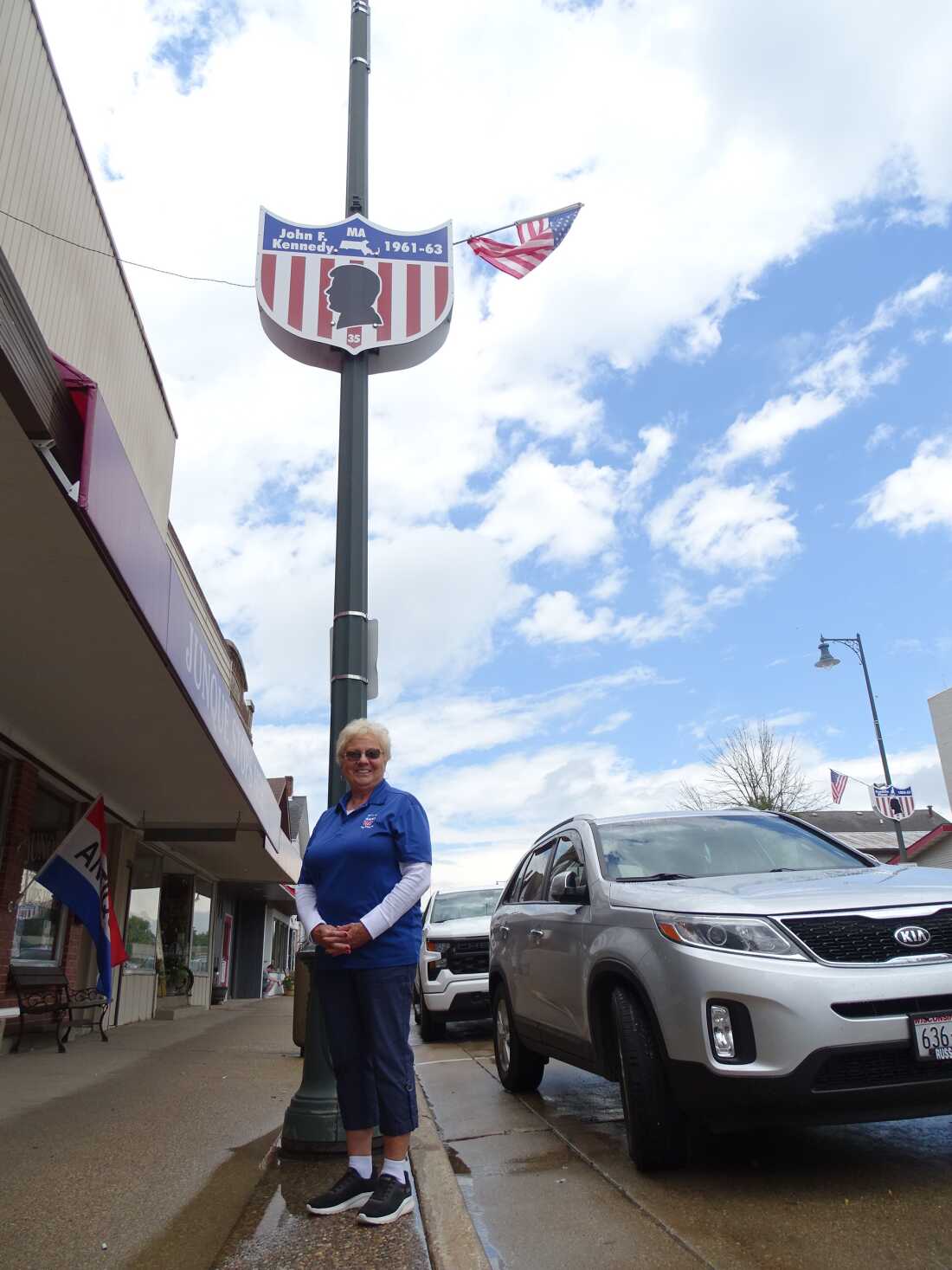
Donna Rogers shows off one of Cuba City’s presidential lampposts.
Susan Bence/WUWM
hide caption
toggle caption
Susan Bence/WUWM
A few years later, she was tapped to help keep the initiative alive.
When she thinks of the country’s history, she says the signing of the Declaration of Independence and abolition of slavery top her list, plus a current event–
“Of course, now, our nation’s 250th birthday. I think those three would be the three most important things in history to me,” she said, quickly adding “[the] right for women to vote, don’t forget that, right?”
Rogers and Cuba City are pulling out all the stops for the 250th, with a parade and a mac-and-cheese festival, because “that was some of our founding fathers favorite foods, along with turkey and cranberries and other items.”
She laughed and admitted she googled that. True or not, Rogers says they’ll go all-out to celebrate the 250th in her “City of Presidents”.
WUWM’s Susan Bence reported from Cuba City, Wisconsin.
In Georgia, a civics competition inspires hope for future generations
At the Georgia state finals of the National Civics Bee, middle school students were peppered with questions about the U.S. government.
Like this one: why is a single energetic executive desirable?
The answer: it promotes accountability and decisive leadership.

9th grader Ella Hummel got it right.
“I’ve always kind of had the idea of serving in politics,” she said after the competition. “And I really think that civics has opened my mind.”
Ella will advance to the civics bee finals later this fall, with her grandmother, Peggy Farmer, cheering her on. Farmer remembers the excitement around the bicentennial in 1976, but said she feels a different energy around this year’s anniversary.
“It’s a togetherness type of thing that’s really not around all the time now,” she mused. “I think it’s just the world’s changed a lot.”
But there is something Farmer will celebrate about America on this Independence Day: her grandkid, the Georgia Civics Bee Champion.
“Maybe she and the kids that was sitting up there, they can change [the country] a little bit. I mean, they seem to be having a ball with each other up there today, so that’s a good thing.”
GPB’s Sofi Gratas reported from Atlanta.
In Texas, appreciating the process of patriotism

Rodney Ellis, who has served 43 years in public office, is guardedly optimistic that America will stay on a path towards progress.
John Burnett
hide caption
toggle caption
John Burnett
Rodney Ellis will celebrate at picnics around his precinct in Houston with barbecue pork ribs and ice tea, and a heaping helping of worry about the nation’s future. The tall, garrulous 72-year-old county commissioner is guardedly patriotic.
“We should be celebrating that America is a process,” he said. “Patriotism is telling the truth, and doin’ the work to repair the harms that have come about over these 250 years.”
The son of a maid and a landscaper, Ellis has served 43 years in public office, first as a Houston city councilman, then state senator, and now as a Harris County commissioner.
Fifty years ago, during the bicentennial, Ellis was a public affairs graduate student at the University of Texas in Austin. In 1976, there were 18 Black representatives in Congress; today there are 67.
“We’ve made tremendous progress since then, tremendous gains,” he said. “And so when I compare what was happening then to what’s happening now, I look at how quickly a lot of those fundamental rights, those gains that we’ve taken for granted have rolled back so quickly.”
He ticked off areas where he believes America has lost ground: clean air and clean water, people of color in key positions in government, owning up to uncomfortable U.S. history, and selfless public service.
But, said the commissioner with a broad grin, that’s how it’s always been in America.
“Progress is made but along the way sometimes you take two steps forward and 10 steps back, but you don’t give up.”
John Burnett reported from Houston, TX.
In Milwaukee, Fourth of July tacos with a big helping of pride

Gissell Vera is proud to be both American and Mexican. She plans to celebrate both of her cultures with a Fourth of July carne asada cookout.
Maayan Silver/WUWM
hide caption
toggle caption
Maayan Silver/WUWM
Gissell Vera ordered carne asada tacos on her favorite patio in Milwaukee, a vibrant spot punctuated with strings of international flags and a steady cumbia drumbeat.
“The music, the colors, the language, all of it is part of me and I am a proud American,” she said.
Vera is a U.S. citizen from a mixed status family; her parents emigrated from Veracruz, Mexico.
“My family has particularly always been grateful for this country and the opportunities that it’s provided us,” said the 25 year-old. “Although there is always the fear and uncertainty of what immigration reform could, how it could impact us, we choose to live every day without fear.”
Vera said there’s a phrase she’s heard many immigrants use to describe their relationship to the United States, “ni de aquí ni de allá,”, meaning ‘neither from here or there.’
“It’s almost like a limbo in which we existed,” she explained. “And I think that now I’m very proud to say that I am ‘de aquí’ and ‘de allá’. So I am proud to be from here and from there.”
She said she’ll join her family for a cookout to celebrate America’s 250th birthday, but instead of hot dogs, they’ll be grilling carne asada.
WUWM’s Maayan Silver reported from Milwaukee.
In the Mountain West, a closer look at a national myth
As America turned 250 this year, historian Megan Kate Nelson used the occasion to take a closer look at a foundational myth of the country’s history and ask, “what stories do we carry forward?”
Her new book ‘The Westerners’ profiled pioneers who, according to Nelson, don’t fit “the narrative of white Easterners moving westward in covered wagons with a nuclear family in tow, engaging with a series of challenges.”

A statue of Sacagawea along the banks of the Missouri River in Great Falls, Mont. Sacajawea was a Lemhi Shoshone woman, who accompanied Lewis and Clark as an interpreter and guide. Her role in the expedition is reexamined in Megan Kate Nelson’s book.
Matt Volz/AP
hide caption
toggle caption
Matt Volz/AP
That includes historical figures like Polly Bemis, who was trafficked from China to the Idaho frontier, and María Gertrudis Barceló, a Santa Fe saloon owner and professional gambler.
Even the well-known figure, Sacagawea, gets another look.
“I read through the Lewis and Clark journals. They mention her more than 150 times, and she is always doing something or saying something,” said Nelson. “My favorite part: when they arrive on the western coast, they set up camp a couple miles away from the ocean, and she yells at William Clark. ‘You are going to take me to go see the ocean! I did not travel all this way not to see the ocean!’”
Nelson said it’s more important than ever to elevate a fuller picture of westward expansion, and to challenge the frontier myth that “there’s only one white pioneer; there’s only one kind of story of American greatness.”
Ryan Warner reported from Crested Butte, Colorado.
In Rhode Island, the parade is nearly as old as the nation itself

Every Independence Day, the yellow stripes dividing Hope Street get a patriotic makeover.
David Wright/Ocean State Media
hide caption
toggle caption
David Wright/Ocean State Media
The town of Bristol, Rhode Island, lays claim to the nation’s oldest Independence Day celebration. This year, they will celebrate America’s 250th with their 241st birthday bash for the country, an effort that brought together over 100 volunteers as part of the Fourth of July committee.
Plans include a parade with at least 34 floats, a golf tournament, a “Miss Fourth of July” beauty pageant, and a gala ball.
Even the double yellow line down Hope Street got its annual red, white and blue makeover for the parade.
For the past decade, Heidi Vermilyea has been in charge of the parade souvenirs, selling hats, t-shirts, and Christmas tree ornaments out of a blue trailer.
“I think I’ve missed the parade once when I was in Europe for the Fourth of July,” Vermilyea admits. “But otherwise, I have been either watching the parade or working the parade my whole life.”
Even when she’s not working the events, she’s decked out in stars-and-stripes, all the way down to her patriotic pedicure.

Heidi Vermilyea runs the souvenir truck for Bristol’s parade every July 4th. But her American flag outfits are year-round display of her patriotism.
David Wright/Ocean State Media
hide caption
toggle caption
David Wright/Ocean State Media
“Politics you can be left, right, moderate, whatever,” Vermilyea explains. “Patriotism is just loving your community. Helping out to make your community, your country a better place.”
The way she sees it, she’s flying the flag for Bristol, her family and friends.
This story was reported by Ocean State Media’s David Wright.
In Oregon, grappling with a complicated history
Some of Mitchell S. Jackson’s fondest childhood memories are of the Fourth of July.
“My mother would always buy me an outfit that had a red, white, and blue color scheme,” Jackson, who is now 50 years old, remembered. “And it was joyous, you know, to don those colors.”
But as the Pulitzer Prize-winning writer grew up, he learned more about America’s history of slavery and racism. Jackson said that made his relationship to his country more complicated, especially after he was convicted on drug and weapons charges as a 21-year-old and imprisoned for over a year.
“I lost my right to vote before I ever voted, before it ever dawned on me that my suffrage was important,” remembers Jackson. “And I would say that that is an American project, that a young Black boy loses his right to vote.”
Jackson said these inequalities, both historical and modern, call into question the very anniversary we’re celebrating.
“When I hear 250, I know that that’s a false number, right?”

Mitchell S. Jackson at the 60th anniversary of the March on Washington. For Jackson, the 250th is not a true celebration of American freedom, since so many people were enslaved at the time.
Erwin JT Trollinger
hide caption
toggle caption
Erwin JT Trollinger
Jackson said that to him, true freedom in America only goes back 160 years, to when the 14th amendment granted everyone equal protection under the law. Or even just 62 years to the Civil Rights Act, which outlawed segregation.
“If you love something, you’re also critical of it,” he pointed out. “You don’t just love it blindly, or I hope you don’t just love it blindly. So if you truly love America, then you gotta tell the truth about America.”
Jackson says there are ways for Black Americans to make the Fourth of July, and America itself, their own. But it’s a group project to understand who we are, and who we’ve been, and who we can become.
Deena Prichep reported from Portland, Oregon.
-
 Politics48 seconds ago
Commentary: Happy Birthday, America! You’ve weathered another rough year
-
 Sports9 minutes ago
Dodgers’ Eliezer Alfonzo praying his sister and stepmother will be found in Venezuela
-

 World19 minutes ago
Reform UK’s Farage failed to disclose funds from convicted criminal: Report
-
News46 minutes ago
Paul Pelosi in hit-and-run in California, car left with major damage, authorities say
-

 Los Angeles, Ca2 hours ago
Firefighters battle Fourth of July blazes around Los Angeles
-

 Detroit, MI2 hours ago
Storm chances linger into the start of the week across Metro Detroit
-

 San Francisco, CA3 hours ago
Relay for America runs flag from San Francisco to D.C. in message of unity
-

 Dallas, TX3 hours ago
Cowboys newcomer already looks like a waste of money in Dallas

