Science
Foreign, feral honeybees are crowding out native bee species in southern California


You’ve probably heard the phrase: “Save the bees.” But new research suggests we may need to be more specific about which bees we’re saving.
Europeans introduced western honeybees (Apis mellifera L.) to the Americas in the early 1600s. They play an essential role in pollinating crops and flowering plants, and are often hailed as the “unsung heroes of our planet.” They are both omnivorous and omnipresent: Researchers have found that western honeybees visit more plant species than any other species of pollinator and are the most common visitor to plants in non-managed habitats worldwide, accounting for nearly 13% of all floral visitors.
The problem is that this dominance may be coming at the cost of some native pollinators.
That’s what caught the attention of Joshua Kohn, a former biology professor at UC San Diego. “Pollination biologists in general in North America tend to ignore western honeybees because they’re not native,” he said. “But when I saw just how abundant they were, I thought to myself: They’re not just a nuisance, they’re the story.”
In San Diego County — a global bee biodiversity hotspot — feral honeybee populations have quietly exploded in number since the late 1960s. Many of these bees trace their ancestry to a hybrid of European and African subspecies, the latter known for traits that boost survival in hot, dry climates — places with mild winters and vegetation that blooms year-round. In other words, perfect for Southern California, where previously domesticated populations became feral colonies that thrived independent of human management, nesting in rock crevices, abandoned rodent burrows and other natural cavities.
However, despite their population growth and spread, researchers don’t know much about these bees’ pollen consumption, or the extent to which their foraging habits may be displacing native species.
A new study published July 7 in the journal Insect Conservation and Diversity seeks to address that knowledge gap. Drawing from field surveys in San Diego’s coastal scrubland, researchers at UC San Diego found that feral honeybees — non-native, unmanaged descendants of domesticated bees — may be monopolizing local ecosystems and effectively squeezing out native pollinators such as bumblebees. In total, these feral bees now comprise about 90% of all bees in the area, according to the study.
“It’s like going to the Amazon rainforest to bird-watch and seeing only pigeons,” said James Hung, an ecologist at the University of Oklahoma and co-author of the study. “I was shocked. This was supposed to be a biodiversity hotspot — but all we were seeing were honeybees.”
The team also wanted to understand how honeybee foraging affected pollen availability for native species, and what that might mean for the latter’s ability to reproduce successfully. The researchers looked at how honeybees interacted with three native plants: black sage, white sage and distant phacelia. They found that in just two visits, a western honeybee could remove more than 60% of the pollen from these flowers. By the end of a single day for all three plant species analyzed, more than 80% of all pollen was gone.
The problem is that this leaves almost no pollen for native bees.
Kohn, a co-author of the study, explained that while western honeybees are prolific foragers, they aren’t always the most effective pollinators. His previous research suggests plants pollinated by these bees often produce less fit offspring, in part due to inbreeding. This is because western honeybees tend to visit many flowers on the same plant before moving on — a behavior that increases the risk of self-fertilization.
What this means for the broader plant community is still unclear, Kohn said. “But it’s likely that the offspring of plants would be more fit if they were pollinated by native pollinators. It’s possible that if honeybees were not in the system that there’d be more bumblebees, which visit flowering plants much more methodically.”
Kohn emphasized that the findings aren’t an argument against honeybee conservation, especially given their importance to agriculture. However, they do suggest we may need to reconsider how to manage domesticated western honeybee populations.
When used for agricultural pollination, managed honeybees are often brought into an area temporarily in what’s called a mobile apiary: essentially, dozens or hundreds of hives kept on a trailer or platform, moved from place to place, wherever pollination is needed. While this is essential for crops, stripping nectaring plants of resources before native species have a chance to feed could lead to their decimation.
Hung suggested designating specific forage zones for commercial beekeeping — ideally in areas less vulnerable to ecological disruption — as a way to offset that pressure. “If we can identify ecosystems that are less sensitive to disturbance — those with a lower number of endemic plant or pollinator species — we could scatter seed mixes and produce way more flowers than any comparable habitat nearby,” he said. “Then, we could set aside some acres of land for beekeepers to come and park their bees and let them forage in a way that does not disrupt the native ecosystem. This would address the conflict between large-scale managed honeybee populations and the wild bees that they could potentially be impacting.”
Rather than replacing crop pollination, the idea would be to offer alternative foraging options that keep honeybees from spilling into and dominating natural areas.
Longer-term, Hung said scientists may need to consider more direct forms of intervention, such as relocation or eradication. “Honeybees have dug their roots very deep into our ecosystem, so removing them is going to be a big challenge,” he said. But at some point, he believes, it may be necessary to protect native plants and pollinators.
In the words of Scott Black, director of the Xerces Society for Invertebrate Conservation, “Keeping honeybees to ‘save the bees’ is like raising chickens to save birds.”

Science
July Fourth fireworks may bring ‘hazardous’ air quality to Southern California. What you need to know

L.A.’s love of fireworks makes for a colorful Fourth of July, with dozens of official celebrations and countless illicit explosions expected for the holiday.
But as each sparkler, Roman candle, palm and peony dissipates, it leaves behind a cloud of noxious gases, soot and finely ground toxic metals — some of which ends up in the lungs of revelers and passersby below.
Hazardous levels of air pollution are expected across central and southern Los Angeles County, northern Orange County, and Riverside and San Bernardino counties from 5 p.m. Saturday evening through 3 p.m. Sunday, according to the South Coast Air Quality Management District. Unhealthy air quality is also expected in northern Los Angeles County and southern Orange County.
Pollution levels are expected to build from dusk onward Saturday, as light winds and increased firework activity lead to an increase in smoke, a South Coast AQMD advisory said. Soot and particulates will likely linger through Sunday afternoon before being dispersed by the wind.
Firework-related pollution can trigger coughs, breathing problems, asthma flares and heart attacks, according to Los Angeles County Public Health, and anyone experiencing severe or worsening cardiovascular symptoms like chest pain or difficulty breathing should seek medical attention immediately.
Pyrotechnics set off at home are even more likely to trigger cardiovascular problems, the American Lung Assn. says, as the burst of pollutants takes place closer to the ground.
July 4 and 5 are traditionally two of the worst days of the year for the region’s air quality, according to South Coast AQMD. This year’s celebration comes on the heels of a late June warehouse fire in Boyle Heights that released extraordinary amounts of soot and smoke across the county, on par with pollution generated by the previous year’s wildfires.
To limit negative health effects, the L.A. County public health department recommends avoiding strenuous physical activity and keeping doors and windows closed. As whole house fans and swamp coolers can suck additional pollutants inside, the department recommends using air purifiers or air conditioners as alternatives when possible.

Few substances are as deeply woven into everyday life as alcohol. It is a fixture at holiday celebrations, work-related social gatherings, sporting events, airports, and brunch or dinner tables. All demonstrate how deeply alcohol has become embedded in social customs and cultural traditions.
Yet alcohol contributes to millions of deaths globally each year and is linked to cancer, liver disease, unintentional accidents, violence and, importantly, dependence and addiction. Despite this, the disconnect between alcohol’s cultural role and its serious health burden is striking. An estimated 2.3 billion people worldwide consume alcohol.
As a physician working in addiction medicine, I regularly care for patients whose alcohol use affects nearly every organ system. It is often not until these patients end up admitted to the hospital that they learn the effects of alcohol on various parts of their body besides their liver.
Newer evidence challenges assumptions about what was long considered “safe drinking.” Even moderate drinking carries risk and is not as harmless as people, including experts, once thought.
Many people associate alcohol risk primarily with addiction or dangerous behaviors such as driving while intoxicated. However, its effects extend far beyond this, into nearly every aspect of a person’s well-being.
While alcohol may transiently improve mood and ease social anxiety, long-term alcohol use can lead to a worsening of mood, cognition and sleep, which can further compound use.
A 2021 literature review found that consuming approximately two standard drinks roughly doubles the odds of sustaining injuries — with or without a vehicle involved. The review also found that heavy episodic (binge) drinking can increase the risk of injury by 50-fold, depending on the amount of alcohol consumed and the type of injury. While alcohol’s effects on the liver are well known, it can also lead to gastrointestinal complications and heart disease
The World Health Organization estimates that 2.6 million deaths each year are attributable to alcohol, accounting for nearly 1 in every 20 deaths worldwide.
While many people recognize the risks of alcohol addiction, people are generally much less aware of the links between alcohol use and cancer risk.
The World Health Organization classifies alcohol as a Group 1 carcinogen — the same category as tobacco and asbestos. In 2025, the U.S. surgeon general emphasized that alcohol increases the risk of at least seven cancers, including cancers of the breast, colorectal, liver, oral, esophagus and larynx. An advisory called for updated warning labels.
Yet fewer than half of Americans recognize alcohol as a risk factor for cancer, particularly for cancers such as breast cancer that are not commonly associated with alcohol use.
Throughout the 1990s and early 2000s, observational studies suggested that moderate alcohol consumption might offer cardiovascular benefits. Over the past decade, however, higher-quality studies have challenged these findings, suggesting that much of the apparent benefit may have reflected differences in the health and lifestyles of moderate drinkers rather than a protective effect of alcohol itself.
Current evidence increasingly suggests that even low levels of alcohol may increase cancer risk.
Federal guidelines acknowledge that adults should “consume less alcohol for better overall health.” However, the most recent version of the “Dietary Guidelines for Americans,” updated in January, removed the previous recommendation to limit intake to no more than one drink per day for women and two for men. It also omitted explicit discussion of alcohol’s links to cancer.
These changes have drawn criticism from public health experts, who argue that the revised language plays down the growing evidence of alcohol-related harms and provides less specific guidance to consumers. The current administrator of the Centers for Medicare & Medicaid Services characterized alcohol as a “social lubricant” that brings people together, rather than emphasizing its well-established health risks.
This may be true physiologically, at least temporarily, but obscures the fact that relying on it as a social lubricant can lead to chemical and psychological dependency. In my view, statements to that effect are shortsighted, prioritizing short-term social effects over more insidious and long-term issues, including addiction.
While many dangerous mind-altering substances are hidden from public perception, alcohol is often placed at the center of it – a trend that shows no sign of changing imminently.
Further, large companies often profit from ads that appeal to young people.
Looking back at the history of tobacco smoking provides some helpful insights. In 1965, 42.4% of the U.S. population smoked. By 2022, that figure had dropped to 11.6%.
This steep decline did not happen because of a single intervention, but through decades of accumulating scientific evidence, public education campaigns, warning labels, restrictions on advertising, smoke-free policies, higher tobacco taxes and shifts in social norms. Together, these efforts transformed smoking from a widely accepted social behavior into one broadly recognized as a major health risk and correspondingly, less socially accepted.
Although alcohol consumption has modestly declined in recent years, it remains deeply embedded in social life in ways cigarette smoking no longer is.
People often assume that if a substance is legal, common and widely socially accepted — even encouraged — it must also be safe. But public health history suggests those assumptions can and should change.
Emma Fenske is an addiction medicine fellow and internal medicine physician at Oregon Health & Science University. This article was produced in partnership with the Conversation.
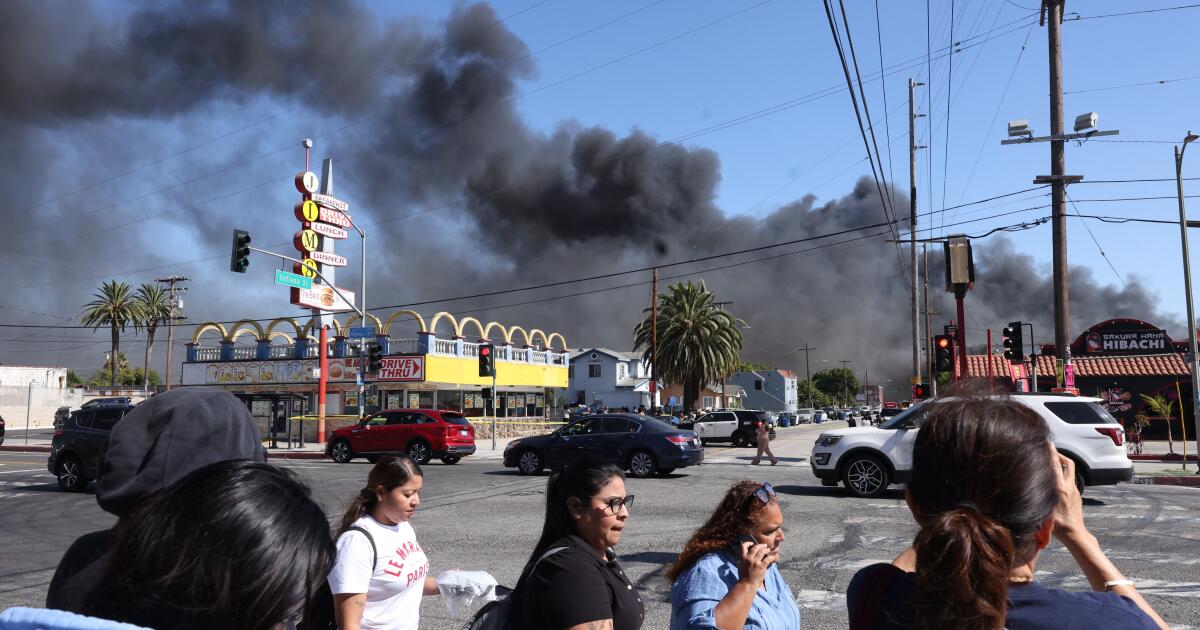
The air near the Lineage refrigerated warehouse fire in Boyle Heights carried astronomically high levels of smoke and soot, surpassing some of the worst air pollution during the Los Angeles County fires in January 2025, according to preliminary data from air officials.
The fire spewed thick black smoke for days. From downtown Los Angeles to the San Gabriel Valley, tens of thousands were enveloped in unhealthful levels of smoke, even as some local officials told residents that the air posed no danger.
As the days wore on, worst off were communities nearest the blaze. On June 19, three days after the facility ignited, a temporary air quality monitoring station at Eastman Elementary in unincorporated East Los Angeles measured an extremely hazardous 755 micrograms per cubic meter of fine particles for more than an hour, according to the South Coast Air Quality Management District.
For comparison, a Caltech air monitor in Pasadena recorded about 650 micrograms per cubic meter during the Eaton fire.
These high levels of fine particles, known as PM 2.5, probably resulted in the surge of residents into local emergency rooms during the fire, according to local health officials. But even now with the smoke gone, people still have not been told what chemicals they were breathing in during the weeklong ordeal.
Michael Jerrett, an environmental health professor at the UCLA Fielding School of Public Health, said his concern is the composition of materials emitted when the building burned.
“These contain many particularly toxic components,” Jerrett said, “and we know little about how these mixtures affect health.”
There is no completely safe level of fine particulate pollution, he noted, meaning higher concentrations are always worse.
During the 2025 L.A. County fires, local air officials announced that several monitors downwind had detected elevated levels of brain-damaging lead and cancer-causing arsenic from toxic paint and construction materials used in older homes.
The Lineage warehouse, built in 2018, is likely to contain different materials of concern. Thick insulation foam required for a massive refrigeration operation, solar panels and refrigerants were burned, leaving many residents on edge.
Even though three public agencies conducted air monitoring, the picture is still murky.
“[Public officials] are speaking with a lot of confidence but not a lot of information,” said mark! Lopez, a community organizer with East Yard Communities for Environmental Justice. “We’ve gotten in the room with folks to discuss where the gaps lie and where assumptions are being made. And I think they are realizing these agencies supposed to protect our air and our health aren’t as reliable as they thought they were.”
In response to the Boyle Heights fire, the South Coast air district deployed a mobile monitoring vehicle to screen for toxic substances in the community near the fire, according to Nahal Mogharabi, a spokesperson for the air district. It found increased levels of bromine, a chemical commonly found in fire retardant, and chlorine, often released from burning plastic. Both were below short-term health-based exposure thresholds.
Toxic metals, including lead and arsenic, were not elevated, according to air district data.
“That was the reassuring piece, that they were not picking up any of the metals,” said Dr. Nichole Quick, chief medical advisor for the Los Angeles County Department of Public Health. “But … that smoke is unhealthy. “You don’t want to be breathing it, regardless.”
The U.S. Environmental Protection Agency set up air monitors around the perimeter of the facility to test for toxic air contaminants, has the results and has not made them public. Julia Giarmoleo, an EPA spokesperson, said the monitors did not detect elevated metals, but would not provide a copy of the data without a federal records request.
The Los Angeles Fire Department’s hazardous material team also tested for ammonia, which is used in refrigeration, and hydrogen fluoride, a toxic chemical that could be released by burning lithium-ion batteries and solar panels.
Fire officials previously said they measured low levels of hydrogen fluoride on the second day of the fire. But the department would not answer questions about its air monitoring. It also told a reporter to submit a public records request.
It remains unclear whether any agency has tested for hydrogen cyanide or isocyanates, highly toxic gases that could be released from burning chemical-laden insulating foam inside the building.
“The real issue is what monitoring has not been done to protect the fence-line community from the air toxics,” said Jane Williams, executive director of California Communities Against Toxics.
Without the EPA or LAFD data, what is known of the smoke’s toxicity rests on the air district’s mobile monitoring.
Jerrett, the UCLA researcher, said that is not ideal for understanding the kind of plume released by the Boyle Heights fire, which rapidly changed direction with the wind.
“This can in some instances lead to levels that look low, but they are resulting from a mismatch between the location of the vehicle and the plume,” he said.
The Boyle Heights blaze, similar to the Eaton and Palisades fires, has revealed the region’s air monitoring can’t always tell people what they’ve been exposed to in a disaster.
“We do need a better monitoring system in place,” he said.
Local officials are now shifting their focus to the rancid odors from millions of pounds of rotting food in the ruined wing of the warehouse. Decomposing food can release hydrogen sulfide, a toxic gas synonymous with landfills and garbage. Lineage hired contractors who are measuring this noxious gas and other pollution. Their data indicate they have not detected hydrogen sulfide.
As Lineage workers haul the rotting food to local landfills, they are using deodorizing mist and have discussed using shrink wrapping to suppress the stench and minimize issues for nearby homes.
At this point, the odors are believed to be an inconvenience rather than a public health threat, according to Quick, the county medical advisor. She said running air purifiers may help to reduce odors indoors.
“It’s very important for folks to understand that the odors themselves do not indicate any dangerous levels of toxins, mold, bacteria, and so forth,” Quick said. “But the odors are a public nuisance.”
The air district is still encouraging residents to report odors to its online complaint system or by calling (800) 288-7664.
-

 Los Angeles, Ca48 minutes ago
Firefighters battle Fourth of July blazes around Los Angeles
-

 Detroit, MI1 hour ago
Storm chances linger into the start of the week across Metro Detroit
-

 San Francisco, CA1 hour ago
Relay for America runs flag from San Francisco to D.C. in message of unity
-

 Dallas, TX1 hour ago
Cowboys newcomer already looks like a waste of money in Dallas
-

 Miami, FL2 hours ago
Police search for suspect after man is shot while on a boat near hotel in Fort Lauderdale on 4th of July
-

 Boston, MA2 hours ago
Sonny Gray shines again, and the Red Sox make it two straight wins at the Angels to start grinding road trip – The Boston Globe
-

 Denver, CO2 hours ago
Aldi expanding into Colorado, applies for permits at two Denver locations
-

 Seattle, WA2 hours ago
Seattle Storm lose 77-72 to Fire behind Carla Leite’s 20 points

