Lifestyle
Restaurateur Rose Previte shares recipes she learned from women around the world


TONYA MOSLEY, HOST:
This is FRESH AIR. I’m Tonya Mosley. One of the first lessons restaurateur Rose Previte learned early in life was what she calls the secret code – the ways her family used food to hold on to culture. Previte grew up in a small town in Ohio eating almost exclusively home-cooked Lebanese dishes that were passed down from her great-grandparents who immigrated to the U.S. But as she writes in her new cookbook, “Maydan: Recipes From Lebanon And Beyond,” it took a life-changing move to Russia for her to discover that following in her family’s footsteps was her calling. In her new cookbook, which Bon Appetit recently named one of the best cookbooks of the year, Previte shares some of her family’s tried and true recipes, as well as recipes from home cooks throughout the Middle East and Eastern Europe. Many of these recipes come from areas we often think of as conflict and war zones like Lebanon, Georgia, and Ukraine.
Previte owns four D.C. area restaurants – Compass Rose, which serves street food from around the world like Jamaican curried conch, Mexican tacos al pastor and Algerian vegetable tagine, the Kirby Club in Virginia, which specializes in kebabs, and the Michelin star-rated Maydan, which serves food from Lebanon and other parts of the Middle East. She also runs the neighboring cocktail bar Medina.
Rose Previte, welcome to FRESH AIR.
ROSE PREVITE: Thank you for having me. That was a kind introduction.
MOSLEY: Maydan is such a rich word because as we learn from you, it’s a word that carries across regions and languages and it means the same thing.
PREVITE: I find it a really powerful word. And, you know, ironically, it is an Arabic word that I learned in Kyiv, Ukraine, which seems like not a place where you would hear a lot of Arabic. But as I was sightseeing while my husband was working back in, like, I guess it was 2009, I just kept hearing everyone say meet at the Maydan, meet at Maydan. And I came to find out it was sort of the slang, you know, or the colloquial, local way of saying, like, the main square, which I believe is Freedom or Independence Square, technically, but generically it’s called Maydan. And so I looked into it a little bit more and realized in Tbilisi, Georgia, in Tehran, Iran, in all of these countries, the word is used in the exact same way to mean this kind of central gathering place. And I thought that was the power of what I wanted my restaurant spaces to be. You know, like where the food is very similar throughout a vast region but it’s actually all the same at the end of the day.
MOSLEY: In this cookbook, we not only learn recipes from home kitchens that span across the Middle East and Eastern Europe, we also learn your origin story, how you came to this idea of bringing home kitchen food from the world into a restaurant setting, so I think it’s best to start there because your journey started with a three-year stint in Russia beginning around 2009. And your husband is journalist David Greene, who folks may know as the former host of Morning Edition. At the time, he had gotten a job as a foreign correspondent in Russia. This was his dream job. But this is not – it was not part of your life plan.
PREVITE: Oh, no, no, no, no, no. Absolutely. I don’t know if any of my life plan went the way I expected after I met David, but (laughter) most of that is a very good thing, actually. We were living in New York City just one year exactly when he came home and said that there was an opening in the Moscow bureau. And nowhere in my whole life had I desired to live in Russia. But…
MOSLEY: Had you ever visited before?
PREVITE: Oh, heck no. No. I had done study abroad in the south of Spain, I traveled Europe and I had an amazing sense of adventure, and the travel bug had 100% bit me after that study abroad experience. So I wanted the adventure. I wasn’t quite 30 years old, we didn’t have kids, so logically, I could justify the decision, right? And, you know, I was also probably overly confident that study abroad had prepared me for Moscow because it didn’t. I assure you, nothing prepares you for that. And I also think I underestimated the difficulty of not knowing the language before we went. Nothing I anticipated – and probably that’s why we went, ’cause had I realized how hard everything would be, I might not have agreed.
MOSLEY: You would have said no right away.
PREVITE: Yeah.
MOSLEY: The thing, as well, was that you had a career that you were headed towards in public policy.
PREVITE: Oh, yeah. I was fresh out of grad school with, like, the vigor of, you know, a young person who thinks they can go out and change the world now that they’ve studied, you know, the law and policy. And that’s what I went to D.C. for in the first place was to change the world and fix things. And I felt policy school was going to be that way. And I had worked for just one year exactly with the New York City Council, was really enjoying it. I was a policy analyst. So yeah, it wasn’t exactly in the cards to get on an airplane to Moscow exactly a year after moving there.
MOSLEY: So you all were stationed there in Moscow. You and David also, though, while you were living there, visited lots of other places. I think more than 30 countries. And this is where most of your culinary discoveries happened. You write about how you and David would try to eat local foods wherever you went.
PREVITE: Always. And David has a stomach of steel. I should also give credit to that. He can eat anything. That was the greatest part. We learned a lot in Russia, but the fact that we were able to travel was really powerful. It was to places we would never have been like, oh, let’s go on vacation to Kazakhstan. No.
MOSLEY: Yeah.
PREVITE: Like, Americans rarely say that, right? But there we were, Kazakhstan, Belarus, parts of Central Asia, and then in the Middle East, which I didn’t travel to as a child, so it was very cool to start going to Egypt and Turkey regularly. So it was all around, yeah, like, a food-filled travel experience. When David wasn’t working, we would explore together and often get lost together. And, you know, this is – by the way, he has a black market iPhone. I don’t. This is on just the cusp of iPhone. So we’re still getting around with, like, maps and stuff.
MOSLEY: Oh, you’ve got, like, “Thomas Guide”-type…
PREVITE: Oh…
MOSLEY: …Maps.
PREVITE: …We’ve got our “Let’s Go” books. We’ve got all that because truly, we don’t have that access that we have now. So we were getting lost a lot. But what would end up happening is almost always, we would find some amazing place to eat and find directions but then, you know, stayed for something, some snack, and then get back on our way once we figured out we weren’t forever lost and we were going to get home, you know?
MOSLEY: You all had something called the kebab test…
PREVITE: Oh.
MOSLEY: …Where you would have a kebab, and it would tell you something about a place.
PREVITE: We have this theory that, you know, almost all the countries we went to had a kebab culture of some sort, and it was always tied to street food. And that’s why Compass Rose’s first menu was based on…
MOSLEY: Your first restaurant.
PREVITE: …Street food from – yes. I’m sorry, Compass Rose, which we opened in 2014 after getting back to the U.S. But it was a menu of street foods from around the world because that is – was David and I’s favorite thing. And that tended to be where our greatest memory was held was, again, in some street stall, rarely a food truck. Let me tell you, the places we go, food trucks are really a privilege and luxury. Like, most of the time, you’re just talking a grill or a fire on the side of the road.
MOSLEY: Like a stand.
PREVITE: Just a stand. Yeah. There’s nothing fancy about it like we have here. So I’m talking just grills, fire, sometimes a whole goat is just hanging and they’re cutting off slices of goat and throwing it on the fire. Sometimes it’s camel. We did that in Oman. But we ate all of it, and we couldn’t have been happier. And then always had, like, some memory, like getting lost or finding someone amazing to talk to. And it always came back to the food. But the kebabs, like, to me, they carry, like, the flavors of whatever country you’re in. So often, it’s whatever spices – like, when we were in Oman, it was tamarind. Tamarind rubbed and marinated shrimp, and tamarind was a flavor that, for example, in Lebanese cooking, we don’t use that often. So it was just a profile that I will always associate with that trip, with that experience with the guy who was grilling the shrimp, who we begged for the recipe, who was really confused why we would want it.
MOSLEY: Oh, really?
PREVITE: Yeah.
MOSLEY: When you asked, he thought…
PREVITE: Yeah. I’m just, you know, there isn’t, like, some big food culture, restaurant culture in a lot of these places. So for me to say I’m dreaming of opening a restaurant one day, I’d really love to know how you made this, it takes a minute, and then usually there’s an element of, you know, kind of surprise and then flattery that’s like, oh, OK, you like it so much you would bring it back to America and put it in a restaurant.
MOSLEY: Yeah.
PREVITE: And, you know, we had that experience over and over again. But I feel like, yeah, the kebab tends to be a real, you know, example of what you’re going to find when you dig deeper into the food culture of that country.
MOSLEY: Well, what’s interesting about your restaurants and this cookbook is that you all traveled all around the world, but your eyes are kind of set on Eastern Europe and the Middle East and specifically places where we consider them conflict zones. Where anytime those areas are brought up, it’s in the context of something that has happened there. But you’re drawn to those areas.
PREVITE: Definitely. And I think my sense of adventure is great. So that overcomes fear, often. And David, as a travel companion who’s gone into war zones for his entire career, is not afraid of anything, you know, so we were definitely not afraid to travel to parts of this region, like, you know, generally called the Middle East, where, you know, a lot of us are trying to get away from that terminology, but for purposes of the cookbook, it was definitely easier to use that to describe the region. But I like to say we traveled from, you know, Tangier to Tehran and from Batumi to Beirut.
So if you think of that region of the world, that’s where we concentrated a lot of our travels from – while we were in Russia and since we’ve been back in the States, I go repeatedly back to Lebanon and to Turkey. I’m dying to go back to Oman, but I haven’t been there recently. And then the Republic of Georgia, which a lot of times is not associated – right? – with the Middle Eastern food, but it is the crossroads of everything. And you will hear me talk about it and you’ll hear it in the book…
MOSLEY: It’s in the cookbook.
PREVITE: …Over and over again.
MOSLEY: Yes.
PREVITE: Yeah. I’m sorry. I’m obsessed.
MOSLEY: You have a love affair with Georgia.
PREVITE: And not a drop of Georgian blood. I mean, you know…
MOSLEY: Yeah.
PREVITE: …23andMe will confirm.
MOSLEY: What is it about the people and the places and the food?
PREVITE: It is such a beautiful place physically. But the people, the hospitality, the food and the wine are like nothing I’ve experienced. And now we’ve been to over 60 countries. And Georgia reminded me so much of Lebanon or Lebanese culture where it’s like our love language is food. We are going to invite strangers to our table. We’re not afraid of you. We want – regardless of the fact that you don’t know who we are because, like you said, of conflict. If – it was part of the Soviet Union for so long that so many Americans just lump it with Russia, and it couldn’t be more different.
MOSLEY: One thing that you write about so beautifully in this cookbook is kind of the realization that you had given up your dreams for your husband. And so I want to go into that moment because it’s what Russia represented for you in that moment of time. Was there a particular moment or culmination of moments while you were there in Russia that you realized I’m not sure who I am in this moment?
PREVITE: It was a culmination, but – and it happened slowly, you know, and I think it was slow because I think I went in thinking I’d figure out something workwise. I figured I would, worst case, bartend ’cause that – I was a 10-year bartender back in D.C., you know, I was like, there’s – I’ll figure it out. But as it became more and more apparent there was nothing I could do. I couldn’t get a visa. I couldn’t speak the language. I was starting to get, you know, the realization that I was a housewife ’cause we didn’t have kids. And while I was traveling, it’s like everyone says, the grass is always greener. You’d think it’s so romantic, and my girlfriends at home are like, wait, all you do is follow your…
MOSLEY: Go to different countries.
PREVITE: …Husband around traveling?
MOSLEY: Yeah.
PREVITE: What the hell are you complaining about?
MOSLEY: Eating wonderful food.
PREVITE: Yeah.
MOSLEY: Yeah.
PREVITE: I’m like, I know, I know, and this is an enormous privilege and I’m 100% recognizing that. But I’m a little worker bee. I just got out of school. I’d never not worked in my whole life, and because I grew up in a very patriarchal home, it was very traditional and we came from a very traditional background of women stay home and men work, I was determined that I was not going to follow that pattern, and I think that’s why it really, really got me when I figured out that that’s what I was doing. And I talk in the book about cleaning this chicken – and it’s true. I was in the kitchen with, you know, my phone to my ear talking to David, who’s in the office, about what he wanted for dinner. And I’m literally holding a whole chicken over a sink. And I’m looking at – and I look in the mirror, there’s this big mirror, and it’s dark because it’s winter. So even though I’m making dinner, it’s pitch black…
MOSLEY: It’s 4 o’clock in the…
PREVITE: …Because…
MOSLEY: …Evening. Yeah.
PREVITE: Sure is. It’s 4 o’clock, and I have no idea what time it is ’cause it’s never gotten light because it’s winter in Russia. And I see this reflection of myself – chicken in hand, you know, phone on my ear. And I had seen my mother in…
MOSLEY: You saw your mother.
PREVITE: …In this pose…
MOSLEY: You saw your mom’s reflection.
PREVITE: …So many times. And my mother is so beautiful and so amazing in so many ways, but I knew that she didn’t get her dreams of what she wanted her life to be because she was raising kids and following a very old-fashioned way of being. And I had been so determined. And there I was, looking at myself like, well, here you are.
MOSLEY: If you’re just joining us, my guest today is restaurateur Rose Previte. She has a new cookbook called “Maydan: Recipes From Lebanon And Beyond.” We’ll continue our conversation after a short break. This is FRESH AIR.
(SOUNDBITE OF MUSETTE EXPLOSION’S “SWING VALSE”)
MOSLEY: This is FRESH AIR, and today, we’re talking to Rose Previte, owner of four restaurants and writer of a new cookbook called “Maydan: Recipes From Lebanon And Beyond.” Previte’s restaurants include the Kirby Club in Fairfax, Va., and the D.C.-based Michelin star-rated Maydan.
There was this important trip that happened near the end of your stint. You and David traveled the full route of the Trans-Siberian Railway, which – let me get this right – it spans 6,000 miles.
PREVITE: Yes.
MOSLEY: I bet a lot of contemplation about life and purpose happened with you on that train trip.
PREVITE: It comes full circle. This is, like, a full year – from the chicken moment to the train is probably, like, a full year of brooding – right? – because it was toward the end of the trip. I was really antsy to go back to work at this point. And then David says, my finale story is going to be this train from Moscow to Vladivostok, and it’s the length of the largest country in the world. And we’re going to take the regular old train. And so I…
MOSLEY: You got to describe this train.
PREVITE: I mean…
MOSLEY: But anyway, yeah.
PREVITE: There – surprisingly, I think everyone sees the vision of the train as cold. What’s funny is it’s below freezing every single day. Not one day did it ever get above freezing that we’re in Siberia in December in 2011, OK?
MOSLEY: So you’re wearing – what are you wearing on the train? Your full…
PREVITE: Well, by this point, I figured out what kind of winter coat. So, yeah, we’re all bundled up. But the train itself is actually very hot because it’s fueled by coal. It’s very warm. There’s a samovar full of water at the end of every train car. So the one gift the train gives you is constant hot water. So we’re eating, you know, ramen noodles and stuff like that, because the train car that has the dining car that has this huge menu actually turns out to have none of the food that’s on the menu. And it ended up being a joke with us because we – you know, after days – we’re talking, like, you go 60 hours without getting off the train, right?
MOSLEY: Yeah.
PREVITE: And the only thing you have to look forward to is the meal car. So we’d go down regardless of what train we were on because we would get off. We took three weeks to take this trip. You can do it in four days if you don’t get off at all. But we’re getting off in villages. We took three weeks to do it, so we were on different trains. But the one thing that every train had in common – and as a food person, you could understand my utter dismay – was a completely wretched food car. And there’d be this elaborate menu, as thick as the Bible.
MOSLEY: And you couldn’t get anything on it.
PREVITE: No.
MOSLEY: What could you get?
PREVITE: Borscht. You could get borscht.
MOSLEY: And you have to describe what that is.
PREVITE: I mean, the only thing they had was borscht, and we still laugh about it because we – like, chicken Kyiv, stuffed cabbage. We’d point to all these beautiful things, and they’d say, nyet, nyet, nyet – just no, no, no in Russian over and over and over. And then finally they’d say borscht, which is a beet-based vegetable soup. You can add meat if you want, but oftentimes on the train there was no meat. It was just vegetables in, you know, beets basically, so this red broth. And while good at first, it gets real, real old. Like, I couldn’t eat beets when we got back to the States for a couple of years. Like, it was memory of these long journeys and the just complete disappointment of thinking that you were going to get a nice hot meal, and all you would have was borscht.
So that was the state of the train – lots of tea, lots of ramen noodles. You would get off for a minute maybe at a stop, and you could buy, like, sausages or these stuffed baked goods. They were stuffed with potatoes or cabbage or whatnot, you know, on the side of the train tracks or something when we could jump off for a few minutes. But it really wasn’t enjoyable because it was freezing wherever you were. So to get off, it was like a shock of cold, and then you’d get back on the hot train, so…
MOSLEY: You did have these hosts though. You’d stop, and…
PREVITE: Oh, yeah.
MOSLEY: …People would host you. So what were some of the things that they fed you when you would stop at these homes?
PREVITE: It – and that’s the beauty. And that’s where I wanted to make the distinction between Moscow, because when we were out in – you know, deeper into Russia, into smaller towns and villages, we were very welcomed. People were very friendly. You know, David’s approaching them as a journalist, so often we would just be talking to strangers, but they would never just leave it at, I’m going to do this interview. They would always…
MOSLEY: They would always make you something.
PREVITE: …Invite us into their houses. Yeah. And so we were getting these beautiful pickled tomatoes, pickled cucumbers, pickled anything and vodka. Like, there’s really – that stereotype is real. Everyone did give us vodka. But again, what is in the heart of all of these stories that I’m telling you? It’s always food, and that I carried right back on to the train. And that started to bring me back to, you know, my somewhat angry, angsty, you know, musings about not knowing what to do with my life ’cause now we’re on the cusp of going back to the U.S. I haven’t worked in three years. We’re not moving back to New York. We’re moving back to D.C., where I hadn’t even worked a year before that. So now I’m, like, looking at five years of nothing on my resume and not knowing, you know, what was going to happen. And truly, those many, many days of frozen tundras and little wooden houses covered in snow – I mean, that’s what you’re looking at out the train window.
MOSLEY: As you’re looking out the window.
PREVITE: And again, no iPhone, and even if we did, there’s no charge, so, like, you can’t even charge your devices. There’s no electricity. So we are just thinking and talking and thinking. And that is really – if you’ve already been kind of musing on something, if you really want to hit it home, hit home, you know, the question you’re asking yourself, sit on the Trans-Siberian for 60 hours at a time over three weeks, and you will start to have clarity. And I realized, like, food was such a part of my life. By denying myself, you know, even contemplating how to make a career out of it, I was kind of denying part of myself.
And when I started to think about, you know, my mom, after all those years of taking care of us, she finally, at 60 – six-zero – years old, got her own restaurant, and she did finally use food to propel her dream of having a restaurant and start to feed the entire community. And she’d been doing that out of our house while she catered, you know, just from her kitchen growing up. But for 10 years, she did have her own business. And I saw her pride in that, and I saw her success, and it warmed my heart so, so much. But what I felt bad about was she got it so much later in life that she didn’t get to enjoy it.
And I had always been very, I think, conservative or not trusting myself up to this point. So this was a moment of also trusting myself that I can make a career out of food. And everyone knows the statistics on restaurants. Like, everyone knows that it’s not a good business to go into if you want any kind of stability or work-life balance. So most of the odds are against you. But in that moment, I was like, you know what? Why don’t I just do it now? That’s what I’m going to do. I’m going to go back to America, and I’m going to at least explore how you start your own business in food, having no idea how, but I would figure it out.
MOSLEY: Our guest today is Rose Previte. She’s a restaurateur with four restaurants in the Washington, D.C., area. She has a new cookbook called “Maydan: Recipes From Lebanon And Beyond.” More after a break. I’m Tonya Mosley, and this is FRESH AIR.
(SOUNDBITE OF AARON GOLDBERG AND GUILLERMO KLEIN’S “AIRPORT FUGUE”)
MOSLEY: This is FRESH AIR. I’m Tonya Mosley. And if you’re just joining us, my guest today is restaurateur Rose Previte. She’s the owner of three restaurants and the writer of a new cookbook called “Maydan: Recipes From Lebanon And Beyond.” Previte’s restaurants include the D.C.-based Compass Rose, which serves street food from around the world, the Kirby Club in Fairfax, Va., and the Michelin-starred Maydan, which specializes in North African and Middle Eastern cuisines. Previte is also the co-founder of the wine company Go There Wines. Her love of Lebanese food comes from her upbringing. Her great-grandparents migrated from Lebanon, and she grew up with her mother cooking Lebanese dishes almost seven days a week.
Rose, one of the really interesting threads in your book is what you call the inherited immigrant experience, and I was really drawn to that way of describing it because as Americans, we tend to separate ourselves from our immigrant heritage after a few generations. We separate ourselves and really don’t connect it to our current-day identity. Did you ever have a phase in life where you pulled away from your heritage?
PREVITE: You know, interestingly enough, no, because I think my parents’ generation did because of when they grew up. They grew up in civil rights era Detroit – my mom did – and it was a time of danger to look different or not American. And that was very much what my mom’s Lebanese family was. And so Arabic was taken away. Like, don’t speak this in school. Even though my mom grew up with her grandparents and as a kid did speak it, it was taken away for safety. And so their generation pulled away. But they kept it behind closed doors, you know, in the home. It was always the food. And then in moving us to a small town in Ohio where I grew up…
MOSLEY: Ada, Ohio.
PREVITE: Ada, Ohio, population 3,000. It is not a suburb of anything. The closest cities are Dayton, that’s about an hour away. Toledo was about an hour and a half away. And there, they knew they were going to have to overcompensate because there were no Lebanese restaurants until you got to Toledo…
MOSLEY: Yeah.
PREVITE: …About an hour and a half away. So we were going to have to – they were going to have to go on overdrive of passing down culture, and food was the way that they did it. And it was very much – my mom did an amazing job of making sure we were proud of it, even though it was quickly realized that we were different. That was part of our identity and something to be proud of. And I grew up in a place that while very – we were very different, we weren’t made fun of. I was very fortunate. Like, we weren’t made fun of for being different. We always felt a little odd, especially with…
MOSLEY: You felt other.
PREVITE: We felt other. We had the garlic-smelling house and we had, you know, we went to school with our clothes smelling like food. Nobody else’s did. Our lockers – and we had all those stories, but we were very welcomed. And by high school, it was, like, we were the house to eat at. Like, that’s definitely where you went for the good food, you know?
MOSLEY: What kinds of stuff would your mother make?
PREVITE: Oh, my gosh, I mean, all of the favorites. I mean, back then – this is like ’90s Ohio. You were drinking Mountain Dew and pizza at other people’s birthday parties.
MOSLEY: (Laughter) Yeah.
PREVITE: But at ours, we were either doing, like, authentic Sunday sauce, which, let me tell you, includes pig’s feet and things like that. That’s, you know, if we did the Italian stuff. But my mom would do, you know, kousa, like, the cored-out squash that are stuffed with lamb and rice, which is one of the recipes in the cookbook. Tabbouleh instead of just a green salad. We’d have a parsley tomato bulgur salad. You know, that was how the messaging was. This is who you are, and we’re not going to hide from it. In fact, we’re going to present at all of these parties…
MOSLEY: The teenagers were eating well, huh?
PREVITE: They were eating well. And I have three brothers, so there was constantly food. There was a lot of big boys who were eating in our house. And, you know, there was always food on the table, regardless of what time you stopped by. And we just came to identify pride with it. And again, because we weren’t – you know, we were accepted in the community, it was probably a little bit easier. And I know that’s harder for people who do deal with bullying and things like that. But we didn’t. And very quickly, we almost became cool for it. It’s still a little odd to be called exotic in high school, but that was a word often…
MOSLEY: You were called exotic.
PREVITE: I was called exotic. Other things, as well. But again, often by just – almost like people who didn’t know they were saying something inappropriate. Or asking what I was, that was, like, a daily basis. Like, well, what are you? Because you couldn’t be placed, exactly. So I quickly had to become, you know, articulate in how to explain where I’m from and why.
But that inherited immigrant experience was like, but I’m not, you know, myself, internally, I felt guilt because I knew I wasn’t born there. I knew my mother wasn’t born in Lebanon, but I was claiming this history and this culture and wanting to make sure that was OK because I hadn’t suffered through the immigration that my grandparents had gone – you know, generation had really suffered through. But so much of what they went through was passed on. Like, my mom grew up with her grandparents who were the ones that came from Lebanon. And she – you know, the hard work, the poverty was inherited, you know? And there’s just certain traits that are passed down to you from that that I felt were a huge part of my life and defined who I was. So it was kind of saying it’s OK for me to own this.
MOSLEY: You all would go to Detroit often, though. Your parents, your mother in particular, is from Detroit. Your aunts and uncles lived there – your grandparents. And Detroit has a very large Lebanese population. It actually does hold the distinction – or it held for a long time as having the largest Middle Eastern population outside of the Middle East. So you can get all types of food there. Lebanese food is just a regular thing that you can get just about anywhere. What did visiting Detroit as a kid mean to you?
PREVITE: Oh, well, you know, I mean, it was so fun ’cause all our cousins were there. So there was cooking, there was family, and then there was the stocking up. Because we lived a little bit farther away, for my mom to keep catering and keep Lebanese food on our table, we had to go to all the stores in Detroit and also in Toledo, and I was shocked when I got to D.C. and I couldn’t find the Lebanese stores that seemed so prevalent in, you know, Toledo and in Detroit. So those little trips were, like, a huge part of my upbringing and such a fun part of it.
MOSLEY: Let’s take a short break. If you’re just joining us, my guest today is restaurateur Rose Previte. She has a new cookbook called “Maydan: Recipes From Lebanon And Beyond.” We’ll continue our conversation after a short break. This is FRESH AIR.
(SOUNDBITE OF GILAD HEKSELMAN’S “DO RE MI FA SOL”)
MOSLEY: This is FRESH AIR. Today we’re talking to Rose Previte, owner of three restaurants and one cocktail bar and writer of a new cookbook called “Maydan: Recipes From Lebanon And Beyond.”
So I want to talk just a little bit about some of the dishes in the cookbook and some of the things you discovered just through your travels. Like, there’s a recipe in your book for something really simple – tomato cucumber salad. But you write how you don’t know if there’s a country in the world that does not have a version of this salad. Did you start to see patterns or similarities like this as you moved through these different regions?
PREVITE: Oh, for sure.
MOSLEY: I’m thinking about the bread too.
PREVITE: Yeah, the bread, the kabobs. The tomato cucumber salad was just on repeat with slightly different spices or oils. You know, the Georgians put walnuts in it. Lebanese put mint in it. You know, it was just, like, places that seemed very different but did have a similar dish. In fact, our bread – and the recipe’s in the book – but is the flatbread that we use at Maydan. People always try to call it, like, pita or naan. And I’m like, no, no, no, no, those are different. And we actually don’t title it. We just call it flatbread because the recipe was inspired by multiple places and even the journey of bread that’s made in a tandoori-style oven. So we use a clay oven that’s fueled by fire.
MOSLEY: Yes.
PREVITE: We don’t use a commercial oven. It’s kind of crazy, actually. But it works.
MOSLEY: Do you have a favorite dish that your mom would make for you when you were a child?
PREVITE: I mean, the kibbeh nayeh. It’s basically a lamb tartare in more common terms.
MOSLEY: And how do you make it?
PREVITE: You have to go to, in my world, the Lebanese butcher or a halal or Middle Eastern butcher to get a very fat-free grade of finely ground lamb. So the fat content is basically the important thing. You got to take most of it out. So it’s like a very pure, very lean lamb that’s cut with a certain die. And then bulgur, which is the basically, you know, wheat germ, as it’s referred to. That’s basically what makes kibbeh kibbeh. You can put bulgur in potatoes – that recipe’s in the cookbook – in pumpkin. As long as there’s bulgur in Lebanese cooking, it is, at that point, kibbeh.
So kibbeh nayeh is raw lamb. Our recipe is very basic. It has ground onion in it, you know, salt and pepper. It’s served with olive oil. It’s served with raw onions and pita – what you guys – what’s called pita bread. We called it Syrian bread growing up – but Lebanese flatbread. And you make a bite with the onion and the oil and the ground lamb. And it’s a beautiful dish which – my family is Syrian Orthodox. So as a Christian family, we also put a cross. We make a cross in the middle because, my mom always told me, it was to pray that no one got sick on the raw meat. So you pray and you put a cross, and that’s how it’s presented to you. Sounds a little weird, but I think the nostalgia of it and just the flavor is super unique. And we only did it for special occasions. You know, it wasn’t an everyday dish. And so I also associate it with really special holidays.
And when I traveled in Lebanon, though, I’ll tell you, I went to both my grandfather’s village and my grandmother’s village. They actually make this dish very differently. And so…
MOSLEY: Does it taste different?
PREVITE: I acknowledge that in the book, actually.
MOSLEY: Yes.
PREVITE: There’s the recipe from Bishmizzine, which is northern Lebanon, where my grandfather’s from. They use a lot more spice, and they serve it with a pepper sauce that’s almost like a harissa – so different than the way my mom’s family does it, which is just way more flavor of the ingredients and the raw meat, not covered up by any spices. And the harissa was just, like, a – mind-blowing to me. We never did that. But my grandfather’s family did. And probably someone from North Africa who immigrated at some point to Lebanon brought that to this village, and everyone just from this village makes it that way.
MOSLEY: You have a section in the book where it’s, like, a list of maybe a dozen things that we should all have in our pantry if we want to delve into these recipes. Can you give us a simple recipe to use for something like za’atar, which is an ingredient that is typical in Lebanese food?
PREVITE: I mean, the most simple is just what we call talami bread, which is just dough that has some olive oil on top of it and then sprinkled with za’atar. So I’m not pushing you in the book to make your own za’atar blend. That would be hardcore, and you can do it if you want. But there are amazing mixes available in a lot of stores now, even in not specialty Middle Eastern stores. Za’atar is a plant. It, in itself, is an herb, but it’s blended with a bunch of other herbs. And that is, you know, the beauty of the region too. It’s the same name, but different regions have different ones. Like, there’s Lebanese, Palestinian, there’s even Aleppo blend. So specifically from Aleppo – not just from Syria, but from Aleppo.
So it’s a very, like, regional specialty that families are very proud of. So don’t go making your own. You can buy a lot of really good ones. And all I have to do – and I just did it at Christmas with my mom – is she had some – she had bought some pita that she decided was not acceptable at the local grocery store. So we cut it up, we put olive oil on it, we spread za’atar – we mixed it with olive oil and za’atar, threw it in the oven and made za’atar chips. And then you can use those for any of the dips. It makes your hummus a hundred times more exciting. You can just put some olive oil – I recommend unfiltered Lebanese olive oil – on top, and then you sprinkle za’atar on your everyday grocery store hummus, and it just makes it so much more exciting. I hope you use our recipe to make your own.
But za’atar changes everything. And so I think keep it in your pantry, even if you’re not making an elaborate recipe. You have old dough that you didn’t – you had left over from the bread recipe, or you made homemade pizza and you had some left over. Use that za’atar. Throw it over olive oil, stick it in the oven and it will taste like you spent hours making it.
MOSLEY: Food is political – what we choose to eat, who has access to it. I mean, it’s a story shaped by economics and geography and immigration. These are all things you’re thinking about.
PREVITE: All of the time. And I think, you know, the moment it all collided was in my realization, living in Russia, that I couldn’t actually get Georgian wine at the time. It was embargoed. At the time, Russia was punishing Georgia for a skirmish that they had had a few years before we got there. So all the expats are like, you got to have the Georgian wine. It’s the cheapest, highest quality wine you’ll ever have. But, oh, sorry, you can’t actually get it here right now.
MOSLEY: You can’t – access to it.
PREVITE: And once I dug in to, like, the politics of it, I’m like, this is crazy. But then I thought, for the first time after policy school, oh, my God, wine is geopolitical? This is all my worlds crashing together. You’re punishing this country because the only people buying Georgian wine back then were Russia. And it really affected the economy. The bright side is it caused Georgia to have to start selling to other countries, which is now why we can get it so easily, and a lot of people in Europe can get it so easily.
MOSLEY: Oh, interesting.
PREVITE: But that was a shift out of necessity because they were – like, the wine industry was decimated once Russia did that. But then I said to myself – that’s where the policy person came in and thought, well, when I open this restaurant, I’m going to sell as much Georgian wine as humanly possible. It’s my Putin protest. And, you know, I have to say, I was very proud. Compass Rose, for the first few years, did sell more Georgian wine than any other restaurant in America. But then as we traveled, I realized Georgia’s not the only place. They have this 8,000 years of winemaking that nobody knows about, because in the U.S. – in the Western markets, we’re always like France and Spain and Italy.
MOSLEY: There’s a certain place. Absolutely, yeah.
PREVITE: That’s it. There’s, like, three European countries – that’s it. And I was like, wait a second, Lebanon, my ancestral homeland – full of amazing wine that is very hard to access in the United States. And so I realized this is a political problem because why don’t we – because of geography, because of politics, because of socioeconomic reasons, because of war? That’s the only reason we don’t know about Georgian wine or Lebanese wine. And so, yes, I’ve made it partially my mission to combine my, you know, policy – combine my food and policy background in this way.
MOSLEY: There’s so much conflict happening in these regions at this very moment. I’m thinking about the origin of Maydan for you came from a visit to Ukraine and you hearing that term. How do you reconcile all of that as you’re trying to provide joy, a space where people are consuming food that comes from these places, while also holding space for people who are really dealing with terrible things?
PREVITE: No, from Day 1 of opening Maydan, my hope was to welcome people into the space the way people had in the countries that we visited. So our opening team went to Tunisia, Morocco, Lebanon, the Republic of Georgia and Turkey. Those were the five countries where we did a research trip. A lot of countries you do associate with conflict, and we had the absolute opposite experience, right? We could not have felt safer. We could not have felt more welcomed.
And so Maydan’s intention from Day 1 was to extend that hospitality and again inform people that the places that they only associate with things like the Arab Spring or communism actually have people just like us trying to be just like us, which is safe, and care for their families and feed their families. And, you know, food to me has always been that equalizer, the thing we all need. And what we hope with the cookbook and what the restaurants are always, you know, trying to do, even in the hardest of times like we’re in right now, is to continue that message of, like – again, back to the obligation that I have to keep telling people, you know, about these beautiful places I was fortunate enough to see and to try to make them seem more approachable through the food.
MOSLEY: Rose Previte, thank you so much for this conversation and this cookbook.
PREVITE: No, I appreciate you letting me have it. Thank you for listening.
MOSLEY: Rose Previte’s new cookbook is called “Maydan: Recipes From Lebanon And Beyond.” Coming up, we remember actor Tom Wilkinson, who died on Saturday at the age of 75. This is FRESH AIR.
(SOUNDBITE OF TOMMASO / RAVA QUARTET’S “L’AVVENTURA”)
Copyright © 2024 NPR. All rights reserved. Visit our website terms of use and permissions pages at www.npr.org for further information.
NPR transcripts are created on a rush deadline by an NPR contractor. This text may not be in its final form and may be updated or revised in the future. Accuracy and availability may vary. The authoritative record of NPR’s programming is the audio record.


Swift has attended fashion’s biggest night, the Met Gala, a handful of times over the years. Perhaps no appearance was more memorable than 2016’s event where it was not her dress, but her hair that made an impact. Swift’s bleached platinum bob at the star-studded fund-raiser that year was part of a short-lived era known as “Bleachella” to some fans.
Some fans believe the 2016 event, which both Swift and her ex-boyfriend, the actor Joe Alwyn attended, is where the couple might have first encountered one another. A moment Swifties think the songstress referenced in “Dress,” singing “flashback when you met me, your buzz cut and my hair bleached,” a line that describes how both stars looked that night.
For her first time as host on “Saturday Night Live,” a then 19-year-old Swift arrived having already written the song she would sing as the opening monologue. Seth Meyers, the show’s head writer at the time, later recalled bringing Swift into Lorne Michaels’s office, where she performed a “perfect” musical monologue and noted it was better than what the show’s writers had concocted for her to deliver. Swift has served as host and musical guest on the sketch-comedy show over the years. She’s also made repeated cameo appearances, including appearing alongside Kerry Washington and Betty White in a “Californians” sketch in 2015 for the show’s 40th anniversary.
In 2023, Swift and Travis Kelce both made cameo appearances on the show. The same day, they were also spotted by tabloids holding hands in New York City, one of the earliest public glimpses of them as a couple.
The iconic arena in Midtown Manhattan will serve as the venue for a private, two-day event around the wedding of Swift and Kelce on July 2 and 3. The first event will reportedly be a smaller gathering of 100 people for a rehearsal dinner at the Infosys Theater, a venue inside the Garden, while as many as 1,000 guests are expected to arrive at the venue the next day for a larger celebration, with possible stage appearances. Swift has some history with the Garden, performing there several times over the years, as well as sitting courtside and cheering the Knicks to a win during a game earlier this summer.
Whenever the singer is spotted coming and going from the Greenwich Village recording studio — which was founded by Jimi Hendrix and has hosted icons like the Rolling Stones and Chuck Berry over the years — fans are immediately abuzz with whispers about new music. Swift has worked there with Jack Antonoff, her longtime collaborator, on albums including “Lover” and “Folklore,” as well as re-releases of her older albums.
Swift has been spotted plenty of times at this Italian hot spot in the West Village neighborhood of Manhattan, most recently in May, celebrating Lena Dunham’s 40th birthday. If you can’t get a table, try your hand at making their famed — and delicious — salad dressing.
For a period between 2016 and 2017, Swift rented a four-story townhouse in Manhattan’s West Village. The pad appears to have inspired her 2019 track “Cornelia Street” from the album “Lover.” It’s a road she’ll never walk again, at least according to her lyrics.
Fans still regularly visit the house, even though it has been nearly a decade since Swift inhabited the home, which has an indoor swimming pool. In 2023, some Swifties made pilgrimages to the location after news broke on her split with the actor Joe Alwyn, whose relationship fans believe to be the inspiration for many of the tracks on “Lover.”
Swift’s residence in the TriBeCa neighborhood of Manhattan has grown over the years. She initially bought two penthouses from the “The Lord of the Rings” director Peter Jackson in 2014. A fan who once visited the apartment recalled Swift’s father saying that when his daughter first viewed the place, the actor Ian McKellen, who had been living there, was sitting in the kitchen. She has since purchased several adjacent properties.
Fans have seen glimpses of the home on social media over the years and, more recently, watched Swift use a fire extinguisher to put out a small candle blaze in the kitchen in a video posted by Swift’s recent musical collaborator Gracie Abrams.
Good luck getting a table here if you are not Swift or Kelce. The upscale American restaurant in SoHo is known for comforting dishes like a French dip sandwich and an ice cream sundae, as well as its savory sour-cream-and-onion martini from the cocktail menu. Swift has visited several times — including outings with Gigi Hadid and Sabrina Carpenter.
In “Delicate,” Swift sings of an unnamed “dive bar on the East Side.” Swifties believe this dark speakeasy on East Seventh Street is that bar. Fans also believe the song was written about Swift’s ex-boyfriend, the actor Joe Alwyn. The pair broke up in 2023; later that year she met Kelce.
This exclusive, members-only club in Lower Manhattan is frequented by plenty of celebrities, including Swift. The club bans photography and videos, as well as members of the media, and patrons are barred from identifying others in the room on social media or to the press.
Still, even with the privacy rules, there have been plenty of posts and photos documenting Swift coming and going from Zero Bond. There was a visit in 2023 with the actor Miles Teller and his wife, Keleigh, as well as a recent celebratory evening with the Haim sisters in June after the group watched the Knicks win at Madison Square Garden in matching shirts. There have also been multiple visits with Kelce over the years.
Swift spent part of her 34th birthday celebration at this rustic American restaurant on the Lower East Side of Manhattan. Wearing a black minidress bedazzled with a moon and stars — a nice nod to the visual themes of her “Midnights” era — she partied the night away at Freemans’ upstairs cocktail bar with guests including Jack Antonoff, Blake Lively, Zoë Kravitz, the Haim sisters, Sabrina Carpenter and her childhood best friend, Abigail Anderson Berard, who was immortalized in Swift’s song “Fifteen.” The pop star was also seen dining here with Gracie Abrams earlier that same year.
People line up for hours — yes, hours — to secure a spot at this restaurant in the Carroll Gardens neighborhood of Brooklyn. The brick-oven pizza spot, which is B.Y.O.B. and cash only, is a favorite of pizza connoisseurs — though not those at The New York Times — and celebrities alike. (Its owner has said he does not accept reservations.) Beyoncé, Jay-Z, the Beckhams and, of course, Swift have all been seen dining here, though unclear if they had to sweat it out in the line like us mere mortals. Swift, who once sent her dad to hand out pizzas, though likely not from Lucali, to fans camping out in New York to watch her perform on “Good Morning America,” has shared meals here with famous friends including Blake Lively and Selena Gomez, as well as a date night with Kelce.
The Brooklyn neighborhood where, if Swiftie lyrical interpretations are to be trusted, Swift left a now-infamous scarf at the home of one Maggie Gyllenhaal around 2010. Swift was dating Gyllenhaal’s brother, Jake, at the time and their relationship is believed to have inspired Swift’s “All Too Well,” a 2012 heart-wrencher of a song beloved by many fans, which Rolling Stone once ranked as her best song. “You keep my old scarf from that very first week,” Swift sings. In 2017, Maggie Gyllenhaal told Andy Cohen on “Watch What Happens Live” that she was “in the dark about the scarf.”
Swift later released an updated, 10-minute version of the track in 2021. A red scarf featured prominently as a thematic motif in “All Too Well: The Short Film,” which Swift also released that same year.
Lifestyle
DLTA’s former Ace Hotel is reborn as a ‘creative hub’ — and yes, you can still sleep there
The historic 1920s tower that once housed the beloved Ace Hotel is entering a new era just in time for the summer.
Two years after opening in the iconic Spanish Gothic building on South Broadway, Stile Downtown Los Angeles has unveiled its multimillion-dollar renovation and its expansion from a limited-service hotel to a full “creative hub.” The makeover adds a 24/7 membership-based creative lab with state-of-the-art music studios, co-working lounges, an updated rooftop bar called Somewhere Special, a restored theater and a curated retail shop for the community.
“We don’t really want to call it just a hotel — it’s more of a hub,” says Jaisun Ihm, CEO of AJU Continuum, the investment company that purchased the historic space.
Throughout the space are throwback touches — for instance, hotel guests can borrow a Walkman and browse the curated cassette library with titles like Sade’s “Promise,” Paula Abdul’s “Forever Your Girl” and the Isley Brothers’ “Between the Sheets.”
Behind the massive overhaul is South Korea-based AJU Continuum, which purchased the property in 2019 but didn’t change the name until 2024. The project marks the investment company’s first U.S. expansion.
“We don’t really want to call it just a hotel — it’s more of a hub,” says Jaisun Ihm, CEO of AJU Continuum, which is best known for its culture-forward Ryse Hotel in Seoul. With Stile, Ihm says their mission was to “connect L.A. to Seoul.”
Ryse, Ihm says, encapsulates today’s eclectic lifestyle hotel: “It’s grounded in street culture. We say it’s iconoclastic. It’s youthful in nature.”
AJU Continuum teamed up with L.A. architecture and interior design studio Design, Bitches — the group behind the chic Checker Hall in Highland Park and Verve Coffee Roasters in the Arts District. Ihm didn’t care that it was Design, Bitches’ first hotel venture. After working with several firms over the years, he was tired of seeing the same aesthetic everywhere and wanted to work with a team that would bring a “bold” perspective, he says.
When the creatives at Design, Bitches got the invitation, they were all in. “I’ve always wanted to do a hotel,” says RA Rudolph, the studio’s co-founder. “I love hotels and I have opinions,” she adds laughing.
For Angelenos who frequented the Ace Hotel, a maverick venue that helped revitalize downtown L.A. for a decade beginning in 2014, walking through Stile will feel both familiar and new. While the building’s bones remain intact — a requirement of its historic-cultural monument designation — the space has an industrial-modern twist inspired by L.A.’s creative spirit.
For example, the United Theater on Broadway, which was once the 1927 flagship movie palace for the influential United Artists collective (Mary Pickford, Charlie Chaplin, Douglas Fairbanks and D.W. Griffith), now features fresh carpet, modernized sound and stage equipment and roughly 125 new light fixtures inspired by the lobby’s original Spanish Revival-style chandelier. As a nod to the building’s legacy, where Hollywood’s earliest icons broke away from major studios to control their own work, AJU Continuum has launched its own in-house booking team for the live entertainment venue. Also, the giant neon “Jesus Saves” sign that has sat atop the building since its days as a church is still there — and the owners have no plans to remove it.
1

2

3

4

5

1. A clawfoot tub inside the Loft King Suite. 2. Lounge chairs inside the Loft King Suite. 3. Hotel guests lounge in the rooftop pool. 4. Adriana Castellanos and friends hanging out in the lobby bar. 5. Photos taken in the photo booth at the Somewhere Special rooftop bar.
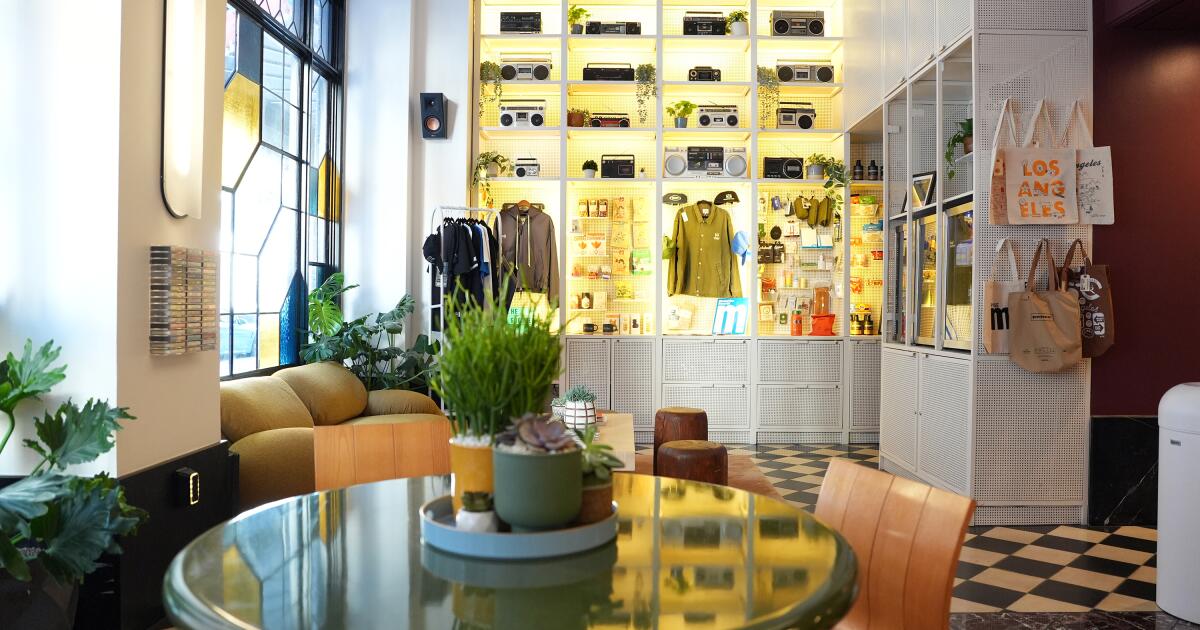
Some of the most significant changes can be found in the hotel lobby, which features a curated convenience store called the Goodie Shop, which is adorned with throwback boomboxes. Located next to the front desk, which was significantly condensed, the store is filled with a selection of California-sourced snacks and beverages, lifestyle goods, Stile-branded merch and travel essentials (phone chargers, toothpaste, hair care, etc.).
On the opposite side of the lobby is SparkHouse, a private members club and creative hub for up-and-coming musicians and creatives. The two-story space features professional recording studios, podcast and video suites, co-working lounges and meeting spaces, which are slated to open by early next year once permits are approved, Ihm says. SparkHouse’s cafe and bar is open to the public and sells tea, coffee (try the honey matcha latte), wine, beer cocktails and small bites. Ihm says programming at SparkHouse will include listening sessions, live showcases and even a mentorship program for rising artists.

“I’ve always wanted to do a hotel,” says RA Rudolph, the co-founder of Design, Bitches.
The rooftop bar, which offers stunning skyline views of the city and a pool, is now called Somewhere Special. The design team removed about 90% of the plants that used to pack the area to maximize space for dancing and mingling. Also, the pool area, now painted in a playful shade called Carrot Orange, has more seating and a photo booth nearby.
All 182 guest rooms were given a fresh coat of dusty rose paint, new custom carpet, furniture and upgraded bathrooms. In each room, you’ll find Korean amenities like face masks, a custom robe by a local brand called Room Service Los Angeles and books from the former Los Angeles University Cathedral that occupied the space from 1991 to 2011. With the hotel motto being “stay by your own rules,” Rudolph says it was important for them to make the rooms adaptable to each guest’s needs and to prioritize comfort. The result is uncommon room layouts like the tri-suite king room equipped with two twin-sized beds and a king bed split by a privacy divider that doubles as a playful art installation. Rudolph, who used to travel often with her now-adult children, says that’s the type of room she always wished had existed.
Stile’s arrival comes at a precarious moment for downtown L.A. In recent years, the neighborhood’s once buzzy hospitality and nightlife scene has experienced dwindling foot traffic, slow pandemic recovery and increased vacancies. Some business owners say crime and neglect are driving away customers. Nearly 1,000 businesses left downtown in 2024. Launching a high-concept lifestyle hotel is a bold gamble.

The Goodie Shop, a new curated convenience store, is filled with a selection of California-sourced snacks and beverages, lifestyle goods and travel essentials.
But Ihm says he hopes that Stile will help rejuvenate the area and create an ecosystem that will support neighboring businesses as well. Rudolph says she’s already starting to see that change.
“It’s been nice to see that in the last year that I’ve been coming here to work on the project, it’s livened back up again,” she says. “Especially this block, it feels better.”

Inside the World Cup Cultural Exchange
Getty Images/Getty Images
hide caption
toggle caption
Getty Images/Getty Images
What does America look like to visitors?
We’re finding out in real time as fans and athletes from all over the world visit the United States for World Cup matches across the country. From Ranch dressing, to the wonders of all-you-can-eat buffets, tourists are getting a taste of all the USA has to offer, but how do we square the warm welcome for the World Cup with the United States’ recent stances on immigration? Brittany is joined by immigration reporter Jasmine Garsd, and NPR reporter Juliana Kim to find out.
Want more global perspectives on culture? Check out these episodes:
How often do you think about the American Empire?
Make life harder (and better): Learn another language.
Support Public Media. Join NPR Plus.
Follow Brittany on Instagram: @bmluse
For handpicked podcast recommendations every week, subscribe to NPR’s Pod Club newsletter at npr.org/podclub.
This episode was produced by Liam McBain and Corey Antonio Rose. It was edited by Neena Pathak. Our Supervising Producer is Cher Vincent. Our Executive Producer is Barton Girdwood. Our VP of Programming is Yolanda Sangweni.
-

 Finance4 minutes ago
Regions Financial acquires Montgomery-based investment banking firm Frazer Lanier
-

 Fitness7 minutes ago
Apple Watch vs. Oura Ring: Which Tracks Sleep, Health and Fitness Better?
-

 Movie Reviews19 minutes ago
Millie Bobby Brown leads frothy sleuthing caper
-

 World27 minutes ago
Variety Toasts French Cinema With Post-Cannes Summer Dinner at Paris’ Laperouse With Thierry Fremaux, Guillaume Canet, Pierre-Antoine Capton, Rebecca Zlotowski and Anamaria Vartolomei
-

 Politics36 minutes ago
The Many Ways Trump Is Trying to Tip the Scales for the Midterms
-

 Lifestyle1 hour ago
Map: See Taylor Swift’s NYC Hotspots Ahead of Her MSG Wedding
-

 Education1 hour ago
Opinion | 13 George Washington Interpreters on Embodying an Icon
-

 Technology1 hour ago
Mystery box shows are complicated for everyone — even the actors

