Lifestyle
On the centennial of his birth, James Baldwin remains relevant today


The author James Baldwin would have turned 100 on Aug, 2.
Evening Standard/Getty Images/Hulton Archive
hide caption
toggle caption
Evening Standard/Getty Images/Hulton Archive
James Baldwin would have celebrated his 100th birthday Friday — on Aug. 2. On NPR and elsewhere, you can find deep examinations of his legacy – as everything from an orator, a fashion icon, to civil rights activist. But he was, of course, a writer first and foremost.
So, we thought: Why not spend a moment breaking down a few of his sentences to figure out what made his writing so affecting, so indelible, so good that it’s still worth reading today?
We’ve chosen a few lines from two of his most well-known books — his essay collection The Fire Next Time and his novel Go Tell It on the Mountain. In many ways, these books are in conversation with each other. The opening essay to The Fire Next Time is Baldwin’s letter to his 14-year-old nephew describing the faulty institutions that make up his life — his family, his faith, and his country. And the second essay opens like this: “I underwent, during the summer that I became fourteen, a prolonged religious crisis.” In Go Tell it on the Mountain, Baldwin writes a bit of fiction drawn from his own life, about a 14-year-old boy who is finding out those very same faults, as well as figuring out his own sexuality. And it opens on a very similar day of crisis.
For each book, we’ve enlisted the help of an expert to talk about what they find interesting about Baldwin’s writing style, and what legacy each work leaves. The interviews, which follow below, have been edited for length and clarity.
The Fire Next Time
The two essays in The Fire Next Time were published in the 1960s. But they still sounded new in the early 2000s when Jesmyn Ward first read them. Ward is the author of a number of books including Sing, Unburied Sing and her memoir The Men We Reaped. We called her up for this book in particular because she edited a 2016 collection of political essays and poetry titled The Fire This Time, as a nod to Baldwin. “I wanted to let him know, wherever he may be, that there are those of us who look up to him and who are attempting to do the same work that he did with the same honesty and same fearlessness” said Ward. The first essay, titled “My Dungeon Shook: Letter to my Nephew on the One Hundredth Anniversary of the Emancipation,” starts like this:

Penguin Random House/Penguin Random House
Dear James:
I have begun this letter five times and torn it up five times. I keep seeing your face, which is also the face of your father and my brother. Like him, you are tough, dark, vulnerable, moody – with a very definite tendency to sound truculent because you want no one to think you are soft.
What tone is he setting here?
JW: That first sentence in the first sentence – “I’ve begun this letter five times and turn it up five times.” Right there, he’s signaling to his nephew, we’re about to talk about something that’s very difficult. But softens that with the next line, “I keep seeing your face.” Following up with such a careful, close sort of observation about his nephew’s characteristics in the way that they sort of echo his father and his grandfather. That’s love, right? Because I love you enough to see you clearly.
You were born where you were born and face the future that you faced because you were black and for no other reason. The limits of your ambition were, thus, expected to be set forever. You were born into a society which spelled out with brutal clarity, and in as many ways as possible, that you were a worthless human being.
This is another example of his straightforward honesty with his nephew. But what did you make of it?
JW: It’s all still true. That’s one of the things that is so genius about specifically this letter. There are these moments in the texts where he doesn’t use his nephew’s name and he just uses you. And in those moments, especially in moments like this, when he is so straightforward about what he sees in America. And where he is so straightforward about how the world has been constructed to jail, or to confine in some ways. And it feels like he’s speaking to me. It feels like this wise, older wise person is sitting with me and they’re telling me something about my life and about the circumstances of my life that I dimly understood, but was not able to articulate.
This entire country has been constructed in a way that it is very easy to be terrified and bewildered and to sink into despair and hatred. And so I think that often when we return to Baldwin, what we want is we want someone to acknowledge our emotions. But then also just to say at the same time, you feel this way because this place has been constructed in this way and it is all predicated on this false understanding of your not being human. And in this section, he just makes room for your emotions. For you to feel what you feel. But then also gives you something of a gift that you can take out into the outside world and use it to help you navigate this really difficult reality.
In the next essay, titled “Down at the Cross: Letter from a Region in My Mind,” he goes to interview Elijah Muhammad, the head of the Nation of Islam, and has this dinner. And it’s rare to read something where Baldwin is not the big dog in the room. What do you make of James Baldwin the reporter being packaged inside Baldwin the essayist?
JW: I felt for Baldwin at that moment. There are so many levels of awareness that he’s sort of struggling with. He’s not the most important person in the room and in the minds of the people around him. He’s not the most erudite person in the room. And he’s also aware of the fact that the Honorable Elijah Muhammad is courting him. [Muhammad] wants [Baldwin] to buy into his philosophy. And Baldwin is aware of the fact that he can’t.
A couple of times throughout the essay he talks about the fact that, after this dinner, he’s going to meet up with some white friends and he’s going to have drinks. And these are people who he cares about and who he loves and who are part of his social circle. And who he can’t just relegate to the category of white devil. It’s very interesting to me how Baldwin is juggling all these different awarenesses and how, at the same time, there are things about the Black Muslims philosophy that he understands.
And I looked around the table. I certainly had no evidence to give them that would outweigh Elijah’s authority or the evidence o f their own lives or the reality of the streets outside.
He’s a writer. So he sees the human. He observes the human. He understands. He’s able to look at each of these people that he’s interacting with and he’s able to understand something of what they are struggling with and something of what they brought to this moment. All of that is what makes him the great writer who he is.
Go Tell It on the Mountain
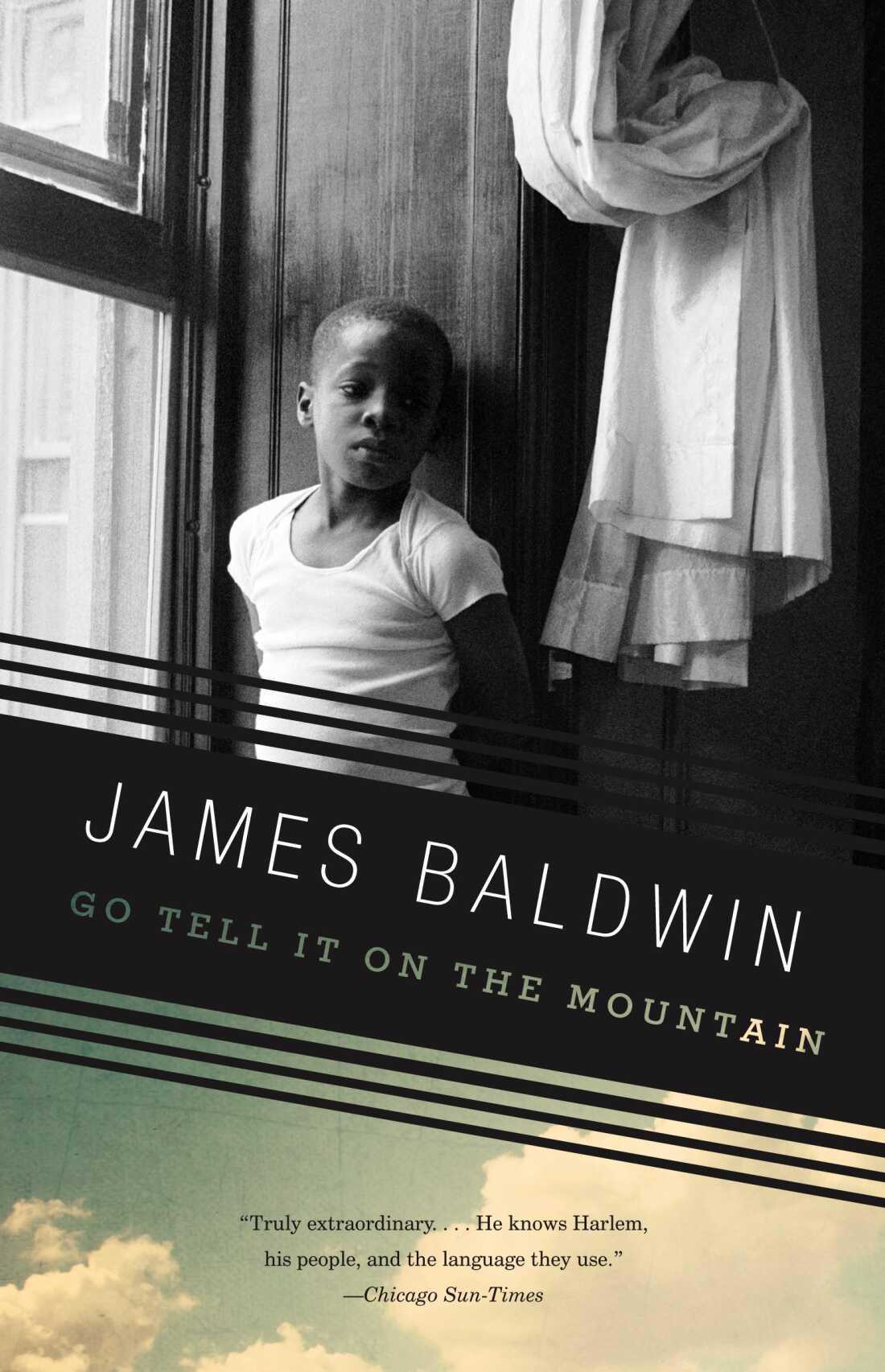
When it comes to Baldwin’s fiction work, there are plenty of books worthy of examination. But there’s something special about Go Tell It on the Mountain. “He describes this as the book he had to write if he was ever going to write anything else,” says McKinley Melton, associate professor and chair of Africana studies at Rhodes College. “I often think of it as a revisitation of his childhood with a narrative perspective that knows and understands all of the things a young Baldwin wishes he had known and understood when he was 14.”
The novel follows a boy named John undergoing that same crisis of faith Baldwin described in The Fire Next Time. But he opens it a little differently in fiction.
Penguin Random House/Penguin Random House
Everyone had always said that John would be a preacher when he grew up, just like his father. It had been said so often that John, without ever thinking about it, had come to believe it himself. Not until the morning of his fourteenth birthday did he really begin to think about it, and by then it was already too late.
That last clause kind of reads like a horror story.
MM: There’s something deeply ominous about the way that that opening paragraph closes. You open with this idea of, oh, this is just an introduction to a young man who’s stepping into a role that the father has laid out. You come into it feeling kind of hopeful and optimistic and, oh, what a beautiful thing that everybody’s envisioning this future for this young man. And we think about everything that it means when people say, oh, that kid’s going to be a preacher. We see him as an orator, we see him as an intellectual, we’ll see him as charming, we see him as engaging. We see a leader when we look at this kid. And so there’s something very optimistic about that opening that then turns by the end of the novel into. But that was actually the source of his doom.
I want to jump ahead a few pages. There’s this guy named Elijah. He’s a couple years older, and he teaches Sunday school.
John stared at Elisha all during the lesson, admiring the timbre of Elisha’s voice, much deeper and manlier than his own, admiring the leanness, and grace, and strength, and darkness of Elisha in his Sunday suit, wondering if he would ever be holy as Elisha was holy.
MM: This is another sentence that I often will pause with students to kind of think about and say, what’s going on here? And then they just say, “Oh, my God, he has a crush.” Yeah, he has a crush. Absolutely. But then we look at it and, I look at this passage and, because of all of the ways that the different clauses bounce off of one another throughout the sentence, you’re kind of leaving this saying, well, does John have the hots for Elisha? Because John is learning that he’s probably gay. Or is John admiring Elisha because he is all of the things that John has been told he’s supposed to be in terms of this kind of striving toward being a preacher when he grows up and the kind of idea of being saved in the idea of being holy, in the idea of looking good in a Sunday suit.
The middle chunk of the book goes into the lives of his aunt, his mother, and his step father. And I want to focus on his step father, Gabriel. And if you grew up in the church you know that the people who are sinners and then find God are often the most vociferously faithful. And Gabriel definitely fits that mold. There’s a bit where he has an affair with a woman named Esther, and he gets Esther pregnant.
Near the end of that summer he went out again into the field. He could not stand his home, his job, the town itself – he could not endure, day in, day out, facing the scenes and the people he had known all his life. They seemed suddenly to mock him, to stand in judgement on him; he saw guilt in everybody’s eyes.
John is scared of hell and eternal damnation. Gabriel seems more scared of other people, and very earthly judgements, right?
MM: I often think about the unfolding of this novel. We start with John in this moment of chaos and a lack of understanding. And then the novel takes us back through each of these characters who we come to understand better. We come to understand John better. He’s struggling with sin in a space that feels deeply private, deeply unspoken. Gabriel is differently positioned because he’s already in that position of prominence. He’s standing at the pulpit. He’s you know, they’re both afraid of judgment. Right. But John is afraid of revelation. And Gabriel fears that everybody already knows. Gabriel is afraid of the judgment that comes based on the fact that, like, oh, they already know who I’ve always been.
But ultimately, both of them are struggling with this sense of judgment and condemnation and the fear of being, quote unquote, discovered for being less than the holy men that they have aspired to be. But I think what Baldwin is saying is: I’m not just critiquing the church, or the Black church, or the fundamentalist church. I’m asking us to think about what damage does it do to us when we are so deeply, deeply wedded to certain beliefs that don’t allow us the fullness of our humanity? And if you’re going to be sympathetic for John, you have to figure out a way to be sympathetic for Gabriel, even if his actions don’t invite sympathy in the same way.

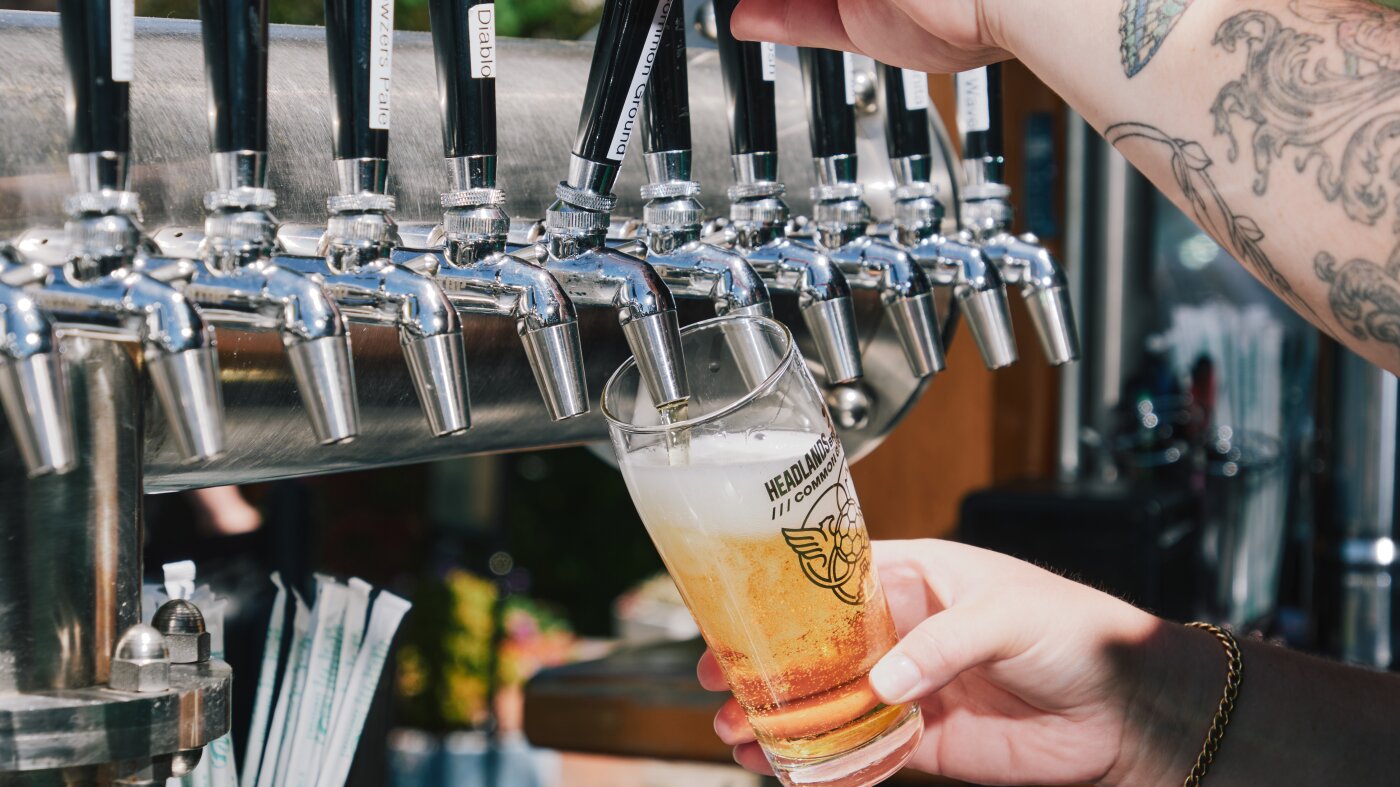
Headlands Brewing launched its World Cup-themed beer Common Ground ahead of the first World Cup game in June.
Justin Gellerson for NPR
hide caption
toggle caption
Justin Gellerson for NPR
The British betting company William Hill predicts that soccer fans will throw back more than 5 million pints of beer in stadiums and fan zones during this year’s World Cup. And that number doesn’t even account for the millions of pints being poured in bars as fans tune in to the global soccer event.
But while international soccer crowds are focusing on goals and penalties, a trio of craft breweries from the tournament’s three host nations are using the tournament to brew something increasingly rare: cross-border solidarity.

A shared recipe with local spin
The collaboration began months ago over a flurry of video chats and emails. The beermakers at Rey Árbol Brewing Co. in Mexico, Headlands Brewing in the United States, and Cabin Brewing Co. in Canada set out to design a single, unified recipe representing the brewing traditions of all three nations.
“It’s a Mexican lager,” said Alejandro Gomez, founder of Rey Árbol.
“That’s like a West Coast IPA,” said Ryan Frank, chief operating officer and brewmaster for Headlands.
“And up in Canada, most of our beers are hop driven,” said Haydon Dewes, co-founder of Cabin. “So we thought, let’s go for a dry-hopped Mexican lager.”
While all three breweries share the exact same recipe, each is giving the final product a distinct local spin, including unique, regionally designed labels. A four-pack of the U.S version costs $15.99. Frank said Headlands has produced about 130 cases of the limited-run brew.
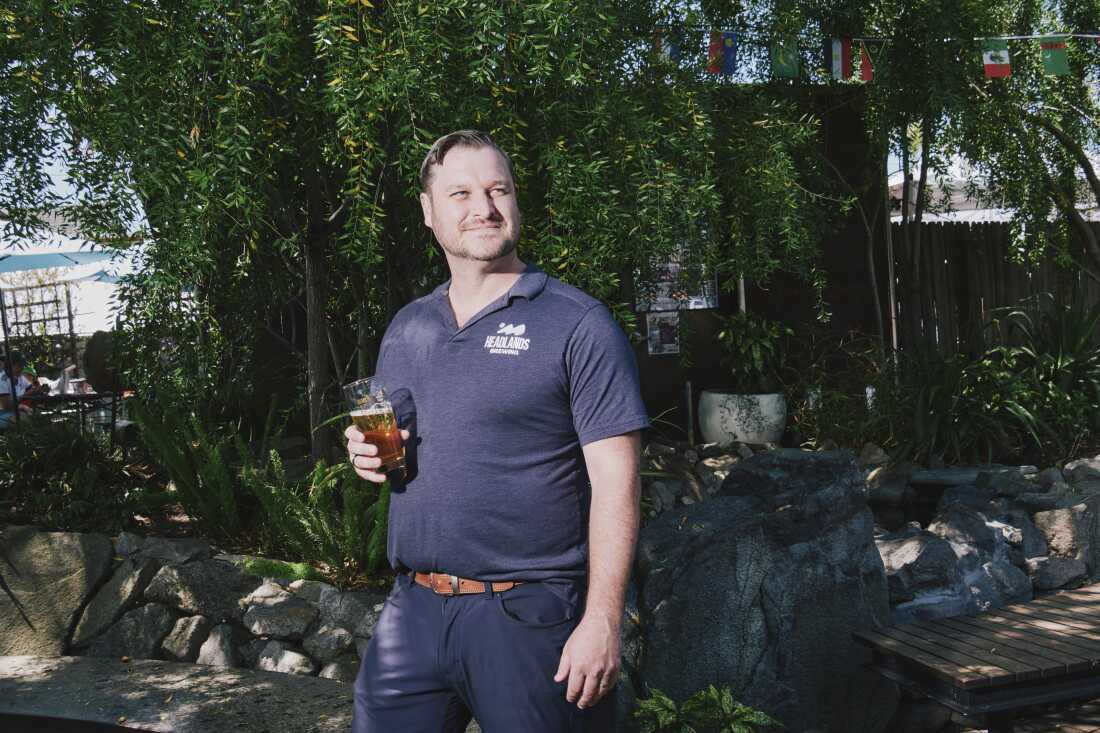
Headlands Brewing COO and brewmaster Ryan Frank drinks a Common Ground beer in Berkeley, Calif., on June 11.
Justin Gellerson for NPR
hide caption
toggle caption
Justin Gellerson for NPR
For the brewers, however, the project is less about marketing and more about connection: They named the multinational beer “Common Ground.”
“When I go to California or Canada, they will treat me like family,” Gomez said.
“It makes the world feel so much smaller,” said Dewes.
“It’s about building bridges and knowing what’s important in life,” said Frank. “And for us, that’s soccer and beer.”
Geopolitical friction in the taproom
The official rhetoric surrounding World Cup 2026 mirrors the brewers’ optimism, with promotional materials promising a tournament where billions are “united as individuals, united as billions.”
Yet this idealistic messaging stands in sharp contrast to a prickly geopolitical reality. Tensions between the U.S., Mexico and Canada have mounted over trade tariffs and auto manufacturing standards as the three nations renegotiate long-standing trade agreements.
The independent brewers behind Common Ground are feeling that friction firsthand through the rising costs of aluminum cans and raw ingredients.
“There are 15% tariffs slapped on any European-grown hops, which are really critical to some of our core brands,” Frank said.

Headlands Brewing brewmaster Ryan Frank and CEO Austin Sharp share a Common Ground beer in Berkeley, Calif., ahead of the first World Cup game on June 11.
Justin Gellerson for NPR
hide caption
toggle caption
Justin Gellerson for NPR
The political discord hasn’t just been confined to trade boards.
When signing an executive order to establish a White House Task Force for the World Cup in March 2025, President Trump suggested that cross-border hostilities might actually benefit the tournament. “Oh, I think it’s gonna make it more exciting,” the president said.
A bittersweet reminder
Tension on the soccer field is one thing; between nations, it’s another.
“It’s true that when it comes to the actual soccer, we’ve developed a very healthy, vibrant rivalry between the three countries,” said Andrés Martinez, the author of The Great Game: A Tale of Two Footballs and America’s Quest to Conquer Global Sport and co-director of Arizona State University’s Great Game Lab, which studies the intersection of sports, media and geopolitics. “But we’re also linked together in this very symbiotic relationship.”
Martinez said that when the U.S., Canada and Mexico initially launched their collaborative bid to host the World Cup back in 2017, the political climate was warmer.
“It was meant to showcase these tight bonds that had developed between the three countries,” Martinez said.

The makers of Common Ground used a shared recipe, but all created their own distinct packaging for the beer: Canada’s Cabin Brewing Co.; Mexico’s Rey Árbol Brewing Co.; the United States’ Headlands Brewing.
Cabin Brewing Company, Rey Árbol Brewing Company, Headlands Brewing
hide caption
toggle caption
Cabin Brewing Company, Rey Árbol Brewing Company, Headlands Brewing
But relations have soured since then, making cross-border business collaborations like Common Ground an anomaly rather than the norm for this tournament.
“To see craft beers across the three countries coming together like this, it’s a bittersweet reminder of what we were hoping to see a lot more of,” Martinez said.
Finding the real common ground
If trade wars and political posturing are looming large in Washington, D.C., Ottawa and Mexico City, they feel a world away at Headlands Brewing’s busy North Berkeley location.
As fans gathered to watch a crucial match between Mexico and South Africa at the start of the tournament, the sunny patio erupted into cheers and shrieks of “Goal!” when Mexico found the back of the net.

Headlands Brewing hosts a screening of the first World Cup game on June 11 in Berkeley, Calif.
Justin Gellerson for NPR
hide caption
toggle caption
Justin Gellerson for NPR
Hovering over a pint of the collaborative brew, soccer fan Roberto Mandujano reflected on the cross-border experiment.
“Three different ways, three different taste buds come together to make something cool,” he said.
When asked about the underlying political tensions between the host nations, Mandujano shrugged off the discord.
“We live in a world where everyone wants to make everything political,” Mandujano said. “But I think we’re all here for soccer. So I guess that’s the common ground.”

Pillarhenge is an eyesore. Since construction at the Eagle Rock site — so nicknamed after a decrepit colonnade — first stalled in 2008, the only thing that accumulated faster than the garbage and graffiti were the epithets from outraged community members.
While many saw blight at the corner of Colorado Boulevard and Holbrook Street, a local artist saw opportunity. One of the site’s 36 pillars — the tallest one in the middle — could be a perch for a big, pink, screeching bird.
“It was a vision, and I just knew we would do it,” says the artist who goes by Flod and is finally ready to share his story. Flod insists on anonymity because, “isn’t it more fun to leave it a mystery?”
Pinky overlooks workers pouring concrete at a construction site known as Pillarhenge because of its colonnade.
Flod scraped together tomato cages, chicken wire, paper, glue and pink house paint. “I’m kinda into recycling, so I didn’t even buy materials for it. It was supposed to just give a laugh, maybe last a day,” he says. That was more than a decade ago.
One day in 2014, Flod’s young adult nephew, adept at climbing, helped him hoist the 4-foot, about 10-pound papier-mache sculpture atop the 70-foot pillar. It fit perfectly. In the years since, the bird, affectionately dubbed Pinky, has inspired a movement. There are custom T-shirts, multifarious fan art, an online forum and a dedicated posse keeping constant watch. Pinky’s fame grew even as the bird bent, molted and faded with each turn of the calendar.

-
Share via
As much as locals loathe Pillarhenge, they idolize Pinky. And now that construction at the site of “The One on Colorado,” a six-level, mixed-use development with 31 units, has restarted, the bird’s future is uncertain.
“There’s a lot of love for this crazy bird,” says Jonathan Ford, who has a direct view of Pillarhenge from his backyard. “It’s iconic.”
While discarded elements are through lines in Flod’s sculptural work, it’s the community impact that separates Pinky from the rest. “I’ve done other things I like a lot, but this one definitely exceeded expectations by many, many times over,” he says.

Flod, the artist behind Pinky, watched in obscurity as the bird’s popularity grew.
A reclusive artist steps forward
Flod never set out to be found. He was happy to relish in Pinky’s celebrity from the shadows. That changed in April 2023 when unknowing construction workers unceremoniously removed a disintegrating Pinky from its eyrie.
General contractor Enrique Valdez of Azteca 111 Builder Inc. was tasked with cutting the ratchet straps securing Pinky, seemingly putting an end to the bird’s reign.

Construction manager Enrique Valdez saved Pinky after concerned locals shouted at him when he removed the molting bird from its perch.
Then something unusual happened as Valdez descended in the boom lift with Pinky’s remains. Valdez recalls, “A few people stopped and yelled, ‘Don’t take Pinky!’” The distressed locals approached Valdez with cellphone videos they’d taken of the act. “They asked if I was going to bring him back and showed me the Facebook page.”
The Facebook page — Goodbye Pillarhenge Park — has been the hub of Pillarhenge lore since 2015. No sooner had clips of Pinky’s removal been posted than comments began streaming in: “Sad day for proud bird,” “End of an era,” “The bird was the best thing about Pillarhenge.”
“I didn’t know Pinky had so many fans!” laughs Valdez while describing the predicament he was in.
The community’s protectiveness saved Pinky from the landfill. Valdez deposited Pinky at a warehouse belonging to the site’s owner, showing him the Facebook posts of Pinky’s removal. The site has changed hands multiple times, with the latest owner being Ara Tchaghlassian, founder of retailer American Tire Depot.
“I told him, ‘It seems we have a legend on our hands,’” explains Valdez.
After stabilizing the hillside, the development team discussed remaking the bird with the help of the original artist. But nobody knew who that was.
“People are just done with decades of this ugliness,” says Annie Choi, owner of Found Coffee across the street from Pillarhenge, about the site. “But it also has this weird claim to fame, you know,” she says, as a regular enters the shop wearing a Pinky T-shirt.

When construction manager Enrique Valdez removed the dilapidated Pinky in 2023, it was placed in a storage unit until Flod the artist could be found.
As a career documentary filmmaker, I’m always on the lookout for quirky Los Angeles stories. I’ve been photographing Pillarhenge for more than eight years, largely on black-and-white film. I met Valdez in May 2023, shortly after construction had restarted. He invited me onto a boom lift to photograph the site from above and inquired if I knew who had made Pinky, which he’d removed just days prior. I offered to do some sleuthing.
While I fruitlessly tapped my L.A. street art connections, Valdez posted in Goodbye Pillarhenge Park: “Looking for the original artist to refurbish the bird.” He included photos of Pinky, headless and forsaken, but safe amid piles of overstuffed filing boxes.
Unbeknownst to its more than 800 members, Flod had been lurking in the public group for years, silently celebrating each new mention of Pinky. Valdez’s post presented a unique moment of decision for the reclusive artist: to reply risked abandoning a mystique he’d long cultivated; but ultimately the lure of a sanctioned Pinky reboot proved too tempting to refuse.
Fortifying Pinky, but for how long?

Beyond site-specific work, Flod also creates masks as part of his art practice.
Tiptoeing into Valdez’s DMs with “I may know the artist,” the two arranged to meet at the warehouse where Flod disclosed his identity, declining compensation and asking only for access to Pillarhenge. Pinky’s carcass then returned home with Flod, who set about removing the rotted skin from the chicken-wire skeleton, which he repurposed for its next version, covering it in paint-dipped cloth, instead of paper and white glue, to better withstand the elements.
Tellingly, the exterior of Flod’s home studio is Pinky’s exact shade of pink. In the yard, multicolored concrete sculptures adorn nearly every nook and cranny. Inside, hand tools, musical instruments and partially completed papier-mache projects are everywhere. “Mind the points,” Flod cautions, as I maneuver around an oversize papier-mache mask covered in protruding footlong spikes. “I can’t fix those if they break.”

Skull masks are a particular theme in Flod’s work.
The back room of Flod’s studio is like a butcher’s walk-in fridge, where dozens more masks hang from the ceiling, each more outlandish than the last. There’s a bug-eyed rabbit, a blue donkey and several variations of what appear to be skulls. “That one’s name is Charles E. Fromage.” I repeat the name and Flod adds, “Get it?”
Pinky is not Flod’s first foray into site-specific social commentary. On a hike in 2005, Flod came across a truck tire lodged between two boulders in Malibu Creek. Returning to the site with a bag of cement, he made a mixture with sand and water from the creekbed. After slathering it over the immovable garbage to make it appear as if it were just one more river rock, he titled the piece “Reinventing the Wheel.” Then there was 2015’s collaborative effort “Stella the Steelhead,” a 35-foot fish skeleton stuffed full of trash taken from the L.A. River, which a group of artists, environmental activists and volunteers towed behind an adult tricycle along the river’s bike path.
Just two months after its rescue, in December 2024, Pinky’s rebirth was heralded in Eastsider LA as “a Christmas miracle.” However, a rainstorm soon damaged Pinky’s reinforced cloth wing and the bird was temporarily removed for repairs. It was around that time that Ford moved near Pillarhenge. One morning he went out back with his coffee and noticed something … pink.
“I texted my neighbor and he responded immediately: ‘Pinky’s back! Oh, thank God, I didn’t know what happened. I love that thing!’ And I just went, So this is normal.”
During Pinky’s broken-wing pit stop, my 10-year-old daughter Margaret Green and friends Ezra Cunningham and Meta Nalepa encountered the bird in a nearby driveway while delivering their neighborhood newspaper. Flod, a subscriber, acknowledged he was Pinky’s creator. Margaret’s article, “Pink Bird: Eagle Rock Artist Found,” includes a rare photo of Pinky away from its pillar-top nest.
In response to being discovered by the grade-school journalists, Flod is effusive: “That was a really cool part of [Pinky’s] story. It definitely means a lot to me. That kind of stuff is the whole thing.”
Now, time is running out on the bird as the rising tide of concrete, scaffolding and rebar obscures Pinky from pedestrian view along the south side of Colorado Boulevard. Another few months and …“Well, you’ll still be able to see Pinky from the freeway,” says Valdez, who expects the construction work to finish in about two years.

Someone made an egg to accompany Pinky atop Pillarhenge. Flod promises it wasn’t him.
In Goodbye Pillarhenge Park, one member’s recent comment betrays what many are perhaps not ready to admit: “I will miss Pillarhenge.”
Recently, a giant egg appeared in a nest atop the pillar beside Pinky’s. “I had nothing to do with that!” insists Flod. Rumors swirl as to what will emerge when the egg hatches: Life-size bronze? Historical landmark plaque? While not quite so grandiose, Valdez says discussions are ongoing regarding the bird’s future.
“If Pillarhenge is completed and Pinky goes into the lobby or something, that’s all right, I guess,” Flod concedes. “We need more housing.” Then the artist’s acquiescence gives way to a defiant smirk: “But I want the bird to win.”

Emma D’Arcy (Rhaenyra).
Ollie Upton/HBO
hide caption
toggle caption
Ollie Upton/HBO
This is a recap of the most recent episode of HBO’s House of the Dragon. It contains spoilers. That’s what a recap is.
Credits! As you’d expect, last week’s Battle of the Gullet earns some new thread in the Die, You! Tapestry — there’s Sharako and Corlys goin’ at it. And there’s poor dead Jacaerys, looking for all the world like your gramma’s tomato pincushion. (I’ve only just realized that when you see blood pooling around a figure in the tapestry, it means they’re dead. Both Sharako and Jacaerys get scarlet blooms — but not Corlys. Hunh.)
We open on the smoking aftermath of the sea-battle, and then we see Rhaena, whose attempt to help Team Black turned into a big ol’ whoopsiedoodle, tearing away on Sheepstealer looking well and truly freaked. (To be clear, Rhaena’s the one who looks freaked; Sheepstealer’s just like, “Welp, my work is done here. Gotta be hitchin’ a ride on the wiiiiind.”)
They don’t close-caption a character’s internal monologue, but from the expression on her face, Rhaena’s would read something along the lines of “Ohcrapohcrapohcrapohcrapohcrap.”

Rhaena (Phoebe Campbell).
Theo Whiteman/HBO
hide caption
toggle caption
Theo Whiteman/HBO
On Dragonstone, the dragonkeepers receive Jacaerys’ corpse and sort of crowd-surf it into the castle like he’s Peter Gabriel during “Lay Your Hands On Me.” Sir Lorent Marbrand, Rhaenyra’s less-than-loyal royal guard, asks a shaken Baela: “The battle?” to which she responds, shakily, “T’is won.”
Which is helpful to know, because from where I’m sitting it looked like a pretty unilateral, omnidirectional clustermess.
If you thought the creators of the show were gonna spare us seeing Rhaenyra’s reaction to Jacaerys’ death (and duly supply Emma D’Arcy with their Emmy clip in the process), you were much mistaken. It’s pretty wrenching stuff. And speaking of wrenching: When Ser Lorent attempts to pull Rhaenyra away from her son’s body, she wrenches out of his grip and turns on him, along with the rest of her Small Council, which has shrunk to just two dudes so now must technically be referred to as her Tiny Council.
On the island of Driftmark, which was sacked by the Triarchy last episode, the Blacks storm the beach to set about … unsacking it. Alyn and Baela talk wistfully about Corlys and their respective daddy/great uncle issues in yet another feelings-y conversation that really seems it belongs in an earlier season, when things were a little less Guys There’s A War On Can We Maybe Focus, Please?
Addam, flying on Seasmoke, somehow locates Corlys, who just seems a bit winded. Let’s pause to unpack that sentence for a second.
Both the clauses “somehow locates Corlys” and “just seems a bit winded” describe a set of circumstances that are equally and wildly unlikely. Credulity-straining. Even flatly preposterous. But given that they immediately follow a phrase describing a dude flying around on a dragon, we kind of have to let them both go, you know? Funny how it works, the fantasy genre.

Baela (Bethany Antonia) and Alyn (Abubakar Salim).
Theo Whiteman/HBO
hide caption
toggle caption
Theo Whiteman/HBO
Rhaena’s made it back to the Vale, but Lady Jeyne Arryn wants nothing to do with her. Phoebe Campbell’s wiry, wild-eyed performance as Rhaena is turning into one of this show’s stealth comic highlights — she’s giving Scrat from Ice Age, and I can’t get enough. Lady Arryn reluctantly agrees to let Rhaena crash in the Vale, but otherwise washes her hand of the girl, who has clearly skipped every installment of the venerable How to Drain Your Dragon franchise.
The only thing missing was a turkey leg
Near the Gods Eye lake, Daemon and his riverlords celebrate their victory over the Lannisters that is officially known as The Battle by the Lakeshore but which the soldiers have taken to calling the Fishfeed (because the Lannister host was driven into the lake and slaughtered there among the reeds). They celebrate with a bawdy song, like the uncouth Shakespearean rustics they are. You know: There’s lots of assorted “Huzzah!”s and mead spilling out of tankards and whatnot. Full Ren Faire vibes. Ye Olde Partye-ing.
My guy Ser Simon Strong shows up, only to receive a snooty reception from Daemon, which is classic Daemon but still makes me mad because Simon deserves better — the man brought a cask of wine! Little thing called the social contract, Daemon, look it up. Do the minimum.
Simon brings a note from the Queen informing Daemon of Jacaerys’ death and summoning him to King’s Landing to help her take back the Iron Throne. He orders the riverlords to march there, but to leave a small garrison at Harrenhal. This will be important later.

Before he ducks out, Daemon meets with Alys Rivers one last time, and pithily sums up my feelings about all their scenes together last season: “I would thank you for your help but I’m not sure yet what your purpose has been.”
Alys wants Harrenhal for herself. Daemon smirks at this, then snoots, then sneers, and then departs, leaving only a thick cloud of condescension in his wake. I can’t imagine that’s a series wrap on Alys, though. Homegirl’s got way too much creepy main character energy to have her plotline pruned in such a perfunctory manner.
The thugs who captured Aegon and Larys’ wagon last week get attacked by the Triarchy. Aegon pulls an arrow from one dead body and uses it as a shiv to create another dead body. It’s a nice comedic visual, because you can’t really cut a dashing kingly figure if you’re hunched over a dude poking him with a glorified spork. He and Larys steal away from the ambush, and Aegon insists they head to Rook’s Rest where, you will perhaps recall, Aegon’s dragon Sunfyre was last seen, missing presumed broasted.
Alicent, in full-on scheming mode, visits the Gold Cloaks (read: the City Watch). (This whole bit? With Alicent working behind the scenes to effect the change she wants to see in the world? Is a show invention, and a good one. It gives her a lot more to do than she managed back in Season 2, when she just sort of … went for a swim.)
At City Watch HQ, we get what is essentially a locker room scene, because the HBO butt-quota must be met. She tries to sell their commander Ser Luthor Largent on the lie that Queen Helaena is ordering the soldiers to stand down and let Rhaenyra take the throne. She and Ser Luthor just sort of regard each other warily for a bit, and then the scene cuts. Drama! Tension! Or their relative lack, depending on how generous you’re feeling!
The Daemon download
Daemon has made it back to Dragonstone and gets caught up on all the stuff he missed last season, which turns out to be a tremendous lot. First, he finds Ulf and Hugh lounging around playing Mario Kart in the rec room. He’s angry that they left his garrison at Harrenhal undefended against Aemond and Vhagar. They mention Alys, who told them to fly back to Dragonstone, and Daemon is taken aback, realizing that Alys has been playing them all. (Told you! More to come from the Harrenhal Stevie Nicks, I’ll warrant!)
He’s surprised to see Mysaria there, as you might imagine. They trade barbs, but soon settle into a good old fashioned gossip session that includes the line, “Not everything is about you, Daemon,” which let’s stipulate is just a very 21st-century Earth thing — both the sentiment and its phrasing — to put into the mouth of a medieval fantasy character. But no matter! We’re all of us firmly ensconced in our new, much healthier Letting Things Go Era, right gang?
Daemon tries to comfort Rhaenyra, who’s processing that two of her sons are very dead. He does manage to cheer her up a bit by saying he believes her about the prophecy — the Song of Ice and Fire, all of it. I’m on record as not loving this device, which is another show invention. It strikes me as the writers’ attempt to attach House of the Dragon to the hugely hugely successful monoculture phenomenon that preceded it, which is fine. But all those visions of White Walkers and Daenerys and whatnot do not and cannot affect the story this show is trying to tell, so the only purpose they ever manage to serve is to nudge us in the ribs and say, “Hey. ‘Member those blue-eyed guys? And the three-eyed raven? And the lady with the three dragons? ‘Member them?” It’s world building as The Chris Farley Show, and it’s a mighty thin gruel.
Back at the Red Keep, Ser Jasper Wylde, the repugnant master of laws on Aegon’s (now Aemond’s) Small Council, shoves his way into Alicent’s chamber and informs her that he knows about her plans to let Rhaenrya take the throne. And then, to remind us that a: Ser Jasper is indeed hella repugnant and b: that we’re watching a George R.R. Martin IP, he attempts to sexually assault her. Grand Maester Orwyle breaks in before that can happen, and has Wylde arrested.
Meanwhile, Rhaenyra, Daemon, Ulf and Hugh fly from Dragonstone to King’s Landing, ignoring the protests and warnings of her By Now Itty Bitty Council.
Alicent, I know the world is killing you
In the courtyard of the Red Keep, Alicent fetches Helaena, who’s studying bugs, as is her wont, and saying something that’s probably supposed to be meaningful (“This is strange … it isn’t the season,”) but dammit we can’t be wasting time parsing your vague oracular mumblings now, woman! There’s a war on!
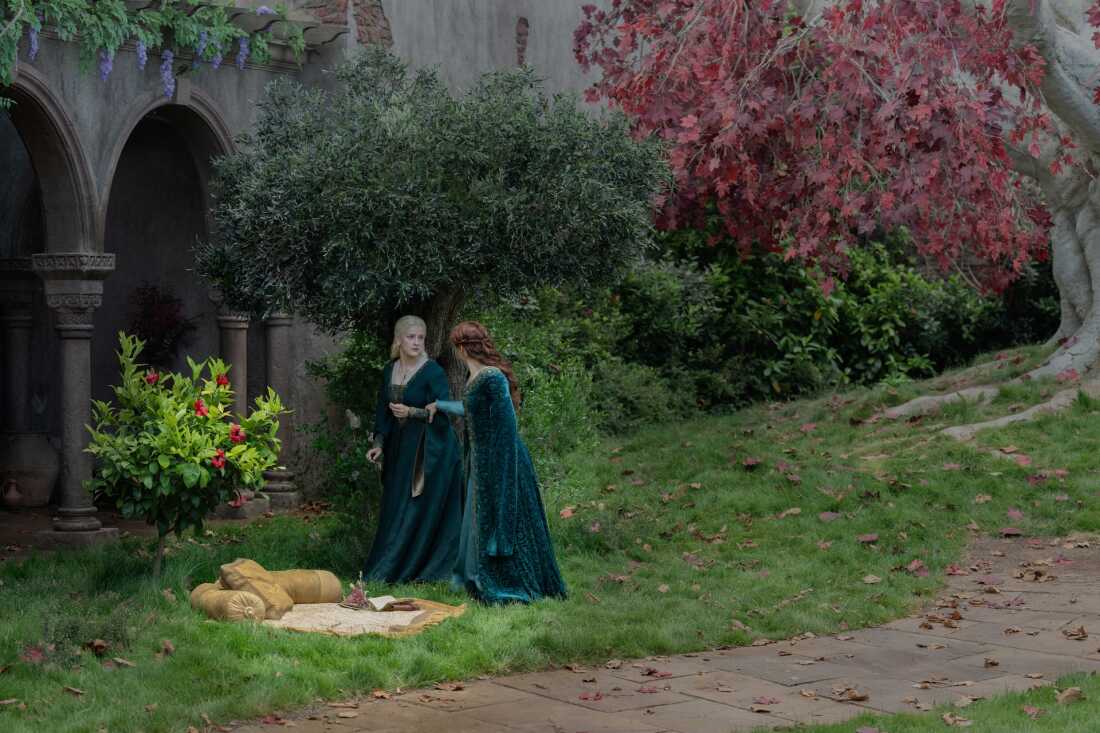
Helaena (Phia Saban) and Alicent (Olivia Cooke).
Ollie Upton/HBO
hide caption
toggle caption
Ollie Upton/HBO
As they walk together to instruct the Red Keep’s guards to stand down and let Rhaenyra in, we get the full confession from Alicent — she knows she misunderstood King Viserys’ final words, and should not have installed Aegon on the Iron Throne. Which is interesting, if not surprising.
Fire & Blood, the book on which this series is based, consists of differing historical accounts of this war, deliberately leaving questions about various characters’ motivations and intent up to the reader. The show has never bothered with that, and has always asked us to side with Rhaenyra. So while Alicent’s confession and remorse isn’t surprising, it’s easily the most explicit and definitive statement we’ve gotten yet on that score. And it makes me wonder if, just to keep things interesting and balanced story-wise, the cracks in Rhaenyra’s composure we’ve been seeing lately aren’t due to widen into gaping fissures.
This scene on the battlements with the guards gives us an episode MVP moment from Phia Saban’s Helaena, when she takes the cue from Alicent to say something Queenly and imperious to the dubious guard, and promptly declaims, “I will not have any beast harmed,” and then looks really pleased with herself.

Criston Cole (Fabien Frankel), Gwayne Hightower (Freddie Fox) and co.
Theo Whiteman/HBO
hide caption
toggle caption
Theo Whiteman/HBO
Somewhere near Harrenhal, Criston Cole and Gwayne Hightower see that Vhagar and Aemond have finally shown up to the freaking party, which pleases them. There is much Huzzah-ing.
And indeed, as they fly over Harrenhal, Aemond and Vhagar make short work (short rib work, more like) of the small garrison Daemon left behind. Aemond enters the castle, slicing through what little resistance he meets like a hot knife through lightly armored butter.
He arrives in the hall where the hobbity Ser Simon Strong and his hobbity sons are eating dinner, hobbitishly. Simon, bless his Falstaffian, arteriosclerotic heart, attempts to placate Aemond in exactly the same way he placated Daemon last season, with kind words of supplication and flattery. But no — they can’t see eye-to-eye (heh), and Aemond takes out my poor, sweet, avuncular Ser Simon, and his sons.
In the process, he takes a dagger to the side and starts losing gouts and gouts of blood, just as Alys Rivers shows up.
I’m sure that will work out well for him.

Ser Simon Strong (Simon Russell Beale).
Ollie Upton/HBO
hide caption
toggle caption
Ollie Upton/HBO
At the Red Keep, a remarkably similar scenario to Aemond’s plays out for Rhaenyra and Daemon. While most of the guards have hung up their shields, they meet some resistance on their way to the throne room, which Daemon easily dispatches. His Valyrian steel goes snicker-snack.
As they approach the Iron Throne, the Kingsguard (aka White Cloaks) show up to defend it. But then the City Watch (aka the Gold Cloaks) show up to side with Rhaenyra and Daemon, and the balance of power shifts back. (Daemon used to run the Gold Cloaks, back in the day, so there’s some bro-y business between him and the Ser Luthor Largent).
Then someone shouts, “Seize them!” which is a phrase that makes any situation empirically better — try it out at your next church potluck! — and the White Cloaks get fully seized.
But Rhaeyra doesn’t plop her butt on the Iron Throne just yet — she wants Aegon the Usurper brought to her. (“Bring him to me!” being another great phrase that we don’t get to bust out often enough, in this our sad, fallen, denuded world.)
Meanwhile, Alicent and Helaena, dressed in richly appointed, vibrantly hued cloaks, attempt to blend into the drab colorless burlap-clad rabble of King’s Landing in exactly the same way that a pair of drag queens would blend into an Apple store.
Subscribe to his Only-Ifans
In King Aegon’s chambers, Daemon finds only Grand Maester Orwyle, who promises fealty to Rhaenyra — and to give up someone who might satisfy the Queen’s thirst for vengeance.
He’s thinking of Jasper Wylde, but when Daemon goes to visit Wylde’s cell, the jailer informs him that Larys Strong left him “a gift” in case he ever returned. Turns out it’s way better than boring old repugnant Jasper Wylde — it’s Otto Hightower himself.
Oh, Rhys Ifans, how we missed you, and how Westeros has missed Otto’s sagacious, cool-headed approach to ruling a kingdom. Ifans doesn’t get a lot to do in his final scene, but he makes the most of it. He’s dragged before the Rhaenyra, who — after some dithering, and one sinew-slicing false start — lops off his head with Daemon’s sword Dark Sister. Ditto Daemon to Jasper Wylde, and good riddance.
Then and only then she climbs the Iron Throne, and sits. If her subjects notice that flop-sweat on her brow, and how generally shaky she seems, they tactfully pretend not to.
Parting thoughts
- OK I was kidding — we do, in fact, have to try to parse Helaena’s words. “That’s strange — it’s not the season.” That indicates something happening before its proper time — Rhaenyra on the Iron Throne, probably? Or Helaena and Alicent leaving the Red Keep?
- Operation Daeronwatch: No updates. Kid still MIA.
- HBO has clarified for us that last week’s scene with Ulf, Hugh, Addam and Alys — and this week’s scene between Daemon and Alys — do not take place on the Isle of Faces, as I and many others inferred, but just on the shores of the Gods Eye. Despite the fact that we saw a Green Man, one of the guardians of the Isle of Faces. Guess he was just … nipping into town for groceries?
- Last season, on one of Daemon’s interminable dream/vision midnight walkabouts, he saw himself dressed as Aemond — down to the eyepatch. I chalked it up to pointless mystic goof-juicery then, but the show now seems to be drawing direct parallels between the two characters. To what end, exactly, I still can’t say.
- Pour one out for Ser Simon Strong, the most relatable character in the whole dang series if, like me, you are a soft sort who’s more about eating and drinking than fighting. And keep pouring it out for Sir Simon Russell Beale, who invested a fairly stock character with human warmth and humor and — it bears repeating — softness. Westeros is a cruel, hard place for us indoor kids.
-
 News8 minutes ago
Senate Ethics Committee dismisses complaint against Sen. Ruben Gallego
-

 New York1 hour ago
Read the Indictment of Malik Beasley
-

 Los Angeles, Ca1 hour ago
Stolen Sea Scouts boat found in Marina del Rey, suspect arrested
-

 Detroit, MI2 hours ago
Michigan House passes bill to restrict big investors from amassing single-family homes
-

 San Francisco, CA2 hours ago
San Francisco rolls out heightened security measures ahead of World Cup knockout match, 4th of July
-

 Dallas, TX2 hours ago
Klyde Warren Park reveals expansion plans, construction timeline
-

 Miami, FL2 hours ago
Person hospitalized after fire breaks out at North Miami Beach apartment building
-

 Boston, MA2 hours ago
Scottish soccer fan who died in Boston was ‘Tartan Army to his core,’ fundraising page says – The Boston Globe

