Lifestyle
‘My role was making movies that mattered,’ says Jodie Foster, as ‘Taxi Driver’ turns 50


Jodie Foster, shown here in 2025, plays an American Freudian psychoanalyst in Paris in Vie Privée (A Private Life).
Gareth Cattermole/Getty Images
hide caption
toggle caption
Gareth Cattermole/Getty Images
Jodie Foster has been acting since she was 3, starting out in commercials, then appearing in TV shows and films. She still has scars from the time a lion mauled her on the set of a Disney film when she was 9.
“He picked me up by the hip and shook me,” she says. “I had no idea what was happening. … I remember thinking, ‘Oh this must be an earthquake.’”
Luckily, the lion responded promptly when a trainer said, “Drop it.” It was a scary moment, Foster says, but “the good news is I’m fine … and I’m not afraid of lions.”
“I think there’s a part of me that has been made resilient by what I’ve done for a living and has been able to control my emotions in order to do that in a role,” she says. “When you’re older, those survival skills get in the way, and you have to learn how to ditch them [when] they’re not serving you anymore.”

In 1976, at age 12, Foster starred opposite Robert De Niro and Harvey Keitel in Martin Scorsese’s film Taxi Driver. Foster’s portrayal of a teenage sex worker in the film sparked controversy because of her age, but also led to her first Academy Award nomination. She remains grateful for the experience on the film, which turns 50 this year.
“What luck to have been part of that, our golden age of cinema in the ’70s, some of the greatest movies that America ever made, the greatest filmmakers, auteur films,” she says. “I couldn’t be happier that [my mom] chose these roles for me.”
In the new film Vie Privée (A Private Life), she plays an American Freudian psychoanalyst in Paris. With the exception of a few lines, she speaks French throughout the film.
Interview highlights
On learning to speak French as a child
My mom, when I was about 9 years old, she had never traveled anywhere in her life and right before then, she took a trip to France and fell in love with it and said, “OK, you’re going to learn French. You are going to go to an immersion school, and someday maybe you’ll be a French actor.” And so they dropped me in where [there] was a school, Le Lycée Francais de Los Angeles, that does everything in French, so it was science and math and history, everything in French. And I cried for about six months and then I spoke fluently and got over it.
On being the family breadwinner at a young age
My mom was very aware that that was unusual, and that would put pressure on me. So she kind of sold it differently. She would say, “Well, you do one job, but then your sister does another job. And we all participate, we’re all doing a job, and this is all part of the family.” And I think that was her way of … making my brothers and sisters not feel like somehow they were beholden to me or to my brother who also was an actor. And not having pressure on me, but also helping her ego a bit, because I think that was hard for her to feel that she was being taken care of by a child. …
There’s two things that can happen as a child actor: One is you develop resilience, and you come up with a plan and a way to survive intact, and there are real advantages to that in life. And I really feel grateful for the advantages that that’s given me, the benefits that that has given me. Or the other is you totally fall apart and you can’t take it.
On her early immersion into art and film
My mom saw that I was interested in art and cinema and took me to every foreign film she could find, mostly because she wanted me to hear other languages. But we went to very dark, interesting German films that lasted eight hours long. And we saw all the French New Wave movies, and we had long conversations about movies and what they meant. I think that she respected me.
I did have a skill that was beyond my years and I had a strong sense of self … [and the] ability to understand emotions and character that was beyond my years. [Acting] gave me an outlet that I would not have had if I’d gone on a path to be what I was meant to be, which is really just to be an intellectual. … It was a sink or swim. I had to develop an emotional side. I had to cut off my brain sometimes to play characters in order to be good, and I wanted to be good. If I was gonna do something, I wanted it to be excellent. So in order to do that, I had to learn emotions and I had to learn, not only how to access them, but also how to control them so that I could give them intention.

Jodie Foster attends the Cannes Film Festival in 1976 to promote Taxi Driver.
Raph Gatti/AFP for Getty Images
hide caption
toggle caption
Raph Gatti/AFP for Getty Images
On sexual abuse in Hollywood
I’ve really had to examine that, like, how did I get saved? There were microaggressions, of course. Anybody who’s in the workplace has had misogynist microaggressions. That’s just a part of being a woman, right? But what kept me from having those bad experiences, those terrible experiences? And what I came to believe … is that I had a certain amount of power by the time I was, like, 12. So by the time I had my first Oscar nomination, I was part of a different category of people that had power and I was too dangerous to touch. I could’ve ruined people’s careers or I could’ve called “Uncle,” so I wasn’t on the block.
It also might be just my personality, that I am a head-first person and I approach the world in a head-first way. … It’s very difficult to emotionally manipulate me because I don’t operate with my emotions on the surface. Predators use whatever they can in order to manipulate and get people to do what they want them to do. And that’s much easier when the person is younger, when the person is weaker, when a person has no power. That’s precisely what predatory behavior is about: using power in order to diminish people, in order to dominate them.
On her decision to safeguard her personal life
I did not want to participate in celebrity culture. I wanted to make movies that I loved. I wanted to give everything of myself on-screen, and I wanted to survive intact by having a life and not handing that life over to the media and to people that wished me ill. …
What’s important to consider is that I grew up in a different time, where people couldn’t be who they were and we didn’t have the kinds of freedoms that we have now. And I look at my sons’ generation, and bless them, that they have a kind of justice that we just didn’t [have] access to. And I did the best I could and I had a big plan in mind of making films that could make people better. And that’s all I wanted to do was make movies. I didn’t want to be a public figure or a pioneer or any of those things. And I benefited from all of the pioneers that came before me that did that hard work of having tomatoes thrown at them and being unsafe. And they did that work and I have thanked them. I thank them.
We don’t all have to have the same role. And I think my role was making movies that mattered and creating female characters that were human characters and creating a huge body of work and then being able to look back at the pattern of that body of work and go like, “Oh wow, Jodie played a doctor. She played a mother. She played as a scientist. She played an astronaut. She killed all the bad guys. She did all of those things — and had a lesbian wife and had two kids and was a complete person that had a whole other life.” And I think that will be valuable someday down the line, that I was able to keep my life intact and leave a legacy. There’s lots of ways of being valuable.
Lauren Krenzel and Thea Chaloner produced and edited this interview for broadcast. Bridget Bentz, Molly Seavy-Nesper and Beth Novey adapted it for the web.


Can you say no to a friend’s wedding?
Getty Images/Getty images
hide caption
toggle caption
Getty Images/Getty images
Are we spending too much on other people’s weddings?
Going to a friend’s weddings can be so fun and meaningful… but it can also really hurt your wallet. A survey by LendingTree found that 31% of people who had been to a wedding in the past five years had accrued debt to attend. So what’s driving up the cost of weddings for guests? And what makes it so hard to say no to these expenses?
Brittany breaks it down with Allyson Rees, senior analyst at trend forecasting firm WGSN, and Annie Joy Williams, assistant editor at The Atlantic.
This episode was produced by Liam McBain, with additional support from Corey Antonio Rose. It was edited by Neena Pathak. Our Supervising Producer is Cher Vincent. Our Executive Producer is Barton Girdwood. Our VP of Programming is Yolanda Sangweni.
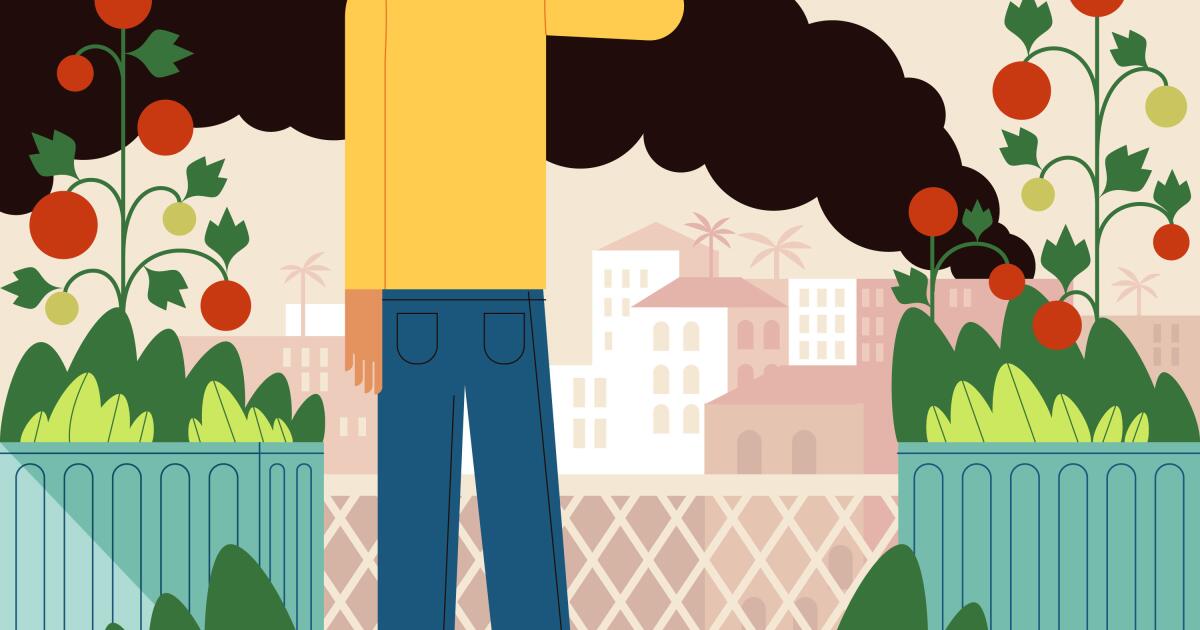
After the eight-day-long fire in a 500,000-square-foot Boyle Heights warehouse, eastern Los Angeles residents are contending with putrid smells, soot and potentially hazardous airborne chemicals after heavy plumes of smoke spread throughout the city. But those who grow food in nearby neighborhoods may also be wondering: How will the fires affect the plants and produce in my garden?
The Boyle Heights warehouse, owned by Lineage — a global temperature-controlled storage facility operator — housed 85 million pounds of frozen food and other products. In the days since the fire, local emergency visits for smoke inhalation and throat pain spiked while agencies still scramble to measure the amount of PM 2.5 — harmful fine particles — and heavy metals, like lead and arsenic, in the air.
According to researchers, any toxic airborne chemicals would likely stem from the charred foam insulation, metal exterior, burned solar panels and any lithium batteries that might have been present inside the warehouse.
After a fire, heavy metal particles can spread through ash and smoke over gardens and inhibit growth, said Olukayode Jegede, an agricultural toxicologist and assistant professor at UC Davis. Since the warehouse fire is so recent and cleanup has just begun, Jegede said the precise impact on gardens can’t be measured until comprehensive soil tests are conducted in the area.
While the L.A. city government hasn’t announced plans for soil testing, the Contaminant Level Evaluation and Analysis for Neighborhoods project at USC is offering free contaminant testing for Boyle Heights and East L.A. residents. Residents can collect soil samples and deliver them to Boyle Heights City Hall and other locations for an evaluation of lead, arsenic, chromium and mercury levels.
The good news is produce, plants and roots can still be preserved. According to Jegede, many of the soil tests conducted last year in the Altadena area after the Eaton fire showed that gardens and poultry were not as contaminated as one might expect.
“Quite a number of the soils we tested [in Altadena] were not really contaminated,” Jegede said. “We weren’t seeing many soils with concerning elevated levels of metal, so gardeners should not be too alarmed when these things happen.”
Nevertheless, there are several measures that gardeners can take to keep themselves, their children, plants and produce safe from potentially harmful contaminants stemming from the fire. Researchers, gardening experts and horticulturists offered some guidance on the handling, recultivation and cleanup that can keep you and your garden in good health.
How do I remove ash and contaminants from my garden?
Altadena horticulturist Leigh Adams said Boyle Heights plants and produce already live in a difficult environment, surrounded by industrial warehouses that spread contaminants daily.
“That area has been used industrially for 100 years, and the soil is impacted by many, many, many things,” Adams said. “Low-income neighborhoods and gardens usually don’t have a lot of resistance against dominant manufacturing.”
This means that the contamination of gardens in eastern L.A. won’t be as catastrophic as compared with those in Altadena, a more suburban environment, Adams said. But fallen ash still poses major health risks if ingested or inhaled.
An advisory from University of California Agricultural and Natural Resources last year recommended suiting up in an N95/KN95 mask, long sleeves, pants, close-toed shoes and gloves before attempting to deal with ash in the garden to limit exposure to potentially toxic contaminants. The advisory added that individuals should make sure all of this gear is cleaned thoroughly before bringing it back inside.
Once in the proper gear, Adams recommends removing the top two inches of topsoil from gardens, where the highest concentration of contaminants will settle after a fire. Using a plastic bag to collect the soil and disposing of it in the garbage — not green yard waste bins — will help to reduce the spread of airborne chemicals.
Gardeners with raised beds are advised to remove approximately six inches of soil, because excess ash can raise the pH level and prevent nutrients from soaking into the soil bed.
After this, watering the garden gently but plentifully will help to promote soil health and get rid of most of the ash present on plant leaves and stems. Adams said replacing the top two inches of soil with store-bought mulch or straw will help to contain any remaining ash and prevent it from spreading any further.
Experts say to avoid using leaf blowers if ash is present in the garden because they can send particles airborne. Doing so will increase the likelihood of heavy metal particles, which can carry lung irritants and carcinogens, being spread and inhaled.
A Boyle Heights resident keep a watchful eye on the fire at the 5,000-square-foot commercial building, which stores 85 million pounds of frozen food.
(Genaro Molina / Los Angeles Times)
Is it safe for me to eat produce from my garden?
Several studies, including one from the UC Cooperative Extension of Sonoma County, have shown that consuming produce in a fire-affected area poses minimal health risks.
Jegede said most root vegetables like potatoes and carrots, along with any fruit that has an outer layer, can be washed to remove potential contaminants, even if they were covered in ash. Peeling the outer layer of your produce can also help to reduce potential risks, he said.
Lettuce and other leafy foods with multiple layers pose a higher risk of contamination, but with a vigorous wash and peeling the outer layers, even the greens can be saved. The County of Los Angeles Department of Public Health recommends soaking leafy produce and fuzzy fruits like peaches in a 10% white vinegar and 90% water mixture.
Jegede said if the leaves or fruit are too delicate to wash or ash is still visible, it would be best to dispose of the produce.
How can I tell if my soil is contaminated?
After ridding your garden of visible ash, you might wonder how to tell if your plants will still thrive in the soil.
At-home soil tests that measure for alkaline, fertility and pH levels are widely available and can be purchased for $15 to $100 (for more detailed results) online. But Jegede said these tests can’t tell the full story of soil health.
Comprehensive soil testing is “something you can’t do properly at home,” Jegede said. “In labs, we are testing for metals like lithium and zinc, stuff that an at-home test will not show … If it comes to the point that you’re worried about your soil, I would just send it out to a lab.”
Wallace Laboratories in El Segundo, Babcock Laboratories in Riverside, Waypoint Analytical in Anaheim and other labs offer more detailed soil tests that measure heavy metal particles in addition to other fertility factors. Prices at Wallace Laboratories can range from $115 to $295 for a complete compost test.
The soil below two inches should be unharmed, Adams said, so long as new compost is set and plants are watered plentifully, which will promote natural biological cycles.
“What you’re doing is capping the soil, so that moisture stays in there, and instead of being dirt, it’s a living system called soil,” Adams said. “The more carbon we can get into our soil, the better.”
What can I do to help my soil recover?
For the last 12 years, Adams has been working with Metabolic Studio, a Los Angeles-based art and research hub focused on environmentalism, on methods for bioremediation, the practice of using additional fungi, plants and compost to decontaminate ash and break down contaminants.
Adams said straw, mushrooms, corn, rye and sunflowers are great bioremediators that can help to repair damage to soils. She said certain samples she’s worked on with Metabolic Studio have gone from testing at high heavy metal levels to nearly contaminant-free.
But for a more immediate fix, wash your produce, water your plants and have a little patience during ash cleanups. Your garden should look better in no time, Adams and Jegede said.

Inde Navarrette and Michael Johnston in Obsession.
Focus Features
hide caption
toggle caption
Focus Features
Two big horror films, Obsession and Backrooms, just smashed all box office expectations. So much of their success has been driven by Gen Z, which is now the biggest moviegoing demographic. But what makes a movie a Gen Z movie? Today we’re bringing you an episode of NPR’s It’s Been a Minute. Host Brittany Luse talks about this trend with Sam Adams and Reanna Cruz.
If you want to hear more about these movies, check out these episodes:
In ‘Obsession,’ love hurts. It really, really, really hurts.
‘Backrooms’ brings YouTube horror to the big screen
Zendaya brings ‘The Drama,’ we bring the spoilers
Connect with Pop Culture Happy Hour:
Letterboxd / Facebook
Our weekly newsletter
Support Pop Culture Happy Hour+
-

 Mississippi53 seconds ago
Mississippi’s first Dutch Bros now open in Pearl
-

 Missouri6 minutes ago
UPDATE: Suspect wanted in Kansas captured near Columbia; Missouri State Highway Patrol aircraft plays key role | 93.9 The Eagle
-

 Montana13 minutes ago
Butte gears up for Montana Folk Festival, which starts Friday
-
 Nebraska16 minutes ago
Supreme Court will hear Nebraska’s fight over access to Colorado’s South Platte River
-

 Nevada21 minutes ago
As temperatures rise, HELP of Southern Nevada continues homeless outreach efforts
-

 New Hampshire28 minutes ago
New hampshire set to approve world’s first $100 million bitcoin-backed municipal bond
-

 New Jersey31 minutes ago
Police conclude investigation at Walmart in Cherry Hill, officials say
-

 New Mexico36 minutes ago
Monsoon high shifts slightly west but rain is still possible Wednesday in New Mexico

