Lifestyle
‘Craziest thing you can do’: Why are so many adventure seekers warming up to ice climbing?

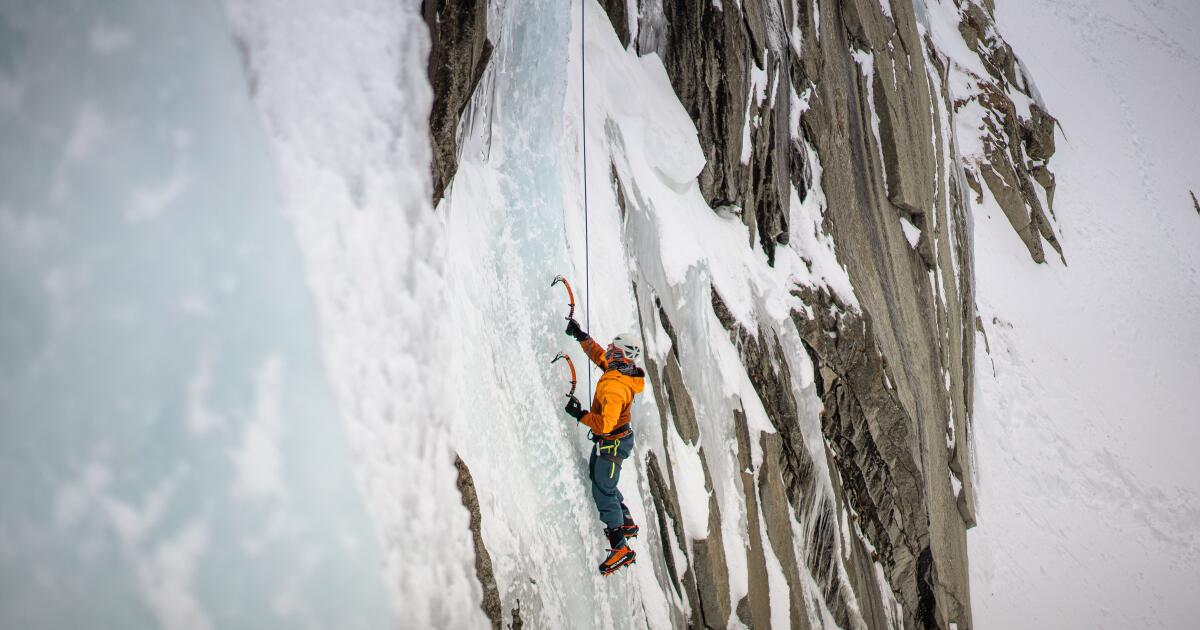
Thwack! Thwack! Thud!
Oh, thank god, my whole body exclaimed. After a few swings, the razor-sharp pick I clutched lodged firmly into a cascading frozen waterfall. Shards of ice exploded from the point of contact onto my face. A taste of blood. At least the hold seemed solid. I raised one foot and kicked the tippy-toe spike of a traction device attached to my boot into the opalescent surface. Then I raised the other.
Like a cat walking on extended claws, I made my way up Chouinard Falls in Lee Vining Canyon, an ice-climbing mecca in the state. Swing, crash, thud. Two steps. Swing, crash, thud. Two steps.
I wasn’t fast. I definitely wasn’t graceful. But I was ice climbing.
Ice climbing, as the name suggests, entails scaling frozen water. Even mountain goats can’t scramble up vertical ice, so specialized equipment is needed. Like rock climbing, the sport entails a rope system — known as belaying — but differs in substantive ways.
Not only does ice-climbing gear resemble medieval torture devices, but the sport, for obvious reasons, must be done in the cold. Ice forms in the shade, adding to the chill factor. Particularly frigid climbs can bring on the “screaming barfies,” a cluster of symptoms that include severe hand pain and nausea. (My sun-soaked Angeleno blood curdles at the thought.) As climbers chop into the ice with their tools and crampons, frozen debris rains below.
Ice-climbing gear includes sturdy mountaineering boots, crampons, sharp picks called ice tools, ropes and more.
(Richard Bae / For The Times)
While it is still relatively obscure, several mountain guides said ice climbing received a nudge closer to the mainstream with the explosion of outdoor recreation in recent years. Roughly 2.5 million Americans climb ice, rock or pursue mountaineering, increasing nearly 18% from the mid-2000s, according to the Outdoor Industry Assn., a collective that includes business leaders, climate experts and policy makers.
“Before I tried it, I always had this idea that it was the craziest thing you could do,” said Michael O’Connor of Sierra Mountain Guides. “I was, like, does the ice just fall down and hit you? And, yeah, the equipment seems cool, but it also seems horrifying.”
Yet O’Connor came away from his first tussle with ice, around 2010, wanting more.
Now, “by the time fall is hitting and I see the ice starting to form up and start to hear about people climbing on things, I’m like, ‘All right, I’m getting kind of psyched.’ And then once it’s here in Sierra, I’m like, ‘Let’s go.’ And it’s so fun.”
Sunny California, ice climbing’s unlikely birthplace
Conquerors of big mountains have long contended with ice. Once upon a time, alpinists laboriously hacked steps into it — literal stairways to heaven. That all changed in the mid-1960s to early 1970s. Renowned climber Yvon Chouinard — who set up a blacksmith shop in Ventura and later opened outdoor clothing brand Patagonia’s first store nearby — developed a curved pick that could claw into steep ice and stay put. Early climbs using the innovative tool were made in California’s Eastern Sierra Nevada.
“It’s no stretch to call that the ice-climbing revolution,” said Doug Robinson, who frequently climbed with Chouinard in those days and helped usher in the sport’s transformation.
Climbers began to haul themselves up frozen waterfalls and dangling icicles, carving out a discipline separate from mountaineering. Sunny California, far from the epicenter of the sport today, can broadly be considered the cradle of its modern form.
Climbers scale the ice falls at Lee Vining Canyon, about 30 miles north of Mammoth (Richard Bae / For The Times)
(Richard Bae)
The allure of ice climbing
Ice fanatics and detractors alike speak reverentially of its ephemeral quality. (The qualifier is so intertwined with the practice that a recent Instagram post I came across read, “This is a generic ice climbing post… ephemeral ephemeral ephemeral ephemeral ephemeral…”)
Unlike rock, ice is constantly changing. It can form, melt and reform multiple times a season — and exactly how it manifests is different each time. Depending on the climber, this presents an interesting puzzle or infuriating challenge.
Adrian Ballinger, owner of Lake Tahoe-based guiding company Alpenglow Expeditions, highlighted the creative movement the malleable surface permits.
Getting to the ice is not always easy, particularly in parched California. The trek to famed ice falls in Lee Vining Canyon can be grueling depending on the conditions. (Richard Bae / For The Times)
(Richard Bae)
In rock climbing, “whether you’re outside or in the gym, there are a certain number of places where you can put your hands and feet and that’s it,” he said. “The beauty of ice is since you have these spikes on your feet and in your hands, you can make your handholds and footholds anywhere you choose.”
The same principle makes it accessible to a range of body types, he added. While one rock climb might be better or worse for a short person, ice allows people of all shapes to forge their own path.
Then there’s just the badassery of pursuing an activity that epitomizes radical.
Ready to climb? Here’s how to get started
Despite its hardcore aura, ice climbing is more accessible than it seems. Interest, drive and hardiness can carry a novice a long way, according to alpine veterans.
“It’s pretty intuitive,” said Aaron Jones, 37, a mountain guide based in Bishop whom I met while he was climbing with his cousin in the small town of June Lake. “If you can swing a hammer, you can swing an ice tool.”
It does, however, require a significant amount of expensive gear and technical know-how to get off the ground. It’s not something you can learn entirely through YouTube videos. Seasoned climbers recommend sampling the sport by tapping a reputable mountain guiding service or pairing up with an experienced friend with enough patience to show you the ropes.
Necessary gear includes mountaineering boots, crampons (devices with long spikes fitted onto stiff-soled boots that dig into ice and snow to prevent falls), two ice tools (the picks), harness, helmet, ropes, ice screws (to protect the lead climber) and winter clothing. Because these items can amount to hundreds, even thousands, of dollars, it’s not advised to buy everything for your first go. It’s best to see if you enjoy the sport and then try out different equipment before your wallet takes a hit.
Ice is constantly changing, so no two ice-climbing experiences are ever the same.
(Richard Bae / For The Times)
Climbers use razor-sharp ice tools to haul themselves up frozen waterfalls. An anchor, center, attaches the rope system to the slick surface. (Richard Bae / For The Times)
(Richard Bae)
Besides group and individual instruction, guiding services generally provide all the goodies you need to send ice. If you’re connected to a rock-climbing or outdoorsy community, you may be able to borrow some gear. Some can be rented.
There are no requirements to book a beginner’s outing with Alpenglow, “just that you’re up for a day of adventure outside,” said Ballinger, an internationally recognized skier and climber. Private outings hover around $700 per person, he said. Alpenglow’s group intro courses in mountaineering, avalanche rescue and more start around $275.
The same goes for Sierra Mountain Guides, which offers a two-day introductory ice climbing course. It costs $515 per person on weekends and $480 midweek. O’Connor said a full day of private guiding averages $500 or more.
While you don’t need to be an accomplished athlete, a basic level of fitness is often needed just to sojourn to the ice — particularly in parched California. Once you get there, you need enough gas to climb and then make the same trek back in a state of enhanced fatigue.
“You have to have some resilience and robustness to just withstand those elements alone. And then if you add in climbing and carrying all of your equipment … it’s definitely not for everyone,” O’Connor said. “I’m not saying that everyone shouldn’t try it, but not everyone’s gonna like it.”
As the rising sun spat fiery fuchsia across the sky, three companions and I caravanned to an unmarked trailhead near the eastern entrance to Yosemite National Park. Outfitted in rigid mountaineering boots, I hiked for 1½ hours over snow-covered boulders to reach the ice falls of Lee Vining Canyon.
Melinda Guerrero, 34, an experienced rock climber in my party who was trying ice for the first time , quickly calculated when we’d need to leave to avoid scrambling back after sunset. “I definitely don’t want to do that in the dark,” she asserted. My chafed heels whimpered in agreement.
Where to climb
It may not come as a complete surprise that California is not the ultimate destination for ice. That said, it’s home to several iconic ice playgrounds that are driving distance from the megalopolises of Los Angeles and San Francisco.
Lee Vining Canyon is arguably the most popular ice climbing destination in the Golden State. Renowned climbers Yvon Chouinard and Doug Robinson pioneered modern ice climbing techniques there more than a half-century ago.
(Richard Bae / For The Times)
Eastern Sierra Nevada
- Lee Vining Canyon. Located near the small Eastern Sierra hamlet of Lee Vining, this area is arguably the best-known and most popular destination in the state. It lures climbers with its dependable ice that tends to linger during the winter. It also offers climbing routes suitable for beginners. Getting there isn’t a walk in the park: the trek to get there, known as the approach, involves navigating talus fields and steep passages that may be blanketed in snow.
- June Lake. This mountain community near Mammoth offers exponentially more accessible roadside ice. As the name suggests, ice seekers need only to pull over along the June Lake Loop and walk a short distance to a crag with relatively low angle ice ideal for learning on. Horsetail Falls is another popular spot that can be hiked to.
Northern Sierra Nevada
Ballinger’s guiding company typically brings clients to two zones in the Tahoe area:
Because of Tahoe’s heavy snowfall, Ballinger said the climbs become shorter as powder builds up and covers the routes.
Beyond California
Dedicated climbers converge in areas better known for ice, such as Cody, Wyo.; Ouray, Colo.; Hyalite Canyon near Bozeman, Mont.; Valdez, Alaska; and Canmore in the Canadian Rockies.
When to climb
Ice-climbing season in sunny California tends to be short and, yes, ephemeral. It typically runs from December through March in the Eastern Sierra, but is highly dependent on weather conditions.
Tahoe’s season this year started in mid-November and Ballinger anticipates it will last through January, with a possibility of extending through February or March.
It’s critical to gauge the condition of the ice before getting on it. Sierra Mountain Guides posts handy ice reports.
When I visited the Eastern Sierra in mid-December, the temperatures were unusually warm. It made for more comfortable climbing (i.e., neither my fingers or toes screamed in pain), but less favorable ice conditions.
Clothing considerations
What distinguishes ice climbing from many other other winter sports is that it involves relatively long periods of inactivity. While one person climbs, another waits below (or above) and belays them. This trade-off of movement and pause makes a clothing layering system particularly important.
The person who isn’t climbing generally throws on a heavy jacket and warm gloves. The outer jacket is shed while climbing and often gloves will be swapped for ones that allow for more dexterity. If the walk to and from the ice wall is long or strenuous, it’s important that you can strip off layers when you inevitably heat up.
Bringing “four pairs of gloves is not uncommon,” O’Connor said.
A note on danger
Shards of ice whizzed past me on a deviously slick platform underneath frozen waterfalls that resembled lofty ice sculptures. One thumped my hand, as if to say, “Outta my way!”
“They didn’t tell you about this part?” asked Jake Ballard, observing my consternation amid the onslaught. Ballard, 42, an experienced rock climber, recently started to tackle ice.
Actually, I had been told that one of the hazards of ice climbing is falling frozen debris. But I mistakenly assumed that ice would only plummet occasionally. (Later, I saw Ballard belaying a friend while he crouched behind a ridge to avoid the ice’s flight path.)
Falling frozen debris poses a major, even fatal, hazard to ice climbers.
(Richard Bae / For The Times)
No activity conducted in the mountains is 100% safe, ice climbing included. Risks can be managed, minimized, but not entirely avoided.
Mountain experts generally agree that ice climbing is more dangerous than outdoor rock climbing. Avalanches, sharp equipment, cold weather and unstable ice all threaten bodily harm.
“If you’re in the wrong place at the wrong time ice can fall and, if it hits you, there’s big enough pieces that it will kill you,” O’Connor said, adding that there are practices employed to position yourself to lower the likelihood of being hit.
There’s also a major difference between the risks posed by what’s known as leading and top roping a climb, both terms used in rock climbing. A person who leads a climb sets up the rope system that makes climbing safer for those who follow. They’re less protected on the first ascent and can suffer a serious fall. The person who climbs after the system is set up will be on top rope, which means that their partner should be able to catch them if they fall with minimal consequence.
Jones, who owns Sierra Climbing School, said the changing nature of the medium makes screws inserted into the ice to limit the distance the lead climber can fall “inherently suspect.”
“When you’re top roping … it’s just as safe as rock climbing as long as you’re not like stabbing yourself with a pick,” he said.
Climbing ice in a warming world
Climate change has made the evanescent sport more precarious. Increased heat doesn’t just shrink the available ice, but threatens to make what does freeze unreliable.
Ballinger said climate change has shortened the season as lingering higher temperatures often delay the start before returning early in the spring to lop it off.
A spike in temperatures during the season can weaken the bonds of the ice and make it unsafe to climb. Once upon a time, Ballinger said they could reliably “run ice” consistently on weekends once the season started. Now fluctuations on the thermometer make it touch and go.
“In California, it’s always been ephemeral, but it’s even more so now,” he said.
Though California is home to several ice playgrounds — including Lee Vining Canyon and June Lake — ice climbing season tends to be short. So go while you can.
(Richard Bae / For The Times)


Sunday Puzzle
NPR
hide caption
toggle caption
NPR

On-air challenge
Today’s theme is “hot.” Every answer is a familiar two-word phrase in which the first word starts HO- and the second word starts with T-.
Ex. Rowdy bar with country music, in slang –> HONKY TONK
1. Guided walkthrough of a property
2. Any member of the N.H.L.
3. Lone Star State metropolis that’s the fourth-largest city in the U.S.
4. Like an animal with its four legs bound (hyph.)
5. Instruction manual (hyph.)
6. A little pompous and arrogant, informally (hyph.)
7. Punny greeting from a magician
8. Someone who steals animals from a stable
9. Congestion that drivers encounter around July 4th, say
10. Acquisition of a company against its will.
11. Exclamation for “wow!” on TV’s “Batman”
Last week’s challenge
Last week’s challenge comes from Evan Kalish, of Bayside, N.Y. Take the name of a nocturnal creature, in two words. The first word is a spooky sound. Move the last letter of the first word to the start of the second word and you’ll get another spooky, nocturnal sound. What is the creature and what are the sounds?
Answer: Screech owl –> howl
Winner
Dan Sadoff of St. Paul, Minnesota
This week’s challenge
This week’s challenge comes from Rawson Sheinberg. of Plymouth, Mich. Think of a U.S. city with a two-word name. Add a letter to the first word, without rearranging letters, to name a country. Then, without adding a letter, rearrange the letters of the second word to name another country. What places are these?
If you know the answer to the challenge, submit it here by Thursday, July 2 at 3 p.m. ET. Listeners whose answers are selected win a chance to play the on-air puzzle. Important: include a phone number where we can reach you.

If you’re struggling to use up leftovers like a half-eaten rotisserie chicken, turn the assignment into a creative exercise, says chef Margaret Li. It’ll make the cooking process more fun and less guilt-driven.
Pulse/Getty Images/Corbis RF Stills
hide caption
toggle caption
Pulse/Getty Images/Corbis RF Stills
On a recent weeknight, I opened up my fridge and found an assortment of half-eaten or ignored food.
That included takeout that I didn’t find appetizing enough to eat for lunch. A rotisserie chicken with most of the meat picked off. A couple of raw vegetables from the farmers market that were starting to wilt.
“There’s nothing to eat,” I told myself. Yet even I knew that was ridiculous. There was plenty of food in my fridge. I just didn’t feel inspired to cook with it.
So I asked some chefs for guidance. How could I more consistently use leftovers and the other ingredients I tend to overlook?
Start with a mindset shift, says Margaret Li, chef and co-author of the cookbook Perfectly Good Food: A Totally Achievable Zero Waste Approach to Home Cooking. Think about cooking with leftovers as a creative, experimental exercise, not a guilt-driven one.
“It ends up being this fun game where you are creating something from what seems like nothing and solving this puzzle, and then you get to eat it,” she says.
There are other good reasons to use up your food scraps. Nationally, about a quarter of food products go to waste, according to the nonprofit ReFED. In my own household, where we spend about $200 a week on groceries, that means I might be throwing out the equivalent of $50 of food — an unnecessary burden on my wallet, not to mention the environment.
The chefs I spoke to had some practical tips about using up more of the food we buy. Here are a few that I put to the test.
Find your “hero recipes”
Build up an arsenal of go-to recipes that are flexible enough to use up just about any ingredient. Li calls them “hero recipes.”
I tried one of these from her cookbook, called “Make-It-Your-Own Stir-Fry.” (Scroll down for the recipe.) It includes loose ingredients like “1 pound crisp-crunchy vegetables” or “4 cups leafy greens.”
In the spirit of the recipe, I pulled vegetables out of my fridge at random and did not measure them out. The sauce was a simple mixture of soy sauce, vinegar, sugar and water. By the time I topped my bowl with chopped scallions, the dish looked like a gourmet meal, not an afterthought.

Other ideas: “You could put anything in a frittata, and it’ll be great,” says Tamar Adler, chef and author of The Everlasting Meal Cookbook: Leftovers A-Z.
Or, if you have day-old rice on hand, cook it alongside other ingredients to make fried rice. “Saute some aromatics — ginger, garlic, onion — in oil,” Adler says. Then add your rice and whatever leftover bits you have, like the rotisserie chicken and older produce I had in my fridge.
“Just take the approach of making it more flavorful and crispy and then spicy, and then usually adding a squeeze of lemon,” Adler says.
Label your leftovers
Keep a permanent marker and painter’s tape in your kitchen to label and date your leftovers, Li says. “That is a classic chef’s method for knowing what something is and when it was made. That saves you the guessing game.”
Adler takes the concept a step further and labels her leftovers with their intended use. Leftover blueberries are labeled “muffins-to-be on Tuesday,” she says. “I really like doing that — assigning the destiny of the food.”

So after a night of Ethiopian takeout, when we ended up with an entire container of leftover injera, I followed Adler’s advice and thought about what it might become in the future.
I imagined scrambling the spongy, tangy bread with eggs, akin to scrambling matzo into matzo brei. “Injera for eggs,” I wrote on the container. Sure enough, their destiny was fulfilled the following morning.

Li keeps a dedicated bag in her freezer just for scraps from which to make chicken or vegetable stock. That bag houses carrot peels, the ends of onions, extra garlic cloves and chicken bones.
Flavia Morlachetti/Getty Images/Moment RF
hide caption
toggle caption
Flavia Morlachetti/Getty Images/Moment RF
Don’t forget your odds and ends
Adler encouraged me to never, ever throw away the stems of herbs. Stems don’t get as much glory as tender, pretty leaves, but they still have the same herby taste.
“I’m going to chop these herbs up or stick them in a blender with a clove of garlic,” she says. Then add olive oil. “And then it’s just gonna be my base sauce for everything.”
So I foraged a few varieties of half-cut herbs from my refrigerator drawers, most of them sad looking and unidentifiable.
I threw out the stems that had turned brown and gooey and put the rest in a blender. I added garlic on Adler’s instructions, nuts and kale for bulk, and plenty of olive oil and salt. Then, on a whim, I added a splash of olive juice for brightness.
The result was somewhere between a pesto and a chimichurri, and it elevated that night’s otherwise routine dinner. And Adler was right: Once the stems were blended, it tasted exactly the same as the leaves. (The same idea applies for broccoli stems in a cheesy broccoli soup, Li says.)
Li likes to keep her odds and ends organized with an “Eat Me First” box in her fridge. That’s where she keeps half-used lemons, leftover coconut milk or produce that’s starting to get wrinkly. “You kind of have an idea for, OK, here’s where you look first,” she says.
Don’t strive for perfection
Cooking these meals did feel like a game, as Li had suggested. It brought me unexpected joy to use up as many existing ingredients as possible — to the point where I often spent much longer in the kitchen because I kept thinking of new ideas: If I turn these wrinkly sweet potatoes into a soup, then I can caramelize this half-cut onion for a topping, and then I can use the leftover soup as a sauce tomorrow …
Did I cook more often, though? Probably not. My cooking energy burned brighter but fizzled out after a few nights, at which point I ordered takeout.
So I was glad to hear Li’s take: If you’re too hard on yourself, you’re not going to enjoy it at all. “ I try not to be too obsessive about eating absolutely everything,” she says. If my takeout was truly terrible, I’m allowed to toss it or, better yet, compost it.
If you really want to use up everything, you can always chuck ingredients into the freezer. Li has dedicated freezer bags for different dishes, like vegetable scraps for soups or fruit discards for smoothies. (She labels them, of course.)
And how does that smoothie taste? It’s “delicious,” she says, “even if it’s made up of all the things that have been rejected in the past,” she says.
Recipe: Make-It-Your-Own Stir-Fry
Excerpted from Perfectly Good Food: A Totally Achievable Zero Waste Approach to Home Cooking. Copyright ©2023 by Irene Li and Margaret Li. Used with permission of the publisher, W. W. Norton & Company, Inc. All rights reserved.
Sauce
- 1 tablespoon soy sauce
- 1 tablespoon water
- 1 teaspoon sugar
- 1 teaspoon black vinegar, rice vinegar, lime juice, or other acid
- 1 tablespoon neutral oil, or enough to lightly coat the bottom of your wok or skillet
- 1 garlic clove, thinly sliced or minced, or more as desired
- ½-inch piece fresh ginger, minced or grated (optional)
- Pinch chili flakes or 1 small chile pepper, diced (optional)
- 4 cups leafy greens, torn into bite-size pieces, or 1 pound crisp-crunchy vegetables, cut into chunks
- Kosher salt
Stir the sauce ingredients together in a small bowl and set by the stove.
Heat a wok or large skillet over high heat until just smoking, then add the neutral oil and tilt to coat the bottom of the pan.
Add the garlic, ginger (if using), and chili flakes (if using) and stir-fry for 10 seconds. Add the greens and/or vegetables, in stages as necessary, and toss in the garlicky oil, then add the sauce and cook to your liking, stirring frequently.
Vegetable chunks may need 4 to 7 minutes — if you want to speed up the process, cover the pot so the vegetables steam for a minute or two, then uncover and toss again. Sturdy greens may need 3 to 5 minutes to get tender (we like to let them sit for a bit and char for extra texture).
Lighter leaves will need less than a minute to wilt down. Stir in a spoonful of any additional sauce you like, season with salt to taste, then sprinkle with your favorite garnishes and a generous drizzle of sesame oil.
A sprinkle of crunch is a great way to finish a stir-fry. Our favorites include crushed cashews or peanuts, toasted sesame seeds, thinly sliced scallions, and fried onions or shallots.
Your turn: What are your favorite go-to leftover recipes?
We’d love to hear from you! Share your recipe with us at lifekit@npr.org with your full name. We may publish it on NPR.org.
The story was edited by Malaka Gharib. The visual editor is CJ Riculan. We’d love to hear from you. Leave us a voicemail at 202-216-9823, or email us at LifeKit@npr.org.
Listen to Life Kit on Apple Podcasts and Spotify, and sign up for our newsletter. Follow us on Instagram: @nprlifekit.

Stephen Malkmus & the Jicks perform onstage during day two of the Boston Calling Music Festival at Boston City Hall Plaza on September 26, 2015 in Boston, Massachusetts. (Photo by Mike Lawrie/Getty Images)
Mike Lawrie/Getty Images
hide caption
toggle caption
Mike Lawrie/Getty Images
This week’s show was recorded in Chicago with host Peter Sagal, judge and scorekeeper Alzo Slade, Not My Job guest Stephen Malkmus and panelists Emmy Blotnick, Joyelle Nicole Johnson, and Gianmarco Soresi. Click the audio link above to hear the whole show.
Who’s Alzo This Time
Pool Problems; Don’t Forget to Hydrate; The Rise of Hot Podium Guy
Panel Questions
TSA Gets A Dressing Down
Bluff The Listener
Our panelists tell three stories about game shows in the news, only one of which is true.
Not My Job: Stephen Malmus, lead singer and guitarist for Pavement, answers our questions about road construction
Indie rock legend and founder of Pavement, Stephen Malkmus, joins us to play a game called, “Pavement repairs are underway!” Three questions about road construction.
Panel Questions
The Battle Over A Home Sale; The Best Three Words To Get Over A Loss and Out of a Meeting?; A New Job in the Dating World
Limericks
Alzo Slade reads three news-related limericks: Good News For Gym Slobs; Cruisin’ For A Tattooin’; Fringe Food Benefits
Lightning Fill In The Blank
All the news we couldn’t fit anywhere else
Predictions
Our panelists predict what will find after the reflecting pool is emptied
-
 Entertainment2 minutes ago
Sigh. Again? ‘Love Island USA’ confirms another contestant fired over apparent use of racial slur
-
 Politics12 minutes ago
Commentary: This California bill is so bad it has me agreeing with a Trump Republican
-
 Sports24 minutes ago
Wife, kids of Dodgers’ Miguel Rojas in Caracas when earthquakes hit Venezuela
-

 World32 minutes ago
Stars, Stripes, VIPs and Protests: Brussels hosts US Independence bash
-

 News57 minutes ago
Can the so-called nanobubbler save the Reflecting Pool? | CNN Politics
-

 Los Angeles, Ca2 hours ago
Climbers rescued from Tahquitz Rock in San Bernardino National Forest
-

 Detroit, MI3 hours ago
Report: Pistons Targeting 7-Time All-Star Wing to Pair With Cade Cunningham
-

 San Francisco, CA3 hours ago
6/28 Gamethread: Giants vs. Braves

