Lifestyle
Chloe Kim’s protégé foiled her Olympic three-peat dreams. She’s celebrating anyway


Chloe Kim (L), Gaon Choi (C) and Mitsuki Ono celebrate with their medals after the women’s snowboard halfpipe event in Livigno, Italy on Thursday.
Cameron Spencer/Getty Images
hide caption
toggle caption
Cameron Spencer/Getty Images
Want more Olympics updates? Subscribe here to get our newsletter, Rachel Goes to the Games, delivered to your inbox for a behind-the-scenes look at the 2026 Milan Cortina Winter Olympics.
MILAN — U.S. snowboarder Chloe Kim’s quest for a historic Olympic halfpipe three-peat was foiled by none other than her teenage protégé.

Kim took home silver, after 17-year-old Gaon Choi of South Korea rebounded from a dramatic crash to overtake her in the final run.
“It’s the kind of story you only see in dreams, so I’m incredibly happy it happened today,” Choi said afterward.
Kim, 25, was within arm’s reach of becoming the first halfpipe snowboarder to win three consecutive Olympic golds. Despite a last-minute shoulder injury, she cruised easily through Wednesday’s qualifiers, which were actually her first competition of the season.
And she was looking like a lock through much of Thursday’s final — under a light nighttime snowfall in Livigno — which hinged on the best of three runs.
Kim’s strong first showing gave her 88 points and an early lead, which she held for the majority of the competition as many other contenders — including her U.S. teammates Bea Kim and Maddy Mastro — fell on one or more of their runs.

A big crash nearly ended Choi’s night early, but after a medical exam she returned to the halfpipe slope for two more runs.
Gregory Bull/AP
hide caption
toggle caption
Gregory Bull/AP
Choi also took a heavy fall on her opening run, needing a concussion check. She almost missed her second turn, only to fall again. But an impressive third run propelled her to the top of the leaderboard, with 90.25 points.
“It wasn’t so much about having huge resolve,” she said later. “I just kept thinking about the technique I was originally doing.”

Then all eyes were on Kim, the last rider of the night, with a chance to retake the lead. But she fell on her cab double cork 1080, a trick she had landed cleanly in previous runs, which stuck her with her original score. Choi and her team broke down in happy sobs and cheers immediately.
As Choi wiped her eyes, a beaming Kim greeted her at the photo finish with a warm hug. As they lined up alongside bronze medalist Mitsuki Ono of Japan, Kim stood to Choi’s side and pointed at her excitedly.
“I’ve known [Choi] since she was little, and it means a lot to see that I’ve inspired the next generation and they’re now out here killing it,” Kim said afterward.
Choi is the same age Kim was in 2018 when she became the youngest woman to win an Olympic snowboard medal.
The two have known each other for nearly a decade, a bond that began when Choi’s father struck up a friendship with Kim’s dad — who emigrated from South Korea to the U.S. — in the lead-up to the 2018 Winter Olympics in Pyeongchang.
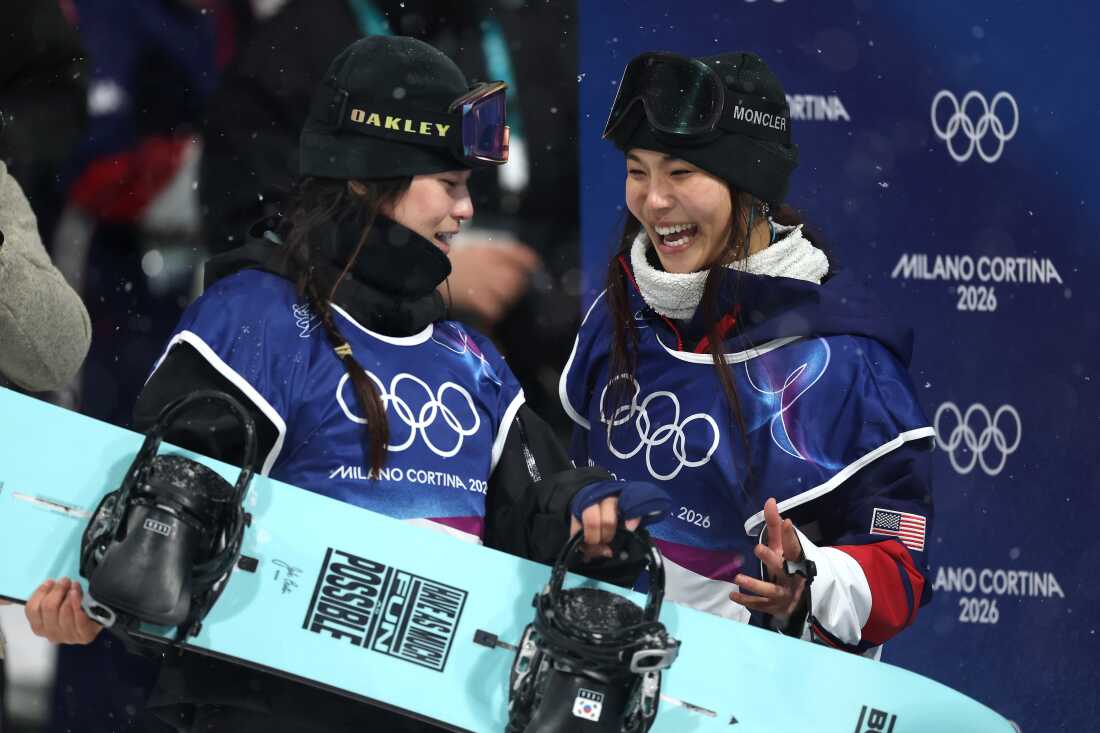
Kim (R) gave Choi (L) a warm reception after the last run of the night.
Patrick Smith/Getty Images Europe
hide caption
toggle caption
Patrick Smith/Getty Images Europe
“Chloe’s dad did a lot of mentoring to my dad,” Choi said after winning the first World Cup she entered in 2023, at age 14. “I didn’t know much because I was young, but Chloe’s dad gave my dad a lot of advice. It made me who I am today.”
Kim and her dad helped bring Choi to the U.S. to train with at California’s Mammoth Mountain, and maintained a supportive relationship. Kim spoke highly of Choi at an earlier press conference, calling it a “full-circle moment” and saying she sees “a mirror reflection of myself and my family.”

“We’re seeing a big shift to Asians being dominant in snow sports,” she added. “I’ve had aunts telling me that I shouldn’t snowboard, get a real career, focus on school. It’s cool to see that shift happening.”
Choi’s victory makes her the first female Korean athlete to win a medal in snow sports. This is also South Korea’s first snowboard gold.
“I want to introduce this sport more to my country through my performance at this Olympics,” Choi told Olympics.com before the Games. “I also believe that enjoying the Games is just as important as achieving good results.”


How to enter your Sporty Spice era.
Getty Images/quantic69/Olga Kurbatova/Anastasiia Zvonary/Photo Illustration by NPR
hide caption
toggle caption
Getty Images/quantic69/Olga Kurbatova/Anastasiia Zvonary/Photo Illustration by NPR
Reality dating and professional sports are not as different as you’d think.
Brittany is in her Sporty Spice era – she watched the NBA playoffs, she’s following World Cup games, and she’s watching the New York Liberty play their WNBA season. These games are daily – and so is the reality dating show Love Island. And she noticed that the two formats are not very different at all. Defector.com staff writer and co-owner Kelsey McKinney came to the same conclusion – so the two of them discuss why these games of athleticism and love can bring us together… and why they get valued differently in our culture.
For more episodes on sports and reality TV, check out:
Get rich or die trying: how sports betting is changing our love of the game
Is this the end of reality TV?
The ugly truth of America’s expensive homes
Support Public Media. Join NPR Plus.
Follow Brittany on Instagram: @bmluse
This episode was produced by Liam McBain. It was edited by Neena Pathak. Our Supervising Producer is Cher Vincent. Our Executive Producer is Barton Girdwood. Our VP of Programming is Yolanda Sangweni.


As the nation marks the 250th anniversary of its founding, NPR asked students all around the country to reflect on the moment and to make podcasts about the American experience and what “life liberty and the pursuit of happiness” means to them.


We received more than 700 entries, including many conversations with immigrant parents, grandparents, aunts and uncles about why their family decided to move to the United States. Others scored high-profile interviews with veterans, government officials and even Gloria Steinem.
We listened to reenactments and retellings of histories like the Battle of Monmouth, the Stonewall riots, the Underground Railroad and a special presentation on President Theodore Roosevelt’s pets. Other podcasts take place in the present, including one in which students report on civics education in their school.
Our team chose a handful of winning entries and honorable mentions from fourth graders, middle and high schoolers. Here they are, in alphabetical order:
Winners
Abridged
Students: Grace Kepka and Angelika Garrett, Montgomery Blair High School in Silver Spring, Md.
Teacher/Sponsor: Kyle Wannen
High schooler Grace lives in Takoma Park, Md., one of the handful of cities in the United States that allow 16 year olds to vote in all local elections. In her podcast with her friend Angelika, they discuss the power of the youth vote, and how voting rights encourage residents to learn about their government and be more politically active in their communities.
Civics in Our Schools
Students: Izabella Anthony, Benjamin Baigel, Bridget Castellon, Rile DeLeon, Maxwell Gibbs, Daniel Hernandez, Malcolm Johnson, Sylpa Kafle, Mason King, Kyle Li, Maximus Lin, Emmerson Quinn, Ariella Schoenfeld, Owenize Udevbulu and Dara Widzowski, Hewlett Elementary School in Hewlett, N.Y.
Teacher/Sponsor: Jaime Harrington
“Here’s the surprising truth. Many Americans, even grownups, don’t know the basics of how our country was founded or how our government works.” In Civics in Our Schools, a group of fifth graders voice their concerns about the lack of good civics education and discuss what they can do to be better citizens.
Leaving Greece
Student: Livie Courser, Wickliffe Progressive Elementary School in Upper Arlington, Ohio
Teacher/Sponsor: Shelly Hughes
Livie interviews her grandfather about his move from Greece to the United States. “How did it feel to immigrate to the U.S.?” she asks. “Very hard. Very very hard,” he responds. He shares with his granddaughter why he took the risk, and how his move to the U.S. allowed him to work hard at a factory, dream big and eventually open up his own restaurants.
Researching the Underground Railroad
Students: Travis Bozeman and Oliver Heering, South Douglas Elementary School in Douglasville, Ga.
Teacher/Sponsor: Thomas Bruno
“Did you know around 100,000 slaves escaped using the Underground Railroad?” In a deep dive into a slice of history they learned from school, fourth graders Travis and Oliver report on the Underground Railroad. They present their research in the podcast, and weave in the expert interview they scored.
The American Dream
Student: Makayla Cheung, Mercer Island High School in Mercer Island, Wash.
Teacher/Sponsor: Lauren Schechter
In her podcast about her father, Makayla explores how different everyone’s American Dream is. Case in point, her dad moved from Hong Kong to the United States because of his talent in running. He tells Makayla he had a hard time adjusting at first and understanding his coach. But cross country, he says, didn’t require too much communication, and the sport gave him confidence and a way for him to find community and connect with other people.
The Journal
Student: Violet Maxinoski, Carmel High School in Carmel, Calif.
Teacher/Sponsor: Shelley Grahl
In an interview with her daughter Violet, Sandi Maxinoski revisits stories from her journal from the years she served in Iraq. She describes being in “cities fractured by bombings, checkpoints, smoke and uncertainty,” then returning to the United States where she felt an “intense amount of security” being able to walk down the street without the fear of something blowing up. Through these conversations, Violet discusses how the “life, liberty and happiness” she’s gotten used to shouldn’t be taken for granted.
Welcome Home, Grandpa
Student: Ursula Koestner, Roslyn High School in Roslyn Heights, N.Y.
Teacher/Sponsor: Matthew Vogt
“The Vietnam War destroyed more than it saved, even decades after its end,” high schooler Ursula says in her podcast. “My grandfather remains one of its victims despite returning home alive.” In her moving podcast, Ursula shares her family’s story and explores the generational trauma and lasting impact the Vietnam War has on veterans.
Honorable Mentions
America the Beautiful
Students: Pareena Gupta and Vidushee Bala, Amador Valley High School in Pleasanton, Calif.
Teacher/Sponsor: Stacey Sklar
America: The Ups and the Downs
Student: Alana Burwell, The Waldorf School of Philadelphia, Philadelphia, Pa.
Teacher/Sponsor: Anyta Thomas
America’s New Favorite Sport-Girls’ Flag Football
Students: Josephine Barry-Kao and Malcolm Barry-Kao, Lowell High School in San Francisco, Calif.
Teacher/Sponsor: Jacqueline Moses
An Intro to Differing Perspectives
Student: Waylon Heikinen, Ingomar Middle School in Franklin Park, Pa.
Teacher/Sponsor: Heath Gamache
Becoming American
Students: Karolina Zientek, James Gearhart, Andrea Vezmar, Troy Murray and August Hutchison, Greenwich High School in Greenwich, Conn.
Teacher/Sponsor: Lukasz Zientek
Before You Drop A Track: America’s 250th Anniversary
Student: Lukas Boulom, Public Academy For Performing Arts in Albuquerque, N.M.
Teacher/Sponsor: Su Hudson
Dawg Talk | Are we equal now?
Students: Makenna Aniszewski, Trinlee Leitner, Nagamoshitha Manivannan, Nethra Prabhu, Vaishnavi Tiwari and Sophia Van Dorn, Otwell Middle School in Cumming, Ga.
Teacher/Sponsor: David Miller
Democracy for Everyone or No One
Student: Jeju Daisy Ahn-Miles, Punahou School in Honolulu, Hawaii
Teacher/Sponsor: Christine Ahn
Everything Given Forward
Student: Lara Leon, Mountain View High School in Mountain View, Calif.
Teacher/Sponsor: Tom Chang
Fifty Stars, One Banner
Student: Naina Dhillon, Khan Lab School in Palo Alto, Calif.
Teacher/Sponsor: Emily Lindsey
Freedom’s Shore
Student: Dipa Chéry, The Kinkaid School in Houston, Texas
Teacher/Sponsor: Olen Rambow
From One Immigrant To Another
Student: Afomia Lemma, St. Mary’s Lynn in Lynn, Mass.
Teacher/Sponsor: Tiringo Endalamaw
Hope and Resistance
Student: Zinnia Bender, North Fork High School in Hotchkiss, Colo.
Teacher/Sponsor: Clara Pena
How Is My Life Like In US
Student: Yicheng Sun, Rectory School in Pomfret, Conn.
Teacher/Sponsor: Andrew Barker
Life of a Soldier
Students: Della Axelband, Peyton Johnson, Lily Epstein and Lilly Murillo, Jupiter Middle School in Jupiter, Fla.
Teacher/Sponsor: Sireesha Rutter
More Than A Photograph
Student: Josie Sloan-Westmoreland, The Learning Community School in Swannanoa, N.C.
Teacher/Sponsor: David Bird
Moving From Country to Country
Students: Ida Buerckert, Daniella Cubas, Ayano Enishi and Anastaiia Koshyk, Irving A. Robbins Middle School in Farmington, Conn.
Teacher/Sponsor: Alysson Olsen
Picketts Charge
Student: Zoe Snyder, Susquenita High School in Duncannon, Pa.
Teacher/Sponsor: Terrance Shepler
“So What??”
Student: Caroline Harris, Marin Academy in San Rafael, Calif.
Teacher/Sponsor: Kelly Kurtzig
Somewhere Over the Rainbow
Student: Lark (Miles) Jackman, Public Academy For Performing Arts in Albuquerque, N.M.
Teacher/Sponsor: Su Hudson
Teddy Roosevelt and His Pets
Student: Abbott Mearns and Keaton Rainwater, College Place Middle School in Lynnwood, Wash.
Teacher/Sponsor: Colindra Connolly
The Battle of Monmouth: A Twist on History
Students: Leonardo, Zinna and Kaiden, Marlboro Middle School in Marlboro, N.J.
Teacher/Sponsor: Tara Meara
The Freedom to Fail
Students: Abraham Coher and William Pan, Polytechnic School in Pasadena, Calif.
Teacher/Sponsor: Aliya Coher
The Government Exodus: Why Federal Workers Resign
Student: Anna Su, Montgomery Blair High School in Silver Spring, Md.
Teacher/Sponsor: Kyle Wannen
The Name I Chose Polly Bemis (September 11, 1853 – November 6, 1933)
Student: Jubilee Sung, Imaginate Ink in Irvine, Calif.
Teacher/Sponsor: Clarissa Ngo
The Pig and Potato Podcast
Student: Petra Rouhana, Maryvale Preparatory School in Lutherville, Md.
Teacher/Sponsor: Deirdre McAllister
The Small Pond of Peace
Students: Noam Dekel, Ronnie Dekel, Ian Rodriguez, Leonardo Leon-Espinoza, Singary Fofana, Ashly Arboleda-Osorio, Olumide Martin and Salma Elshaarawi, P.S. 333 Manhattan School for Children in New York, N.Y.
Teacher/Sponsor: Karin Patterson
to be united as citizens
Student: Josh Langlois, Cloverleaf Home Education in Highlands Ranch, Colo.
Teacher/Sponsor: Tony Winger
Two Worlds, One Dream
Student: Allayar Maratov, Rectory School in Pomfret, Conn.
Teacher/Sponsor: Andrew Barker
What is Home?
Student: Siobhan Allen, The Hewitt School in New York, N.Y.
Teacher/Sponsor: Jonathan Sabol
-

 New York53 minutes ago
How a Museum Security Guard and Artist Lives on $51,000 in Parkchester
-

 Los Angeles, Ca55 minutes ago
Heat advisory issued as Southern California temps near triple digits this week
-

 Detroit, MI1 hour ago
Detroit Battery Safety Provider Reaches to the Skies with Med Hawk
-

 San Francisco, CA1 hour ago
A Locals-Approved Modern Guide to Fisherman’s Wharf: Seafood, Beer Gardens + Iconic Bay Views
-

 Dallas, TX2 hours ago
New glitzy Houston steakhouse Juliet opens next to Delilah this summer
-

 Miami, FL2 hours ago
Allapattah man faces charges over armed robbery after crash in Miami’s Liberty City
-

 Boston, MA2 hours ago
Somehow, This is a Fitting, Confusing End to Jaylen Brown’s Boston Celtics Career
-

 Denver, CO2 hours ago
Denver Broncos 2026 schedule

