Lifestyle
At 70, she embraced her Chumash roots and helped revive a dying skill


Around 1915, the last known Chumash basket maker, Candelaria Valenzuela, died in Ventura County, and with her went a skill that had been fundamental to the Indigenous people who lived for thousands of years in the coastal regions between Malibu and San Luis Obispo.
A century and two years later, 70-year-old Santa Barbara native Susanne Hammel-Sawyer took a class out of curiosity to learn something about her ancestors’ basket-making skills.
Hammel-Sawyer is 1/16 Chumash, the great-great-great-granddaughter of Maria Ysidora del Refugio Solares, one of the most revered ancestors of the Santa Ynez Band of Chumash Indians for her work in preserving its nearly lost Samala language.
But Hammel-Sawyer knew nearly nothing about Chumash customs when she was a child. As a young mother, she often took her four children to the Santa Barbara Museum of Natural History, where she said she loved to admire the museum’s extensive collection of Chumash baskets, “but I had no inkling I would ever make them.”
Nonetheless, today, at age 78, Hammel-Sawyer is considered one of the Santa Ynez Band’s premier basket makers, with samples of her work on display at three California museums.
Short, reddish brown sticks of dried basket rush sit in a small basket in Susanne Hammel-Sawyer’s kitchen, waiting to be woven into one of her baskets. The reddish color only appears at the bottom ends of the reeds, after they dry, so she saves every inch to create designs in her baskets. “These are my gold,” she says.
(Sara Prince / For The Times)
She grows the basket rush (Juncus textilis) reeds that make up the weaving threads of her baskets in a huge galvanized steel water trough outside her Goleta home and searches in the nearby hills for other reeds: primarily Baltic rush (Juncus balticus) to form the bones or foundation of the basket and skunk bush (Rhus aromatica var. trilobata) to add white accents to her designs.
All her basket materials are gathered from nature, and her tools are simple household objects: a large plastic food storage container for soaking her threads and the rusting lid of an old can with different-sized nail holes to strip her reeds to a uniform size. Her baskets are mostly the yellowish brown color of her main thread, strips of basket rush made pliant after soaking in water.
The basket reeds often develop a reddish tint at the bottom part of the plant when they’re drying. “Those are my gold,” she said, because she uses those short ends to add reddish designs. Or sometimes she just weaves them into the main basket for added flair.
The only other colors for the baskets come from skunk bush reeds, which she has to split and peel to reveal the white stems underneath, and some of the basket reeds that she dyes black in a big bucket in her backyard.
“This is my witches’ brew,” she said laughing as she stirred the viscous inky liquid inside the bucket. “We have to make our own from anything with tannin — oak galls, acorns or black walnuts — and let it sit to dye it black.”
Hammel-Sawyer is remarkable not just for her skill as a weaver, but her determination to master techniques that went out of practice for nearly 100 years, said anthropologist and ethnobotanist Jan Timbrook, curator emeritus of ethnography at the Santa Barbara Museum of Natural History, which claims to have the world’s largest museum collection of Chumash baskets.
“Susanne is one of the very few contemporary Chumash people who have truly devoted themselves to becoming skilled weavers,” said Timbrook, author of “Chumash Ethnobotany: Plant Knowledge Among the Chumash People of Southern California.” “Many have said they’d like to learn, but once they try it and realize how much time, patience and practice it requires … they just can’t keep it up.”

Susanne Hammel-Sawyer adds another row to her 35th basket, working from a straight back chair in her small living room, next to a sunny window and the tiny table where she keeps all her supplies.
(Sara Prince / For The Times)
In her eight years, Hammel-Sawyer has made just 34 baskets of various sizes (she’s close to finishing her 35th), but she’s in no hurry.
“People always ask how long it takes to make a basket, and I tell them what Jan Timbrook likes to say, ‘It takes as long as it takes,’” Hammel-Sawyer said. “But for me, it’s a way of slowing down. I really object to how fast we’re all moving now, and it’s only going to get faster.”
She and her husband, Ben Sawyer, have a blended family of five children and nine grandchildren, most of whom live near their cozy home in Goleta. Family activities keep them busy, but Hammel-Sawyer thinks it’s important for her family to know she has other interests too.
“When you’re older, you have to be able to find a passion, something your children and grandchildren can see you do, not just playing golf or going on cruises, but doing something that matters,” she said. “I wish my grandmother and my father knew I was doing this because it’s a connection with our ancestors, but it’s also looking ahead, because these baskets I’m making will last a very long time. It’s something that comes from my past that I’m giving to family members to take into the future, so it’s worth my time.”
Also, this isn’t a business for Hammel-Sawyer. Her baskets are generally not for sale because she only makes them for family and friends, she said. The baskets at the Santa Barbara Museum of Natural History and the Santa Ynez Chumash Museum and Cultural Center belong to family members who were willing to loan them out for display. The Chumash museum does have some of Hammel-Sawyer’s baskets for sale in its gift shop, which she said she reluctantly agreed to provide after much urging, so the store could offer more items made by members of the Band.

For the last eight years, Susanne Hammel-Sawyer has used the same old can lid, punched with nail holes of various sizes, to strip her moistened basket threads to a consistent size.
(Sara Prince / For The Times)
The only other basket she’s sold, she said, was to the Autry Museum of the American West, because she was so impressed by its exhibits involving Indigenous people. “I just believe so strongly in the message the Autry is giving the world about what really happened to Indigenous people, I thought I would be proud to have something there,” she said.
Making a basket takes so long, Hammel-Sawyer said, that it’s important for her to focus on the recipient, “so while I’m making it, I can think about them and pray about them. When you know you’re making a basket for someone, it has so much more meaning. And I’m so utilitarian, I always hope someone will use them.”
For instance, she said, she made three small baskets for the children of a friend and was delighted when one used her basket to carry flower petals to toss during a wedding. Almost any use is fine with her, she said, except storing fruit, because if the fruit molds, the basket will be ruined.
Baskets were a ubiquitous part of Chumash life before the colonists came. They used them for just about everything, from covering their heads and holding their babies to eating and even cooking, Timbrook said. They put hot rocks into their tightly woven baskets, along with food like acorn mush, to bring the contents to boil.
“People think pottery is a higher form of intellectual achievement, but the thing is, baskets are better than pottery,” Timbrook said. “They’ll do anything pottery will do; you can cook in them and store things in them, and when you drop them, they don’t break.”

2

3

1. Tule reeds that grows in the yard in preparation of basket weaving. 2. Susanne Hammel-Sawyer weaves a basket. 3. A basket sits during a break in weaving with tools on a table. (Sara Prince / For The Times)
After Hammel-Sawyer’s first marriage ended, she worked as an assistant children’s librarian in Santa Barbara and met a reference librarian named Ben Sawyer. After their friendship turned romantic, they married in 1997 and moved, first to Ashland, Ore., then Portland, and then the foothills of the Sierras in Meadow Valley, Calif., where they took up organic farming for a dozen years.
Meadow Valley’s population was 500, and the big town was nearby Quincy, the county seat, with about 5,000 residents, but it still had an orchestra and she and her husband were both members. She played cello and he viola, not because they were extraordinary musicians, she said, but because “we played well enough, and if we wanted an orchestra, we would have to take part. I loved how strong people were there. We were all more self-sufficient than when we lived in the city.”
The Sawyers moved back to Santa Barbara in 2013, the year after her father died, to help care for her mother, who had developed Alzheimer’s disease. And for the next four years, between caring for her mother, who died in 2016, and the birth of her grandchildren, family became her focus.
But in 2017, the year she turned 70, Hammel-Sawyer finally had the space to begin looking at other activities. Being she’s 1/16 Chumash, she was eligible for classes taught by the Santa Ynez Band. She had seen several class offerings come through over the years, but nothing really captured her interest until she saw a basket-weaving class offered by master basket maker Abe Sanchez, as part of the tribe’s ongoing effort to revive the skill among its members.
Most Chumash baskets have some kind of pattern, although today people have to guess at the meaning of the symbols, Timbrook said. Some look like squiggles, zigzaggy lightning bolts or sun rays, but the wonder, marveled Hammel-Sawyer, is how the makers were able to do the mental math to keep the patterns even and consistent, even for baskets that were basically everyday tools.
Hammel-Sawyer is careful to follow the basics of Chumash weaving, using the same native plants for her materials and weaving techniques that include little ticks of contrasting color stitches on the rim, something visible in most Chumash baskets. She keeps a good supply of bandages for her fingers because the reeds have sharp edges when they’re split, and it’s easy to get the equivalent of paper cuts.
She keeps just two baskets at her house — her first effort, which “wasn’t good enough to give anybody,” she said, laughing — and a basket hat started by her late sister, Sally Hammel.

This basket hat was started by Susanne Hammel-Sawyer’s sister, Sally Hammel, but the stitches became ragged and uneven after Sally began treatment for cancer. She was so distressed by her work, she hid the unfinished basket, but after she died, Hammel-Sawyer found it and brought it home to complete it. It’s one of only two baskets she’s made that she keeps in her home.
(Sara Prince / For The Times)
“Sally was an artist in pottery, singing, acting and living life to the fullest,” Hammel-Sawyer said, and she was very excited to learn basketry. Her basket hat started well, but about a third of the way in, she got cancer “and her stitches became more and more ragged. She had trouble concentrating, trouble preparing materials,” Hammel-Sawyer said. “Everything became so difficult that she hid the basket away. I know she didn’t even want to look at it, let alone have anyone else see it.”
After her sister died in 2020, Hammel-Sawyer had a hard time finding the basket, “but I did, and I asked my teacher what to do, and he said, ‘Just try to make sense of her last row’ … So that’s what I did.” She added a thick black-and-white band above the ragged stitches and finished the blond rim with the traditional contrasting ticking.
The hat rests now above the window in Hammel-Sawyer’s living room, except when she wears it to tribal events.
“Sally and I were very close, and I think she’d just be happy to know it was finished and appreciated,” Hammel-Sawyer said. “Even the hard parts … deeply appreciated.”


Can you say no to a friend’s wedding?
Getty Images/Getty images
hide caption
toggle caption
Getty Images/Getty images
Are we spending too much on other people’s weddings?
Going to a friend’s weddings can be so fun and meaningful… but it can also really hurt your wallet. A survey by LendingTree found that 31% of people who had been to a wedding in the past five years had accrued debt to attend. So what’s driving up the cost of weddings for guests? And what makes it so hard to say no to these expenses?
Brittany breaks it down with Allyson Rees, senior analyst at trend forecasting firm WGSN, and Annie Joy Williams, assistant editor at The Atlantic.
This episode was produced by Liam McBain, with additional support from Corey Antonio Rose. It was edited by Neena Pathak. Our Supervising Producer is Cher Vincent. Our Executive Producer is Barton Girdwood. Our VP of Programming is Yolanda Sangweni.
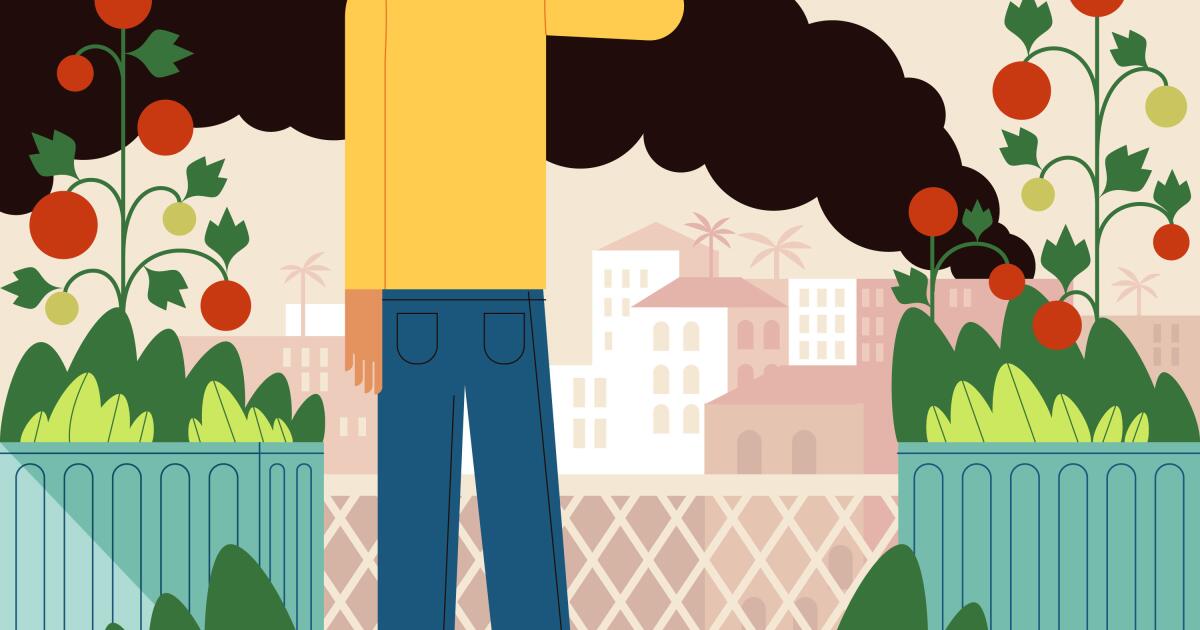
After the eight-day-long fire in a 500,000-square-foot Boyle Heights warehouse, eastern Los Angeles residents are contending with putrid smells, soot and potentially hazardous airborne chemicals after heavy plumes of smoke spread throughout the city. But those who grow food in nearby neighborhoods may also be wondering: How will the fires affect the plants and produce in my garden?
The Boyle Heights warehouse, owned by Lineage — a global temperature-controlled storage facility operator — housed 85 million pounds of frozen food and other products. In the days since the fire, local emergency visits for smoke inhalation and throat pain spiked while agencies still scramble to measure the amount of PM 2.5 — harmful fine particles — and heavy metals, like lead and arsenic, in the air.
According to researchers, any toxic airborne chemicals would likely stem from the charred foam insulation, metal exterior, burned solar panels and any lithium batteries that might have been present inside the warehouse.
After a fire, heavy metal particles can spread through ash and smoke over gardens and inhibit growth, said Olukayode Jegede, an agricultural toxicologist and assistant professor at UC Davis. Since the warehouse fire is so recent and cleanup has just begun, Jegede said the precise impact on gardens can’t be measured until comprehensive soil tests are conducted in the area.
While the L.A. city government hasn’t announced plans for soil testing, the Contaminant Level Evaluation and Analysis for Neighborhoods project at USC is offering free contaminant testing for Boyle Heights and East L.A. residents. Residents can collect soil samples and deliver them to Boyle Heights City Hall and other locations for an evaluation of lead, arsenic, chromium and mercury levels.
The good news is produce, plants and roots can still be preserved. According to Jegede, many of the soil tests conducted last year in the Altadena area after the Eaton fire showed that gardens and poultry were not as contaminated as one might expect.
“Quite a number of the soils we tested [in Altadena] were not really contaminated,” Jegede said. “We weren’t seeing many soils with concerning elevated levels of metal, so gardeners should not be too alarmed when these things happen.”
Nevertheless, there are several measures that gardeners can take to keep themselves, their children, plants and produce safe from potentially harmful contaminants stemming from the fire. Researchers, gardening experts and horticulturists offered some guidance on the handling, recultivation and cleanup that can keep you and your garden in good health.
How do I remove ash and contaminants from my garden?
Altadena horticulturist Leigh Adams said Boyle Heights plants and produce already live in a difficult environment, surrounded by industrial warehouses that spread contaminants daily.
“That area has been used industrially for 100 years, and the soil is impacted by many, many, many things,” Adams said. “Low-income neighborhoods and gardens usually don’t have a lot of resistance against dominant manufacturing.”
This means that the contamination of gardens in eastern L.A. won’t be as catastrophic as compared with those in Altadena, a more suburban environment, Adams said. But fallen ash still poses major health risks if ingested or inhaled.
An advisory from University of California Agricultural and Natural Resources last year recommended suiting up in an N95/KN95 mask, long sleeves, pants, close-toed shoes and gloves before attempting to deal with ash in the garden to limit exposure to potentially toxic contaminants. The advisory added that individuals should make sure all of this gear is cleaned thoroughly before bringing it back inside.
Once in the proper gear, Adams recommends removing the top two inches of topsoil from gardens, where the highest concentration of contaminants will settle after a fire. Using a plastic bag to collect the soil and disposing of it in the garbage — not green yard waste bins — will help to reduce the spread of airborne chemicals.
Gardeners with raised beds are advised to remove approximately six inches of soil, because excess ash can raise the pH level and prevent nutrients from soaking into the soil bed.
After this, watering the garden gently but plentifully will help to promote soil health and get rid of most of the ash present on plant leaves and stems. Adams said replacing the top two inches of soil with store-bought mulch or straw will help to contain any remaining ash and prevent it from spreading any further.
Experts say to avoid using leaf blowers if ash is present in the garden because they can send particles airborne. Doing so will increase the likelihood of heavy metal particles, which can carry lung irritants and carcinogens, being spread and inhaled.
A Boyle Heights resident keep a watchful eye on the fire at the 5,000-square-foot commercial building, which stores 85 million pounds of frozen food.
(Genaro Molina / Los Angeles Times)
Is it safe for me to eat produce from my garden?
Several studies, including one from the UC Cooperative Extension of Sonoma County, have shown that consuming produce in a fire-affected area poses minimal health risks.
Jegede said most root vegetables like potatoes and carrots, along with any fruit that has an outer layer, can be washed to remove potential contaminants, even if they were covered in ash. Peeling the outer layer of your produce can also help to reduce potential risks, he said.
Lettuce and other leafy foods with multiple layers pose a higher risk of contamination, but with a vigorous wash and peeling the outer layers, even the greens can be saved. The County of Los Angeles Department of Public Health recommends soaking leafy produce and fuzzy fruits like peaches in a 10% white vinegar and 90% water mixture.
Jegede said if the leaves or fruit are too delicate to wash or ash is still visible, it would be best to dispose of the produce.
How can I tell if my soil is contaminated?
After ridding your garden of visible ash, you might wonder how to tell if your plants will still thrive in the soil.
At-home soil tests that measure for alkaline, fertility and pH levels are widely available and can be purchased for $15 to $100 (for more detailed results) online. But Jegede said these tests can’t tell the full story of soil health.
Comprehensive soil testing is “something you can’t do properly at home,” Jegede said. “In labs, we are testing for metals like lithium and zinc, stuff that an at-home test will not show … If it comes to the point that you’re worried about your soil, I would just send it out to a lab.”
Wallace Laboratories in El Segundo, Babcock Laboratories in Riverside, Waypoint Analytical in Anaheim and other labs offer more detailed soil tests that measure heavy metal particles in addition to other fertility factors. Prices at Wallace Laboratories can range from $115 to $295 for a complete compost test.
The soil below two inches should be unharmed, Adams said, so long as new compost is set and plants are watered plentifully, which will promote natural biological cycles.
“What you’re doing is capping the soil, so that moisture stays in there, and instead of being dirt, it’s a living system called soil,” Adams said. “The more carbon we can get into our soil, the better.”
What can I do to help my soil recover?
For the last 12 years, Adams has been working with Metabolic Studio, a Los Angeles-based art and research hub focused on environmentalism, on methods for bioremediation, the practice of using additional fungi, plants and compost to decontaminate ash and break down contaminants.
Adams said straw, mushrooms, corn, rye and sunflowers are great bioremediators that can help to repair damage to soils. She said certain samples she’s worked on with Metabolic Studio have gone from testing at high heavy metal levels to nearly contaminant-free.
But for a more immediate fix, wash your produce, water your plants and have a little patience during ash cleanups. Your garden should look better in no time, Adams and Jegede said.

Inde Navarrette and Michael Johnston in Obsession.
Focus Features
hide caption
toggle caption
Focus Features
Two big horror films, Obsession and Backrooms, just smashed all box office expectations. So much of their success has been driven by Gen Z, which is now the biggest moviegoing demographic. But what makes a movie a Gen Z movie? Today we’re bringing you an episode of NPR’s It’s Been a Minute. Host Brittany Luse talks about this trend with Sam Adams and Reanna Cruz.
If you want to hear more about these movies, check out these episodes:
In ‘Obsession,’ love hurts. It really, really, really hurts.
‘Backrooms’ brings YouTube horror to the big screen
Zendaya brings ‘The Drama,’ we bring the spoilers
Connect with Pop Culture Happy Hour:
Letterboxd / Facebook
Our weekly newsletter
Support Pop Culture Happy Hour+
-

 Maine4 minutes ago
A hard lesson for Democrats in Maine. Plus, we have some news about Ed Markey. – The Boston Globe
-

 Maryland11 minutes ago
Governor Moore Announces Awardees for $1.23 Million Investment to Help Maryland Workers Thrive in a Changing Economy
-

 Michigan14 minutes ago
‘Big Brother’ season 28 to premiere this week. One guest from Michigan
-

 Massachusetts14 minutes ago
Cool off this summer at these 10 splash pads in central Massachusetts
-

 Minnesota26 minutes ago
EF2 tornado injures two, damages homes near Detroit Lakes, Minnesota
-

 Mississippi29 minutes ago
Mississippi’s first Dutch Bros now open in Pearl
-

 Missouri34 minutes ago
UPDATE: Suspect wanted in Kansas captured near Columbia; Missouri State Highway Patrol aircraft plays key role | 93.9 The Eagle
-

 Montana41 minutes ago
Butte gears up for Montana Folk Festival, which starts Friday

