Entertainment
Ted Turner, CNN creator who revolutionized the media industry, dies at 87


Ted Turner, the brash media mogul who created CNN and revolutionized how Americans watched television, and who wielded his media empire and wealth to pursue liberal global causes and land conservation, has died. He was 87.
Turner died Wednesday, CNN reported, citing a news release from Turner Enterprises.
In 2018, he revealed he had been diagnosed with Lewy body dementia, a neurodegenerative disease.
The media business is full of big-talking executives. But Turner’s outsized public persona — some called him the “Mouth from the South” for his free-wheeling trash talk — actually matched the Georgian’s influence on news, politics, sports and entertainment in the late 20th century. Over and over again, Turner shook up established industries by invading quickly and expanding options for consumers, while railing against monolithic competitors who were less daring or nimble than his maverick Turner Broadcasting System.
Turner created the cable stations TBS and Turner Classic Movies; he owned the Atlanta Braves baseball team, the Atlanta Hawks basketball team, and revitalized professional wrestling with World Championship Wrestling.
Turner was one of the first adopters of cable and satellite broadcasting technology, and for many rural Americans living beyond the tower signals of major cities, Turner was the first person to bring them interesting TV.
He constantly generated headlines. He had a Clark Gable pencil mustache, raced sailboats, cavorted with the late communist leader Fidel Castro in Cuba, and at one point married Academy Award-winning actress and activist Jane Fonda. His wealth enabled him to become one of the largest private landowners and wealthiest philanthropists in the U.S.
July 1990 image of Ted Turner with Jane Fonda.
(Tony Duffy/Getty Images)
His crowning cultural achievement was the creation of the Cable News Network in 1980, which created the model for today’s cable news titans. The 24-hour news channel was not widely expected to be a success. All-night broadcasting had not been proven as a business model in an industry dominated nationally by corporate monoliths like ABC, NBC and CBS, where news programming was something that happened on a set schedule. And CNN’s headquarters weren’t in media centers like New York or Los Angeles, but Atlanta.
But Turner believed that “over-the-air networks would decline as audiences turned to videos and other outlets for entertainment on demand,” journalist Daniel Schorr, whom Turner courted to join CNN, recalled of Turner’s pitch in a 2001 memoir.
“The network future belonged to whoever would deliver what was happening now — live news and live sports. That was why he wanted to be the first to deliver all news, all sports, all the time,” Schorr wrote.
Within two years, CNN had more than 9 million subscribers; many millions more were to come. By the 2000s, Turner’s once far-flung idea for an around-the-clock news service had become so successful that it had attracted imitators like MSNBC and Fox News.
“We not only became profitable, but also changed the nature of news — from watching something that happened to watching it as it happened,” Turner said of CNN in 2004. “If we needed more money for [broadcasting from] Kosovo or Baghdad, we’d find it. If we had to bust the budget, we busted the budget. We put journalism first, and that’s how we built CNN into something the world wanted to watch.”
Robert Edward Turner III was born in Cincinnati on Nov. 19, 1938, and raised in Georgia. A mischievous child — who later became a mischievous adult despite attending the Georgia Military Academy — he had a tough childhood at the hands of his alcoholic father, Ed.
“Ninety percent of the arguments I had with Ed were over his beating Ted too hard,” Ted’s mother, Florence Turner, recalled later.
“My dad ran an old-fashioned household and he insisted that pretty much everything had to be his way,” Ted Turner said in a 2008 memoir. “My father and I had a complex relationship but I loved him.”
The younger Turner attended Brown University but dropped out before graduating. His savings had run out, his father had stopped financially supporting his tuition, and in his final days on campus, he was suspended for bringing a woman to his dorm room, according to his memoir.
He soon joined his father’s expanding billboard advertising company, Turner Advertising, where he had been working off and on for years since childhood and which had since become one of the largest advertising companies in the South.
He inherited the business at the age of 24 after his father died by suicide. By then, Turner had already had years of experience helping run the company, and he worked furiously to reverse his father’s recent sale of part of the company to a competitor and paid down its daunting debt, an act of corporate savvy that presaged the empire-building to come.
While growing the business, Turner was also pursuing his passion for competitive sailing, which is how he met his first wife, Judy Nye, in college. It’s also how their marriage ended. Turner intentionally hit his wife’s boat during a 1963 race to keep her from passing him, and the pair, who had two children, split immediately afterward.
It was to be the first of three divorces for Turner, who was better at sailing and at business than keeping marriages together. “My problem is I love every woman I meet,” Turner has said. He would go on to win the America’s Cup in 1977 while expanding his father’s company into a modern multimedia conglomerate.
Using the billboard business as a springboard into new industries, Turner started buying local radio stations across the South in the late 1960s. In 1970, he bought the Channel 17 television station in Atlanta, competing with local network affiliates by airing old movies whose rights were affordable and picking up programming dropped by the less nimble competition. He didn’t like putting news on prime time back then — too negative — and soon picked up broadcast rights for the Braves, Hawks and other local sports.

Oct. 1998 photo of former President Jimmy Carter, right, and Atlanta Braves team owner Ted Turner, during Game 6 of the National League Championship Series in Atlanta.
(PAT SULLIVAN/AP)
The Braves were a ratings hit, and when the team flailed and went up for sale, Turner’s company became its owner in 1976. The team continued to flail but Turner boosted its profile with gimmicks such as sewing “Channel 17” on the back of a pitcher’s jersey and dressing up as the team’s batboy and manager, to the league’s disdain. Turner bought the Hawks shortly after.
With his ambitions for TV limited by entrenched local network affiliates, Turner expanded his independent station’s reach across the South and then the U.S. by embracing the new technologies of cable and satellite broadcasting. Channel 17 became nationally known as the “SuperStation,” with call letters WTBS, later shortened to TBS. The quirky Atlanta station’s local broadcasts of old movies and sports games had become national broadcasts.
Still hungry for more, Turner finally turned his attention to news programming. He launched CNN in 1980 in a desperate bid to create a national 24-hour news channel before the broadcast titans ABC, NBC and CBS — and their gargantuan budgets — could beat him to it.
There were some lean early years. But the nascent channel fended off an attempt by ABC to create a competitor, and critics could see the value of an ever-present news channel, even if quality was a little thin at times. “Non-viewers of CNN are missing a lot. There are so many reasons to watch,” Los Angeles Times critic Howard Rosenberg wrote in 1986, hailing the 6-year-old channel as an “institution.” “It’s not always good, but it’s always there.”
In 1986, CNN was the only broadcaster running live coverage when the Challenger shuttle liftoff ended in disaster. In 1991, the network gave Americans a live and uninterrupted look at the invasion of Iraq. American officials held news conferences knowing that Iraqi leader Saddam Hussein was watching them on CNN.
Americans had seen images of war before, but not broadcast nonstop into their homes.
“CNN seeks to be a stethoscope attached to the hypothetical heart of the war, and to present us with its hypothetical pulse,” the French theorist Jean Baudrillard wrote, critiquing the conflict as a media spectacle. Media scholars began to wonder whether a “CNN effect” was influencing government policy. Officials found that they now had to respond much more quickly to crises unfolding on live television.
Turner was not adversarial to communist countries of the era and even tried his own version of the Olympics, called the Goodwill Games, a bit of private-sector peace-craft that brought the Soviet Union and the U.S. out of their respective Olympic boycotts and back into direct competition in the 1989s. All on television, of course.
Turner also saw professional wrestling as part of his sports portfolio, at one point trying to pit his World Championship Wrestling program against competitor Vince McMahon’s wrestling empire, then called the World Wrestling Federation. Turner similarly tried to take a bite out of MTV with the Cable Music Channel, with a promise “to stay away from the excessive, violent or degrading clips to women that MTV is so fond of putting on.”
The moralism was a Turner hallmark. Turner had started his life as a conservative — Turner had met his second wife, Jane Smith, at a 1964 fundraiser for Republican presidential candidate Barry Goldwater — and turned toward more liberal-leaning causes, such as world peace, nuclear nonproliferation and fighting climate change, later in life.
At the 1990 American Humanist Assn.’s annual convention, Turner presented his “Ten Voluntary Initiatives” — his atheistic version of the Ten Commandments — which included pledges to world peace, environmentalism, nonviolence and “to have no more than two children, or no more than my nation suggests.” (Turner had five children — Rhett Turner, Laura Turner Seydel, Jennie Turner Garlington, Robert E. “Teddy” Turner IV and Beau Turner.) He would become a major private donor to the United Nations, pledging $1 billion and launching the United Nations Foundation nonprofit.
In 1991, a year marked by the collapse of the Soviet Union, the first U.S. war against Iraq and the confirmation hearings of Supreme Court Justice Clarence Thomas, Time magazine named Turner its “Man of the Year” for his “visionary” creation of CNN, which covered those events live. He also married Fonda that year (the ceremony was reported by CNN) and his Braves narrowly lost the World Series.
Time’s honorific was also a nice bit of corporate synergy. The magazine’s parent company, Time Warner, owned about 20% of Turner Broadcasting System stock.
Adversaries thought that Turner’s ventures could be reckless and impulsive. Far-seeing accomplishments in national broadcasting and the creation of CNN were also paired with several expensive misadventures, including a failed attempt to buy CBS. Turner had to unwind a purchase of the MGM film studio less than a year after buying it, though he held onto one valuable asset: The studio’s film library, which became the foundation of the Turner Classic Movies channel.
In 1996, Turner Broadcasting merged with Time Warner to form the world’s largest media company, marking the beginning of the end of Turner’s apex in corporate media. Time Warner’s 2000 merger with budding internet giant AOL, then the largest-ever corporate merger, ended in disaster. Turner, who had not been a key player in the negotiations, was fired as an executive.
As the company’s largest shareholder, his wealth plummet with its stock price. Turner resigned from the board in 2003, and in 2007, announced he had sold his shares in the company. In his later days, one of his best-known ventures was his Ted’s Montana Grill restaurant chain. The headlines stopped coming as often.
“I’ve often considered and joked about what I might want written on my tombstone,” Turner said in a 2008 memoir. “At one point, when I felt like I could get out of the way of the press, ‘You Can’t Interview Me Here’ was a leading candidate. … These days, I’m leaning toward, ‘I Have Nothing More to Say.’”
Pearce is a former Times reporter.



When I spend time around fellow writers, regardless of their achievements, conversation is much the same as in any other context. When I watch groups of fictional writers in films, they are continually striving to outdo one another, to show off their brilliant intellects. It’s a constant process of trying too hard, and it’s exhausting. To his credit, Dustin Hoffman, who plays established literary genius David in this torrid tale of family conflict, doesn’t come across this way, rising above the clumsy script thanks to his patient approach. The same cannot be said of the other actors, all of whom have proved their talent elsewhere yet seem seduced by the notion that this is how intelligent people behave.
The plot here is fairly simple, and not without potential. David’s son Jacob (Tom Sturridge) is a copywriter and successful creator of jingles, but after his wife Elise (Alison Brie) wins a major award, he starts getting insecure, wanting to prove that he can make it as a proper literary type. The obvious way to do this seems to be to write a biography of David, but David has no interest in engaging with this. He provides a number of reasonable justifications for this. Underlying them is the fact that we all tend to frame ourselves in different ways for different people. What one might be willing to say to the great anonymous public is not necessarily something one might feel able to say to one’s son.

This stalemate is broken by the arrival of John (André Holland, fresh from the similarly awkward – but smarter – The Dutchman), an old friend of Jacob whom David remembers fondly. At Elise’s instigation, a secret deal is made: John will look after the increasing fragile older man during the day and, in the process, extract his stories from him, giving them to Jacob for his book. John agrees to this because he needs the money Jacob offers him, and it seems like a sweet deal. It immediately sets up a power imbalance, however.
Complicating matters further are John’s past as a literary protégé who failed to fulfil his promise; the fact that he was once in a relationship with Elise, whose dissolution she regrets; and the pressure that she’s under to match her great success, from an agent who subscribes to the popular but rather tedious belief that inspiration is most easily found in bad behaviour.
Another way writers in films differ from those in the real world is that for them, critical success comes with money, so they don’t have to write very much. A good deal of this film is spent listening to them whine about how hard it is, as if under the misapprehension that it’s not really a form of work. Sturridge is particularly unfortunate; between this and Jacob’s whining about issues with his parents, he doesn’t get much else to do. Brie has a little more to work with as the film flirts with the idea that we’re caught up in Elise’s imaginary scenarios, but this doesn’t really convince. Holland manages to salvage something, but it’s only Hoffman who is really able to interject some energy into proceedings – ironic given that he spends a lot of his scenes in a haze of cannabis smoke.
It’s not terrible. Writer/director Alex Vlack frames scenes nicely enough and all the technical work is carried out to a good standard. There’s just little reason for viewers to invest. Like its characters, it’s intent on trying to communicate cleverly, but has very little to say.
Reviewed on: 04 Jul 2026

Comedy saved Teruko Nakajima’s life.
In 2016, Nakajima received psychiatric care at Cedars-Sinai Medical Center, diagnosed with depression, PTSD and suicidal ideation. Her doctors searched for ways to manage her stress by exposing her to various activities, including video games, serene Icelandic landscapes and an aerial silks performance. The last brought her anxiety down, revealing that the arts were the answer. Her doctor prescribed the arts, comedy specifically, so she went to the Upright Citizens Brigade for class.
She found a calling and a safe space in comedy.
“I didn’t know I was born a comedian,” Nakajima said. “Finally, I really felt I was accepted as a comedian, validated for who I am.”
Nakajima shares her healing journey to the stage in “Made in America,” which just had an encore performance at UCB on Tuesday after its award-winning run in 2022 (it is also available for streaming on UCB’s website through Tuesday). The one-woman show arrives in time for the United States’ 250th anniversary on Saturday, documenting Nakajima’s search for the American dream as a first-generation Japanese American woman. “Made in America” premiered in 2022 at the Hollywood Fringe Festival during Joe Biden’s presidency and following the Jan. 6 United States Capitol attack. In 2026, its musings on identity and belonging pierce through today’s political landscape shaped by Donald Trump’s second presidency.
“I wanted to let people know this is an American story,” she said.
“Made in America” is about Nakajima’s life. It begins in her mother’s womb. She felt so safe there, she yearned to return. Growing up, she experienced an emotionally and physically abusive life at home, recalling her father breaking furniture and her mother’s alcohol-induced belittling comments. But her name, Teruko, translates to a “shining child.” Thus, she proclaims in the show, “I’m a superstar!”
The beauty in “Made in America” is Nakajima’s ability to find the humor in her trauma. When the show transitions to her life in America, she talks about her life as a dominatrix in New York City and her struggles with romance in Los Angeles. Her comedic jabs at the American economy and humorous reflections juxtapose somber moments of stillness in the midst of her struggles. This balance puts her life into perspective, revealing a positive personality beneath a dark saga.
Nakajima performs “Made in America” at Upright Citizens Brigade Theater.
(Nick Rasmussen)
“I look very happy-go-lucky and cheerful, but actually, I am a very dark person because I have a dark history,” she said. “I always wanted to leave my story behind. I wanted to leave my mark in this world before I died, so I needed to make something.”
The first class Nakajima took at UCB was John Flynn’s storytelling course. There, she started building pieces of the show without realizing it. As they added up, the idea for a show surfaced. After class one day, she asked Flynn to direct it. Flynn, who has been teaching at UCB in New York and L.A. for about 20 years, agreed.
“She disarms people,” Flynn said. “There’s something about her that is just so unique and so delightful that you won’t forget her.”
Flynn first met her at his storytelling open mic. She walked in with her emotional support dog Titi (also known as Tiny Teruko), wearing her signature red heart-framed glasses, without lenses. Soon, these glasses would make him double over in laughter when she performed and cried, dabbing her eyes with tissue through the frame.
“When you start to learn her story and the experiences she’s had, it is amazing that she is so positive,” he said. “She’s such a sort of undeniable positive energy that she just radiates all the time, which is so compelling and why people are so drawn to her.”

Revived at UCB amid Trump’s second term and the nation’s 250th birthday, Nakajima’s show doubles as a defiant immigrant love letter to America — and a refuge for audiences feeling alone.
(Nick Rasmussen)
Nakajima puts all of herself into the show. Aside from comedy, she has been a cheerleader in Japan, a salsa dancer in New York and a sculptor on the side — she loves sculpting MLB players’ butts; Derek Jeter is her favorite. In the show, she folds these aspects of her life into a single story, dancing from section to section. Comedy is more than just laughs; it’s storytelling.
“I am so good at cheering people up, since I was very little,” she said. “I had no competition with others because I’m the one and only. Nobody looks like me.”
Together, Flynn and Teruko parsed through her life stories to give the show an arc. For Flynn, it’s like carving away at what is already there to create something fun and cohesive, like a sculpture. “What’s fun about directing one-person shows like this is that it’s usually just two people in a room putting something together,” Flynn said.
Bringing the show back this year, the work gets sharper and tighter, but the biggest shift is in its conclusion. Once optimistic about the future of life in America, the show now has a stronger desire to make change. There was a sense of hope in 2022 for women like Nakajima, an immigrant who sought safety in a new country and struggled with abuse from her family and strange men. Today, as Trump’s immigration policies lean on deportation and discrimination, she simply wants to be seen.
“America, thank you for not giving up on me,” Nakajima said toward the end of the show. She is proud to be American, not just because she gets to have the same nationality as her dog Titi, but primarily because of the new life it offered her. America promised happiness. Whether it actually comes is another story, but in this one, the promise itself gave her a sense of purpose.
“After the show, people come to me in person and through messages,” she said. “A lot of people said, ‘I felt like I am not alone.’ That gives me so much hope and unity. I feel safe and like I have something to look forward to because I’m not the only one.”
Flynn realized how much he took for granted while working on the show with Nakajima. “I think, even though these are scary times and things seem to be going in directions that aren’t the best, there are still great people, and there’s something that is still there and is not dying and is still fighting,” Flynn said.
When she began her acting journey, Nakajima thought she’d turn to drama, but there’s something more unguarded in comedy.

Nakajima holding up her dog Titi during a performance of “Made in America.”
(Nick Rasmussen)
“I’m very authentic and invincible through comedy,” she said.
By the end of “Made in America,” Nakajima is no longer trying to find her way back to her mother’s womb. She is confident in her place in the world. She remembers that she is a star. She brings out her dog Titi, who was hidden on stage throughout the entire performance, and shares that UCB gave her a new outlook on life. Comedy breaks away her stresses and allows viewers to be vulnerable with her.
“I always wanted to feel safe,” she said. “I never had that. Finally, I found a safe space, and then I realized that I’m actually important. I’m actually worthy. I’m so happy right now to be able to express myself through comedy because it’s the truth.”
Movie Reviews
1986 Movie Reviews – About Last Night, Big Trouble in Little China, The Great Mouse Detective, Howling II, Psycho III, Under the Cherry Moon | The Nerdy

Welcome to an exciting year-long project here at The Nerdy. 1986 was an exciting year for films giving us a lot of films that would go on to be beloved favorites and cult classics. It was also the start to a major shift in cultural and societal norms, and some of those still reverberate to this day.
We’re going to pick and choose which movies we hit, but right now the list stands at nearly four dozen.
Yes, we’re insane, but 1986 was that great of a year for film.
The articles will come out – in most cases – on the same day the films hit theaters in 1986 so that it is their true 40th anniversary. All films are also watched again for the purposes of these reviews and are not being done from memory. In some cases, it truly will be the first time we’ve seen them.
This time around, it’s July 4, 1986, and we’re off to seeAbout Last Night, Big Trouble in Little China, The Great Mouse Detective, Howling II, Psycho III, and Under the Cherry Moon.
About Last Night
St. Elmo’s Fire was awful. This feels like a make-good for two of the actors.
Danny Martin (Rob Lowe) meets Debbie Sullivan (Demi Moore) and their chemistry is electric and immediate. They waste no time becoming serious, and moving in together, despite neither of them having ever had a serious relationship. They quickly discover it’s not quite as easy as just sharing an apartment like you do with a roommate.
I didn’t love the movie (mainly due to Jim Belushi’s Bernie character), but I did enjoy it far more than I anticipated.Moore and Lowe’s on-screen chemistry really clicked far more than most on-screen couples.
It’s a good character study, and keeps you engaged. Is it essential viewing? That’s up to you.
Where to watch: Available to stream.
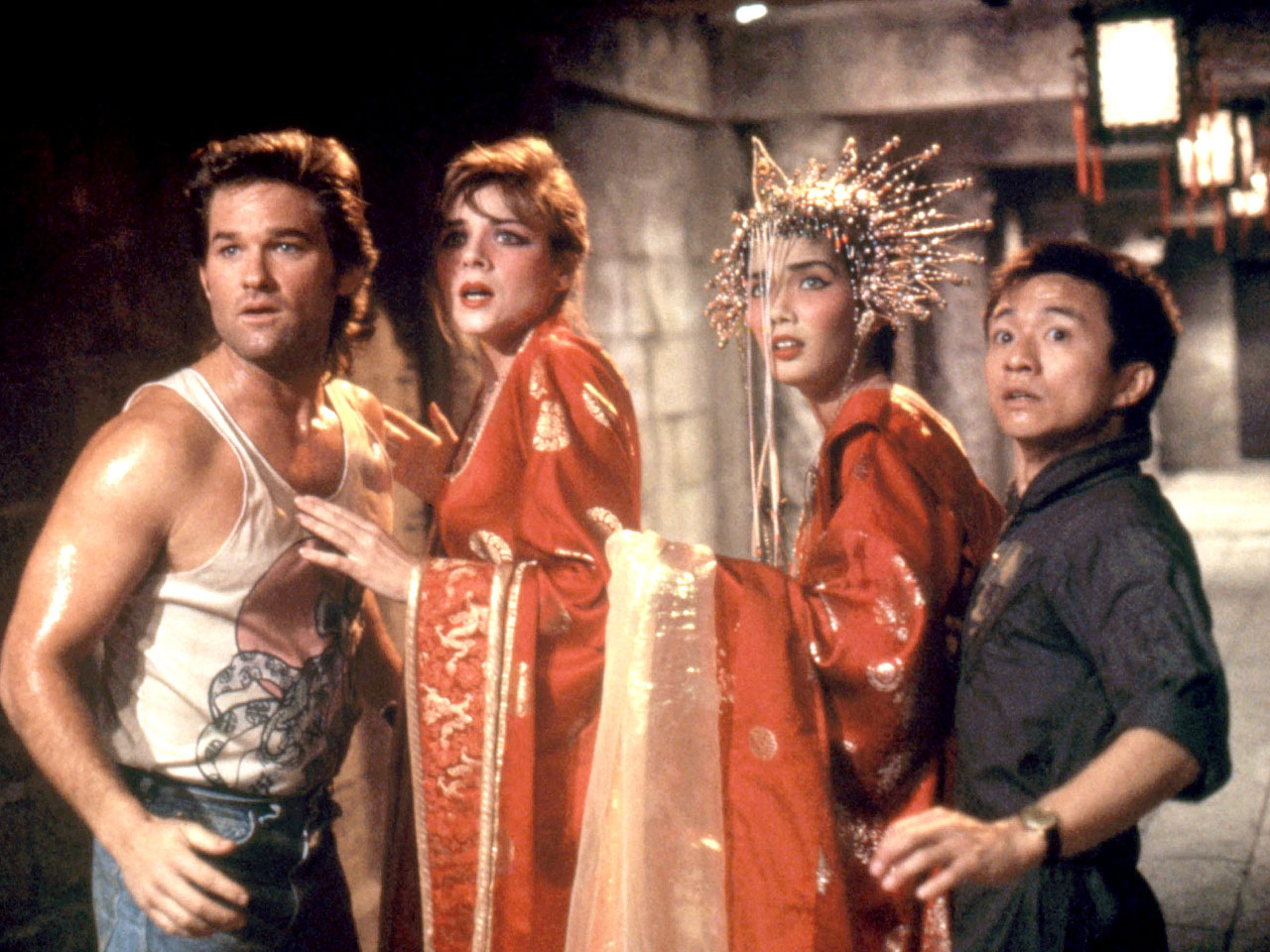
Big Trouble in Little China
If there was ever a poster child for a movie that found a second life in rentals and on cable, this is it.
Jack Burton (Kurt Russell) is a over-the-road trucker with a lot of thoughts on life and how important reflexes are. While making a delivery in Chinatown, he gets sucked into a situation with an ancient Chinese evil trying to regain its humanity, and all Jack really wants is to get his truck back.
John Carpenter wasn’t quite a household name, but with films such as Halloween, The Thing and Escape From New York to his name, people were taking notice. Teaming with Russell for another outing seemed like it would be another win, but this one proved just a little too odd for mainstream audiences. Once it got into our homes, however, everyone fell in love with it.
As Jack Burton always says, it’s a must-see for any 80s journey.
Where to watch: Available to stream.

The Great Mouse Detective
I had never seen it, and as Disney films go, I would have been fine keeping it that way.
Set in Longon in 1897, a young mouse named Olivia Flaversham witnesses her toymaker father get kidnapped. She seeks out Basil of Baket Street, also known as the Great Mouse Detective. Along with David Q. Dawson, recently returned from serving in the military in Afghanistan, the three of them try to stop Professor Ratigan from replacing the Queen.
It’s just a Sherlock Holmes story, but with mice. I didn’t find anything that compelling about it. It was pretty enough to look at, but the story just left me fairly empty.
Where to watch: Available to stream.

Howling II
I… have a lot of thoughts.
Following up on the end of the The Howling, Ben White (Reb Brown) buries his sister Karen White, and quickly learns she was a werewolf. He teams up with werewolf hunter Stedan Crosscoe (Christopher Lee) to take down Stirba (Sybil Danning), the queen of the werewolves who is about to celebrate her 1,000th birthday, and stop the spread of the werewolf curse.
On paper it sounds fine, in execution it is just… horrible. Poorly lit, horrible acting, low-grade effects, and costuming that leaves you more confused than anything else.
Avoid at all costs.
Where to watch: Available to stream.

Psycho III
I have to admit, so far these sequels haven’t been horrible.
Following up shortly after the vents of Psycho II, Norman (Anthony Perkins) is still hiding the body of Emma Spool, and having issues again with seeing “Mother.” He hires drifter Duane Duke (Jeff Fahey) to run the motel. He also meets Maureen (Diana Scarwid), a nun on the run after she accidentally kills one of her sisters. With a new woman in his life, Mother has some thoughts on what Norman should be doing.
In general I actually enjoyed this new outing in the franchise, although it feels it missed some opportunities at the end of the story of Norman and Maureen working together. What if Maureen had actually been the one manipulating Norman this time? There was another movie lurking in the background that sadly never gets broached.
What we did end up with, however, was entertaining.
Where to watch: Available to stream.

Under the Cherry Moon
This film was unfairly maligned.
Christopher Tracy (Prince) and Tricky (Jerome Benton) as wooing women in France in hopes of getting enough money to head back to Miami one day. When Christopher hears about Mary Sharon (Kristin Scott Thomas) inherting a trust fund of $50 million for her 21st birthday, she becomes his next mark, but little does he know how it will end for him.
Following Purple Rain, Prince could do no wrong in Hollywood and was given a blank check for his next film. Audiences and critics did not warm to this film as it wasn’t Purple Rain 2 and it lived with a bad reputation for years.
I hadn’t seen it in 35 years or more when I watched it for this report, and… I really enjoyed it. It’s over-the-top, but in the right way. Prince was clearly paying homage to the silent movie romance films, and it works for what it is. Is he a great actor? No. Does it work for this film? Yes.
Honestly, this may be one of the most enjoyable films I’ve had in this project in several weeks. It’s worth a reassessment.
Where to watch: Available to stream.
1986 Movie Reviews will continue on July 11, 2026, with Club Paradise.
-
 Colorado3 minutes ago
Bishop Castle is still standing as Aspen Acres wildfire continues to burn nearby
-
Connecticut8 minutes ago
Mary Ball Tomolonius Obituary
-

 Delaware15 minutes ago
Woman shot in parking lot of pizza shop in Delaware
-

 Florida18 minutes ago
1 dead, 3 injured after lightning strikes family off Florida beach
-
Georgia23 minutes ago
Georgia Lottery Powerball, Cash 3 results for July 4, 2026
-

 Hawaii30 minutes ago
Fatal crash closes H-1 West near Aala St. overpass
-

 Idaho33 minutes ago
Idaho woman reunites with biological family in Moldova after being kidnapped at birth
-

 Illinois45 minutes ago
Georgia man saved rare 1998 Lamborghini Diablo SV from Illinois just in time before it was destroyed

