Entertainment
‘Sinners,’ ‘The Pitt’ win big at Writers Guild Awards after L.A. ceremony cancellation


The already highly decorated “Sinners” was among the top winners at the 78th Writers Guild Awards on Sunday in New York City.
The horror film, directed and written by Ryan Coogler, won the award for original screenplay, and its biggest competitor for the best picture Oscar, Paul Thomas Anderson’s “One Battle After Another,” clinched the win for adapted screenplay. “Sinners” star Miles Caton accepted the award for the former, and “One Battle” cast member Shayna McHayle for the latter.
“Sinners” star Miles Caton and “One Battle After Another” actor Shayna McHale accepted the awards for original and adapted screenplay, respectively.
(Cindy Ord / Getty Images for Writers Guild of America East)
In the TV realm, “The Pitt” made a splash with awards for drama series, new series and episodic drama.
As for lifetime achievement honors, Robert Smigel presented Stephen Colbert with the Walter Bernstein Award for critiquing the power elite on his late-night show, which will air its final episode in May. Terry George received the Ian McLellan Hunter Award for Career Achievement from Don Cheadle, and Diana Son earned the Richard B. Jablow Award for Devoted Service to the Guild from last year’s recipient, Kathy McGee.
Most years, the Writers Guild holds simultaneous ceremonies in New York and Los Angeles. But the East Coast edition became a solo affair after WGA West canceled its ceremony amid an ongoing strike by its own staff union, who claimed guild management had “surveilled workers for union activity, terminated union supporters, and engaged in bad faith surface bargaining.”
The L.A. ceremony was set to honor James Cameron with the Laurel Award for Screenwriting Achievement, Don Reo with the Paddy Chayefsky Laurel Award for Television Writing Achievement and Mstyslav Chernov with the Paul Selvin Award for “2,000 Meters to Andriivka,” which won the award for documentary screenplay Sunday evening.
While WGA West’s board of directors said the ceremony was postponed to give members “an uncomplicated celebration of their achievements,” the Writers Guild Staff Union characterized the cancellation as an attempt to sow division between management and unionized staff, which is ill-timed given upcoming contraction negotiations between the WGA and the Alliance of Motion Picture and Television Producers, which represents Hollywood studios and streamers. In 2023, the WGA went on its longest-ever strike, lasting 148 days.
Comedian and Emmy-nominated producer Roy Wood Jr., who this year hosted the WGA’s East Coast ceremony for the third time, during his opening monologue offered (in jest) his predictions for the negotiations, which begin later this month.
“First, I predict somebody’s gonna lose their s—,” the host said. “Cooler heads are gonna prevail, and then somebody else is gonna lose their s—.”
Here is the full list of Writers Guild Award winners:
Original screenplay: “Sinners,” written by Ryan Coogler; Warner Bro. Pictures
Adapted screenplay: “One Battle After Another,” screenplay by Paul Thomas Anderson, screen story by Paul Thomas Anderson, inspired by the novel “Vineland” by Thomas Pynchon; Warner Bros. Pictures
Documentary screenplay: “2,000 Meters to Andriivka,” written by Mstyslav Chernov; Frontline Features
Drama series: “The Pitt,” written by Cynthia Adarkwa, Simran Baidwan, Valerie Chu, R. Scott Gemmill, Elyssa Gershman, Joe Sachs, Noah Wyle; HBO Max
Comedy series: “The Studio,” written by Evan Goldberg, Alex Gregory, Peter Huyck, Frida Perez, Seth Rogen; Apple TV
New series: “The Pitt,” written by Cynthia Adarkwa, Simran Baidwan, Valerie Chu, R. Scott Gemmill, Elyssa Gershman, Joe Sachs, Noah Wyle; HBO Max
Limited series: “Dying for Sex,” written by Sheila Callaghan, Harris Danow, Madeleine George, Elizabeth Meriwether, Amelia Roper, Kim Rosenstock, Sasha Stewart, Sabrina Wu, Keisha Zollar; FX/Hulu
TV & streaming motion pictures: “Deep Cover,” written by Derek Connolly and Colin Trevorrow; Prime Video
Animation: “Shira Can’t Cook” (“Long Story Short”), written by Mehar Sethi; Netflix
Episodic drama: “7:00 A.M.” (“The Pitt”), written by R. Scott Gemmill; HBO Max
Episodic comedy: “Prelude” (“The Righteous Gemstones”), written by John Carcieri, Jeff Fradley, Danny R. McBride; HBO Max
Comedy/variety series – talk or sketch: “Last Week Tonight with John Oliver,” senior writers: Daniel O’Brien, Owen Parsons, Charlie Redd, Joanna Rothkopf, Seena Vali; writers: Johnathan Appel, Ali Barthwell, Tim Carvell, Liz Hynes, Ryan Ken, Sofía Manfredi, John Oliver, Taylor Kay Phillips, Chrissy Shackelford; HBO Max
Comedy/variety specials: “Marc Maron: Panicked,” written by Marc Maron; HBO Max
Quiz and audience participation: “Celebrity Jeopardy!”, head writer: Bobby Patton; writers: Kyle Beakley, Michael Davies, Terence Gray, Amy Ozols, Tim Siedell, David Levinson-Wilk; ABC
Daytime drama: “The Young and the Restless,” associate head writers: Jeff Beldner, Marla Kanelos, Dave Ryan; writers: Susan Banks, Amanda L. Beall, Marin Gazzaniga, Rebecca McCarty, Madeleine Phillips; CBS/Paramount+
Children’s episodic, long form and specials: “When We Lose Someone” (“Tab Time”), written by Sean Presant; YouTube
Short form streaming: “The Rabbit Hole with Jimmy Kimmel,” writers: Jimmy Kimmel and Jesse Joyce; YouTube
Documentary script — current events: “Trump’s Power & the Rule of Law” (“Frontline”), written by Michael Kirk and Mike Wiser; PBS
Documentary script — other than current events: “Forgotten Hero: Walter White and the NAACP” (“American Experience”), written by Rob Rapley; PBS
News script — regularly scheduled, bulletin or breaking report: “Devastating Flooding in Texas” (“World News Tonight with David Muir”), written by David Muir, Karen Mooney and Dave Bloch; ABC News
News script — analysis, feature or commentary: “Remembering Palestinian Journalists Killed by Israeli Forces” (“Ayman”), written by Lisa Salinas; MSNBC
Digital news: “An Isolated Boarding School Promised to Help Troubled Girls. Former Students Say They Were Abused.,” written by Sebastian Murdock and Taiyler Mitchell; HuffPost
Radio/audio documentary: “Jerry Lewis’ Lost Holocaust Clown Movie” (“Decoder Ring”), written by Max Freedman; Slate
Radio/audio news script — regularly scheduled, bulletin or breaking report: “ABC News Radio Top of the Hour News”, written by Robert Hawley; ABC News Radio
Radio/audio news script — analysis, feature or commentary: “The Life and Legacy of Jimmy Carter,” written by Gail Lee; CBS News Radio
On air promotion: “CBS Comedy,” written by Dan Greenberger; CBS
Times staff writers Stacy Perman and Cerys Davies contributed to this report.


In the last decade or so, Angelina Jolie has been on screen less frequently. So when she is — and not in forgettable tentpoles like “Eternals” — it’s worth paying attention. There seems to be a thoughtful intentionality to the roles she now chooses, almost as if this astoundingly famous woman wants to tell us something vital about herself, offering clues into her understandably guarded personal life.
Take 2015’s “By the Sea,” which she wrote and directed. Coincidentally or not, that pained study of marital dissolution, co-starring Jolie’s then-husband Brad Pitt, intersected with the couple’s real-life breakup — not to mention Jolie’s grief over the death of her mother, Marcheline Bertrand. Two years ago, Jolie portrayed a version of the elusive, emotionally closed-off opera singer Maria Callas in “Maria.” The conception of the role, marked by a dim view of stardom’s suffocating alienation, was something Jolie clearly understood. Moviegoers should be careful not to read too much autobiography into an actor’s creative choices, but Jolie makes such speculation tantalizing, adding additional layers of drama to her films.
The intermittently affecting “Couture” feels similarly close to her heart, depicting a filmmaker whose life is interrupted by a cancer diagnosis — a reality Jolie knows all too well. In 2013, she underwent a preventive double mastectomy over concerns of her likelihood to develop breast or ovarian cancer. (Bertrand died of cancer in 2007.) Knowledge of Jolie’s circumstance will inform a viewer’s reaction to her wounded, resilient performance, but our inherent sympathies can only take French writer-director Alice Winocour’s ensemble piece so far.
Jolie plays Maxine, an American indie director hired to create a flashy opening film for Paris Fashion Week. Newly arrived in the City of Light, she has only a few days to put together the short, assisted by her trusted cinematographer Anton (Louis Garrel). As we deduce from the phone calls Maxine makes back home, she’s also going through an acrimonious divorce and has trouble connecting with her blasé teenage daughter. At least this Paris paycheck gig will bolster her finances — and get her ready for the feature film she’s been wanting to make for years.
Just then, though, Maxine’s future gets a rewrite. A French doctor (Vincent London) tells her she has breast cancer and needs a double mastectomy immediately. Maybe she can finish the Fashion Week film, but her passion project must wait. An artist and mother who has spent her adulthood in constant motion will have to learn what it means to stop everything and be still.
The film’s title would appear to be a reference to the story’s setting, but in French, “coutures” can also mean “stitches,” and indeed Winocour sews together three thematically linked story strands. As Maxine wrestles with her cancer diagnosis, an inexperienced South Sudanese model named Ada (Anyier Anei) works Fashion Week so she can send money home to her family. (Ada has no interest in modeling, hoping instead to become a pharmacist.) Meanwhile a makeup artist, Angèle (Ella Rumpf), longs to be an author, although she cannot get anyone interested in her writing. Each one becomes a part of the fabric of Fashion Week, but their disparate problems are a far cry from the glitzy event’s self-importance.
Winocour has often made films about women balancing their public-facing life with their private selves In 2019’s “Proxima,” Eva Green played an astronaut missing her young daughter. In 2022’s “Paris Memories,” Virginie Efira starred as an interpreter recovering from the shock of surviving a terrorist attack. Winocour shows us the intimate, vulnerable spaces within her characters that those on the outside don’t have access to.
“Couture’s” three principals rarely interact with one another, but those meaningful exchanges argue that, amid the mad clatter of the everyday, a brief, unguarded moment with a stranger can be supremely restorative. Unfortunately, the juggling of storylines ends up being more schematic than insightful. Angèle’s narrative never catches fire and while Anei is striking as Ada, that section of the film feels slightly patronizing, reducing this immigrant tale to yet another strained salute to perseverance.
This leaves Jolie as the movie’s magnetic center, with Maxine drifting through despair as she ponders what to do. Her doctor insists that the surgery cannot wait, but putting her ambitions on hold means losing a part of herself — a different kind of death sentence than the one she’s now facing.
The character is underwritten but Jolie picks up much of the slack through her silently shattered expression. As she’s gotten older, the Oscar winner has become more comfortable doing less in her performances, allowing for a fragile serenity that is belied by the anguish and anxiety roiling underneath. It’s not just our recognition of the real-life parallels that make Jolie so touching in “Couture” — it’s that ineffable star power she’s possessed for so long. In a story about a potential tragedy, what’s saddest is that Winocour’s film cannot match its lead’s effortless command.
‘Couture’
In French and English, with subtitles
Rated: R, for language, some sexuality, nudity and brief bloody violence
Running time: 1 hour, 46 minutes
Playing: Opens Friday, June 26 in limited release

By ABBIE BERNSTEIN / Staff Writer
Posted: June 26th, 2026 / 08:03 PM
SUPERGIRL movie poster | ©2026 Warner Bros./DC Studios
Rating: PG-13
Stars: Milly Adcock, David Corenswet, Eve Ridley, Matthias Schoenaerts, Diarmaid Murtagh, Jason Momoa, David Krumholtz, Emily Beecham
Writer: Ana Nogueira, based on characters created by Jerry Siegel & Joe Shuster
Director: Craig Gillespie
Distributor: Warner Bros./DC Studios
Release Date: June 26, 2026
The new SUPERGIRL doesn’t have that “Eureka! This is how you do this now” spark that galvanized its immediate franchise predecessor, last year’s SUPERMAN. Director Craig Gillespie and screenwriter Ana Nogueira, basing the film on characters created by DC Comics’ Jerry Siegel & Joe Shuster, probably wisely, aren’t going for that.
Instead, the SUPERGIRL makers are intent on providing a lively adventure, getting to the point quickly and letting the action unspool with unquestionably strong motivation, abetted by plenty of punch-ups, kicking and frequent explosions.
Supergirl, aka Kara Zor-El (Milly Adcock), is from the now-dead planet Krypton, just like her cousin Clark/Kal-El/Superman (David Corenswet). However, where Clark has chosen to remain on Earth, where the yellow sun gives him superpowers that allow to help Earth’s residents, Kara likes to party on planets that have a red sun, where she has no unusual abilities.
This is because Kara seems to have taken to heart a dictum from a different comic book universe – with great power comes great responsibility – and decided the inverse is true: with no power comes no responsibility.
We get insight into exactly why Kara is so duty-averse over the course of SUPERGIRL, and it’s probably not a spoiler to say that she re-examines some attitudes as events unfold.
Kara plans to celebrate her twenty-third birthday on a backwater red sun planet. The bar where Kara chooses to drink is entered by preteen Ruthye Knoll (Eve Ridley), whose family has been murdered by brigands, led by the horrendous Krem (Matthias Schoenaerts). Ruthye is out for revenge. Kara thinks Ruthye is a bit young and pure-hearted to be on a murderous quest.
Even on a planet with a red sun, though, Kara is still handy with fists and feet. Ruthye sees what Kara can do and concludes she is the ideal ally. Kara absolutely refuses to help. Then something occurs that credibly rouses Kara to do whatever it takes to achieve her aims, which sort of line up with Ruthye’s.
No explanation is needed for why Kara feels such urgency, which we easily share. Her concern for Ruthye is understandable and her connecting to larger purpose is shown rather than spoken.
Intriguingly, the aesthetics of SUPERGIRL are largely those of STAR WARS, with some MAD MAX and BLADE RUNNER thrown in. The filmmakers have a good time with all sorts of utterly nonhuman alien people and figuring out how to make interplanetary versions of familiar items like vending machines.
The pace is pleasingly brisk and the structure doesn’t require much exposition. When they hit a hard-to-answer question like why Kara is Supergirl while Clark is Superman, they acknowledge it and then get out from under without irritating anybody.
For anyone wondering about the veracity of the recording from Superman’s parents that appeared in SUPERMAN, a quick line of dialogue here confirms it (sorry, Jor-El supporters).
There is the expected amount of CGI involved, including a great motion-capture performance by Kara’s dog Krypto (modeled upon executive producer/SUPERMAN director James Gunn’s dog), but a lot of the stunts and makeup appear gratifyingly practical.
Adcock is fine in all of Kara’s moods, from wasted to resistant to determined, with a delightful reaction to feeling her body’s response to the yellow sun. Ridley is an appealing young hero, and Corenswet offers wholesome support. Schoenaerts lets Krem revel in his own soft-spoken vileness, and Jason Momoa enthusiastically portrays an intergalactic bounty hunter. David Krumholtz is affecting as Kara’s scientist father.
SUPERGIRL isn’t going to redefine superhero movies, but it’s a perfectly enjoyable example of the form.
Related: Movie Review: THE GET OUT
Related: Movie Review: CAMP
Related: Movie Review: LEVITICUS
Related: Movie Review: DISCLOSURE DAY
Related: Movie Review: KRAKEN
Related: Movie Review: FIND YOUR FRIENDS
Related: Movie Review: CHUM
Related: Movie Review: CAROLINA CAROLINE
Related: Movie Review: THE SUMMONING
Related: Movie Review: BACKROOMS
Related: Movie Review: SPEED DEMON
Related: Movie Review: PRESSURE
Related: Movie Review: PASSENGER
Related: Movie Review: I LOVE BOOSTERS
Related: TV Review: GREAT PERFORMANCES: STAGEBOUND
Related: Movie Review: OBSESSION
Related: Movie Review: LIFEHACK
Related: Movie Review: IS GOD IS
Related: Movie Review: AFFECTION
Related: Movie Review: ITCH!
Related: Movie Review: HOKUM
Related: Movie Review: ANIMAL FARM
Related: Movie Review: OVER YOUR DEAD BODY
Related: Movie Review: LEE CRONIN’S THE MUMMY
Related: Movie Review: HAPPY HALLOWEEN
Related: Movie Review: NORMAL
Related: Movie Review: FACES OF DEATH
Related: Movie Review: EXIT 8
Related: Movie Review: READY OR NOT 2: HERE I COME
Follow us on Twitter at ASSIGNMENT X
Like us on Facebook at ASSIGNMENT X
Article Source: Assignment X
Article: Movie Review: SUPERGIRL
Related
Related Posts:

In 2015, musician Roberto Carlos launched Boleros de Noche, an annual concert series held in Los Angeles that aimed at preserving and showcasing the Latin American bolero music genre.
This year, the event is celebrating its 10th anniversary with performances at the Ford on Aug. 1 by Puerto Rican singer and former Calle 13 member iLe and L.A.-based bolero trio Voz Bohemia
On Friday, the city of L.A. honored the series’ decade-long run and legacy of uplifting bolero music by declaring Aug.1 “Día del Bolero.”
Boleros are ballads noted for their slow tempo and romantic lyrics accompanied by a crooning vocal style. Though the genre originated in Cuba, it quickly gained popularity across Latin America, with each culture putting their own spin on it. In the early 20th century, the evolving sound of boleros was shaped by the Cuban group Trio Matamoros, Mexican composer Agustín Lara, Puerto Rican artist Rafael Hernández and Ecuadorian singer Julio Jaramillo.
The genre saw a resurgence in popularity in the 1980s and ‘90s when famed Mexican artists Juan Gabriel and Luis Miguel embraced the bolero sound. In recent years, the bolero movement has been modernized and electrified by artists such as Mon Laferte, Romeo Santos, Adrian Quesada and Kali Uchis. In the last five years, Quesada has released two bolero albums, “Boleros Psicodélicos” and “Boleros Psicodélicos II,” that mix the genre’s classic sounds with elements of psychedelic rock.
“Over the past decade, Boleros de Noche has presented numerous concerts featuring both local and international artists, has brought together thousands of people across the city to bask in the lush orchestration of this music,” said City Councilmember Nithya Raman, who presented Carlos with the honor. “For so many in the Latino community and beyond, this isn’t just music, it’s memory, it’s home, and perhaps most importantly, it’s heritage being carried forward.”
Raised in L.A. County by parents who immigrated from the Mexican state of Oaxaca, Carlos says he first fell in love with live performance and bolero music in his midteens, when he would frequent the now-defunct Teatro los Pinos in South Gate.
He yearned for that same level of comfort and awe at music and wanted to share that with a larger audience. The first iteration of Boleros de Noche took place in 2015 at an art gallery in Echo Park.
“Over the years, I have heard countless stories from audience members who tell me how this music reminds them of their parents, grandparents, first loves and family traditions,” Carlos said Friday at City Hall. “Ten years ago, bolero was rarely part of our city’s cultural conversation, and today bolero programming can be found across Los Angeles, and I’m honored that Boleros de Noche has been a driving force behind its growth.”
Boleros de Noche has sold out shows at the Ford over the last few years and has featured artists such as Gaby Moreno, Marisoul and the legendary trio Los Panchos. In 2025, the event made its debut at Chicago’s historic Symphony Center.
The bolero genre’s popularity and cultural significance has been spotlighted outside of L.A. in recent years as well.
On Dec. 5, 2023, UNESCO, the United Nation’s agency aimed at safeguarding social and cultural foundations, recognized the musical genre as an Intangible Cultural Heritage of Humanity.
As part of Friday’s ceremony, Carlos and his bolero group Los Rebeldes Románticos performed several tunes, including the Mexican bolero classic “Sabor a Mí.”
Last year, Carlos spoke with The Times about his ambitions for Boleros de Noche and the mentality that drives the event series.
“At Boleros de Noche, [I want] for us to speak in Spanish, to feel recognized, to do this music as a celebration for all these artists that unfortunately became background music for a lot of like weddings and quinceañeras,” he said. “How about if we celebrate them and give them recognition? How about if, through my events, I can take people back to the 1940s to my experience at Teatro los Pinos?”
Given recent attacks on Latinos on the local and national levels, Carlos said he hoped his events would create a safe and welcoming gathering place.
“It’s about bolero music. It’s about community. It’s about people. It’s about the musicians,” he said. “Many of the musicians were undocumented. They brought this music to L.A. through their hometowns.”
-
 Lifestyle12 minutes ago
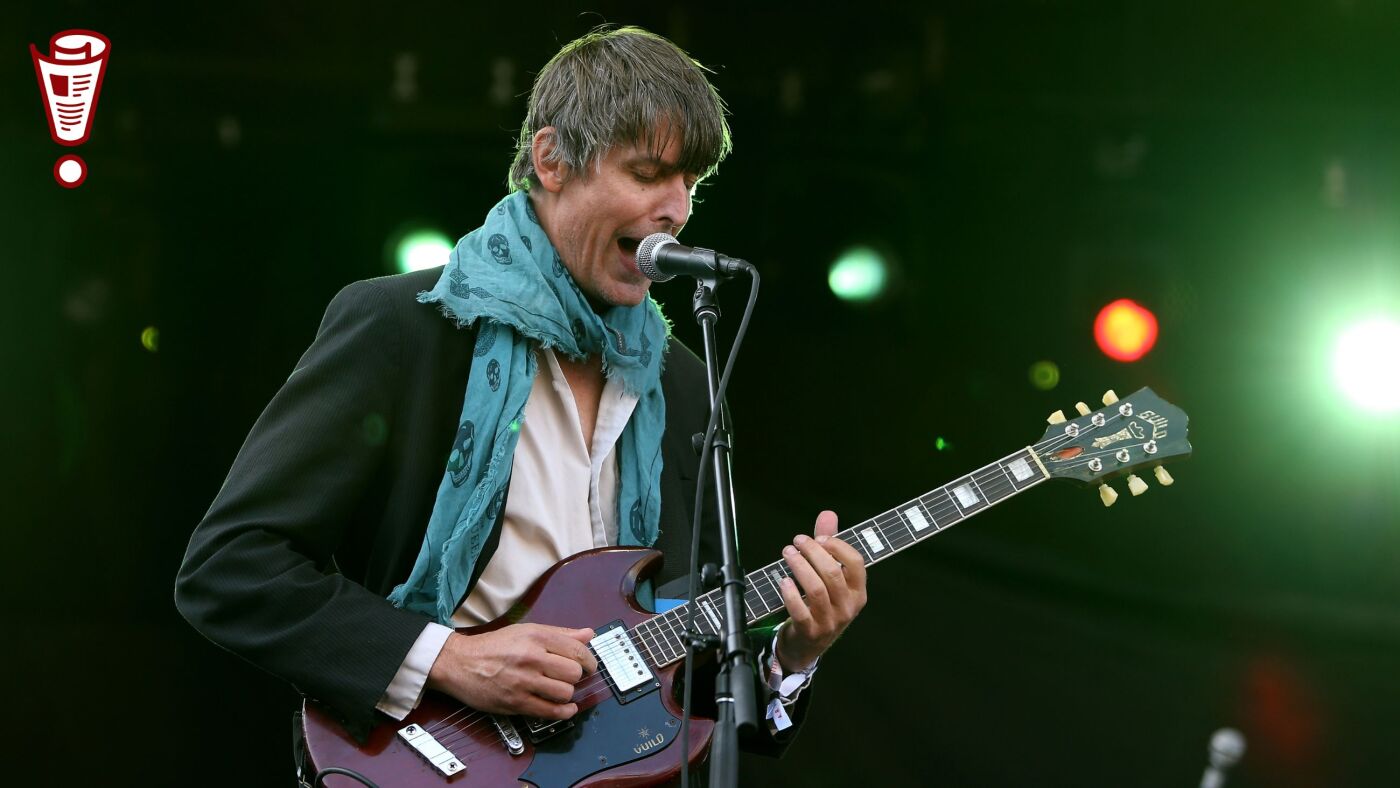
‘Wait Wait’ for June 27, 2026: With Not My Job guest Stephen Malkmus
-

 Technology22 minutes ago
Margaret Atwood says the problem with AI is ‘garbage in, garbage out’
-

 World27 minutes ago
Gulf countries strongly condemn Iran’s drone attack on Bahrain as rising tensions threaten MOU
-

 Politics34 minutes ago
Jeffries welcomes Democratic Socialists into the fold as critics warn party is revealing ‘exactly who it is’
-

 Health37 minutes ago
These leafy greens could help protect your lungs, study suggests
-

 Sports42 minutes ago
Knicks hand Mamdani-backed candidate cease and desist letter for using team’s logo in campaign: report
-

 Technology49 minutes ago
Empty envelopes in your mailbox? Do not scan that code
-
 Business52 minutes ago
Truck parking lot plans near Port of Los Angeles spark backlash among residents

