Movie Reviews
‘Pretty Lethal’ Review: Ballerina Baddies Spin and Slit Throats in a Suspense Thriller That Skips Pivotal Narrative Beats


Razor blades and pointe shoes prove pretty lethal in Vicky Jewson’s bloody and blistered ballet thriller, which finds a dysfunctional ballerina troupe fighting for survival after a run-in with a deadly Hungarian mob. Streaming on Prime Video later this month, “Pretty Lethal” couldn’t have come at a better time, given all the drama and discourse surrounding Timothée Chalamet’s controversial remarks on the cultural value of ballet and opera relative to mainstream art forms, which earned pointed responses from both worlds.
While the film, written by former ballerina Kate Freund, is far from a critique on the material decline of the live arts, it clearly gestures towards a shrewd observation Chalamet and his particular brand of sleaze might easily dismiss: the body, and therefore ballet, as a vessel of cinematic storytelling — a visceral physical language turning into an audiovisual one. For hardcore fans of the genre and ballet alike, it’s basically a treasure trove, regardless of whether it cannot reference other ballets past “The Nutcracker,” regardless of whether all the hijinks miss a beat or stop short of depth.

The five Los Angeles-based prima ballerinas — played by Maddie Ziegler, Lana Condor, Avantika, Millicent Simmonds, and Iris Apatow — have been preparing all their lives to debut at the National Theatre in Budapest, which could change the course of their careers. Especially for those who aren’t as lucky to have a head start in life, like the left-out Bones (Ziegler), who wouldn’t be able to compete without the sponsorship of the mother of spoiled brat and bully Princess (Condor). “Ballet is a rich bitch sport,” as Bones puts it, perhaps the same point the “Marty Supreme” star is trying to make, albeit conceitedly.
After landing in Hungary, a day before the grand showcase, the group’s bus breaks down in the middle of nowhere. Fretting over the dance of their lives, they have to steel themselves for something far worse. Opting to keep out of the forest, they take shelter in a dingy roadside inn run by Uma Thurman’s Devora Kasimer, a fallen ballet prodigy, and her henchmen. It doesn’t take long for the danger to make itself known, with the young women’s mentor (Lydia Leonard) as the first casualty. As the ballerinas hatch a plan to come out of their predicament alive, bodies begin to drop dead.
“Pretty Lethal” is fundamentally a movement movie, featuring a C+C Music Factory needle drop early on — one that is deeply attuned to swapping men for women in the realm of action cinema. At times, the film is tolerably grotesque body horror or an acid trip movie filled with Bible verse reciting, as Avantika plays the moral, religious North Star; at others, it’s an outright revenge tale, particularly as the sparse plot pivots to Devora, who is out to settle an old score with Michael Culkin’s Lothar Marcovic, a cruel crime lord. A vindictive pursuit that ends rather predictably, as we scan the routine, but are never allowed to behold the dance in its full glory.
The “Kill Bill” star is exciting to watch, but not compelling enough to make up for the shortcomings of the uninspired script, which displays an annoying knack for stating the obvious via clichéd dialogue, that indeed the ballerinas have to band together to survive, paired with pretty lethargic pacing. Ziegler, meanwhile, is already fantastic as the only character with survival instinct, at least initially, at which point I thought it would tip “Pretty Lethal” into a final girl movie. It’s hard to ask more of Ziegler, given she really doesn’t have much to work with.
The camerawork is adequate, but never lifts the movie to a greater aesthetic delight. Close-ups on framed photographs depicting Devora’s younger, more graceful self offer less a sense of history than ambient suspense. If anything, backstories here are neatly left to the imagination. Likewise, the dreary inn, through Zsuzsa Kismarty-Lechner and Charlotte Pearson’s production design, is emblematic of Devora’s faded dream — a space where “The Nutcracker” somehow never ends. The centerpiece is, of course, the melee/dance-off between the ensemble in white tutus and the violent thugs, toe blade and all. Choreographed to stunning and outrageous effect, this might just be the most death-dealing dress rehearsal you’ll ever come across. That the goons didn’t just instantly shoot at the ballerinas also makes it all the more silly.
Despite the contrivance, Jewson makes fascinating theater out of this, flipping the archetypal image of the ballerina, and therefore femininity, on its head and rendering it as a kind of weapon, forged by years of putting up with enormous pain, against a world beset by patriarchal violence. The quintet spins, stretches, and slits throats, combining grace and discipline in what one might call “ballet-fu,” perhaps a new genre to invest in. They cram their bodies into kitchen cabinets, as does a doll in a window box. They move as a single, cohesive unit. Yet, while most of that seems top-tier entertainment, where the actors are clearly having all the fun working together, testing out new stunts, all the bone-breaking can only keep you on the edge of your seat for so long.
Framing ballet as a source of high-octane action is incredibly inventive, but “Pretty Lethal” remains a standard suspense thriller, a work that is ultimately kneecapped by a writing that renders the deeper textures of the characters largely gestural, only meant to drive the proceedings onward with sheer force. The more it generates spectacle, the more you notice how the screenplay fails to keep in step. Glimpses into past lives, including that of Bones, are hardly given any attention past suggestive pathos or plainly stating them up top that before the final dance graces us to hammer home the film’s feminist message, “Pretty Lethal” has already, totally, worn us down. No plié to absorb all the shock. In this way, Jewson’s vision is quite fatal.
Grade: B-
“Pretty Lethal” premiered at the 2026 SXSW Film and TV Festival. It streams on Prime Video globally on March 25.
Want to stay up to date on IndieWire’s film reviews and critical thoughts? Subscribe here to our newly launched newsletter, In Review by David Ehrlich, in which our Chief Film Critic and Head Reviews Editor rounds up the best new reviews and streaming picks along with some exclusive musings — all only available to subscribers.



When I spend time around fellow writers, regardless of their achievements, conversation is much the same as in any other context. When I watch groups of fictional writers in films, they are continually striving to outdo one another, to show off their brilliant intellects. It’s a constant process of trying too hard, and it’s exhausting. To his credit, Dustin Hoffman, who plays established literary genius David in this torrid tale of family conflict, doesn’t come across this way, rising above the clumsy script thanks to his patient approach. The same cannot be said of the other actors, all of whom have proved their talent elsewhere yet seem seduced by the notion that this is how intelligent people behave.
The plot here is fairly simple, and not without potential. David’s son Jacob (Tom Sturridge) is a copywriter and successful creator of jingles, but after his wife Elise (Alison Brie) wins a major award, he starts getting insecure, wanting to prove that he can make it as a proper literary type. The obvious way to do this seems to be to write a biography of David, but David has no interest in engaging with this. He provides a number of reasonable justifications for this. Underlying them is the fact that we all tend to frame ourselves in different ways for different people. What one might be willing to say to the great anonymous public is not necessarily something one might feel able to say to one’s son.

This stalemate is broken by the arrival of John (André Holland, fresh from the similarly awkward – but smarter – The Dutchman), an old friend of Jacob whom David remembers fondly. At Elise’s instigation, a secret deal is made: John will look after the increasing fragile older man during the day and, in the process, extract his stories from him, giving them to Jacob for his book. John agrees to this because he needs the money Jacob offers him, and it seems like a sweet deal. It immediately sets up a power imbalance, however.
Complicating matters further are John’s past as a literary protégé who failed to fulfil his promise; the fact that he was once in a relationship with Elise, whose dissolution she regrets; and the pressure that she’s under to match her great success, from an agent who subscribes to the popular but rather tedious belief that inspiration is most easily found in bad behaviour.
Another way writers in films differ from those in the real world is that for them, critical success comes with money, so they don’t have to write very much. A good deal of this film is spent listening to them whine about how hard it is, as if under the misapprehension that it’s not really a form of work. Sturridge is particularly unfortunate; between this and Jacob’s whining about issues with his parents, he doesn’t get much else to do. Brie has a little more to work with as the film flirts with the idea that we’re caught up in Elise’s imaginary scenarios, but this doesn’t really convince. Holland manages to salvage something, but it’s only Hoffman who is really able to interject some energy into proceedings – ironic given that he spends a lot of his scenes in a haze of cannabis smoke.
It’s not terrible. Writer/director Alex Vlack frames scenes nicely enough and all the technical work is carried out to a good standard. There’s just little reason for viewers to invest. Like its characters, it’s intent on trying to communicate cleverly, but has very little to say.
Reviewed on: 04 Jul 2026
Movie Reviews
1986 Movie Reviews – About Last Night, Big Trouble in Little China, The Great Mouse Detective, Howling II, Psycho III, Under the Cherry Moon | The Nerdy

Welcome to an exciting year-long project here at The Nerdy. 1986 was an exciting year for films giving us a lot of films that would go on to be beloved favorites and cult classics. It was also the start to a major shift in cultural and societal norms, and some of those still reverberate to this day.
We’re going to pick and choose which movies we hit, but right now the list stands at nearly four dozen.
Yes, we’re insane, but 1986 was that great of a year for film.
The articles will come out – in most cases – on the same day the films hit theaters in 1986 so that it is their true 40th anniversary. All films are also watched again for the purposes of these reviews and are not being done from memory. In some cases, it truly will be the first time we’ve seen them.
This time around, it’s July 4, 1986, and we’re off to seeAbout Last Night, Big Trouble in Little China, The Great Mouse Detective, Howling II, Psycho III, and Under the Cherry Moon.
About Last Night
St. Elmo’s Fire was awful. This feels like a make-good for two of the actors.
Danny Martin (Rob Lowe) meets Debbie Sullivan (Demi Moore) and their chemistry is electric and immediate. They waste no time becoming serious, and moving in together, despite neither of them having ever had a serious relationship. They quickly discover it’s not quite as easy as just sharing an apartment like you do with a roommate.
I didn’t love the movie (mainly due to Jim Belushi’s Bernie character), but I did enjoy it far more than I anticipated.Moore and Lowe’s on-screen chemistry really clicked far more than most on-screen couples.
It’s a good character study, and keeps you engaged. Is it essential viewing? That’s up to you.
Where to watch: Available to stream.
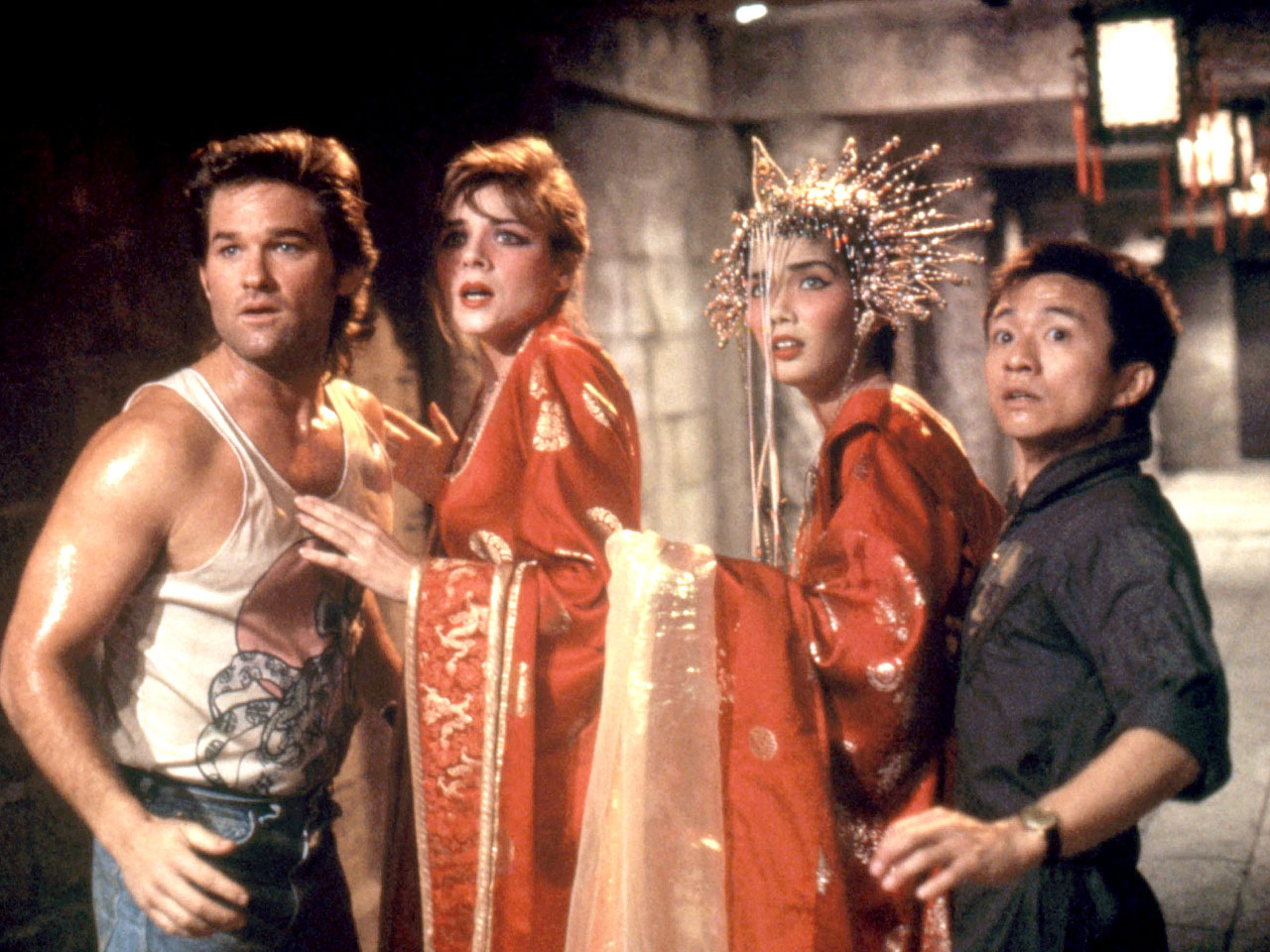
Big Trouble in Little China
If there was ever a poster child for a movie that found a second life in rentals and on cable, this is it.
Jack Burton (Kurt Russell) is a over-the-road trucker with a lot of thoughts on life and how important reflexes are. While making a delivery in Chinatown, he gets sucked into a situation with an ancient Chinese evil trying to regain its humanity, and all Jack really wants is to get his truck back.
John Carpenter wasn’t quite a household name, but with films such as Halloween, The Thing and Escape From New York to his name, people were taking notice. Teaming with Russell for another outing seemed like it would be another win, but this one proved just a little too odd for mainstream audiences. Once it got into our homes, however, everyone fell in love with it.
As Jack Burton always says, it’s a must-see for any 80s journey.
Where to watch: Available to stream.

The Great Mouse Detective
I had never seen it, and as Disney films go, I would have been fine keeping it that way.
Set in Longon in 1897, a young mouse named Olivia Flaversham witnesses her toymaker father get kidnapped. She seeks out Basil of Baket Street, also known as the Great Mouse Detective. Along with David Q. Dawson, recently returned from serving in the military in Afghanistan, the three of them try to stop Professor Ratigan from replacing the Queen.
It’s just a Sherlock Holmes story, but with mice. I didn’t find anything that compelling about it. It was pretty enough to look at, but the story just left me fairly empty.
Where to watch: Available to stream.

Howling II
I… have a lot of thoughts.
Following up on the end of the The Howling, Ben White (Reb Brown) buries his sister Karen White, and quickly learns she was a werewolf. He teams up with werewolf hunter Stedan Crosscoe (Christopher Lee) to take down Stirba (Sybil Danning), the queen of the werewolves who is about to celebrate her 1,000th birthday, and stop the spread of the werewolf curse.
On paper it sounds fine, in execution it is just… horrible. Poorly lit, horrible acting, low-grade effects, and costuming that leaves you more confused than anything else.
Avoid at all costs.
Where to watch: Available to stream.

Psycho III
I have to admit, so far these sequels haven’t been horrible.
Following up shortly after the vents of Psycho II, Norman (Anthony Perkins) is still hiding the body of Emma Spool, and having issues again with seeing “Mother.” He hires drifter Duane Duke (Jeff Fahey) to run the motel. He also meets Maureen (Diana Scarwid), a nun on the run after she accidentally kills one of her sisters. With a new woman in his life, Mother has some thoughts on what Norman should be doing.
In general I actually enjoyed this new outing in the franchise, although it feels it missed some opportunities at the end of the story of Norman and Maureen working together. What if Maureen had actually been the one manipulating Norman this time? There was another movie lurking in the background that sadly never gets broached.
What we did end up with, however, was entertaining.
Where to watch: Available to stream.

Under the Cherry Moon
This film was unfairly maligned.
Christopher Tracy (Prince) and Tricky (Jerome Benton) as wooing women in France in hopes of getting enough money to head back to Miami one day. When Christopher hears about Mary Sharon (Kristin Scott Thomas) inherting a trust fund of $50 million for her 21st birthday, she becomes his next mark, but little does he know how it will end for him.
Following Purple Rain, Prince could do no wrong in Hollywood and was given a blank check for his next film. Audiences and critics did not warm to this film as it wasn’t Purple Rain 2 and it lived with a bad reputation for years.
I hadn’t seen it in 35 years or more when I watched it for this report, and… I really enjoyed it. It’s over-the-top, but in the right way. Prince was clearly paying homage to the silent movie romance films, and it works for what it is. Is he a great actor? No. Does it work for this film? Yes.
Honestly, this may be one of the most enjoyable films I’ve had in this project in several weeks. It’s worth a reassessment.
Where to watch: Available to stream.
1986 Movie Reviews will continue on July 11, 2026, with Club Paradise.
Movie Reviews
Movie Review: ‘Minions & Monsters’ is a very yellow mash note to Hollywood – Sentinel Colorado

-

This image released by Universal Pictures shows a scene from Illumination’s “Minions & Monsters.” (Universal Pictures via AP) -

This image released by Universal Pictures shows minions with the alien character Goomi, voiced by Trey Parker, right, in a scene from Illumination’s “Minions & Monsters.” (Universal Pictures via AP) -

This image released by Universal Pictures shows minion Henry, voiced by Pierre Coffin, left, and Goomi, voiced by Trey Parker, in a scene from Illumination’s “Minions & Monsters.” (Universal Pictures via AP) -

This image released by Universal Pictures shows a scene from Illumination’s “Minions & Monsters.” (Universal Pictures via AP)
Every once in a while, Hollywood gets high on its own supply and makes a love letter to moviemaking. It happened recently with Steven Spielberg’s “The Fabelmans” and George Clooney’s “Jay Kelly.” Now it’s time for the unlikeliest of love-letter writers: canary-yellow, gibberish-speaking, overall-wearing mini-monsters.
“Minions & Monsters” — the third chapter in the ongoing standalone adventures of the “Despicable Me” pint-sized enablers — is about the sheer greatness of moviemaking, and it’s a navel-gazing misfire. Few industries — maybe journalism, sure — is as enamored at making its profession seem heroic.
The Minions this time find themselves at the dawn of both the movie business in Hollywood and the last push by suffragists to get the vote. It’s a weird confluence that writers Brian Lynch and Pierre Coffin fumble.
The movie has playful references to old screen gods — Harold Lloyd dangling from the hands of a clock and Charlie Chaplin swallowed by the gears of a mechanical system — along Hollywood nods to “Casablanca” and the punny title “The Good, the Bad and the Stupid” — but the kids in the audience won’t get them and their parents are just too tired. Harold Lloyd jokes don’t hit as hard in 2026.
Two of the legion of faceless Minions step forward this time — best friends James and Henry, creative misfits amid a smear of yellow drones — to unite and make a movie. (Who knew there was a Minion counterculture?)
Things go very well at first — turns out adding a Minion or two to a cowboy or a heist movie makes them instant kings of the box office — and they soon move into a Beverly Hills mansion and become insufferable. James dreams of winning an Oscar, which in this case is a statuette of a gold banana, a Minion obsession.
But they hit a wall when silent movies turn to talkies. And since they spout nothing but nonsense — “Fantastico” “miso soup” and “vamos” — can’t make the transition. They’re dumped out of the studio system.
That’s when James and Henry finally get the plot going: Make their own killer monster movie by conjuring up real monsters. The first one they try turns out a little weird: The gigantic, fearsome octopus-dragon they request turns out to be a cute green Funko Pop-like critter called Goomi, voiced by Trey Parker. Goomi promises to find them some real monsters. But should we trust him?
Coffin, making his first solo directing effort after co-helming all three “Despicable Me” films and the first “Minions,” voices all the Minions — he must be fun to have at parties — and is an assured hand. The violence levels are a little high for PG, including a beheading and various impalings, plus the usual senseless mayhem.
The screenwriters have included a romantic subplot involving a suffragette voiced by Zoey Deutch who falls for a robot-alien (standout work by Jesse Eisenberg) in a storyline that makes less and less sense. And the framing device — a museum tour guide explaining how Minions shaped Hollywood — sags awkwardly.
Adults can keep awake looking for the Easter eggs Coffin has left for serious cinephiles: “20,000 Leagues Under the Sea,” “Steamboat Bill, Jr.,” “A Trip to the Moon,” “Metropolis,” “Citizen Kane” and “The Blob.” Maybe the best moment in the movie is almost a throwaway: Director George Lucas, appearing as himself.
“Hooray for Hollywood” is on the soundtrack and that might have been the subtitle for the movie itself. There are some people whose eyes get moist thinking about picking up a film camera and following their muse, having their work play in a dark theater to cheers. And then there are others who just want to get on with it already. “Vamos!”
“Minions & Monsters,” a Universal Pictures release that opens in theaters July 1, is rated PG by the Motion Picture Association for “violence/action, language, and rude/macabre humor.” Running time: 90 minutes. One and a half stars out of four.
Related
-

 Health6 minutes ago
July 4 heat delays America 250 celebration as State Fair guests share love of USA
-

 Sports8 minutes ago
Toronto Maple Leafs top pick Gavin McKenna reveals that he’s changing his jersey number
-

 Technology13 minutes ago
China’s robot-run hotel opens to public in 2027
-
 Business21 minutes ago
China-backed AI tool behind fake Brad Pitt fight making Hollywood inroads
-
 Entertainment24 minutes ago
Don Was produced the Rolling Stones, Bob Dylan and Ozzy. At 73, he found his voice in Detroit — and the Dead
-
 Politics35 minutes ago
Commentary: Happy Birthday, America! You’ve weathered another rough year
-
 Sports43 minutes ago
Dodgers’ Eliezer Alfonzo praying his sister and stepmother will be found in Venezuela
-

 World54 minutes ago
Reform UK’s Farage failed to disclose funds from convicted criminal: Report

