Lifestyle
How 7 Looks for ‘The Devil Wears Prada 2’ Came Together


When Molly Rogers got the call to work on the costumes for “The Devil Wears Prada,” she could sense right away that she was involved in something special.
“I knew people were going to go nuts for it — I’d never turned the pages of a script like that before,” said Rogers, who worked on the 2006 film as the associate costume designer under the tutelage of her longtime mentor, the “Sex and the City” costume designer Patricia Field.
But even Rogers couldn’t have predicted just how big the film would become. In the 20 years since its release, the comedy, about the imperious fashion magazine editor Miranda Priestly (Meryl Streep) and her ill-suited assistant, Andy (Anne Hathaway), has become part of the cultural lexicon, thanks to memes and memorable lines like Miranda’s contemptuous catchphrase, “That’s all.”
So when Field, who was busy styling the rom-com series “Emily in Paris,” asked Rogers to handle the costumes for the film sequel — this time as lead designer — she jumped at the opportunity.
Some designers might have been intimidated. Hathaway has called designing the costumes for a “Devil Wears Prada” film a “heroic act,” explaining in a recent Times article: “It’s not just one character arc, it’s so, so many. Fashion is a language in the film; it’s another character.”
For Rogers, though, the experience was more nostalgic than nerve-racking.
“It was like coming back to summer camp,” she said of the production.
On a recent morning at the Four Seasons Hotel in Lower Manhattan, Rogers went over sketches for six pivotal costumes from “The Devil Wears Prada 2” — and one that didn’t make the cut.
Vision in Red
At Rogers’s first meeting with Streep, Miranda’s gala look came up, and both had the same immediate thought: “It has to be red.”
“And she’s the one who said, ‘Let’s do a sleeve on one arm and bare on the other,’” Rogers said of Miranda’s asymmetrical gown, which is a custom-made Balenciaga in red silk super taffeta. “It’s so fabulous.”
The dress, which features a tilted collar and a thin matching belt, was built in Paris, with a team from Balenciaga flying to New York City twice to fit Streep for it.
At one point the actress suggested trying a hat to top off the look — possibly a nod to horns — but Rogers said she knew it was “gilding the lily.”
“It was her white hair alone that the red gown should frame,” she said.
Party in the Back
As Runway magazine’s new features editor, Andy is back in the same orbit as her frenemy and fellow ex-assistant, Emily Charlton (Emily Blunt), who’s now an executive at Christian Dior. To solve a crisis at the magazine, Andy agrees to an expansive feature on the company, whose advertising dollars Runway needs.
For Andy’s interview look, Rogers opted for a black button-down Jean Paul Gaultier pinstriped vest, paired with matching slacks, a pearl necklace — and nothing underneath.
“I was constantly trying to balance found things with things that she could have afforded and that she would wear as a professional reporter,” Rogers said.
There’s also a surprise when Andy turns around: The vest has an all-white silk back.
“I loved that,” Rogers said.
Caped Betrayer
For a scene involving a backstabbing Emily, Rogers went with a sequined Dior houndstooth power suit — with a Zimmermann leather capelet.
“I tried to find Dior pieces that have a little edge to them,” Rogers said of the black-and-white wool number from the spring 2026 collection.
Emily’s style in the sequel, she said, was an extension of the first: The character still has a mix-and-match aesthetic, pairing, for instance, a white Dior button-down with a Wiederhoeft corset and Gaultier black-and-white pinstriped pants.
“We didn’t have enough outfits for her,” Rogers said. “I think she changed 16 times.”
Editor Chic
One lesson Rogers has learned in more than 40 years working with Field, she said, is that “you cannot force an actor to wear anything.”
“You can have your heart set on a gown that you want in a scene and think it’s the perfect color, but you’re not the one in it,” she said. “Pat’s fittings, and mine as well, are very collaborative: Do you like what I brought into the room? How does it feel on you?”
So when she came across this homey, tasseled Dries Van Noten jacket, she crossed her fingers that Streep would dig it.
Streep did.
“She thought it was a great piece for the right scene,” Rogers said. “I thought it had enough oomph to it to still be in the office, and it looked like ‘editor.’ It made me think of Diana Vreeland,” once the editor in chief of Vogue.
Andy’s gala look inverts the movie’s through-line of sleeveless pieces layered atop button-ups and blouses: Here the base layer, a blouse from the Armani Privé fall 2024 couture collection, is sheer, tucked beneath a black silk velvet jumpsuit with pinstripe Swarovski crystal suspenders.
“It came down the runway without a blouse, and I was like, David’s never going to let me do that,” Rogers said, referring to the director, David Frankel. “Anne Hathaway at the dinner table with no blouse on — how cool would that be? But they made us a beautiful sheer blouse.”
Another hat that appeared in Rogers’s initial sketch bit the dust: a velvet Armani beret with jet-black glass stones.
“I am a hat fighter,” Rogers said. “I’ve gone through big hat fights, with Sarah Jessica Parker and I fighting for hats on TV shows. They always don’t want to light them, or they cast shadows, blah blah blah, and it always unfinishes an outfit.”
Though the beret for Andy was fabricated, she said, “sure enough, they killed it.”
Human Disco Ball
When Miranda saunters through the Galleria Vittorio Emanuele II, Milan’s stunning historic shopping arcade, the lights shimmer off the colored crystals and black sequins on her Armani overcoat, turning her into a human disco ball.
“When I read the script, I was like, ‘That needs to dazzle,’” Rogers said of the statement piece from Giorgio Armani’s Privé spring 2025 couture collection, which she layered over a tie-neck Lurex Oud blouse and black trousers.
It was a choice she initially had some trepidation about.
“I was afraid of the pussy-bow blouse on Miranda Priestly,” she said. “Because that feels soft to me. But it was such a cacophony of colors and textures, and I felt like it was strong enough.”
Miranda’s black cat-eye Prada glasses are striking, of course, but Rogers said the boldest accessory was her side-swept white hair.
“I think that there was great resistance to that,” Rogers said. “People didn’t understand that.”
The look was drawn from that of the fashion editor Polly Mellen and the model Carmen Dell’Orefice.
“Meryl and Pat insisted on it,” Rogers said.
Power Gloves
Emily’s gala dress — a strapless Dior gown with a nude tulle and black lace corset top, matching opera gloves and a slinky black satin skirt with a double side bow — was Rogers’s favorite look from the film. Alas, it ended up on the cutting-room floor.
Still, she said, she loved getting the chance to bring an edge to a very un-Emily-like shape.
“When I think of Dior and bows, I think of Charlotte,” Rogers said of the preppy “Sex and the City” character. “So to take a Dior bow and make it look — there’s a bit of a goth idea there. And I thought that was really appropriate for her character.”



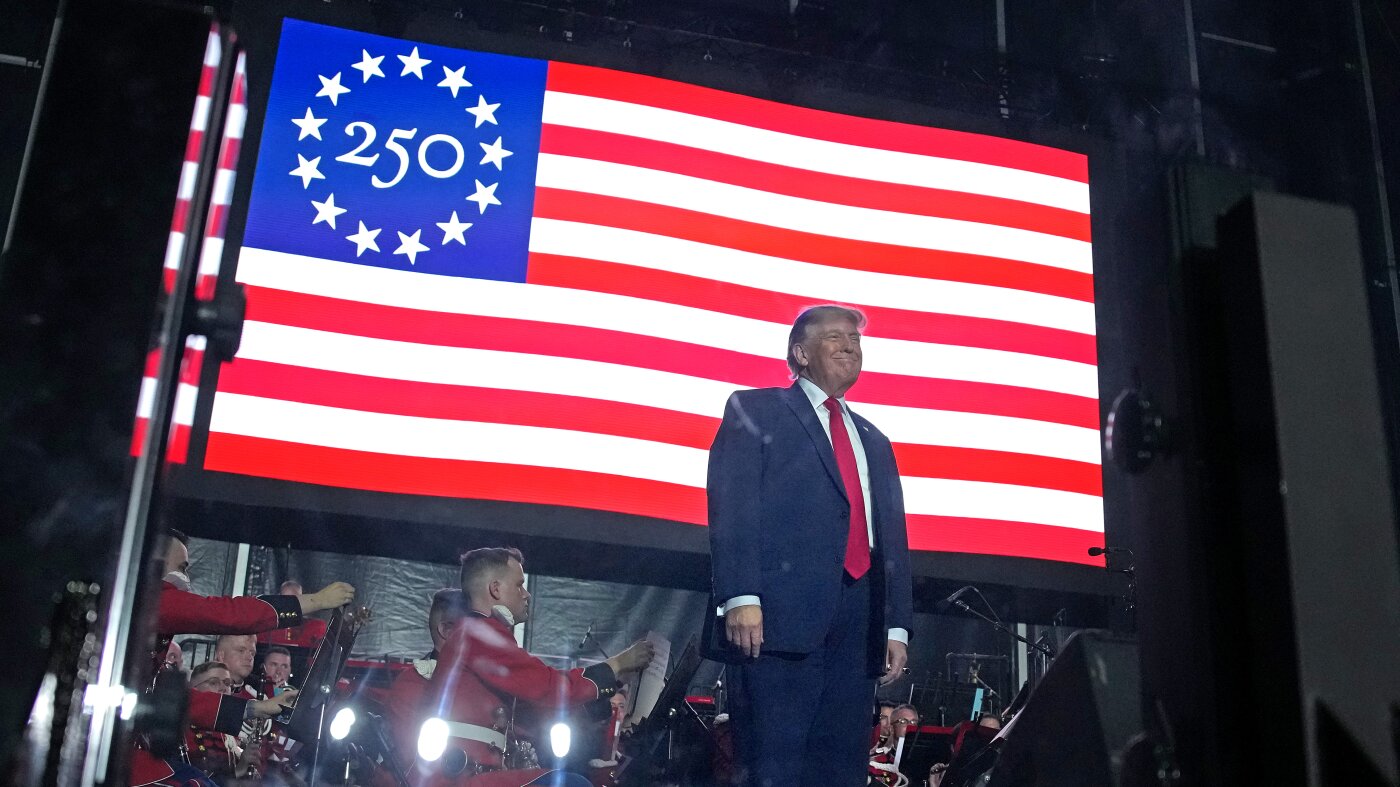
President Trump speaks at a rally kicking off the Great American State Fair last week, part of the anniversary celebrations organized by White House-backed group Freedom 250.
Andrew Harnik/Getty Images
hide caption
toggle caption
Andrew Harnik/Getty Images
As America’s birthday celebrations kick into high gear, so too do criticisms of the preeminent national group organizing them, Freedom 250.
Democrats on the House Natural Resources Committee published a 55-page report Thursday accusing the group of aiding President Trump in turning America’s milestone into a “hotbed of corruption and self-enrichment” through tactics that potentially amount to criminal fraud.
It’s titled “From Vanity to Insanity: How the White House Cheated the American People out of their 250th Birthday.”

Rep. Jared Huffman of California, the ranking Democrat on the committee, told NPR that the report was months in the making. It is based on interviews with unnamed whistleblowers, sworn Congressional testimony, internal Freedom 250 documents and other written responses.
“We put it all together to really tell the story … of how Donald Trump hijacked what should have been a unifying national celebration and repurposed it for his own interests,” Huffman said in a Zoom interview. “This was a team of operatives using the Freedom 250 shell company, but it was also Donald Trump himself telling them what to do.”
The White House referred a request for comment to Freedom 250, though Freedom 250 told NPR that it does not speak for the White House.
Freedom 250 is the public-private partnership behind some of the summer’s most high-profile anniversary events, including a UFC fight outside the White House in June, a controversial state fair on the National Mall, a July Fourth fireworks show opening with a Trump rally, and the “Patriot Games,” a high school athletic competition scheduled for August.
It was created via executive order last year, and describes itself as “the national, non-partisan organization leading the celebration of our Nation’s 250th birthday.” But it’s not the only one: Congress had created a nonpartisan commission called America250 for this same purpose in 2016.
Democratic critics and watchdog groups say Trump decided to forge ahead with his own group after unsuccessful attempts to pack America 250 with his allies. Freedom 250 was incorporated as an LLC in October 2025 under the National Park Foundation, the nonprofit arm of the National Park Service, whose board now includes a number of Trump loyalists, including Chris LaCivita, senior adviser on his 2024 campaign.

Visitors can buy Freedom 250 merchandise at the state fair on the National Mall.
Al Drago/Getty Images
hide caption
toggle caption
Al Drago/Getty Images
Thursday’s report describes Freedom 250 as “a shadow organization capable of infiltrating the celebrations and injecting America’s 250th with Trump’s extreme, partisan agenda.”
Several of its events, like the “Great American State Fair” and a prayer gathering on the National Mall, have been criticized for their sanitized presentation of history and overtly Christian bent. The report accuses the group of funding its programming through opaque and questionable avenues, including soliciting foreign funds, misleading donors and selling access to the president.
“Once you siphon off the funds and supplant the real bipartisan commission with this new entity and you declare it the main platform for our nation’s celebration, and you award all these shady contracts to your friends, you can do anything you want,” Huffman said. “And what these folks chose to do was to push a very divisive, very extreme and explicitly sectarian religious agenda into all these materials in our name, using our taxpayer dollars.”
Some of the accusations, if true, could be found to violate federal law. For example, the report alleges that the deception of donors who thought they were supporting America250 — but were actually given banking information for Freedom 250 — could constitute wire fraud.

Freedom 250 spokesperson Danielle Alvarez denied the report’s claims as “categorically false,” calling it a “partisan smear.”
“Congressional members should be ashamed they are spending countless hours fabricating a report instead of joining Americans in creating an absolutely beautiful celebration,” Alvarez wrote in a statement shared with NPR.
The report has not been adopted by the Natural Resources Committee, so does not reflect its official view. Republicans on the committee have so far refused to conduct any oversight on the issue, despite Democrats raising concerns at previous hearings. Republican ranking member Rep. Bruce Westerman did not respond to NPR’s request for comment.
Huffman said his team had tried for nearly a year to get information from Freedom 250, but faced “resistance and obstruction every step of the way.”
“I would hope that Freedom 250, if they claim that … there’s nothing to see here, open up your books,” he said. “Give us the documents that we’ve asked for, and the information we’ve asked for.”
Huffman said his investigation will continue well past July Fourth, especially if Democrats reclaim the House in this fall’s midterm elections. In that case, he didn’t rule out the possibility of subpoenas or criminal referrals if applicable.
Regardless, he believes more information and witnesses will come to light — and says a full accounting is critical to prevent such a playbook from being used again.
“We may not be able to undo the damage they’ve done to us and the national celebration,” Huffman said. “But we can do something very patriotic by reminding everyone that our government belongs to all of us, not to Donald Trump.”
What the report alleges
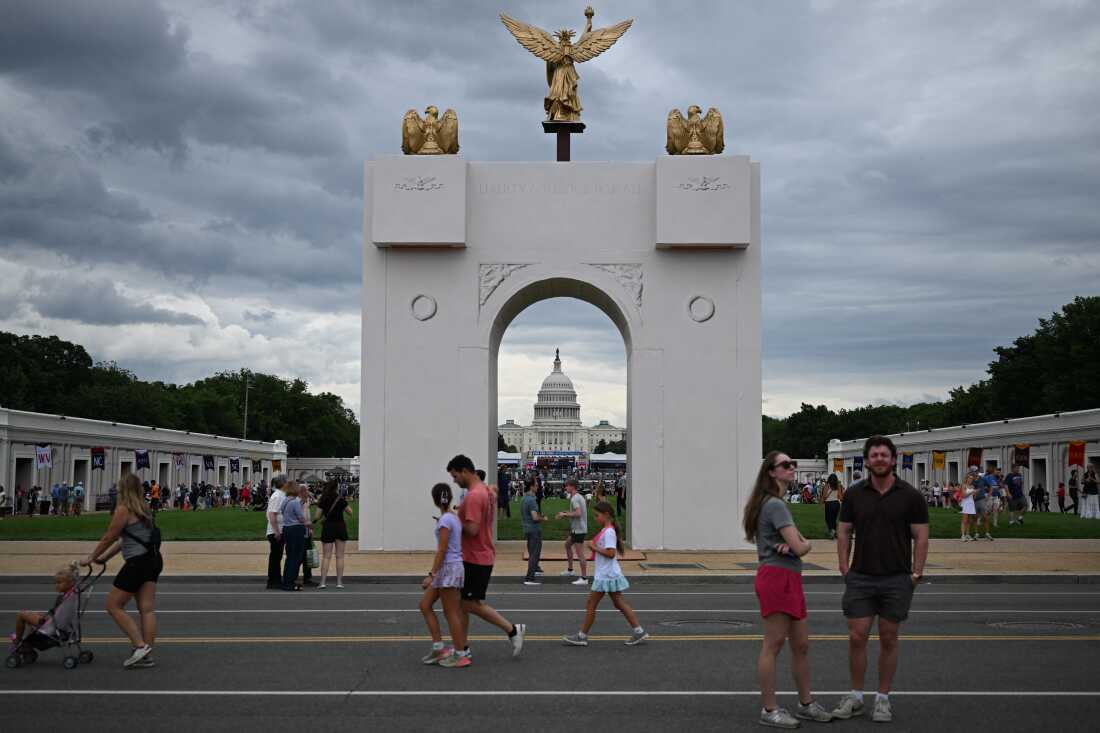
Trump also wants to commemorate the anniversary by building a 250-foot arch, a replica of which stands at the state fair.
Alex Wroblewski/AFP via Getty Images
hide caption
toggle caption
Alex Wroblewski/AFP via Getty Images
The report accuses Trump of long wanting to place himself at the center of the anniversary agenda. It points to events held on his birthdays — last year’s Army 250th parade and this year’s White House UFC fight — and longer-term projects like his plans to build a 250-foot-tall triumphal arch.
It alleges that when America250 resisted that vision, the Trump administration turned the National Park Foundation from a “beloved nonprofit into a presidential shell” by standing up Freedom 250 under its auspices.

It is not clear where that directive came from: Secretary of the Interior Doug Burgum, who serves as ex officio director of the foundation’s board, testified before Congress in May that he was “not aware of the final decision maker on Freedom 250.” That same month, he told CNN the organization is “run out of the White House.”
In any case, Freedom 250 emerged with more visibility and more federal funding than America250.
Alvarez, of Freedom 250, says it “stepped in to rescue our nation’s 250th birthday from years of wasted time, wasted money, and failed planning.” But the report argues it supplanted America250 “through a series of diversions and misrepresentations that drained the chartered Commission of the resources it needed to function.”
The report says Congress allocated $150 million in federal funds last year to the Interior Department for events celebrating the 250th anniversary, with the “understanding” that $100 million of that would go to America250. The group has only received $25 million, it says, citing unnamed sources.
A statement from Freedom 250 says no funds were specifically earmarked for one entity over the other, so “claims that federal funds were ‘diverted’ from America250 to Freedom250 are baseless.”
When asked for comment, America250 Chair Rosie Rios — who served as U.S. treasurer under President Obama — did not address the report. She said the organization “will continue to focus on the values-based programming approved by our bipartisan Commission” and is “supportive” of organizations planning events for the 250th.

The America250 logo is seen on a White House Christmas tree skirt in December. That group is less visible than Freedom 250, but is planning many community-based anniversary events and a concert in Los Angeles.
Anna Moneymaker/Getty Images
hide caption
toggle caption
Anna Moneymaker/Getty Images
The report alleges that Freedom 250 was advertised as an addition to America250 rather than as its replacement, creating confusion. For example, many of the performers who withdrew from a scheduled concert last month said they had falsely believed the event was nonpartisan (it was later rebranded as a Trump rally).
The report alleges that Freedom 250 capitalized on donors’ confusion in a way that potentially amounts to fraud.

“Donors who intended to support America250 were misled and apparently provided with Freedom 250’s banking information, meaning contributions solicited in the name of the nation’s nonpartisan birthday foundation were routed instead to the President’s substitute entity,” it reads.
Freedom 250 said in a statement that “every major sponsor received documentation identifying Freedom 250 as the recipient’s organization before funds were transferred, and donors were free to decline.”
Alan Zibel, a researcher with the progressive consumer advocacy nonprofit Public Citizen, called those allegations “very troubling.” He applauded House Democrats for looking into them, even though they don’t have subpoena power at the moment.
“They’ve given House Democrats, should they take the majority next year, months and months of investigative work to do,” he said. “And there are some pretty rich target opportunities.”
Many questions remain
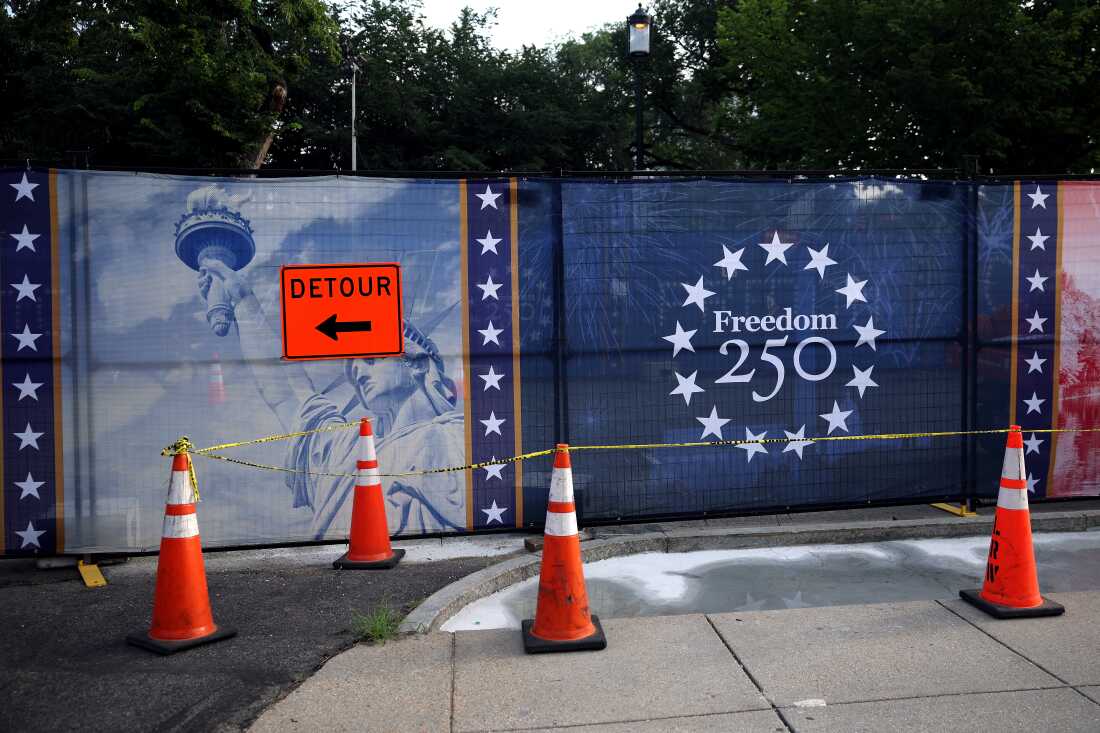
The Freedom 250 logo is visible on fencing around the National Mall on Thursday.
Kevin Dietsch/Getty Images
hide caption
toggle caption
Kevin Dietsch/Getty Images
The bigger-picture problem, critics say, is the lack of transparency throughout the entire process.
“All of these things have been so thoroughly conducted outside of public view,” said Toni Aguilar Rosenthal, a program director at the nonprofit Revolving Door Project. “But I think the House Dems’ report is an excellent extension of those sort of remaining questions that continue to plague just the entire situation and Freedom 250 organizationally.”
Aguilar Rosenthal co-authored a separate report on Freedom 250’s contracts and tactics, along with Zibel from Public Citizen.
Based on their analysis, Aguilar Rosenthal said of the more than $120 million in public funds funneled toward the anniversary celebrations, over $100 million has been “funneled” directly to projects, events and entities with ties to the Trump administration.
Some of those public contracts raise particular alarm among watchdogs. Federal contracts have directed tens of millions of dollars to a company called Event Strategies, Inc., which helped organize Trump’s infamous rally outside the U.S. Capitol on Jan. 6, 2021.

“They had a chance to do this in a bipartisan way or a way that wouldn’t enrich cronies, but they pretty clearly didn’t do that,” said Zibel. “I think that this is a follow-the-money situation that needs to be explored.”
Zibel says many companies — including major defense contractors and tech firms — that have donated to the 250th celebrations also rely on the government for contracts, funding and regulatory oversight. The report mentions that Freedom 250 circulated sponsorship packages culminating in a photo op with Trump, effectively selling access to the president.
Both reports raised questions about potential foreign influence. Alvarez, of Freedom 250, says it does not accept foreign donations.
But Keith Krach, a former Trump administration official who is the CEO of Freedom 250, appeared to solicit just that while speaking at the World Economic Forum in Davos, Switzerland, earlier this year, offering “toolkits for countries, states, companies, all of that.”
“What could be funner than marketing America, or really marketing freedom,” Krach said.
There is little visibility into the origins and destinations of donations in general, Aguilar Rosenthal says. Best case, they are still being used for some of America250’s original goals, she says. Worst case, she says, “public dollars and funds that have been earmarked for semiquincentennial celebrations are being used as a slush fund” for the administration and its political allies.
The report says the National Park Foundation’s donor structure “conceals the identities of those who give and the benefits they may be promised in return.” And at a congressional hearing in February, the foundation’s president and CEO, Jeff Reinbold, promised anonymity for any Freedom 250 donors who requested it (but said donations would otherwise be disclosed in the regular reporting process).
Huffman conceded that any anniversary celebration of this scale would merit scrutiny over spending and contracts. But he said if this had been organized by the bipartisan commission that Congress authorized — with representation from both parties to ask questions and do oversight — it would have been more transparent.
“There would have been public reporting,” he said, “because a publicly-created commission from Congress can’t hide behind the cloak of secrecy of an LLC.”


Swift has attended fashion’s biggest night, the Met Gala, a handful of times over the years. Perhaps no appearance was more memorable than 2016’s event where it was not her dress, but her hair that made an impact. Swift’s bleached platinum bob at the star-studded fund-raiser that year was part of a short-lived era known as “Bleachella” to some fans.
Some fans believe the 2016 event, which both Swift and her ex-boyfriend, the actor Joe Alwyn attended, is where the couple might have first encountered one another. A moment Swifties think the songstress referenced in “Dress,” singing “flashback when you met me, your buzz cut and my hair bleached,” a line that describes how both stars looked that night.
For her first time as host on “Saturday Night Live,” a then 19-year-old Swift arrived having already written the song she would sing as the opening monologue. Seth Meyers, the show’s head writer at the time, later recalled bringing Swift into Lorne Michaels’s office, where she performed a “perfect” musical monologue and noted it was better than what the show’s writers had concocted for her to deliver. Swift has served as host and musical guest on the sketch-comedy show over the years. She’s also made repeated cameo appearances, including appearing alongside Kerry Washington and Betty White in a “Californians” sketch in 2015 for the show’s 40th anniversary.
In 2023, Swift and Travis Kelce both made cameo appearances on the show. The same day, they were also spotted by tabloids holding hands in New York City, one of the earliest public glimpses of them as a couple.
The iconic arena in Midtown Manhattan will serve as the venue for a private, two-day event around the wedding of Swift and Kelce on July 2 and 3. The first event will reportedly be a smaller gathering of 100 people for a rehearsal dinner at the Infosys Theater, a venue inside the Garden, while as many as 1,000 guests are expected to arrive at the venue the next day for a larger celebration, with possible stage appearances. Swift has some history with the Garden, performing there several times over the years, as well as sitting courtside and cheering the Knicks to a win during a game earlier this summer.
Whenever the singer is spotted coming and going from the Greenwich Village recording studio — which was founded by Jimi Hendrix and has hosted icons like the Rolling Stones and Chuck Berry over the years — fans are immediately abuzz with whispers about new music. Swift has worked there with Jack Antonoff, her longtime collaborator, on albums including “Lover” and “Folklore,” as well as re-releases of her older albums.
Swift has been spotted plenty of times at this Italian hot spot in the West Village neighborhood of Manhattan, most recently in May, celebrating Lena Dunham’s 40th birthday. If you can’t get a table, try your hand at making their famed — and delicious — salad dressing.
For a period between 2016 and 2017, Swift rented a four-story townhouse in Manhattan’s West Village. The pad appears to have inspired her 2019 track “Cornelia Street” from the album “Lover.” It’s a road she’ll never walk again, at least according to her lyrics.
Fans still regularly visit the house, even though it has been nearly a decade since Swift inhabited the home, which has an indoor swimming pool. In 2023, some Swifties made pilgrimages to the location after news broke on her split with the actor Joe Alwyn, whose relationship fans believe to be the inspiration for many of the tracks on “Lover.”
Swift’s residence in the TriBeCa neighborhood of Manhattan has grown over the years. She initially bought two penthouses from the “The Lord of the Rings” director Peter Jackson in 2014. A fan who once visited the apartment recalled Swift’s father saying that when his daughter first viewed the place, the actor Ian McKellen, who had been living there, was sitting in the kitchen. She has since purchased several adjacent properties.
Fans have seen glimpses of the home on social media over the years and, more recently, watched Swift use a fire extinguisher to put out a small candle blaze in the kitchen in a video posted by Swift’s recent musical collaborator Gracie Abrams.
Good luck getting a table here if you are not Swift or Kelce. The upscale American restaurant in SoHo is known for comforting dishes like a French dip sandwich and an ice cream sundae, as well as its savory sour-cream-and-onion martini from the cocktail menu. Swift has visited several times — including outings with Gigi Hadid and Sabrina Carpenter.
In “Delicate,” Swift sings of an unnamed “dive bar on the East Side.” Swifties believe this dark speakeasy on East Seventh Street is that bar. Fans also believe the song was written about Swift’s ex-boyfriend, the actor Joe Alwyn. The pair broke up in 2023; later that year she met Kelce.
This exclusive, members-only club in Lower Manhattan is frequented by plenty of celebrities, including Swift. The club bans photography and videos, as well as members of the media, and patrons are barred from identifying others in the room on social media or to the press.
Still, even with the privacy rules, there have been plenty of posts and photos documenting Swift coming and going from Zero Bond. There was a visit in 2023 with the actor Miles Teller and his wife, Keleigh, as well as a recent celebratory evening with the Haim sisters in June after the group watched the Knicks win at Madison Square Garden in matching shirts. There have also been multiple visits with Kelce over the years.
Swift spent part of her 34th birthday celebration at this rustic American restaurant on the Lower East Side of Manhattan. Wearing a black minidress bedazzled with a moon and stars — a nice nod to the visual themes of her “Midnights” era — she partied the night away at Freemans’ upstairs cocktail bar with guests including Jack Antonoff, Blake Lively, Zoë Kravitz, the Haim sisters, Sabrina Carpenter and her childhood best friend, Abigail Anderson Berard, who was immortalized in Swift’s song “Fifteen.” The pop star was also seen dining here with Gracie Abrams earlier that same year.
People line up for hours — yes, hours — to secure a spot at this restaurant in the Carroll Gardens neighborhood of Brooklyn. The brick-oven pizza spot, which is B.Y.O.B. and cash only, is a favorite of pizza connoisseurs — though not those at The New York Times — and celebrities alike. (Its owner has said he does not accept reservations.) Beyoncé, Jay-Z, the Beckhams and, of course, Swift have all been seen dining here, though unclear if they had to sweat it out in the line like us mere mortals. Swift, who once sent her dad to hand out pizzas, though likely not from Lucali, to fans camping out in New York to watch her perform on “Good Morning America,” has shared meals here with famous friends including Blake Lively and Selena Gomez, as well as a date night with Kelce.
The Brooklyn neighborhood where, if Swiftie lyrical interpretations are to be trusted, Swift left a now-infamous scarf at the home of one Maggie Gyllenhaal around 2010. Swift was dating Gyllenhaal’s brother, Jake, at the time and their relationship is believed to have inspired Swift’s “All Too Well,” a 2012 heart-wrencher of a song beloved by many fans, which Rolling Stone once ranked as her best song. “You keep my old scarf from that very first week,” Swift sings. In 2017, Maggie Gyllenhaal told Andy Cohen on “Watch What Happens Live” that she was “in the dark about the scarf.”
Swift later released an updated, 10-minute version of the track in 2021. A red scarf featured prominently as a thematic motif in “All Too Well: The Short Film,” which Swift also released that same year.
-

 News20 minutes ago
Bessent on Trump’s crypto earnings: “I don’t think there’s an appearance problem”
-

 Los Angeles, Ca2 hours ago
Boy, 17, with autism accused in murder of 4-month-old girl at Claremont daycare
-

 Detroit, MI2 hours ago
Brief rally not enough for Tigers vs Rangers as win streak ends at 3
-

 San Francisco, CA2 hours ago
Crash on freeway in Millbrae leaves driver dead after reportedly overturning multiple times, CHP says
-

 Dallas, TX2 hours ago
Paige Bueckers, Azzi Fudd do the usual in Hartford, win. This time with Dallas Wings
-

 Miami, FL2 hours ago
World Cup-inspired art exhibit transforms Miami’s Wynwood with interactive soccer experience
-

 Boston, MA2 hours ago
Stairlift brings relief to residents stuck in building with broken elevator
-

 Denver, CO3 hours ago
Free agent point guard Tyus Jones re-signs with the Denver Nuggets – Denver Stiffs

