Lifestyle
How to have the best Sunday in L.A., according to Kenny Scharf

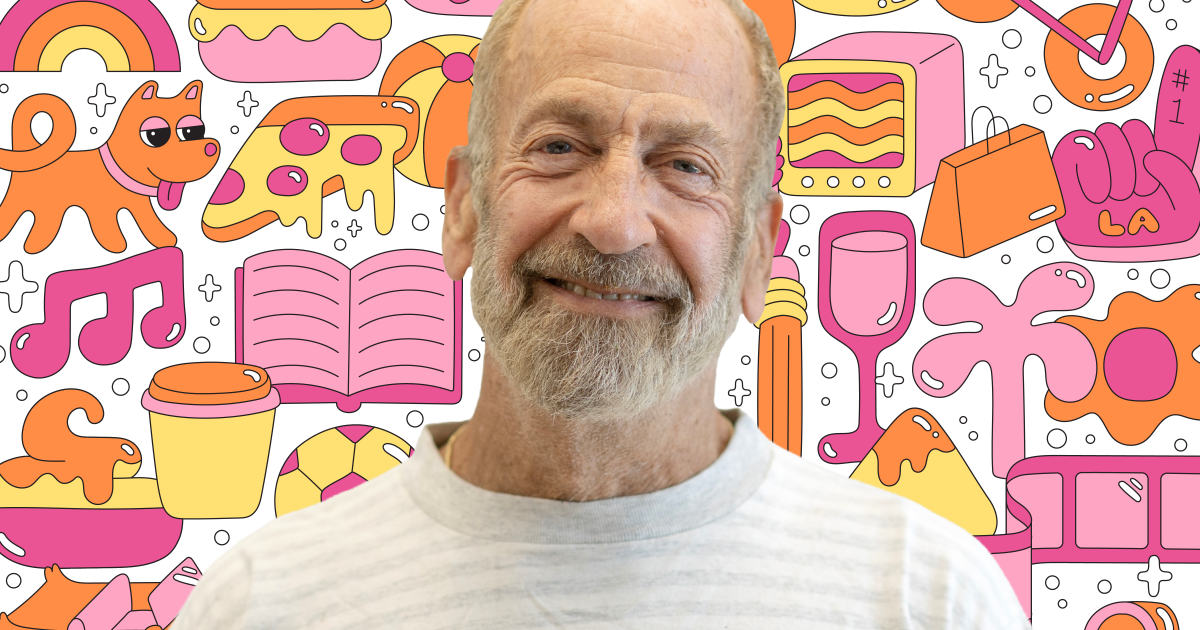
There is no such thing as a day of rest for artist Kenny Scharf, not even Sunday. “I wake up super early. It’s still dark outside,” the Los Angeles native says.
Rising before the sun anchors his active day. “I always have to keep moving,” Scharf says. “Otherwise, I’ll get very depressed.”
An avid hiker and swimmer, Scharf, 67, also maintains a disciplined yoga practice and cycles daily from his Culver City home to his Inglewood studio. There almost everything serves as a canvas, including painted trash doubling as decor and the silkscreened couch on which he’s seated.

In Sunday Funday, L.A. people give us a play-by-play of their ideal Sunday around town. Find ideas and inspiration on where to go, what to eat and how to enjoy life on the weekends.
“I don’t like to waste good paint and silkscreen ink. Why wash it? We apply it everywhere until we use it up,” Scharf says.
Scharf, who grew up in the Valley before making his way to New York City, first gained acclaim in the ‘80s East Village art scene alongside his friends and contemporaries Jean-Michel Basquiat and Keith Haring, his former roommate. The trio also befriended Andy Warhol, who predicted Scharf’s fame.
Renowned for his self-coined “pop surrealism,” Scharf often populates his bold, colorful work with grinning cartoon faces, elastic blobs, and sci-fi creatures floating through cosmic landscapes. Anxieties about overconsumption and environmental degradation lie beneath the playfulness.
Like their creator, Scharf’s works are always on the move, either rolling down the street on the cars he’s painted — featured in his recently published book “Karbombz!” — or traveling to forthcoming exhibitions in Wuhan, Tokyo and Paris.
This interview has been lightly edited and condensed for length and clarity.
5:30 a.m.: Wake up and feed the cats.
My cats, Cutie and Socks — one’s a tabby and the other is a tuxedo cat — wake me up by mewing and walking on me. They’re like, “Hey, I’m hungry.” So I get up and crack open the cans. They like that disgusting, smelly canned food. And then they go out into the yard.
I got the cats because I went to New York for a show. I was gone for five days and I live next to a park, so there are a lot of animals. I came back and my entire house was overrun by mice. I was like, “What the hell am I gonna do? I need cats.” The mice are gone and now I have these cats. They’re so cute and so much fun. They take over my life.

6 a.m.: Detox
I make lemon and hot water. It’s a good way to start the day and clear out the toxins. Right now, I have a lot of citrus because Ed Ruscha’s studio is across the street from my house, and in the back of the studio he has a citrus farm. I go there, especially during this time of year, and get bags of citrus. It’s like a farm community in the middle of L.A. I love L.A. because you can surround yourself with trees and gardens and kind of pretend that you’re not living in a giant metropolitan area.
8:30 a.m.: Iyengar yoga
An Iyengar yoga instructor comes to my house. I find Iyengar is great for aging. You use ropes and gravity to hang and do different things, using your body weight so you can relax into the positions. I also have a swing to go upside down on. When people walk into my living room, they go, “What’s going on here?” because of the ropes on the wall.
In the summer, I’ll go to the beach in Venice and swim in the ocean. It’s wonderful when I’m out in the water. It’s cathartic and cleansing, and sometimes I see dolphins. I’ll go early in the morning before the crowds come.

11:30 a.m.: Mar Vista Farmers’ Market
It’s fun to go there with my daughter Zena, who’s a chef, and my grandkids. We stroll around and get food. All the food stands are delicious. I grew up here in L.A., so I’m into Mexican food. I don’t really want to eat American food. I’m not into hamburgers. I want all the stuff with the culture. I like hot and spicy.
I also buy apples and berries, whatever I can’t grow, because I grow my own food at home.
And I buy stuff from an Indian man who sells Chyawanprash, which is kind of a jam. It’s really concentrated and like an elixir. He also sells Shilajit, which almost looks like tar. You put a little bit under your tongue and it dissolves, and it’s got like every single mineral in it.

2 p.m.: Painting at the studio
I’m painting seven days a week, but I really love coming here on Sundays because nobody’s here and the phone doesn’t ring. Sometimes, my granddaughter, Lua, will come. She paints. Upstairs at the studio I have a little painting area with easels for my grandkids, but my grandson, Jet, isn’t that into painting. I do my work, and Lua’s up there keeping herself busy painting, and it’s great.
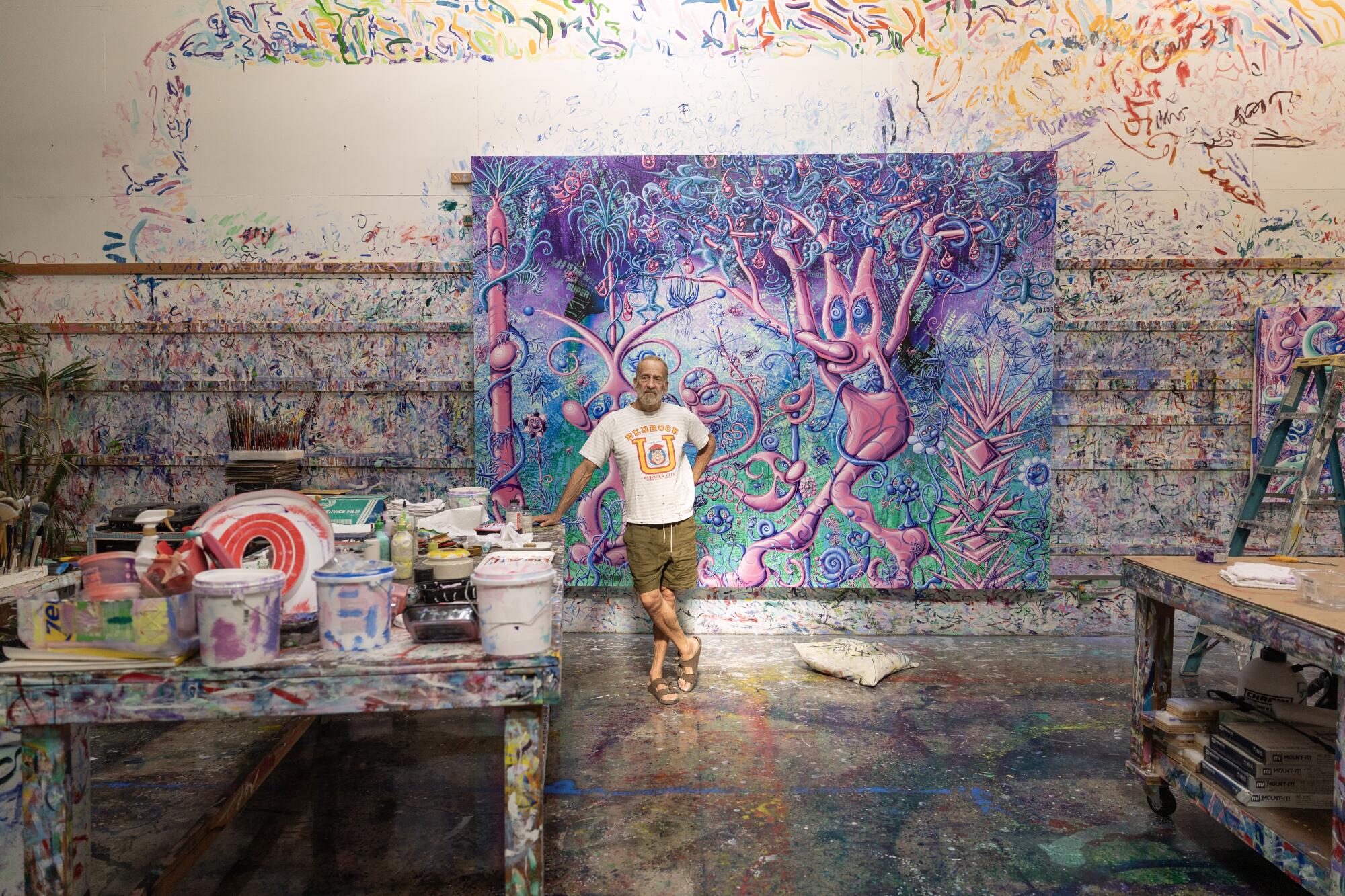
Kenny Scharf in his paint-splattered studio he bikes to every day.
(Myung J. Chun / Los Angeles Times)
5 p.m.: Hike
The easiest one is right behind my house. It goes up to the top of the Baldwin Hills Scenic Overlook where the [Culver City] Stairs go. It’s one of the best views in all of L.A. You can see from the airport to the ocean, downtown, Mount Baldy. You can see almost all the way to Palm Springs, Mount San Gorgonio. The view is amazing.
We also hike a lot in Kenneth Hahn [State Recreation Area].
My grandkids often like to go on a waterfall hike, so there are a couple in Malibu. There are also a couple over in the San Gabriel [Mountains]. We’ll get into the car and drive an hour and hike.
6:30 p.m.: Dinner at a restaurant
Zena, Lua and Jet live close to me, so we have dinner together at least three or four times a week. Because Zena’s a chef, we don’t go out to eat that often, but sometimes we go to a restaurant called Madre that I love. It’s on National [Boulevard]. The food is so good. They often have squash blossoms. They fry them and put a little cheese in them.
I also love Gjelina in Venice. Sometimes I take people from Europe there because it is quintessential California. All the food they make is from the farmers market, so you get a tomato salad with incredible tomatoes.

8 p.m.: Read
I just finished Patti Smith’s latest book, “Bread of Angels.” It’s beautiful. I love her. I saw her perform at Disney Hall recently, and she was selling this book. I actually saw her perform at the Santa Monica Civic [Auditorium] when I was 19. I’d been wanting to move to New York for a lot of reasons, but when I saw her performance, it was, “I’m moving there.” There was so much energy in her.

9 p.m.: Bedtime
Usually I’m in bed by 9 and asleep by 10. When I was young, I was very involved in nightlife. I was working in nightclubs, all of my friends were in nightclubs, so I lived that big time. But now I’m jaded. I don’t want to sound above it all, but I don’t see anything going on that I’m getting excited about the way it was. And I’m not a nostalgic person, so I choose not to go out. I’m happier getting a good night’s sleep.


The first time Pop’s Social, a catering company in South Orange, N.J., that specializes in dirty soda, served an alcoholic drink at an event, something strange happened.
At the event in December, its nonalcoholic offering, a spiced pear-cider seltzer with vanilla and peach syrups, cream, lemon and cold foam, was a hit. The Prosecco-spiked version? Not so much.
“People were more interested in the mocktail than the cocktail,” Ali Greenberg, an owner of the business, said in an interview.
Dirty soda — a customizable blend of soda, flavored syrup, creamer and sometimes fruit, served over pebble ice — has been crossing into the mainstream for years, especially after the cast of “The Secret Lives of Mormon Wives,” the hit reality show that premiered in 2024, frequented Swig, the Utah chain that started it all.
But its reach has gone far beyond the Mormon corridor, and its rise in popularity has dovetailed with an overall decline in U.S. alcohol consumption. “There’s not a lot of Mormon people in our neighborhood,” said Greenberg. “But there are a lot of people who are sober-curious or not drinking.”
The reality show, which follows a group of Mormon influencers in Utah, helped popularize dirty soda beyond the Mountain States and inspired a wave of TikTok videos on the subject. Swig rapidly expanded — growing from 33 locations in Utah and Arizona in 2021 to now more than 150 locations in 16 states — along with other Utah chains, and spawned copycats nationwide.
Dirty soda has joined other Mormon cultural exports, like tradwife influencers, a “Real Housewives” franchise in Salt Lake City and Taylor Frankie Paul, the Bachelorette who wasn’t, that have captivated America.
With the recent rollouts of dirty soda at McDonald’s, Chick-fil-A and Dunkin’ — behold the Dunkin’ Dirty Soda: Pepsi, coffee milk and cold foam — and the appearance on grocery shelves of Dirty Mountain Dew and a coconut-lime Coffee Mate creamer for homemade dirty sodas, we may have reached peak dirty.
The idea for dirty soda came out of a desire for members of the Church of Jesus Christ of Latter-day Saints, which has millions of followers in Utah and surrounding states, to have more options for social drinking, as the church prohibits the consumption of alcohol, hot coffee and hot caffeinated tea.
When Swig introduced dirty soda in 2010, it filled a need, providing a pick-me-up for car-pooling moms and an after-school treat for their kids. It was quickly adopted by many in the community.
“In other cultures, parents go, they pick up their coffee in the morning, and for me and for a lot of my other friends’ parents, it was, ‘Let’s go pick up our dirty soda,’” Whitney Leavitt, a breakout star of “Mormon Wives,” said in an interview.
Leavitt was surprised when her dirty soda order became a recurring question from reporters in recent years. “They were so excited to hear all of the different syrups and creamers that we add to our drinks to make whatever your go-to dirty soda is,” Leavitt said. (Hers is sparkling water with sugar-free pineapple, sugar-free peach and sugar-free vanilla syrups, raspberry purée, a squeeze of lime, and fresh mint if she’s “feeling really fancy.”)
In April, Leavitt became the chief creative and brand officer at Cool Sips, a beverage chain based in New York that sells dirty sodas.
“Mormon Wives” inspired Kaitlyn Sturm, a 26-year-old mother of three from Jackson, Miss., to post recipes for dirty sodas on her TikTok. The one she makes the most contains Coke or Dr Pepper, homemade cherry syrup, a glug of coconut creamer and a packet of True Lime crystallized lime powder, which she combines in a pasta-sauce jar filled with pebble ice. “It kind of has become like a ritual, where I make one for my husband as well, and we have it most evenings,” Sturm said in an interview.
The trend has also hit fast-food menus. The new “crafted soda” menu at McDonald’s is riddled with dirty soda DNA. The Dirty Dr Pepper, with vanilla flavoring and a cold-foam topper, is the chain’s version of what has shaped up to be the universal dirty soda flavor. Since 2024, Sonic, beloved for its porous, soda-absorbing pebble ice, has offered “dirty” drinks — your choice of soda plus coconut syrup, sweet cream and lime.
These drinks might feel new, but there are antecedents in the Italian sodas of the ’90s (fizzy water and a pump of Torani syrup); the Shirley Temple (ginger ale or lemon-lime soda with grenadine and maraschino cherries); and the egg cream, a tonic of seltzer, chocolate syrup and milk. And what is a dirty Dr Pepper with cold foam if not a descendant of the root beer float? “It’s just a soda fountain from 125 years ago,” Kara Nielsen, a food and beverage trend forecaster, said in an interview.
Though Leavitt moved to New York City with her family in December, her dirty soda ritual has remained consistent, with one key difference. “In Utah, we don’t get to walk to dirty soda shops,” Leavitt said. “We have to drive there.”

Annuals include flowers like marigolds and nasturtiums. They grow fast but won’t come back the next spring (though they will drop seeds and possibly propagate). Perennials like lavender and sage will return year after year, but they may take longer to grow. Wildflower and pollinator packets often contain both annual and perennial seeds but are frowned upon by some serious gardeners, because the selection can be haphazard and ill-suited to the area.
It’s a good idea to exercise a little situational awareness. How much rain can you expect? How much sunlight? Dig the earth and feel it between your fingers — is it sandy? Loamy? These are things to keep in mind as you prepare for your journey into horticultural chaos.
“You want to prepare your soil, your site, at least a little bit,” said Deryn Davidson, a sustainable landscape expert at Colorado State University Extension in Longmont, Colo. “Try to get rid of weeds. Make sure the soil is ready to receive seeds.”
Davidson, who has written about chaos gardening, strongly advised covering the seeds with a layer of soil, lest they become bird food. As for watering, that depends on where you live, she added. On the whole, though, the formula is straightforward: “Soil, sun and water is what these seeds need,” Davidson said.
Not everyone is a fan of the trend, or at least the way it has been portrayed on social media. “Nature is not chaos — nature is pattern,” said Robin Wall Kimmerer, a botanist and the author of “Braiding Sweetgrass,” which recommends imbuing modern life with Indigenous wisdom.
“It seems unrealistic,” Kimmerer said of the chaos gardening videos she has watched. The feeling of effortlessness they convey — a common social media effect, almost always the result of deft editing — seems to elide the work that goes into a garden, whether chaotic or not, she suggested.
“I want my garden to be natural and biodiverse,” she said. “That’s a good impulse. I don’t think this technique is going to get you there, but that’s an important impulse.”
Boitnott, the maker of the viral video, offered a simple reason for why chaos gardening has become popular: “It just makes you happy.”
Admission: I suffer from eyestrain. Even right this very second. As a reporter working on a computer more than eight hours most days, my eyes often feel fatigued and itchy by evening.
I’m not alone: More than half of the U.S. population lives with computer vision syndrome, also known as digital eyestrain, and nearly 16.4 million Americans suffer from dry eye syndrome. So I was especially excited to stumble on New Vogue Spa, in the City of Industry, which offers a relaxing, if intriguing, treatment called “Eyeball Care” — something I’d never heard of before at a day spa.
New Vogue Spa is an Asian-style spa with Korean and Chinese influences. The spa’s offerings include massages and body scrubs — I was curious about the “Red Wine Body Scrub” — but I couldn’t help exploring eyeball care, which was much needed after my 50-minute drive from Silver Lake. (The City of Industry is about 30 minutes from downtown L.A. without heavy traffic.)
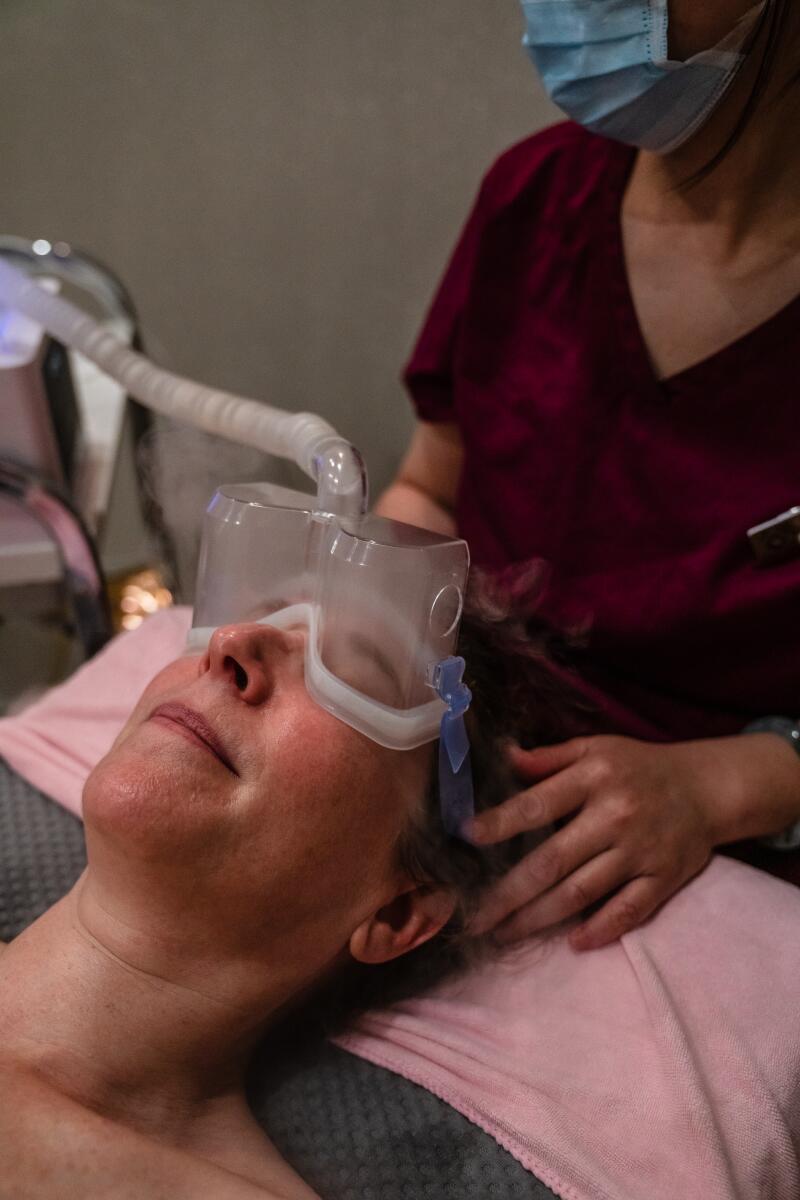
So it came to be that I found myself lying on a massage table, wearing what looked like protruding diving goggles, with clouds of cool, aromatic steam oozing from both sides of it and engulfing my face. A spindly plastic tube extended from my forehead to the “Eye Spa” machine. Serene spa music, a blend of classical piano and loudly chirping birds, trilled in the background as the machine sloshed and gurgled. It felt like lying, creekside, in a spa robe wrapped in a blanket of chamomile and rosemary-scented fog.
-
Share via
As my esthetician, Jenny Chen, adjusted the eye mask and added essential oils to the mist, New Vogue manager Lesley Xie explained that the 60-minute, $125 Eyeball Care treatment aims to hydrate and stimulate blood circulation in the eye area, decrease puffiness and dark circles and aid eye fatigue and dry eye syndrome.
“It’s really helpful for overall eye health for people who are on computers for a long time or sleep really late or who are reading a lot,” she said.
2

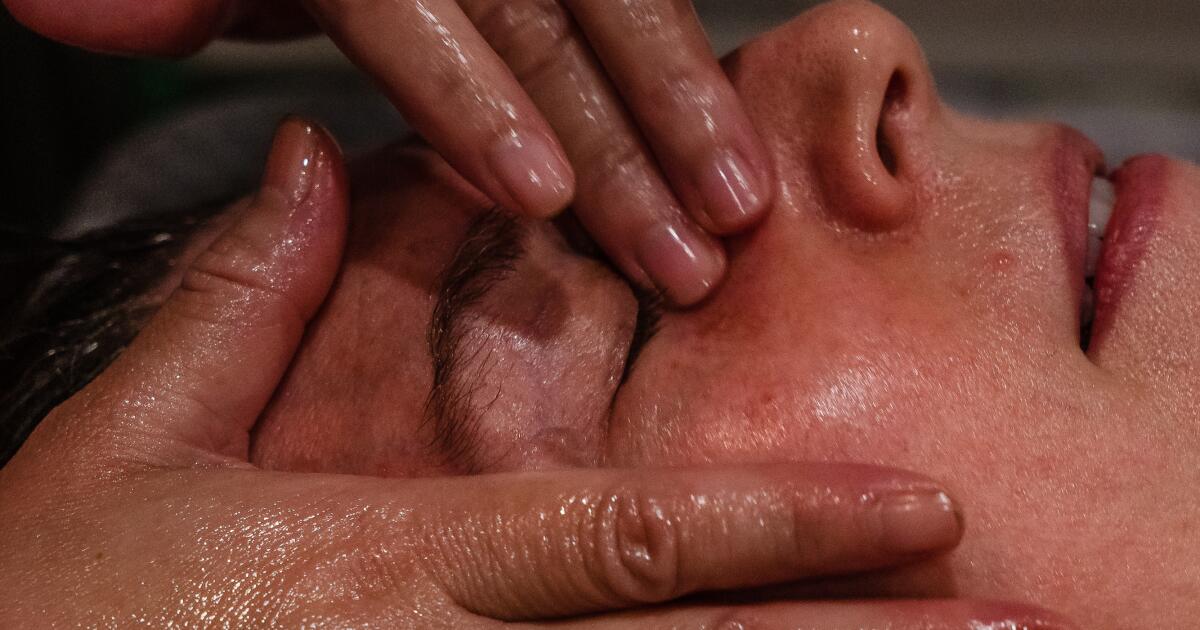
1. The Eyeball Care treatment included a mask filled with cool, aromatic steam to help relieve fatigued eyes. 2. Slippers in the Himalayan Salt Room.
Xie said that eyeball care treatments are common in China. When she was growing up in Guangdong in Southern China, elementary school students were given a break every afternoon to perform “eye exercises,” which involved gently massaging pressure points around their eye areas, for 5-10 minutes.
“It released eye stress because we studied from eight o’clock in the morning until almost noon time,” she said. “It was a break for our eyes to prevent nearsightedness and tired eyes.”
New Vogue Spa’s treatment was supremely relaxing from the onset — part Head Spa, part facial, part eye care. Chen began by massaging my scalp for about 10 minutes, as I tried not to fall asleep.
Next she cleaned my face, applied massage cream and gently massaged my face and eye area, manipulating the outer corners of my eye sockets as well as under my brow bones and on my temples. She was precise and firm but careful — as she pressed on the outside corner of my eye, I felt tension draining down the side of my cheek and neck.

Esthetician Jenny Chen conducts “Golden Eye therapy” on reporter Deborah Vankin.
Xie said the massage is based on traditional Chinese medicine, focusing on stimulating acupressure points around the eyes.
“Gentle massage of these areas is believed to help promote blood circulation, relax the muscles responsible for focusing and relieve visual fatigue,” she said. “While it’s not a medical treatment for vision conditions, it’s widely used as a preventative and restorative method.”
The massage was followed by “Golden Eye therapy,” during which Chen used an electronic device on my face with a metal roller ball on it. It uses “ultrasonic vibration technology,” Xie said, to help the skin absorb the applied moisturizing cream and combat eye puffiness.
The main event was the “cooling steam therapy,” which Xie said was meant to be calming and refreshing and help relieve tired eyes. Chen fitted me with what looked like an enormous diving mask that quickly filled with cool, hydrating mist — I felt droplets of water dripping from my eyes and down my cheeks. The Eye Spa machine uses a “cold mist atomization process,” Xie said, “that disperses micro-particles of moisture combined with soothing essential oils.”
At the end of my treatment, Chen gave me under-eye gel pad masks, for added hydration, while conducting one last head massage. She applied moisturizing eye cream, face cream and sunscreen before sending me off.
Dr. Kristina Voss, an ophthalmologist with Keck Medicine of USC, was enthusiastic about the Eyeball Care treatment.
“It sounds wonderful. Anything that makes you feel good, I generally support,” she said. “It sounds safe because they’re not putting pressure on the eye. Direct pressure on the eyeball [is dangerous]. And I’d be nervous if they were putting something in the eye, but they’re not. Steam, or even cool condensation from a humidifier, is effective for dry eye. Massaging pressure points probably doesn’t treat dry eye, but could potentially treat eyestrain or tension headaches that can be interpreted as eyestrain.”

Los Angeles Times features writer Deborah Vankin inspects her eyeballs after her treatment.
Temporary relief aside, however, Voss warned that the treatment is not a replacement for seeing a doctor if a condition is ongoing.
“It’s relaxing and complementary to a doctor’s dry eye treatments — like medicated drops or in-office treatments — but it’s not a simple fix or cure all,” she said. “Ongoing doctor’s care would be important.”
After my treatment, I was invited to linger in the co-ed Himalayan Salt Room and Red Clay Room or woman-only spa area, complete with a warm soaking tub, lounge area and treatment rooms for body scrubs. (I skipped the adjacent New Vogue MedSpa, where you can get botox, dermal filler or microneedling treatments.)
Guests are also treated to a cup of homemade snow fungus tea (made from tremella mushrooms) with a single jujube, or red, date, floating inside. New Vogue makes a fresh batch every morning for guests, simmering the collagen-rich drink so long it becomes somewhat gelatinous.

2

3

1. The Himalayan Salt Room. 2. The co-ed lounge area. 3. The Red Clay Room.
“Snow fungus focuses on deep hydration and skin plumping, while red dates support circulation and a healthy glow,” Xie said, calling the concoction “a warm bowl of snow fungus and red date soup.”
I can’t speak to the medicinal benefits of snow fungus tea. But after a glass of the warm, woody-tasting drink — together with the hour-long tension-taming eye treatment — I saw the world in a whole new way while walking out the door: clearly, from a relaxed perspective and with the bigger picture in focus.
-

 Alaska8 minutes ago
10 Reasons the 2026 Princess Cruises Season Is the Ultimate Alaska Power Move – AOL
-

 Arizona14 minutes ago
Arizona Diamondbacks Gameday Thread, #40: 5/11 @ Rangers
-

 Arkansas20 minutes ago
Sax star Merlon Devine joins Lupus Foundation of Arkansas to jazz up awareness month
-

 California26 minutes ago
GOP California governor candidates to face off at Clovis forum ahead of primary
-

 Colorado32 minutes ago
Coworking firm Industrious takes former WeWork space in Denver
-

 Connecticut38 minutes ago
New Haven man found with ‘Super Mario’ meth pills to serve federal prison time
-

 Delaware44 minutes ago
Who governs matters: Why school board elections deserve your attention
-

 Florida50 minutes ago
South Florida officers sue Ben Affleck and Matt Damon, claiming details in ‘The Rip’ are too real