Connect with us

Colorado

Wild weather will include fire danger and winter blast Friday into the weekend for Colorado

Published

on

Wild weather will include fire danger and winter blast Friday into the weekend for Colorado


Our prolonged period of strong winds and critical fire danger rolls on for Friday for day number two of a three day threat. Warm temperatures, dry air and super, gusty winds will team up again for a First Alert Weather Day that creates ideal conditions for rapid wildfire spread. 

Advertisement

Winds on Thursday were as strong as a category 2 hurricane in parts of northern Colorado! The Wellington area north of Fort Collins clocked wind gusts of 90 to 100 mph. Category 2 hurricane force is 96 to 110 mph and category 1 is 74 to 95 mph.  

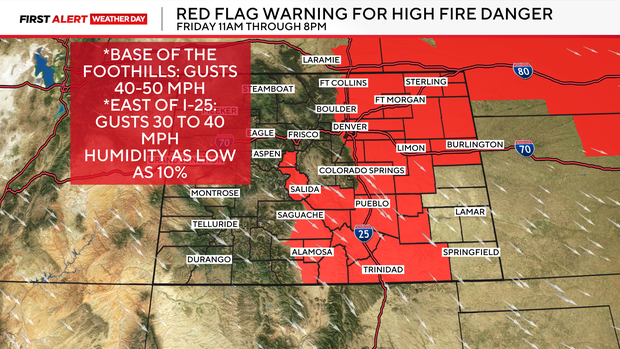
Friday has another Red Flag Warning in place from 11am to 8pm for the entire Denver area, base of the Front Range and most of the eastern plains once again. Winds wont be as strong as Thursday but should gust 40 to 50 mph in the mountains and foothills with 30 to 40 mph gusts east of I-25 and for most of the Denver area.
red-flag-warning.png

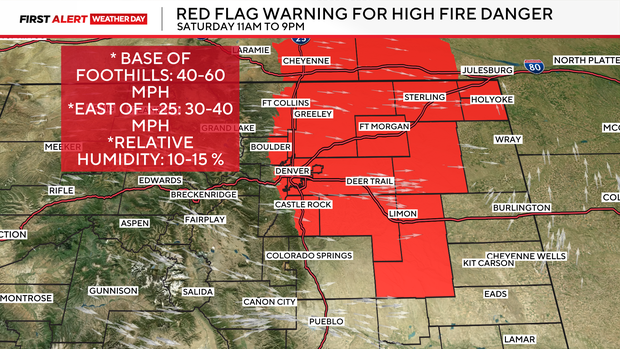
Day three of our wind event will surge on Saturday as a cold front approaches from the Pacific Northwest. Temperatures will be warm again with strong west-northwest winds. Winds will be a bit stronger gusting up to 60 at the base of the foothills and 30 to 40 over the plains.
red-flag-warning-2.png

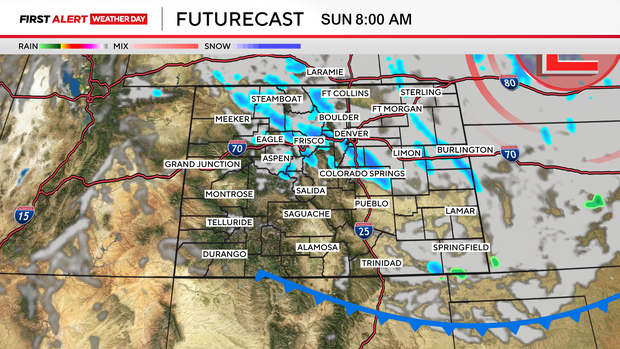
A strong cold front pushes through the region on Saturday night into Sunday. This will bring the Front Range a chance for snow and much colder temperatures to finish the weekend.
Advertisement

co-futurecast-dave.png

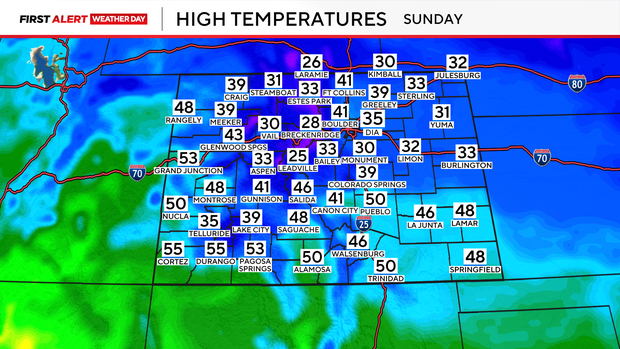
High temperatures on Sunday will plummet as much as 40 degrees cooler from Saturday to Sunday!
co-day-3-highs.png


Source link

Advertisement

Colorado

Colorado legislature passes bill to loosen restrictions on how counties fund affordable housing 

Published

on

Colorado legislature passes bill to loosen restrictions on how counties fund affordable housing 


Deed-restricted homes are pictured under construction near Frisco on Oct. 3, 2024. The project, known as Nellie’s Neighborhood, was developed by the Summit County government.
Kit Geary/Summit Daily News archive

A bill to give counties more ways to fund affordable housing cleared the Colorado legislature Wednesday and is on its way to Gov. Jared Polis’ desk. 

Senate Bill 1 would allow counties to spend property tax revenue collected in their general fund on affordable housing efforts, and allow counties and municipalities to sell buildings and land they own to fund workforce housing developments, except for parks. 

The bill also grants more flexibility for when communities hold local elections to form and fund multijurisdictional housing authorities, and expands eligibility for tax credits that help finance middle-income housing developments. 


The measure is sponsored by Sens. Dylan Roberts, D-Frisco, and Jeff Bridges, D-Greenwood Village, as well as Reps. Andrew Boesenecker, D-Fort Collins, and Chris Richardson, R-Elbert County. 

Advertisement

Roberts, who represents ski towns with some of the highest housing costs in the state, and where housing needs stretch across a broad income spectrum, said the bill gives communities more options for combating their affordability issues. 


“This gives them more tools to have local control over their housing decisions,” he said during debate on the bill in the Senate last month, “and makes sure that they can put more of their community members in housing they can afford so they can continue to live in those communities and make them great places to be.”

SB 1 is supported by an array of local governments and housing groups who say the bill is a common-sense measure that lifts restrictive provisions on how governments finance affordable housing. 

While counties, for example, can use voter-approved property tax dollars, often referred to as a mill levy increase, to fund specific initiatives, like housing, they currently don’t have authority from the state to use property tax revenue that goes to their general fund for housing. The general fund is often a county’s largest fund account and typically supports core programs, like public safety and human services, as well as county departments. 

“The bill would allow counties to contemplate affordable housing as we do any other kind of infrastructure such as water, sewer and roads,” Summit County Commissioner Tamara Pogue said during the bill’s first hearing in late January. “It gives us the flexibility to weigh all these needs as we prepare our budgets, allowing us to make the most thoughtful and balanced decisions possible on behalf of our communities.”

Advertisement

Pogue added that in mountain communities like hers, the cost of building affordable housing continues to become more expensive. She said the county had a housing project estimated to cost $55 million in December 2024, only for that to jump to more than $80 million in March 2025. 

“If counties aren’t given the flexibility to leverage our general funds as we try to fill that gap our efforts will be significantly harder than they already are,” Pogue said. 

The bill ultimately passed both legislative chambers with broad bipartisan support, with the Senate voting 28-6 on Wednesday to approve changes made to the bill in the House, where it passed by a vote of 53-10 the day before. 

A handful of Republicans opposed the measure, with some saying they had a fundamental disagreement with letting affordable housing be the role of local governments. 

“This would be a fine tool for local governments, if that were the proper role of government — to provide housing for the people,” Sen. Mark Baisely, R-Sedalia, said while debating the bill in the Senate last month. “… The way that we should lower the cost of housing would be less and less involvement by the government in our lives, including in our housing.” 

Advertisement

Sen. Janice Rich, R-Grand Junction, said she had concerns about proliferating what she called “high-density development” that could lower homeowners’ property values. Rich said homeowners’ property taxes should not be used to pay for government-supported housing. 

Roberts said his bill does not place any mandates on local governments when it comes to housing, something that has proven to be a thorny issue in the legislature in recent years. Unlike more controversial measures to usurp local zoning codes, which Republicans staunchly opposed, Roberts said SB 1 preserves local control. 

“I thought that’s what my friends on this side of the aisle wanted,” he said.


Source link

Advertisement
Continue Reading

Colorado

Judy Amabile: We must do everything possible to safeguard the public lands that make Colorado special

Published

on

Judy Amabile: We must do everything possible to safeguard the public lands that make Colorado special


By State Sen. Judy Amabile

I moved from New York to Colorado’s Western Slope when I was in the 8th grade — not a particularly easy time for a big life transition. My new school included a week of outdoor education. We hiked steep trails, climbed rocks and rafted a wild river. It was really hard, but also exhilarating. The experience boosted my confidence and sparked a love for the Colorado outdoors that has made my life healthier and richer.

Every Coloradan has a story about their connection to the outdoors. Our identity and economy are rooted in our public lands. Losing them would change everything we value. We must protect them.

In 2025, the Colorado legislature stood together to oppose federal efforts to sell off our public lands. Backed by strong public opposition, those sales were ultimately prevented.

Advertisement

This year, we are challenging a wide array of federal policy changes that disregard public will and abandon a balanced, sustainable approach to land management. These are backdoor policies driven by short-term thinking. They treat our shared lands as mere commodities to be liquidated for the benefit of a few.

That is not who we are.

The current administration’s push to weaken bedrock environmental laws, sidestep public input and privatize public lands is not just bad policy; it is bad business. When short-term privatization replaces long-term stewardship, Colorado pays the price. Our economy suffers. Our communities suffer. And hundreds of thousands of jobs are put at risk.

According to Colorado Parks and Wildlife and Colorado State University, outdoor recreation contributed $65.8 billion to Colorado’s economy in 2023. It supported more than 404,000 jobs — 12% of our entire workforce. It generated $36.5 billion in GDP. Outdoor recreation now outpaces construction, finance and education as an economic driver in our state.

Public lands are not a side issue. They are central to Colorado’s economic strength.

Advertisement

But their value goes far beyond dollars. It’s personal. It’s about public health. Nature isn’t a cure-all, but it is essential. As a hiker, I know that time spent outdoors improves life in countless ways. Our forests, canyons and open spaces reduce stress, strengthen families and build community. Ninety-six percent of Coloradans recreate outdoors, and nearly three-quarters get outside at least once a week.

When the federal government auctions off public lands or shuts the public out of decision-making, it fails Colorado’s communities. And it harms those with the fewest resources the most. Public lands belong to all of us, not just those who can afford to buy them.

That is why I am a proud sponsor of Senate Joint Resolution 26-015. It makes our position clear: Colorado opposes the privatization and selloff of our public lands.

We will continue to stand up and defend the places that sustain our economy, our health and our way of life. We have a responsibility to protect these precious lands for the generations to come.

Judy Amabile is the Colorado State Senator for District 18 (Boulder, Louisville, Superior, Niwot and Gunbarrel).

Advertisement

To send a letter to the editor about this article, submit online or check out our guidelines for how to submit by email or mail.


Source link

Continue Reading

Colorado

What Colorado’s mountain lakes can tell scientists about climate change 

Published

on

What Colorado’s mountain lakes can tell scientists about climate change 

Summit Lake, located in the Mount Blue Sky Wilderness in the Arapahoe National Forest, is among the lakes that have been sampled for over 40 years as part of a U.S. Forest Service program. High-altitude lakes are sensitive, making them a perfect testing ground for evaluating the impacts of climate change and pollutants on ecosystems.
Shelby Valicenti/Summit Daily News archive

For over 40 years, the U.S. Forest Service has been monitoring high-altitude mountain lakes in Colorado to track the environmental impacts of human-caused pollutants and climate changes in delicate wilderness areas and ecosystems. 

Mountain lakes are extremely sensitive, making them a perfect testing ground for measuring ecosystem changes in climate and the environment. 

Mary Jade Farruggia, a postdoctoral researcher at the University of Colorado Boulder’s mountain limnology lab, described them as a “canary in the coal mine” or an early warning system that can help guide which larger ecosystem changes researchers need to look out for. 


“They often show changes as a result of the environment early on, before less sensitive ecosystems might,” Farruggia said. “Understanding how the most sensitive ecosystem changes as a result of our changing environmental conditions provides important foresight for how less sensitive ecosystems may change in the future.”

Farruggia recently partnered with researchers from the Forest Service and University of Colorado Boulder to look at data from 35 southern Rocky Mountain lakes collected as part of the federal agency’s long-term air monitoring program. The study set out to determine whether environmental changes — including climate change and air pollution — have impacted the lakes’ chemistry and ecosystem over time. 

Advertisement


The program and samples collected support various federal efforts — including the National Atmospheric Deposition Program and the Interagency Monitoring of Protected Visual Environments program — created following the 1977 Clean Air Act to assess air and water quality in sensitive, high-elevation wilderness areas. 

Over the last 40 years, over 2,500 samples have been collected in these 35 lakes ranging from 9,600 feet of elevation to 13,000 feet, Farruggia said. All but two lakes, located in the Wind River Range in west central Wyoming, are in Colorado. They span six national forests, 11 wilderness areas and 14 ranger districts. 

Typically, samples are collected from each lake two times every summer. In the past, occasional samples were taken in the winter. With recent changes, Farruggia said the samples look at 19 different chemical parameters, an increase from the 13 it has historically tested for. 

This type of “large-scale, long-term monitoring” is extremely valuable, “particularly as our climate becomes more variable and extreme,” Farruggia said. 

“We cannot measure just one or two mountain lakes for a year or two and extrapolate to all other mountain lakes over decades. We need large programs like this one to capture the variability in lake responses to change over both space and time,” she added. 

Advertisement
For over 40 years, The U.S. Forest Service and partners have collected annual samples from 35 southern Rocky Mountain lakes as part of its long-term air monitoring program.
Courtesy Photo

According to Farruggia, this type of monitoring and data could help answer questions about how this winter’s historically low snowpack in Colorado could impact mountain lakes. 

“For example, we found that some lakes in this dataset are strongly influenced by precipitation, and will be especially sensitive to an extreme snowpack, meaning they will likely experience more change as a result of an extreme snowpack,” she said. “Insights like this can help natural resource managers understand which ecosystems may be most at risk and adapt their management for a changing climate.”

Many of these samples are collected by volunteers and nonprofits. In the Roaring Fork Valley and White River National Forest, Wilderness Workshop, a Carbondale-based conservation nonprofit, has supported the data collection since the late 1980s. The nonprofit has partnered with the national forest to fund a technician position that collects samples in 15 regional lakes. 

“These wilderness and high-mountain lake datasets represent some of the longest-term observations we have for these sensitive ecosystems across the central Rockies,” said Will Roush, executive director of the Wilderness Workshop. “These are the nation’s headwaters, everything else, across dozens of states, is downstream. The long-term monitoring of air and water quality provides a baseline we can use to understand the status of these lake resources and changes that could impact the health of people, wildlife and ecosystems.” 

Last year, after federal budget cuts hit the program, Pitkin County’s Healthy Rivers and Streams Program stepped up to fund and support the White River work in 2026. However, Roush warned that “federal funding is critical for the long-term continuation of the program.”

What is driving changes in mountain lake chemistry? 

Moon Lake, located in the Weminuche Wilderness of the San Juan National Forest, is among the lakes that have been sampled for over 40 years as part of a U.S. Forest Service program to understand environmental changes in high-altitude lakes.
Beau Toepfer/The Aspen Times archive

In a February webinar, Farruggia presented results from their study of the dataset. Isabella Oleksy, also with the University of Colorado Boulder’s mountain limnology lab, and Tim Fegel and Chuck Rhoades, with the U.S. Forest Service’s Rocky Mountain Research Station contributed to the study. 

“We went into it knowing that high elevation lakes such as these tend to be especially susceptible to environmental change due to their clear, dilute waters, small watersheds and sparse vegetation,” she said. “We didn’t know exactly if/how environmental change would affect the lakes, and how sensitive they might be.”

Advertisement

Specifically, the study set out to evaluate how changes in pollutants and emissions, drought conditions and warmer temperatures impacted levels of nitrogen and sulfate in the lakes. 

“Air pollution is the major source of nitrogen and sulfate in these systems,” Farruggia said. “Both nitrogen and sulfate contribute significantly to a lake’s acidity … An acidic lake can harm fish and wildlife, change the chemistry of the lake enough to promote reactions that release toxic metals into the water and make lakes less able to resist further additions of acid.” 

Both chemicals can travel long distances before depositing into these high-elevation lakes. 

Nitrogren, specifically, acts as a “MiracleGro” for lake algae, she added. 

“Lots of nitrogen can promote algal blooms, turning lakes green and less clear,” Farruggia said. “This is exacerbated by warming summer air temperatures due to climate change, since algae also grow better and faster in warmer temperatures.”

Advertisement

As the study set out to determine whether regional trends in air pollution or climate were impacting sulfate and nitrogen levels, they determined that these trends only served as an explanation for sulfate levels in around half the lakes and nitrogen levels in around 30% of the lakes, Farruggia said. 

While most lakes have experienced chemical changes in the past 40 years captured by the dataset, the magnitude and direction of the changes varied at each individual lake. Farruggia described it as “mosaic of regional to local factors” — erosion, drought, land cover, geography, size, elevation and more — that are all interacting to shape the chemical trends and changes at each location. 

“It’s clear that climate and or deposition matter to some lakes, but there isn’t one like golden variable that explains everything about how and why lake chemistry is changing,” Farruggia said. “It’s not quite as simple as being like, we’ve improved air pollution, and therefore, we’ve improved the same pollutants in lakes, unfortunately. So, we’ve just seen that it’s likely a combination of several factors driving change in these lakes.”

While the study is continuing to determine whether more “static” variables like soil and geology interact with pollution and climate, and how they impact levels of sulfate and nitrogen, Farruggia said the results really punctuate the need for this type of widespread, long-term monitoring.   

“Given that our future is not projected to be stationary, climate is projected to become more variable, more extreme,” she said. “We really need this continued monitoring for determining lake responses to ongoing change. We see that most of these relationships are not linear, a lot of them are squiggly.” 

Advertisement


Source link
Continue Reading

Trending

