Washington, D.C
A Virginia boater is suing a DC utility for the Potomac River sewage spill


A Virginia boater is suing a Washington water utility for negligence in the collapse of a pipe that leaked millions of gallons of raw sewage into the Potomac River.
The class action lawsuit filed Friday in U.S. District Court in Greenbelt, Maryland, comes weeks after a January sewage pipe collapse, shooting wastewater out of the ground and into the river in an area just north of Washington, D.C. The spill is seen as a serious environmental blight and became the focus of political bickering between President Donald Trump and Democratic-led Maryland, where the leak occurred.
Dr. Nicholas Lailas, M.D., the plaintiff, is a Virginia resident and recreational boat user on the Potomac who is seeking compensation for people “whose property interests in and use and enjoyment of the Potomac River … have been impaired by Defendant’s conduct.”
The lawsuit alleges that it was DC Water’s responsibility as the owner and operator of the ruptured pipe, known as the Potomac Interceptor, to maintain it in a “reasonably safe condition and to prevent foreseeable harm to persons and property.”
The lawsuit said that preliminary data indicate that there are thousands of people who own property or vessels in the affected parts of the Potomac.
Andrew Levetown, an attorney for the plaintiff, said in an interview Monday that it will take time to get the full breadth of the class, with business owners, property owners and recreational users all having interest in the potential damages caused by the Jan. 19 collapse and leak.
“You’re going to have businesses who lose business because instead of sitting next to the Potomac, their clients are sitting next to the open sewer,” he said.
The suit did not specify a damage amount. DC Water spokesperson John Lisle said in a statement that the collapse of the Potomac Interceptor was “a serious and unexpected event, and our teams remain focused on the response, environmental protection, and restoration efforts. Because this matter is currently subject to ongoing litigation, it would not be appropriate for us to comment further at this time.”
D.C. Mayor Muriel Bowser declared an emergency Feb. 18 and requested that President Donald Trump provide federal resources to help the city fight the leak that dumped 250 million gallons of raw sewage into the Potomac River in its early stages. The president approved the emergency assistance days later to help the city address the emergency.
DC Water gave its most detailed assessment yet of why the Potomac River sewage spill occurred and what it will take to fix it. News4’s Mark Segraves reports.
DC Water said it knew the pipe, first installed in the 1960s, was deteriorating, and rehabilitation work on a section about a quarter-mile (400 meters) from the break began in September and was recently completed. The pipe that ruptured was scheduled for repair this summer.
DC Water’s updates say the emergency repairs are beyond the halfway point and there are no flows into the river.
At a public briefing last week, officials with the utility said they were assessing the cause of the rupture, including whether the way the pipeline was initially constructed contributed to the emergency. David Gadis, the CEO of DC Water, said at that briefing that while it was too early to say definitively, “we are seeing indication that this incident may have been highly unusual.”
Sign up for our free deep-dive newsletter, The 4Front, to get standout News4 stories sent right to your inbox. Subscribe here.



WASHINGTON – Washington, D.C., mayoral candidate Kenyan McDuffie on Thursday conceded the Democratic primary race to Janeese Lewis George.
Although the official certification of the primary race is continuing, McDuffie said in a statement that “it is clear that the voters have chosen a different path.” The former member of the D.C. council said he had contacted Lewis George and congratulated her. He thanked his supporters and urged them to continue working for the city.
“The campaign may be over, but the work of building a safer, more affordable, more prosperous city continues.”
The Associated Press has not declared a winner in the race. Lewis George had a little less than 53% of the vote Thursday morning, which is just a few percentage points above the 50% threshold to avoid ranked choice voting.
The city is scheduled to release preliminary ranked choice voting results on Sunday. AP will call the race before then if it is clear that the ranked choice process will be avoided.
Lewis George has pledged to aggressively stand up to federal intervention into Washington, D.C.’s, affairs, setting up a potential showdown with President Donald Trump over his administration’s moves to challenge the city’s limited autonomy.
If the results stand, Lewis George is likely to win November’s general election in the heavily Democratic city. The winner in the general election will replace Muriel Bowser, who decided not to run again after three terms.
Lewis George would join Robert White Jr., who won the Democratic primary for the district’s delegate to Congress, as the top local officials who likely will contend with the federal government’s intentions for the city. They each campaigned on a promise to take a harder line than their predecessors against the Trump administration’s moves on the district, including its deployment of the National Guard on an ongoing, open-ended mission meant to fight crime.
“As mayor, I will work with anyone who makes D.C. safer,” Lewis George told a crowd of cheering supporters Tuesday night, “but I will also stand up to Trump.”
Washington has limited autonomy and federal leaders retain significant control over local affairs, including approval of the budget and laws passed by the D.C. Council.
Trump further encroached on that autonomy last year when he briefly federalized the city’s police force and deployed an ongoing law enforcement surge that included the National Guard. His efforts to downsize the federal government also roiled the capital region, costing thousands of people their jobs. And he has been reshaping the city by renovating storied landmarks and putting his name or image on buildings.
Lewis George, a self-described democratic socialist and a member of the D.C. Council, has already come under fire from Trump, who last week threatened to place the city under federal control if she won.
“Maybe we’d take back Washington, run it on the federal basis,” he said.
Lewis George, 38, and a third generation Washingtonian, has vowed to overrule an executive order by the city’s police chief permitting local law enforcement to cooperate with Immigration and Customs Enforcement agents. Lewis George argued the order “hurt the trust of our community.”
She also pledged to use any levers available to her through the city’s home rule compact to resist what she called authoritarian infringements on the district’s local governance.
“We have legal tools we can use to fight back,” she told the AP in an interview before the vote. “And we know that when we have gone to court, we’ve won.”
Bowser found herself walking a fine line between staying in Trump’s good graces and responding to the concerns of constituents, many of whom said she didn’t push back hard enough on Trump’s actions. Eleanor Holmes Norton, the 18-term, 89-year-old delegate to Congress, meanwhile, faced mounting concern from critics who said she wasn’t forcefully pushing back on the Trump administration’s moves against the city.
Copyright 2026 The Associated Press. All rights reserved. This material may not be published, broadcast, rewritten or redistributed without permission.
Darren Lyn
18 June 2026•Update: 18 June 2026
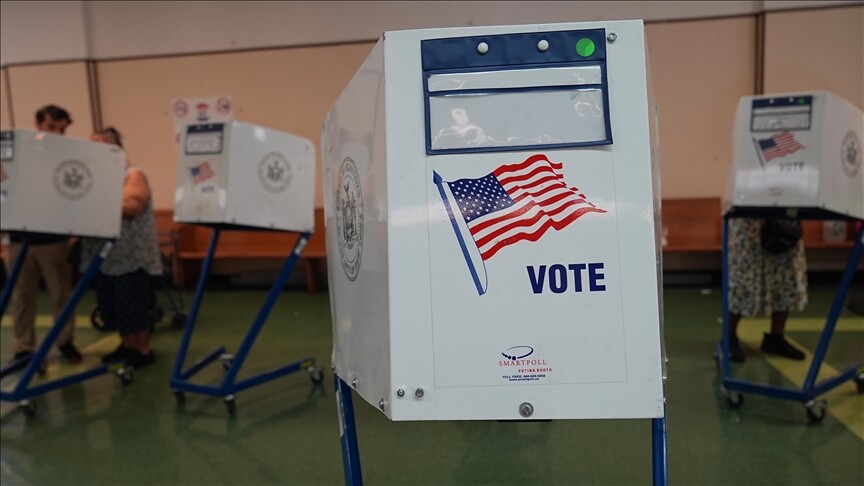
Democratic socialist Janeese Lewis George currently leads the vote tally as of Wednesday versus six other candidates in the Washington, DC Democratic mayoral primary, and if victorious, could be following in the footsteps of the most notable democratic socialist in the United States — New York Mayor Zohran Mamdani.
With 73% of the ballots counted since Tuesday’s primary election in the nation’s capital, the Associated Press (AP) has Lewis George leading with 52.9% of the vote. Her closest challenger is Kenyan McDuffie, who currently holds 36.5%.
The mayor’s office in the District of Columbia has traditionally been a Democratic stronghold, and political experts have said that any Republican challenger is not expected to put up meaningful competition for the mayor’s seat in the general election.
If Lewis George keeps her current lead and wins the majority, she will head to the November election as the favorite to replace three-term Mayor Muriel Bowser, who decided not to run for a fourth term.
A victory for Lewis George would be to the ire of US President Donald Trump, who told reporters that he could attempt a federal takeover of Washington if she won the mayor’s race, according to local media reports.
“We won’t put up with it,” Trump told reporters at a news conference.
Yet Trump has already seen a democratic socialist take power in America’s largest city, with the election of Mamdani as mayor of New York City.
Not to be outdone, the race for the mayor’s office in Los Angeles, California — the second largest city in the US by population — has a democratic socialist, Nithya Raman, in the runoff to vie for the position in November’s general election. Raman will face incumbent Democratic Mayor Karen Bass, who narrowly edged out Raman in the primary 34.3% to 29.0%.
In California’s 14th congressional district, two candidates will head to a runoff election to replace former US Rep. Eric Swalwell, who resigned from Congress in April amid allegations of sexual assault, including rape.
Aisha Wahab secured the first runoff spot on Tuesday with 38.3% of the vote, with the AP on Wednesday calling the second position to go to Melissa Hernandez, who tallied 17.2%.
The runoff election will be held on Aug. 18, with the winner finishing out the rest of Swalwell’s term.

At time of writing, the Associated Press estimates that around 64% of votes have been counted. Races where no candidate wins a majority of first choices will proceed to a ranked choice voting count – most likely the at-large Council and Ward 1 Democratic primaries. With RCV, all nominees will have support from a majority of their party – as will the winner in an at-large Council special election.
Mayor
In the closely watched mayoral race, Councilmember Janeese Lewis George leads with 52.8% of voters’ first choices, followed by former Councilmember Kenyan McDuffie at 36.6%. If Lewis George remains above 50% as the remaining votes are counted, a ranked choice tabulation will not be necessary to determine the winner.
Congressional delegate
Five candidates ran in the Democratic primary to succeed retiring Delegate Eleanor Holmes Norton. Councilmember Robert White won that election with 63.2% of first choices. Councilmember Brooke Pinto came in second with 21.5% of first choices.
At-large Council Democratic primary
Nine candidates ran for the Democratic nomination to succeed at-large Councilmember Anita Bonds. No candidate has won a majority of first choices. Oye Owolewa leads with 33.8%, followed by Lisa Raymond at 15.2% and Kevin Chavous at 13.8%. The result will likely be determined by a ranked choice voting count.
| Candidate | Share of first choices |
| Oye Owolewa | 33.8% |
| Lisa Raymond | 15.2% |
| Kevin B Chavous | 13.8% |
| Greg Jackson | 11.0% |
| Candace Tiana Nelson | 7.7% |
| Dwight Davis | 6.0% |
| Fred Hill | 5.4% |
| Dyana N. M. Forester | 3.7% |
| Leniqua’dominique Jenkins | 3.0% |
| Write-in | 0.4% |
In a choose-one election, Owolewa would have won the nomination despite 66% of voters voting for another candidate. In 2022, for instance, Councilmember Anita Bonds won the Democratic primary for this seat with only 36% of first choices. Now, ranked choice voting will ensure the nominee – whether Owolewa or someone else – has majority support.
At-large Council special election
In the special election for at-large Council, former Councilmember Elissa Silverman is leading with 54.8% of first choices, followed by appointed Councilmember Doni Crawford and Board of Education President Jacque Patterson, with 25% and 19% respectively. If Silverman maintains a majority of first choices, there will be no ranked choice tabulation.
Ward 1
In the competitive Democratic primary for Ward 1 councilmember, Aparna Raj leads with 47% of first choices. Depending on remaining ballots, Raj may win with a majority of first choices, or the winner may be determined by a ranked choice voting count.
Candidate
Share of first choices
Aparna Raj
46.7%
Michael Trindade Deramo
20.3%
Rashida Brown
17.2%
Jackie Reyes Yanes
10.0%
Terry Lynch
5.8%
Write-in
0.1%
Notably, in three Council races – the at-large Council Democratic primary, at-large Council special election, and Ward 1 Democratic primary – candidates cross-endorsed each other, asking voters to rank each other on their ballots. Past elections show that voters often listen to cross-endorsements by candidates they support, so it’s possible candidates who cross-endorsed will benefit when their races go to RCV tallies.
DC’s ranked choice voting elections offer a sharp contrast with the District’s recent past, in which candidates regularly won key primaries without majority support. Since 2012, every districtwide office and six of the eight wards have seen Democratic primaries won with less than 50% of the vote. Since 2020, Ward 2 and Ward 7 have had Democratic Council primaries won with less than 30% of the vote.
FairVote will post more analysis of the DC election over the coming week. In the meantime, visit Grow Democracy DC to learn more about RCV in DC.
-

 Florida44 seconds ago
Weather Aware Day declared for Friday as heat and strong storms threaten Central Florida
-

 Georgia4 minutes ago
DHS appears to axe plan to construct immigration detention megacenter in small Georgia town
-

 Hawaii9 minutes ago
Ambassadors of aloha: Food events aim to boost tourism with unique Hawaii-made products
-

 Idaho16 minutes ago
Idaho State Police arrest Dillon Thorpe on rape, child enticement charges in Elmore County
-

 Illinois19 minutes ago
Beecher City farm suffers heavy damage following ‘wicked storm’
-

 Indiana24 minutes ago
Braun asks regulators to reconsider $71 million AES rate increase
-

 Kansas29 minutes ago
Mixed results for Kansas City World Cup start as some businesses struggle
-

 Iowa31 minutes ago
Iowa High School Baseball Stats: Leaders On The Diamond This Summer

