South-Carolina
SC legislature considers legal sports betting – again

Will Jordan was introduced to sports betting through his coworkers during his sophomore year at the University of South Carolina.
Jordan, a senior, still makes bets today, including a losing wager on this year’s Superbowl. But his outlook on the practice changed after he saw the impact on his friends and others his age, he said. Jordan tends to keep his betting to simply the outcome of a game. But he sees his friends getting more and more into obscure proposition bets. Those are wagers on smaller, individual events or statistics connected to a game, including individual players’ performances.
The amount of advertising for gambling and the expansion of less-regulated alternatives disturb Jordan, he said.
“I’ve just really gotten turned off and a little bit frightened for the future on these sportsbooks,” Jordan said. “When I first got introduced to it, it was obviously a lot more novel for me. But now it’s starting to get a little concerning.”
Jordan uses traditional betting apps such as BetMGM and Bet365 in his home state of Virginia, where betting on a game is legal. In South Carolina he uses Fliff, the first app he was introduced to. Fliff uses an in-app currency, so players are betting with house money, and thus falls under sweepstakes regulations instead of gambling laws.
But legal sports betting and a casino may be in South Carolina’s future if state legislators pass two bills in the Statehouse. Casinos and sportsbooks came up in the 2025 legislative session but failed to make it into law.
Supporters say legalization will bring economic benefits and make gambling safer, but opponents point to the dangers of gambling addiction.
If South Carolina approves sports betting, it would join a growing number of states that allow online sportsbooks.
The impact of gambling
Only one state had a legal sportsbook in 2017, according to a study from researchers at the University of California at San Diego.
Seven years later, that number rose to 38.
USC Professor Stephen Shapiro broke sports bettors into a few categories, including fanatics, moderates and casuals, for research he has done on the industry. More casual gamblers tend to be older, while younger gamblers increasingly fall into the fanatic group, he said.
Shapiro began his studies around the time of the 2018 U.S. Supreme Court decision that opened the door for wide legalization of sports gambling.
Shapiro’s work doesn’t focus on gambling addiction, but he takes it into account. Online sports betting has a higher risk for problem gambling as result of its greater accessibility and the ability to place in-game bets. Traditionally, a gambler would bet on which team wins. But now bettors can gamble on what actions certain players make or the exact score at the end of a quarter.
“The fact that you can do almost an infinite amount of bets within a game just sets up a landscape for problem betting,” Shapiro said.
The betting market is new and unsaturated, leading companies to spend billions on marketing. Ads pop up everywhere – on phones, computers and televisions. Each time a state legalizes betting, a new market appears. And where sports wagering is already legal, there are millions of sports fans who could be potential gamblers, Shapiro said.
Counselor Laura Nicklin treats patients with gambling disorders at LRADAC, a Columbia nonprofit agency that runs a treatment center for substance abuse and other addictions.
There are various criteria used to define gambling addiction, Nicklin said. They include whether someone’s gambling causes them distress or interferes with their employment or relationships.
The legality of any potentially addictive activity has an effect on the risk of addiction, Nicklin said.
“When something’s legal, people are more likely to engage in it … whether that’s substances or gambling,” Nicklin said. “When you’re more likely to engage, you’re more likely to become addicted to it.”
The accessibility of gambling on the phone presents another problem. It can be used to pass the time just like other addictive activities such as social media use, Nicklin said.
“It can be something you do just to numb out when you’re feeling stressed,” Nicklin said. “Pull out your phone, numb out doing any of those activities, including gambling on an app.”
Access to apps and digital programs can usually be blocked, and accounts can be deleted. But that access can just as easily be restored.
Nicklin and other counselors work with patients to develop coping skills to combat these challenges.
Inability to cope with past issues is a common lead-up to addictive disorders, Nicklin said.
“Almost everybody I see coming in with some sort of addiction has some old wounds, like trauma wounds, grief, unmet needs that they’ve been unable to address,” Nicklin said.
Unlike substance abusers, gamblers are not directly ingesting chemicals that affect the brain’s chemistry. But the dopamine rush brought on by betting can act in a similar fashion and fulfill the same role in addressing unmet needs.
Getting to the bottom of those past experiences is one of the first steps in treatment.
What counts as gambling?
Another area Shapiro wants to explore are prediction markets.
Users can put money down on the outcome of future events with these services, but they are regulated as financial instruments such as stocks instead of betting services.
Kalshi and Polymarket are two major players in this field, but financial apps like Robinhood and Webull have also expanded into these services.
“It acts very much like gambling,” Shapiro said.
Using Robinhood, a South Carolina resident can buy a contract on whether a Gamecock team wins its next basketball game. Sports betting is illegal in South Carolina, but the legal status of prediction markets allows this bet to be made.
Kalshi and Polymarket “are the two biggest culprits right now for people my age in regards to sports betting,” Jordan said.
An ongoing lawsuit might change that.
South Carolina Gambling Recovery LLC filed the lawsuit against Kalshi, Robinhood, Webull and the international trading and technology firm Susquehanna last year. The LLC, which incorporated in Delaware, asserts that these markets violate South Carolina’s existing gambling regulations.
The legal challenge was filed in Oconee County, South Carolina, before the federal court system took it up.
Shapiro wonders why consumers would choose between traditional sports betting and prediction markets in states where the former is legal. He also wants to research how the prediction markets influence how sports fans consume games.
Traditional casinos and sportsbooks are split on this new formula.
Some lobby against the practice. Others, such as FanDuel, are starting their own prediction markets to offer alongside existing betting mechanisms.
The industry addresses the state
Representatives from Caesars Entertainment, FanDuel and PrizePicks advocated for legal sportsbetting in front of a Senate subcommittee last month.
Legal sportsbooks would provide a regulated, taxable avenue for an activity many South Carolinians already take part in by going across state lines or using illegal services, they said.
FanDuel has “cutting-edge, responsible gaming tools, ” said Louis Trombetta, director of government relations for the sportsbook and former executive director for Florida’s gaming commission.
The programs track user activity and can slow things down if odd behavior emerges, he said. If a gambler usually places small bets and suddenly makes a $1,000 wager, the system flags it for the company to check in on.
Gambling companies want to make money, but unhealthy habits among customers can be a problem for bookmakers in the long term, he said.
“We want our customers to be enjoying our product without becoming problem gamblers,” Trombetta said. “That is the goal.”
Opponents to legalization showed up as well. President Steve Pettit of the conservative Palmetto Family Alliance told the committee that betting systems rely on those who struggle with gambling, particularly young men.
“Recreational gambling is like a campfire,” Pettit said. “Problem gambling is when the fire escapes the ring or the pit. And pathological gambling is like a wildfire. Legalized, phone-based betting does not contain the fire. It places an ignition in every pocket.”
The Palmetto Family Alliance has made this argument before. The organization began as the Legacy Alliance Foundation, which formed to fight video poker decades ago.



In Laurens County, a dual-sided historic marker stands next to a mailbox off the side of the road. The name Jonathan Downs was commemorated on one side, while the other side was signed with the story of Lindley’s Fort in the American Revolution.
The Battle of Fort Lindley took place July 15, 1776, some 1,800 feet away from the modern-day historic marker. Private farmland now sits where the battle ensued, but physical pieces of history and oral retellings of the battle have continued to propel the story in Laurens County lore.
Loyalists to the British crown and Cherokee citizens planned an attack on a group stationed at the fort. The Little River Regiment used the fort as their base. Loyalist Capt. David Fanning described the scene as a “fort built with logs” in his autobiographical retelling of the Revolutionary War.
Cherokee land had continually been encroached on, which pushed members of the tribe to retaliate.
The loyalists who joined in the attack were dressed as Native Americans. They – along with other South Carolina backcountry loyalists – were referred to as Scopholites. The group took action at midnight for what became a two-hour fight in one of the first conflicts of the Cherokee War of 1776.
Historian Durant Ashmore said the crux of the battle was a clash of culture and a fundamental lack of understanding among the groups.
“One thing that has been very important to understand is the conflicts between cultures – the misunderstandings between cultures – and the deadly consequences that can result from that,” he said.
Luis-Alfredo Garcia
/
South Carolina Public Radio
Troops at the fort had at first not believed word of the upcoming attack when informed by a group of soldiers, according to a pension application of Matthew Brown, who was a 16-year-old boy stationed at a fort about 20 miles away from Fort Lindley. The men were drunk from a night of indulging in rum, which Ashmore said was a common occurrence during the war.
“The Little River Regiment did not believe them. They actually even leveled their guns at them, saying, ‘Who’s telling you such lies as this?’” he said.
Maj. Downs, however, prepped the troops for defense. Downs was a previous member of the First Provincial Congress, Second Provincial Congress, and South Carolina General Assembly.
A sizable chunk of the Patriot troops had already experienced fighting Cherokee citizens during the Anglo-Cherokee War that lasted from about 1758-1761. Soldiers at Fort Lindley responded to the attack by sending out troops in lines of 10. Eventually, the loyalists and Cherokee citizens retreated.
The patriot victory boosted local morale and belief in their cause, but for some unscathed loyalists and Cherokee citizens, the aftermath’s impact trumped the actual battle loss in consequences.
The morning after the battle, troops from the fort found about 30 horses at a campsite. One saddlebag contained the commission papers of Capt. James Lindley. Lindley was a staunch loyalist and the eponymous owner of Fort Lindley.
Six months prior to the battle, he had been captured at the Battle of Great Cane Break. Lindley had promised to not take up arms against patriot forces again, or he would face death. Although he was not captured in the midnight battle, he did succumb to patriot troops at the Battle of Kettle Creek and was hanged for breaking his parole.
As for the Cherokee citizens, their land was further encroached upon and people killed; about 2,000 were killed during the Cherokee War of 1776.
Ashmore said the consequences from escalating conflict were terrible.
“Patriots gathered together with the idea of a plan, the goal of eliminating the Cherokees. Genocide,” he said. “That’s what was preached to the backcountry settlers along with the ability to make their own decisions. A primary motivating factor in the American Revolution is the right of self-determination.”
Luis-Alfredo Garcia
/
South Carolina Public Radio
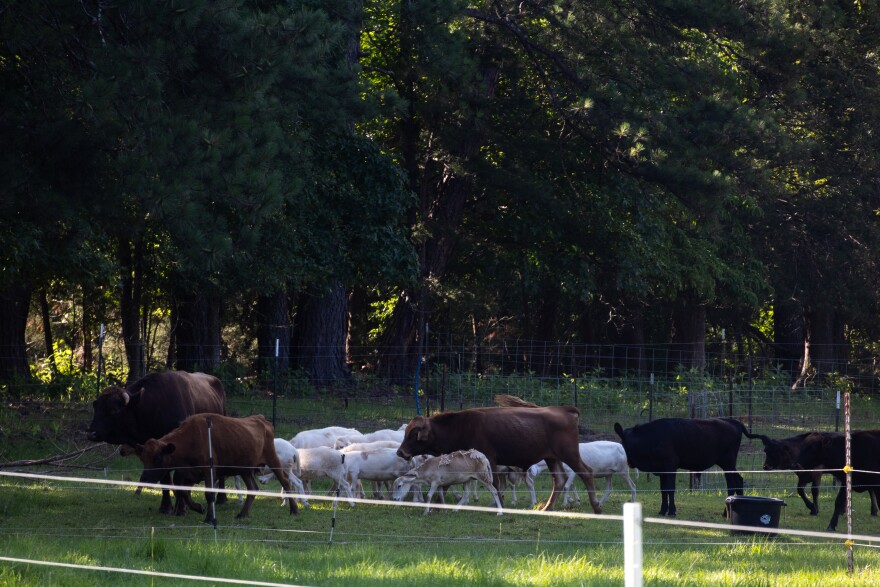
Now, private land with cows and sheep sits on the area where the fort once stood. Ashmore said he gives tours just during the winter to avoid the risk of ticks. The area where trenches once helped shield soldiers are still visible.
Some remnants from the fort now reside at the Laurens County Museum in the city of Laurens’ downtown area. The objects, although not individually labeled, will be part of an upcoming opening collection.

Luis-Alfredo Garcia
/
South Carolina Public Radio
Museum docent Julia Sermons said being informed of local history helps shape modern decisions.
“You have to know where you’re coming from to know where you’re going,” she said.
Ashmore, too, saw the same value.
“We are all in the middle of this,” he said. “This history – the important role that South Carolina played in the Revolution.”
An estimated 14 battles took place in Laurens County, according to Ashmore. He has been keeping track of local history for about 6 years. He said the county has set a 50-year plan to help with future record keeping.

Luis-Alfredo Garcia
/
South Carolina Public Radio


Video of SCHSL 5A Division 1 Upper State track and field championships
Here’s video of some of the action from the SCHSL Class 5A Division 1 Upper State boys and girls track and field championships held May 8 at Dorman.
Riley Vaughn of Spartanburg girls Track and Field was named the 2025-26 South Carolina girls Gatorade Player of the Year.
Vaughn won the shot put and discus events at the Class 5A-D1 state championships. She nailed a 13.1 meters on the shot and 41.77 meters on the discus. Her 14.41 in the shot at the region meet was the state’s best for 2026.
The 5-foot-10 junior helped lead Spartaburg to a fifth-place team finish. Vaughn had also competed on the national stage after taking third place in the shot put event at the Under Armour Nationals.
“Unbeaten in the discus throw on home state soil this year, Vaughn achieved success in both throws, but really sparkled in the shot put circle,” PrepCalTrack editor, Rich Gonzalez, said. “Her season-best there was the state’s top mark in the event in seven years and moved her to No. 4 on South Carolina’s all-time list.”
Vaughn is now part of an elite group of athletes who have won the prestigious award, including four-time Olympic gold medalist Sydney McLaughlin, five-time Olympic medalist Sanya Richards, and 11-time Olympic medalist Allyson Felix.
Vaughn was also named to the Greenville News’ All-Upstate First Team in girls’ Track and Field for the second consecutive season.
Kamryn Jackson covers high school and college sports for the Spartanburg Herald-Journal, Greenville News, Anderson Independent Mail, and the USA TODAY Network. Please email her at KEJackson@gannett.com and follow her on X @KamxJack (formerly Twitter).

-

 World3 minutes ago
Copernicus lead warns extreme heat measures needed or deaths to ensue
-

 News28 minutes ago
“It’s blood money”: Family of exonerated man in Texas yogurt shop murders speaks out after settlement
-

 Los Angeles, Ca2 hours ago
Woman ambushed, violently attacked by robber in downtown Long Beach
-

 Detroit, MI2 hours ago
Where to watch Houston Astros vs Detroit Tigers: TV channel, start time, streaming for June 26
-
San Francisco, CA2 hours ago
I own a Turkish Restaurant in San Francisco. Turkey’s World Cup match here has changed my business.
-

 Dallas, TX2 hours ago
Australia advances at World Cup, how to buy Australia soccer tickets
-

 Miami, FL3 hours ago
2 detained after police pursuit ends with bailout, neighborhood search in NW Miami-Dade – WSVN 7News | Miami News, Weather, Sports | Fort Lauderdale
-

 Boston, MA3 hours ago
Delta flight returns to Logan after smoke scare in cockpit – Boston News, Weather, Sports | WHDH 7News

