California
Lawyers fear 1,000 children from Central America, dozens in California, are at risk of being deported


Lawyers and advocates fear about 1,000 Central American children, including dozens in California, are at risk of being deported to dangerous situations in their home countries before finishing their immigration court proceedings.
They believe the U.S. government is now expanding their list of hundreds of children across the country, which started with children from Guatemala, to include those from Honduras and El Salvador. Lawyers for some children saw their scheduled hearings disappear from the immigration court calendars in recent weeks.
“It has been heartbreaking and infuriating these last two weeks to have to warn our child clients that our government seeks to violate their rights and return them to danger,” said Marion Donovan-Kaloust, director of legal services at the Los Angeles-based Immigrant Defenders Law Center, which represents unaccompanied minors. “The fact that the government is doubling down on this cruel scheme should shock everyone’s conscience.”
In the middle of the night over Labor Day weekend, the government removed 76 Guatemalan children from shelters in Arizona and Texas. Many of their cases had vanished from calendars before the Department of Homeland Security placed them on a plane set to return to Guatemala without telling their parents, according to court documents.
A transport van with migrants onboard departs the Valley International Airport, Sunday, Aug. 31, 2025, in Harlingen, Texas.
(Michael Gonzalez / Associated Press)
A federal judge blocked the flight in an emergency order as children sat aboard a plane on the tarmac. Many feared for their safety should they return to Guatemala, where attorneys say they face gang violence, physical abuse and neglect.
U.S. Department of Justice attorney Sara Welch said during a hearing this week there were “no immediate plans” to remove immigrant children from other countries. The Department of Homeland Security and the Refugee Resettlement office did not respond to requests for comment.
A legal aid worker with knowledge of the situation said Honduran counterparts are expecting 300 children to be returned to the country, which would account for nearly all Honduran children in Office of Refugee Resettlement custody nationwide. Another 100 unaccompanied children from El Salvador are in U.S. government custody, said the worker, who requested anonymity to share sensitive details.
Earlier this summer, Guatemalan officials said U.S. officials had sent them a list of 609 teenagers ages 14-17 to be returned to the country. At least 40 immigrant children living in California were on that list, the legal aid worker said.
In a Sept. 6 sworn declaration, Angie Salazar, acting director of the refugee resettlement office, said that 457 Guatemalan children were initially identified as “potentially appropriate for reunification with a parent or legal guardian,” but that after reviewing individual cases, 327 children were determined to be ultimately eligible for removal from the U.S.
During the hearing this week, Welch walked back earlier government assertions that the children’s parents had asked for them to be returned, after lawyers for the minors produced a memo from the Guatemalan Attorney General that showed officials had contacted about 115 families, nearly half of whom were upset at the prospect of their child being returned.
Another 50 families said they were willing to accept the children, but had not asked for their return. In one case, the memo noted the parents said they will “do everything possible” to get their daughter out of the country again, “because she had received death threats.”
Since the deportation attempt over the holiday weekend, attorneys for the children, who crossed the border without legal guardians and are now under the care of the Office of Refugee Resettlement, have been on high alert.
One attorney with the non profit Estrella del Paso in Texas said in sworn statements that on Sept. 5 she received an anonymous call from a shelter that the “government was planning to repatriate all children under the ORR custody without making any announcements.”
Another attorney, Roxana Avila-Cimpeanu, deputy director of the Florence Immigrant & Refugee Rights Project in Arizona similarly said the same day that “credible reports continued to stream in from the network regarding the imminent removal of Honduran children.”
The facilities that did not wake up the Guatemalan children in the middle of the night were sent a “DEMAND FOR COMPLIANCE” letter from the Office of Refugee Resettlement on Aug. 31.
“Negligent or intentional failure to comply with lawful requests from ORR regarding the care of the children in your care facility will result in prompt legal action and may result in civil and criminal penalties and charges, as well as suspension and termination of contractual relations with your facility,” states the letter, which was obtained by The Times.
The letter frightened shelters and foster families, said Shaina Aber, executive director of the Acacia Center for Justice.
“We have heard from shelters and foster families that they are very nervous and they don’t know whether to follow the law as they understand it from years of doing this work, or to go along with this novel extrajudicial process,” Aber said.
Lawyers in the case are asking Judge Timothy R. Kelly, a Trump appointee, to extend the emergency order, which expires Sunday, and halt the removal of children from other countries who don’t wish to be returned. They argue U.S. officials do not have authority to remove them without providing them an opportunity to have their cases for asylum heard before an immigration judge.
“I am certain that people there who hurt me and threatened to kill me before will once again hurt me and will carry out their threats to kill me,” said one 17-year-old identified as D.I.R. in court records.
Among those named is a 16-year-old Guatemalan boy in long term foster care in Fullerton. His immigration proceedings had been closed and not yet decided. Another is a 16-year-old Guatemalan girl living in foster care in Riverside. She’s in immigration proceedings and is scared of being sent back. Both are being represented by the Immigrant Defenders Law Center.
Some Guatemalan children in the U.S. were interviewed by officers with Homeland Security Investigations, a branch of Immigration and Customs Enforcement, said Efrén C. Olivares, Vice President of Litigation and Legal Strategy for the National Immigration Law Center. Some family members in Guatemala also received calls from local government officials who said their children would be sent back.
Olivares, one of the lead attorneys for the plaintiffs in Washington, warned if the court sided with the Trump administration, “they can do this to all children in ORR custody of every nationality.”
“That’s the worst-case scenario,” he said.
Guatemalan officials have publicly acknowledged efforts to coordinate with the U.S. to receive hundreds of children currently held in U.S. facilities.
The Honduran government posted on X Sept. 1 that it had initiated efforts to coordinate the “safe return of minors deported from the United States.”
While the Salvadoran government has not released public communications about the repatriation of children from the U.S., Olivares pointed to the coordination between the two governments earlier this year, when hundreds of Venezuelan migrants in the U.S. were sent to a notorious mega-prison in El Salvador.
“It’s worrisome that they have a very close relationship,” Olivares said
Meanwhile, two localized cases are playing out in Illinois and Arizona.
On Thursday, a federal judge in Arizona temporarily blocked the Trump administration from removing dozens of Guatemalan and Honduran children living there in shelters or foster care. Similarly, a federal judge stopped the removal of Guatemalan children in Illinois, and a hearing is set for Tuesday.
“These are children who are literally here without without a parent, and very vulnerable,” said Laura Smith, executive director of the Children’s Legal Center in Chicago and an attorney on the Illinois case, who also got word from a facility shortly after Labor Day that immigration officials were readying to take custody of Honduran children. “So I am surprised by the administration’s attacks.”
The move to deport unaccompanied children comes amid broader efforts to strip away protections for young immigrants. For instance, the Administration has sought to end funding for lawyers who represent unaccompanied children. It is also seeking to end a decades-old agreement that requires minimum standards of care for children held in detention.



With California’s June 2nd primary election nearing, Republican candidates for governor, Steve Hilton and Sheriff Chad Bianco, are set to appear at a forum in Clovis.
The Fresno County & City Republican Women Federated is hosting its “Celebrating 250 Years of America Dinner” and a gubernatorial forum on Friday, May 22nd, at The Regency Event Center, 1600 Willow Ave., in Clovis.
The forum will be moderated by State Senator Shannon Grove.
The discussion is expected to focus on major issues facing Californians, with questions presented via video by a panel of state and local figures, including Fresno County District Attorney Lisa Smittcamp on public safety and crime; former Fresno County Sheriff Margaret Mims on border control and citizenship; William Bourdeau of Bourdeau Farms LLC on water rights and agricultural issues; California state Assemblymember David Tangipa on taxation and fiscal responsibility; Jonathan Keller of the California Family Council on parental rights and education; and Matthew Dildine, CEO of Fresno Mission, on homelessness and mental health.
Clovis Mayor Pro Tem Diane Pearce and Fresno County Supervisor Nathan Magsig are listed as masters of ceremonies.
Doors are scheduled to open at 4:30 p.m., followed by a social hour at 5 p.m. Dinner and the program are set for 6 p.m.
Attire is listed as cocktail or business formal. Organizers said a portion of the proceeds will benefit the Veterans Home of California – Fresno.
GOP California governor candidates to face off at Clovis forum ahead of primary (Courtesy: Fresno County & City Republican Women Federated)
[RELATED] Top-two primary could pit same-party rivals as crowded Democratic field fractures votes
“This forum comes at a pivotal moment for our state,” FCCRWF event organizers said. “Bringing the top Republican gubernatorial candidates to Clovis allows Valley families, farmers, and business owners to get real answers on the issues that affect their daily lives, from water infrastructure to public safety and the skyrocketing cost of living.”
Individual tickets are $150, with discounts offered to FCCRWF members.
Table sponsorships are available at the $1,500, $2,500 and $5,000 levels.
Tickets and sponsorships are available online at FresnoRepublicanWomen.org.

Orange County’s top prosecutor said Amazon has agreed to stop California sales of certain e-bikes that can go faster than state speed limits following a series of fatal collisions.
The announcement, first reported by KCRA, comes on the heels of an April consumer alert by California Attorney General Rob Bonta that highlighted a rise in deaths related to e-bike and motorcycle crashes.
“We are seeing a surge of safety incidents on our sidewalks, parks, and streets,” Bonta said in a statement. “To ride a motorcycle or moped, you need to have the appropriate driver’s license and comply with rules of the road.”
Bonta’s alert stated that pedal-assisted e-bikes cannot exceed 28 mph. Throttle-assisted e-bikes are limited to 20 mph.
Amazon had continued to sell e-bikes with speeds over 40 mph. Amazon did not immediately respond to a request for comment.
Electric bikes and motorcycles have become increasingly popular in the last few years, particularly among teens. But the surge has been shadowed by a spate of deadly crashes.
Orange County Dist. Atty. Todd Spitzer has charged at least three parents with allowing their children to ride electric motorcycles illegally, calling the vehicles a “loaded weapon.”
Spitzer noted in a post on X that Amazon said it removed e-bikes advertised with speeds over 40 miles per hour after KCRA contacted the company.
“The company said it has removed the examples provided and is investigating compliance for similar products,” Spitzer wrote.
That includes an Orange County mother, who faces an involuntary manslaughter charge after her son allegedly struck an 81-year-old man with an electric motorcycle. The 14-year-old boy had been doing wheelies on an e-motorcycle
A 13-year-old boy on an e-bike in Garden Grove died earlier this week after veering into the center median and hurtling onto the roadway. The boy was traveling at around 35 mph on a black E Ride Pro electric motorcycle, authorities said.
Amazon’s new sales limits come as the Los Angeles City Council pushes to keep electric bikes of off most city recreational trails, arguing they are a threat to hikers. E-bikes would still be allowed on designated bikeways, such as along the L.A. River.
Daniel Felix, 10, looks out from atop a gargantuan stump of an old-growth redwood on his tribe’s ancestral land. Once, this forest on California’s North Coast was replete with the ancient behemoths that can live beyond 2,000 years.
Only a fraction are left now, depleted by a logging company before the state acquired the forest in the 1940s.
This is unique public land, Jackson Demonstration State Forest, spanning 50,000 acres. Trees are plentiful here, but they might not live a millennium. California’s 14 demonstration forests are required to produce and sell timber to show — or “demonstrate” — sustainable practices. Money from logging — roughly $8.5 million a year — pays for management of the forests by the California Department of Forestry and Fire Protection, or Cal Fire.
Daniel’s tribe, the Coyote Valley Band of Pomo Indians, has pushed to rein in the cutting — spearheaded by his late great-grandmother, Priscilla Hunter. They’re part of a diverse coalition that includes environmental activists, local politicians and other tribes.
Now they may finally get their wish. Assemblymember Chris Rogers (D-Santa Rosa) has introduced a bill that would nix the forests’ logging mandate, instead prioritizing values such as carbon storage, wildfire resilience and biodiversity.
The bill represents the latest chapter in a region legendary for fierce battles over logging, and it marks an uncommon alliance between tribes and the environmental movement.
Under Assembly Bill 2494, there could still be logging, but it would have to support those new principles, and the forests would be funded differently.
And it proposes another significant change. It would pave the way for giving tribes a say in managing the lands for the first time since they were forcibly evicted more than a century ago, and for integrating Indigenous knowledge — like cultural burning — into the forests.
“It’s what we dreamed of,” said Polly Girvin, Hunter’s former partner and a retired lawyer focused on Native American issues. “And to have it come true? I’m used to movements that sometimes take 30 years in Indian Country to get to the justice you’re seeking.”
Kids play in the stump of an ancient redwood during a potluck held after the spirit run in Jackson Demonstration State Forest last month.
(Paul Kuroda / For The Times)
Some backers say the bill offers a new economic path forward for communities behind the so-called redwood curtain. With the decline of logging and cannabis, they see tourism driven by ultramarathons, mushroom foraging and other outdoor activities as a financial savior.
“If we had an increase of 10% of visitors coming to our county because of recreational opportunities, that would more than surpass all of the timber tax in our county,” Mendocino County Supervisor Ted Williams said, projecting an increase in money from a lodging tax.
But the push to reshape forest management is fiercely opposed by loggers and mill owners, who say their work is sustainable and provides blue-collar jobs in a region where they’ve dwindled. Already California imports most of its wood from Oregon, Washington and Canada.
“California has the most rules and regulations of anywhere in the world so all they’re doing is exporting the environmental impact to somewhere else, still using the product,” said Myles Anderson, owner of a logging company in Fort Bragg founded by his grandfather. “It’s pretty disgusting, really.”
Anderson believes the bill will greatly reduce logging, even stop it altogether. In his office, with photos of him and his father at a logging site decades ago, he points out it’s sponsored by the Environmental Protection Information Center. Why else would they and other environmental groups “support it if they didn’t see the same thing that I’m seeing?”

Last month, activists who have sought to rein in logging at Jackson held their first major gathering in about four years, galvanized by the bill that they see as a significant step in the right direction.
(Paul Kuroda / For The Times)
A new but old fight
About five years ago, community members caught wind of plans to chop down towering redwoods within Jackson, near the coastal town of Caspar. Priscilla Hunter would come out to the forest “and could hear them crying — it was our ancestors,” said her daughter Melinda Hunter, the tribe’s vice chairwoman. “Then she had to protect [the trees].”
Environmental activists and Native Americans, not historically allies in the region, joined forces to fight it. “Forest defenders” camped out high in the canopy and blocked logging equipment with their bodies. Some were arrested.
The uprising harked back to the 1980s and 1990s, when iconic environmentalist Judi Bari led Earth First! campaigns against logging in the region. Many of the old tree sitters — white-haired and brimming with stories of Bari — have come out of the woodwork for the latest battle.
For them, it was a win. Cal Fire paused new timber sales and, citing public safety, halted some that were underway — including one expected to generate millions of dollars for Myles Anderson’s logging company.
“We were left with nothing,” Anderson said.
Then, last year, Cal Fire approved the first harvest plan since that hiatus. It riled up the sizable, ecologically minded community.
Jessica Curl, 47, remembers growing up nearby “in a terrain of trunks” as trucks carried out logs. Now the redwoods are regrowing, “gorgeous” and gobbling carbon, she said.
“We’re so lucky to live in an area where we have this amazing climate-change mitigation tool, that if we would just leave it alone would do this amazing work that we’re trying to think of all these cool, inventive things to do.”

Isidro Chavez receives burning sage, or smudging, after a run in Jackson Demonstration State Forest. Smudging is a ritual used to cleanse spaces and individuals of negative energy, promote calm and improve mood.
(Paul Kuroda / For The Times)
Tears of grief, resolve
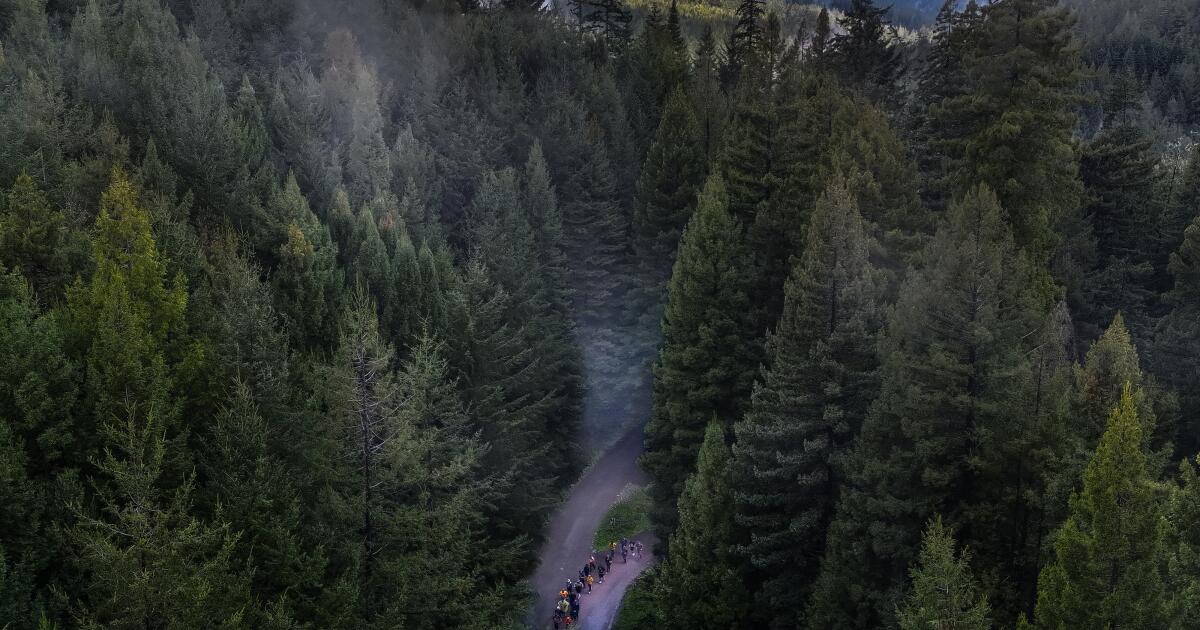
A group of “spirit runners” — a Native American tradition of bringing prayer — sprinted through the heart of Jackson forest as rain poured through the canopy. The mid-April event marked activists’ first major gathering since protests wound down in 2022.
Attendees gathered in a circle to wait for them. Misty Cook, of the Sherwood Valley Band of Pomo Indians, read a statement as eyes misted all around:
“All the living things around us, they miss us. They miss the language. They miss our touch, our hands, touching all of the things — the water, the plants. They miss the songs. They miss the beat of our footsteps and our voices, and they miss the children’s laughter and play, which was so important. They want us to gather them, to use them and to share them. Otherwise they will get sick and possibly die.”
Cal Fire launched a tribal advisory council to bring Indigenous perspective into Jackson. But some local tribes say it’s not enough because they lack decision-making power.
When the runners arrived, the circle absorbed them. Then they continued on to the site of a controversial proposed harvest, Camp Eight. They wrapped a bandana that belonged to Priscilla Hunter around a small tree — a quiet, somber act where she took her last stand. Runners took turns embracing the trunk.
Redwoods at the Capitol
In March, Rogers’ bill cleared a committee and is now in the Assembly Appropriations Committee’s suspense file. A hearing is set for Thursday.
Funding is a major point of contention. Environmentalists say funding these forests with timber operations incentivizes cutting bigger trees. Cal Fire maintains decisions are driven by forest health, not industry demand.
AB 2494 would fund the forests through a tax on lumber and engineered wood products. The shift could create “[o]ngoing state costs and cost pressures of an unknown but potentially significant amount, possibly in the low millions of dollars annually,” according to a legislative analysis.
The California Forestry Assn., a timber industry trade group, says the idea is a nonstarter.
Cal Fire declined to comment on pending legislation but Kevin Conway, the agency’s staff chief for resource protection and improvement, said its nearly 80-year history managing Jackson reflects “care and attention.” Since the state acquired the forest, “we have more trees on the landscape, more habitat and those trees are trending larger,” he said.
For the tribes who have rallied and prayed, a burning question is whether the land will again reflect their vision, or remain shaped by decisions made by others.
Buffie Campbell, executive director of the InterTribal Sinkyone Wilderness Council — co-founded by Priscilla Hunter and one of the groups supporting the bill — said young people wouldn’t be able to fathom the significance of the legislation passing. Maybe that’s a good thing.
“Maybe they don’t need to know about all the fighting that we have to do before they get to go out and enjoy and be tribal guardians stewarding their land.”
-

 New York40 minutes ago
Airbnb Turns to Black Leaders in Its Bid to Make a Comeback in New York
-

 Detroit, MI1 hour ago
Metro Detroit braces for Frost Advisory, Freeze Warning overnight before rain arrives
-

 San Francisco, CA1 hour ago
50 Beagles Rescued From Wisconsin Lab Arrive in Bay Area, SF Activist Faces Felony Charges
-
Dallas, TX1 hour ago
Former Cowboys QB Craig Morton passes away at age 83
-

 Miami, FL2 hours ago
Brickell Avenue Bridge openings spark rush hour gridlock concerns in downtown Miami
-

 Boston, MA2 hours ago
What we know about accused Memorial Drive gunman Tyler Brown
-

 Denver, CO2 hours ago
Broncos Ring of Famer Craig Morton, who led Denver to first Super Bowl, dies at 83
-

 Seattle, WA2 hours ago
Victim identified in deadly Seattle beer garden shooting on Lake City Way; suspect sought