Connect with us

South

Southwest Airlines ends era of free checked bags as profit pressures mount

Published

on

Southwest Airlines ends era of free checked bags as profit pressures mount
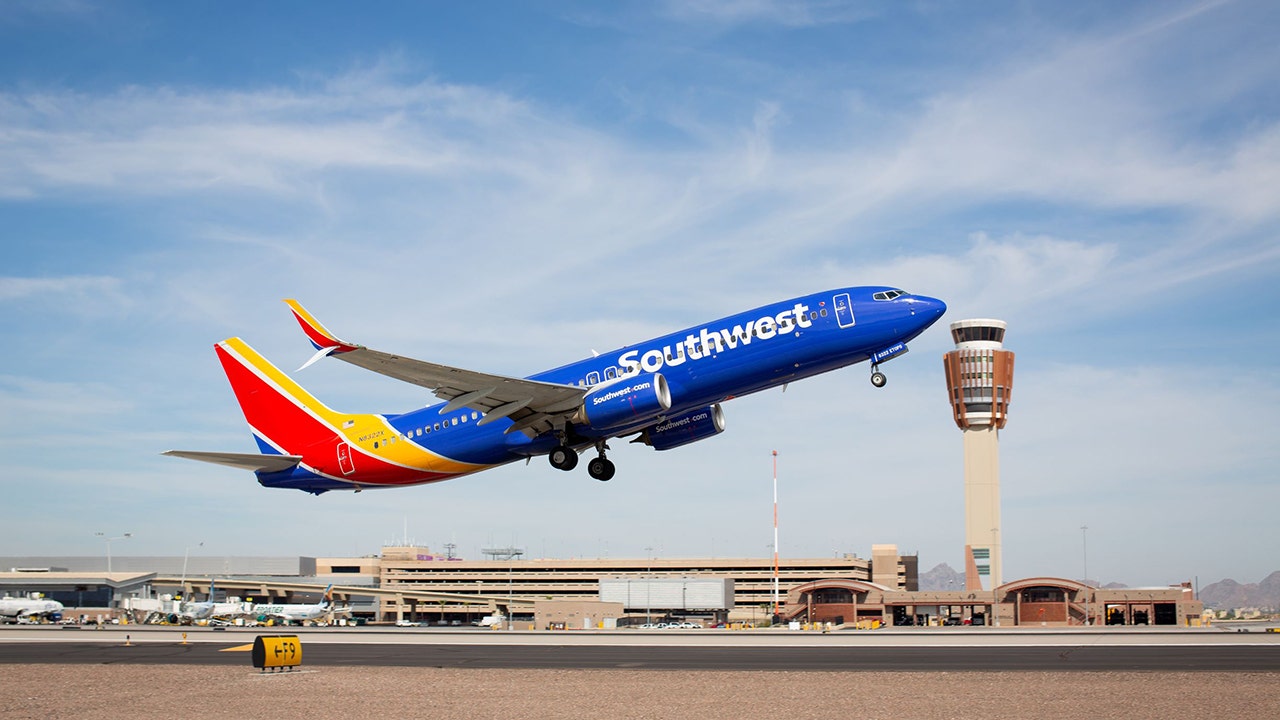

Southwest Airlines is ending its long-standing policy of free checked bags and introducing a new basic fare on Wednesday as the carrier aims to attract new customers and boost profitability.

Most passengers will be charged $35 for their first checked bag and $45 for their second checked bag for flights booked and or changed on or after Wednesday, marking a major shift in its customer-friendly pricing model.

Advertisement

Still, Southwest, considered a “no-frills” carrier, said Rapid Rewards A-List Preferred members and customers traveling on Business Select or Choice Extra fares will receive two free checked bags for up to eight additional passengers traveling on the same reservation. Additionally, A-List Members and Rapid Rewards Credit Cardmembers will get one free checked bag as the carrier aims to encourage more people to join its loyalty program. 

The carrier is simultaneously launching a new basic fare, which will be its cheapest but least flexible fare. 

SOUTHWEST ENDING ITS OPEN SEATING POLICY

Travelers use a Southwest Airlines Co. self-check-in kiosk at Logan International Airport in Boston on Friday, July 19, 2019. ( Scott Eisen/Bloomberg via Getty Images / Getty Images)

CEO Bob Jordan said the changes, announced in March, are part of an effort “to meet current and future customer needs” as well as “attract new customer segments we don’t compete for today.” 

Advertisement

However, unlike rival carriers, Southwest upheld a policy allowing passengers to check free bags, appealing to a wide range of budget-conscious travelers. The policy, along with open seating, helped the carrier distinguish itself as one of the first to adopt and maintain its low-cost model. However, in recent years, financial challenges have forced the airline to reevaluate its approach. 

SOUTHWEST AIRLINES EXITS MULTIPLE AIRPORTS AS BOEING TROUBLES WEIGH

Southwest Airlines Boeing 737-700 aircraft as seen landing at dusk at Ronald Reagan Washington National Airport. (Getty Images / Getty Images)

To drive more revenue growth, Southwest announced in July that it would begin offering assigned seating and offering premium seating options on all flights – a move designed to boost profits by charging higher rates for premium seats across its entire network. The carrier has maintained a single economy-class cabin with open seating assignments for more than 50 years.

Ticker Security Last Change Change %
LUV SOUTHWEST AIRLINES CO. 32.66 +1.71 +5.53%

GET FOX BUSINESS ON THE GO BY CLICKING HERE

Advertisement

Reservations for flights with assigned seats are expected to start in the second half of 2025 for flights operating in 2026. 

Later this year, the company will change the fare classes as well. In the third quarter of 2025, customers will choose between Choice Extra, which was formerly Business Select, Choice Preferred, formerly Anytime, and Choice, formerly Wanna Get Away Plus. The new fares will also have new seat options: Standard, Preferred and Extra Legroom, which will cost extra. 

Southwest is working to gain more customers and increase revenue while navigating a complex landscape. The carrier withdrew its financial forecast last month because of economic uncertainty stemming from tariffs. It didn’t reaffirm its previous forecast of $1.7 billion in earnings before interest and taxes in 2025 and its outlook of about $3.8 billion in 2026.

Reuters contributed to this report. 



Source link

Advertisement

Louisiana

Louisiana baseball claims doubleheader sweep over GSU

Published

on

Louisiana baseball claims doubleheader sweep over GSU


LAFAYETTE, L. (KLFY) — Dominant pitching outings from Andrew Herrmann and Cody Brasch, along with a combined 22 hits helped Louisiana claim a doubleheader sweep of Georgia State, winning the opener, 14-1, before posting a 5-1 victory in the nightcap on Saturday at M.L. “Tigue” Moore Field at Russo Park.

Colt Brown and Donovan LaSalle belted home runs in the opener to help lead a 10-hit attack while Noah Lewis went 3-for-5 with two RBI in the nightcap to lead Louisiana (29-18, 11-12 SBC) to its fourth straight win, its seventh victory in its last eight games and its first doubleheader Sweep in SBC play since facing South Alabama in 2023.

GAME 1 – LOUISIANA 14, GEORGIA STATE 1 (7 innings)
Herrmann (6-2) scattered five hits and fanned six batters in recording his fourth complete game
of the season and moving into a tie for the national lead with Jaden Wywoda of Holy Cross. The
southpaw kept GSU off the board until the seventh when Wesley Bass hit a solo homer to help
the Panthers avoid a shutout.

Louisiana took a 3-0 lead in the second inning, beginning with Brown’s fourth home run of the
the season off GSU starter Brian Crooms (3-4) – a 411-foot blast to center. The Ragin’ Cajuns
added two more runs in the frame when Drew Markle lifted a sacrifice fly to drive in Blaze
Rodriguez before Steven Spalitta slid in under the tag of Panther’s catcher Lucas Grantham on a
double steal.

Advertisement

The Ragin’ Cajuns scored seven runs in the third as Brown drove in Lee Amedee with a bloop
single to left for a 4-0 lead. Spalitta added an RBI single to plate Rigoberto Hernandez and
Brown scored on a balk before Markle hit an RBI double into the left-center field gap.
Amedee drew a bases-loaded walk for an 8-0 lead before a wild throw on a pickoff led to runs
by Mark Collins and Lewis.

LaSalle increased Louisiana’s lead to 13-0 in the fourth after plastering a 0-and-1 pitch for his
eighth homer of the season – a three-run, 424-foot drive to left.

The Cajuns added their final run in the fifth as Lewis scored on a fielding error.
Crooms allowed four runs on a pair of hits in 2.0 innings of work. Bass went 2-for-3 for the

Panthers with Austin Killingworth and Cole Griffith each adding doubles.

GAME 2 – LOUISIANA 5, GEORGIA STATE 1
Brasch (4-2) notched his second straight quality start after allowing one hit, retiring 15 straight
batters and striking out three over 6.2 innings of work. Tyler Papenbrock pitched the final 2.1
innings to earn his first save of the season.

Advertisement

Louisiana broke open a scoreless game in the third as Markle led off with a single and scored on
Lewis’ RBI double to center. Amedee followed with an RBI single to right field off GSU starter
Michael Caruso (5-6) to give the Cajuns a 2-0 lead.

With a 2-0 lead in the seventh, Papenbrock came in to relieve Brasch after Griffith reached on a
two-out, two-base error and got Bass to ground out to second to preserve the lead

The Cajuns increased their lead to 3-0 in the bottom half of the frame as Brown drew a bases loaded walk off GSU reliever Nicholas Holbrook and scored twice in the eighth after the
Panthers cut the deficit to 3-1 in the eighth on Sam Silas drove in Killingsworth on an RBI
groundout.

LaSalle reached on a fielder’s choice and Markle was hit by a pitch before Collins singled
through the left side to drive in LaSalle for a 4-1 lead. After a GSU error moved both runners
into scoring position, Lewis chopped an RBI single up the third-base line to plate Markle.

Louisiana recorded 12 hits off four GSU pitchers with Collins, Rodriguez and Spalitta recording
two hit each. The combination of Brasch and Papenbrock produced 16 groundball outs and
allowed four base runners on the day.

Advertisement

Latest news


Source link

Continue Reading

Maryland

Maryland Gov. Wes Moore’s Army records show training delays, gaps

Published

on

Maryland Gov. Wes Moore’s Army records show training delays, gaps


Questions about Maryland Gov. Wes Moore’s military record have centered largely on the Bronze Star Medal — first on his 18-year-long false claim that he had received it, and then on the controversial circumstances of the award’s presentation in 2024.

But a Spotlight on Maryland investigation has uncovered unexplained gaps and delays in his training that also warrant explanation, according to military personnel.

Spotlight reviewed more than 38 pages from Moore’s official military personnel file, obtained through Freedom of Information Act (FOIA) requests, along with his public statements and prior reporting. To interpret the records, Spotlight consulted with eight retired Army officers.

They say a series of irregularities within the records raises a broader question: Did Moore treat Army service as a ticket-punch from which to build a political career, despite the obligation he accepted when he took the oath of office as a commissioned officer?

Advertisement

A July 3, 2006, Baltimore Sun article quotes Moore as stating he had political ambitions and that a mentor and senior officer advised him that a military deployment would help his resume toward that objective.

When asked directly, Moore did not answer Spotlight’s questions.

The retirees who spoke with Spotlight include a retired brigadier general, a colonel and two retired lieutenant colonels, who also served as Army ROTC professors of military science — Moore was commissioned from a junior college ROTC program. They asked to remain anonymous out of concern that they would be doxed or attacked on social media for providing their professional opinions on an elected official’s military record.

‘Professional non-participant’

On paper, Moore served in the U.S. Army Reserve from Sept. 13, 1996, to Jan. 1, 2014 — 17 years, 3 months and 19 days. But an analysis done by Spotlight on Maryland concludes that, except for one roughly seven-month period of active duty for a deployment to Afghanistan, Moore’s record reflects what a retired brigadier general described as that of a mostly “professional non-participant.” This is an officer whose name remained on the rolls, but who did not fully meet the responsibilities expected of junior officers by the Army.

Moore did not respond when asked if he fully met those responsibilities.

Advertisement

The gaps in training begin near the start of Moore’s career.

Moore attended Valley Forge Military Academy and College in Wayne, Pennsylvania, for junior high, high school and his first two years of college, graduating in 1998 with an associate’s degree. While there, he participated in Army ROTC under a contract that required him to enlist in the Army Reserve. He enlisted on Sept. 13, 1996.

Because he remained an ROTC cadet pursuing a commission, he did not have to attend basic training. His military records also show the Army paid Valley Forge $25,626 in tuition over two academic years through an ROTC scholarship.

Valley Forge is one of four military junior colleges in the country that offers the Army’s Early Commissioning Program, which allows students to become reserve officers after two years of college. The commission is conditional under Army ROTC program requirements. Officers in this program are generally required to complete a bachelor’s degree at an accredited college or university within 24 months and then attend initial entry officer training within three years of appointment. Moore received his commission as a second lieutenant on May 11, 1998, while he was still 19 years old.

In a 2006 résumé submitted during his bid for a White House Fellowship, Moore would later write, “At 19 years old, I was the youngest U.S. Army Officer in 1998.” Spotlight was unable to independently verify that claim, making it one of the earliest examples of Moore’s story not being easily verified in public records.

Advertisement

Marion Military Institute in Alabama, Georgia Military College and the New Mexico Military Institute also commission 19-year-olds annually through the same Early Commissioning Program. Without commissioning records from all four schools for 1998, there is no way to establish that Moore was the youngest officer in the Army that year.

When asked how he knew he was the youngest, Moore did not answer.

Academic delays, missed training

In the fall of 1998, despite the claim he grew up in Baltimore made in his book, “The Other Wes Moore,” he moved to Baltimore for the first time to attend Johns Hopkins University and complete the bachelor’s degree required under the terms of his commission.

Army orders, obtained through a FOIA request, placed 2nd Lt. Moore in “delay status for a period not to exceed 24 months to complete requirements of a baccalaureate degree.” During that period, the Army was supposed to determine whether Moore would continue in the active Army, Army Reserve or National Guard; assign him to a branch of the Army; and set the date for his initial entry officer training, then known as the officer basic course.

That course is mandatory. All newly commissioned officers are required to complete branch-specific training. Depending on the branch, the course can run from 12 weeks to 19 weeks. For the Military Police Corps — the branch to which Moore was eventually assigned — the course is 18 weeks. Reserve and National Guard officers must attend in an active-duty status, meaning they are expected to pause civilian work or schooling to do so.

Advertisement

Records released by the Army verify that Moore could not complete his bachelor’s degree at Johns Hopkins within the Army’s authorized 24-month academic delay period.

At that point, Army regulations would typically require an officer to apply for a waiver to further delay attending his officer basic course by up to 36 months, the maximum delay time allowed by regulation. The Army has confirmed to Spotlight that no such waiver authorization exists in Moore’s records.

Moore did not respond when asked if he applied for a waiver or how he continued his civilian education beyond the Army’s authorized 24-month academic delay in military training.

It ultimately took Moore the full 36 months — from the fall 1998 semester through spring 2001 — to complete his degree at Johns Hopkins. At any point in the last 12 months of delay, which was never authorized, the Army could have forced Moore to pause his civilian education to attend his required entry-level military schooling.

It didn’t happen.

Advertisement

When Moore graduated in May 2001, retired Army officers Spotlight consulted said that he should have attended his officer basic course immediately, just as he had agreed to do, and had been ordered by the Army to do.

A review of Moore’s military education transcript from the Army Training Requirements and Resources System (ATRRS) confirms that Moore was registered to attend the officer basic course at the U.S. Army Military Police School with a report date of June 3, 2001. Moore’s ATRRS transcript also confirms that he never reported.

Spotlight asked Moore for any information that explains how he was able to sidestep this obligation. To date, Moore has not responded.

Instead, Moore turned to Oxford University, where he decided to attend graduate school after learning he had been selected for a Rhodes Scholarship in January 2001. He made this decision despite his military orders explicitly stating: “Academic delay for graduate study is not permitted.”

Retired officers Spotlight consulted point out that Moore’s decision to do this violated the oath of office, as he was failing to well and faithfully discharge the duties he willingly accepted when he was appointed as a second lieutenant in May 1998.

Advertisement

For a newly commissioned officer in Moore’s circumstances, the Rhodes Scholarship should have presented an obvious conflict.

The Army had already funded his first two years of college through ROTC. His orders authorized a delay time to complete a bachelor’s degree, not graduate study overseas in the United Kingdom. Yet Moore accepted the scholarship, and the Army told Spotlight it did not identify a waiver in the records that would have allowed Moore to further delay attendance at his Army officer’s basic course.

He departed for Oxford despite the plain language of his orders prohibiting a delay for graduate school.

Had Moore applied and the Army approved such a request, as governed by Army Regulation 601-25, it would have been an extraordinary waiver, retired officers said.

The Rhodes Scholarship is ordinarily a two-year commitment. That would have pushed Moore five years past his commissioning date and two years beyond the Army’s maximum allowed academic deferment for civilian education (that isn’t medical or law school related) of three years, with the last 12 months requiring a waiver.

Advertisement

Even then, Moore did not finish his Oxford master’s on the usual two-year timetable.

According to reporting in December by the Washington Free Beacon, Oxford confirmed that it took Moore nearly four and a half years to earn his Master of Letters (MLitt) degree.

Moore’s degree was completed in November 2005, while he was on active duty, but it was not formally conferred because he never submitted his thesis for publication in Oxford’s world-famous Bodleian Library, which, according to the Free Beacon, is a requirement for formal conferral by the college.

When asked why he missed military training for Oxford and how he attended school in the United Kingdom for up to four additional years without Army waivers, Moore did not respond.

‘Erroneous enrollment’

One additional curiosity from Moore’s Army ATRRS transcript is that there was an attempt to change his Army branch and enroll in a March 2003 Infantry officer basic course at Fort Benning, Georgia. The transcript indicates that Moore may have reported to Fort Benning but was quickly withdrawn from the course for an unknown reason. The code used for the withdrawal was “erroneous enrollment.”

Advertisement

Moore did not respond when asked why he was withdrawn from the course.

Army records confirm that Moore left Oxford before completing his graduate degree, so he could belatedly attend his mandatory Army training.

On Feb. 22, 2005 — six years, nine months and 15 days after receiving his commission — 1st Lt. Wes Moore reported to the U.S. Army Military Police School at Fort Leonard Wood, Missouri, to complete the basic course required to become a Military Police commissioned officer. It was nearly four years later than the Army’s maximum delay time allowed for.

Retired officers told Spotlight that, by then, Moore had become a sunk cost for the Army. Until he completed initial entry training, he was a non-branch-qualified officer and, therefore, a non-deployable asset while the nation was at war. That’s part of the reason they said an academic delay approaching seven years is unheard of. They agreed it was inconsistent with what they know about law, Army policy and Army regulation. And further agreeing, that even serving in a reserve unit performing part-time duty, an officer without formal branch training would have had limited value and little meaningful ability to lead troops.

Analogous to this would be having only a basic pilot’s license but being asked to fly a commercial airliner without having the appropriate follow-on certificates, ratings and flight experience that always accompany being an airline pilot. Moore had his Army commission and the Army’s pre-commissioning level of military education, but nothing more.

Advertisement

This is why any delay for civilian education beyond 24 months would have required written approval from the commanding general of U.S. Army Human Resources Command (then called Army Personnel Command – PERSCOM), and a delay beyond 36 months would have required annual extensions approved at the same level. The Army confirms that it did not identify such records.

At some point, the Army could have moved to separate Moore administratively for unsatisfactory participation and recoup the $25,626 spent on his ROTC scholarship. Under Army Regulation 135-100, newly appointed officers are required to acknowledge in writing that they must complete a resident officer basic course within 36 months of appointment or face discharge under Army Regulation 135-175 for failing to complete a basic branch course.

When asked how he had a seven-year academic delay without waivers or annual extensions, Moore did not respond.

Unanswered questions

Spotlight sent Moore a letter by overnight UPS, return receipt requested, on Feb. 25, asking six direct questions regarding his academic delay time and his inability to attend his officer basic course for most of the first seven years of his Army career.

The governor has not responded despite his communications team acknowledging receipt of the letter.

Advertisement

Those questions were:

Did you attend another Army branch’s Officer Basic Course before attending the Military Police course in 2005?

Did you obtain the waiver required to extend his original 24-month academic delay to 36 months while finishing his bachelor’s degree at Johns Hopkins?

Did you receive Army permission to disregard his commissioning orders stating that graduate study was not authorized and attend Oxford anyway?

If you did receive permission to attend Oxford, how long did the Army approve the delay before Officer Basic Course attendance could no longer be postponed — 12 months, 24 months or 36 months?

Advertisement

If the Army granted an extension, when did it finally tell you that no further delay would be allowed?

And did then-Maj./Lt. Col. Mike Fenzel [Governor Moore’s friend and mentor] intervene on your behalf in any way — including through his role at the time as a White House Fellow in 2000-01 — to help Moore obtain academic-delay waivers beyond the Army’s 36-month limit?

The Army has confirmed that, other than the initial authorized 24-month academic delay to earn a baccalaureate degree, no additional academic delay waivers exist in Moore’s records; and, to date, Moore has refused to explain how he was able to avoid attending his officer basic course within the required 36 months to attend civilian schooling.

This leaves two central questions in this first chapter of his military career:

How was a reserve officer commissioned in 1998 permitted to go more than seven years before completing the basic officer training the Army required him to finish within three?

Advertisement

And how did he manage to stay in the Army when the service would have been fully justified in separating him for unsatisfactory participation and considering recoupment of his ROTC scholarship?

Had Moore been separated from the Army Reserve, as some military experts think he should have been, he never would have been in a position to deploy to Afghanistan, an experience he has since used to shape his political identity, emphasizing leadership, service and the motto “leave no one behind.”

Drew Sullins can be reached at dpsullins@sbgtv.com. Spotlight on Maryland is a joint venture by FOX45 News, The Baltimore Sun and WJLA in Washington, D.C. Send story tips to spotlightonmaryland@sbgtv.com or call our hotline at (410) 467-4670. Follow us on X at @SpotlightMDNews, and on Instagram and Facebook at Spotlight on Maryland.


Source link

Advertisement
Continue Reading

Mississippi

Why Texas Longhorns Are Facing Must-Win Game vs. Mississippi State

Published

on

Why Texas Longhorns Are Facing Must-Win Game vs. Mississippi State


There is a nickname associated with the storied Texas Longhorns baseball program, on signage around UFCU Disch-Falk, seemingly at every corner, that reads, “The University of Texas at Omaha.” 

It’s the truth, the Longhorns have appeared in the most College World Series in college baseball history. But it’s a daunting expectation that comes with living up to the mantra of ending the season as one of the final eight teams in Omaha. 

For the past two conference series between Vanderbilt and in its current matchup with No. 10 Mississippi State, the Longhorns’ bats haven’t exhibited the same fury as they did earlier in conference play. 

Advertisement

The Longhorns have only scored 11 runs in their past 36 innings at the plate. 

This Mississippi State Series is Texas’ Final Test

Advertisement

Gary Cosby Jr. / USA TODAY NETWORK via Imagn Images

Advertisement

Around this time last season, the wheels were falling off the wagon for the Longhorns, getting swept by Arkansas and losing its final home series to Florida before the SEC Tournament and ultimately losing in the Austin Regional to UTSA. 

While last season’s woes were a combination of starting pitching struggles due to Jared Spencer being knocked down with a season-ending arm injury and the bats struggling to produce, the latter is starting to peek its ugly head into this May. 

Saturday’s game against the Bulldogs at the plate was reminiscent of last season. The Longhorns’ situational hitting was struggling mightily, and the top producers, like Carson Tinney or Anthony Pack Jr., never got the right pitch to dive in crucial runs. 

By the end of the afternoon, Texas batters left a combined 17 runners on base, with four loaded bases situations in the final four innings, allowing Mississippi State to force a rubber match on Sunday. 

Advertisement

Despite losing with that many runners left on base, head coach Jim Schlossnagle wasn’t too worried about heading into Sunday’s game. 

Advertisement

“I think they’re in a good spot,” Schlossnagle said. “The results can cover up some really good things.”

The Bulldogs are an Omaha quality team under Brian O’Connor, and Schlossnagle remarked on that fact pre-series media availability on Thursday and it will be the last true test on the schedule before Hoover and the Regional. 

Granted, the Longhorns will face one more quality team in UTSA for their final midweek game in three days, but in a regional atmosphere, playing games for an entire weekend, the Bulldogs are it. 

Texas closes out the season with an up-and-down Tennessee team and the worst squad in the conference, Missouri, providing opportunities for the Longhorns to tune up before postseason play commences. 

Advertisement

Although there is not much worry inside the Texas locker room for the rubber match against Mississippi State, as the Longhorns have yet to drop just one Sunday game this season. 

Advertisement

“We’re pretty confident,” Temo Beccera said after the Saturday loss. “This is the SEC, every series will be interesting and fun to play in, so we’ll get back at it tomorrow.” 

Sign up to our free newsletter and follow us on Facebook, X and Instagram for the latest news.

Advertisement
Add us as a preferred source on Google


Source link

Continue Reading
Advertisement

Trending