Business
Trump Faces Blowback Over Plans for Crypto Reserve


The consequences of a crypto reserve
Cryptocurrencies are again riding high, after President Trump announced that he would create a national crypto reserve with five tokens, including three lesser-known and highly volatile ones.
It’s the latest boost that Trump has given the crypto industry, which spent some $130 million backing him and other Republicans. But the news drew criticism from many, including conservatives and even ardent crypto backers, over many concerns: giveaways to an already wealthy community, delegitimizing the digital currency industry and more.
“I will make sure the U.S. is the Crypto Capital of the World,” Trump declared on his Truth Social network on Sunday in announcing the reserve, which would involve the federal government stockpiling five tokens: two well-established ones (Bitcoin and ether) and three newer and more thinly traded ones (XRP, solana and cardano).
Proponents say a reserve would help taxpayers benefit from crypto’s price growth. It’s still not clear how such a reserve would work or when it would be introduced, though a Republican-authored bill in the Senate would direct the government to buy one million Bitcoins — worth about $92.6 billion at today’s prices — over five years.
The plan is music to the ears of many in the crypto industry, who have already benefited significantly from Trump moves like picking regulators who will go easier on digital currencies. The price of Bitcoin alone has jumped 36 percent since the election in November.
Critics of all political stripes decried the move. Some Republicans raised questions about spending taxpayer money on risky assets instead of paying down the national debt. Joe Lonsdale, a friend of Elon Musk’s, wrote on X: “It’s wrong to steal my money for grift on the left; it’s also wrong to tax me for crypto bro schemes.”
Some protested the seeming latest conflict of interest involving Trump and crypto, noting that Trump profited from promoting the so-called memecoin $Trump before his inauguration. (The S.E.C. last week said memecoins wouldn’t be subject to regulatory oversight.) “This is getting egregious,” the software developer Nikita Bier replied to Lonsdale’s post. “Every 2 weeks there is a kickback to the family. Completely delegitimizes all the work DOGE is doing.”
Others questioned whether David Sacks, the investor who is Trump’s crypto czar, also stands to benefit from such a reserve. Sacks wrote on X that he had sold his cryptocurrency holdings, but didn’t address any holdings his investment firm has in crypto start-ups. Sacks will chair a first-of-its kind crypto White House summit on Friday intended to discuss ways to spur innovation and growth in the sector.
This poses a longer-term question. Judging by Sunday’s rally in crypto assets, this could vastly benefit crypto investors, who showed that they’re willing to inject huge sums into politics. Could such an explicitly beneficial policy for crypto give them even more ammunition to influence future elections, further reshaping government in their favor?
HERE’S WHAT’S HAPPENING
Consulting firms lobby Washington to save their contracts. Ernst & Young and Booz Allen are among those trying to persuade the Trump administration not to ditch their work agreements, The Wall Street Journal reports. Meanwhile, a new CBS News poll shows Americans are split on whether the so-called U.S. DOGE Service is good; The Times found more errors with DOGE’s contract-cutting math; and President Trump appears to be cautious about cutting Medicaid.
Andrew Cuomo officially enters the New York mayoral race. The former governor, who left Albany in 2021 amid sexual harassment charges, has already picked up two union endorsements and emerged as the new front-runner to unseat Mayor Eric Adams. Cuomo has vowed to crack the city’s homeless problem, and rebuild its police department, but steered clear of mentioning Adams or Trump.
“Anora” scores big at the Oscars. The film took home five Academy Awards, including best picture, director, actress and original screenplay. It has pulled in just $41 million globally, one of the lowest grossing films ever to win best picture, but it illustrated how smaller distributors like Neon, which released the movie, and A24, which was behind “The Brutalist,” outshined bigger studios in awards this year.
How will Europe pay to aid Ukraine?
European defense stocks are rallying on Monday, along with the euro, after the region’s leaders vowed to take on “the heavy lifting” of defending Ukraine from Russia. It’s the latest development in the three-year-old war after Friday’s Oval Office blowup put President Volodymyr Zelensky of Ukraine on the outs with President Trump.
But behind the investor enthusiasm lies the question: Can Europe, facing high debt loads, chronically low growth and looming tariffs imposed by Trump, afford more military spending?
Ending the Russia-Ukraine war carries a high cost. Prime Minister Keir Starmer of Britain rolled out a four-point plan this weekend at a gathering of European leaders and Zelensky.
It includes an Anglo-French “coalition of the willing” to defend any eventual deal for Ukraine, which could mean “boots on the ground and planes in the air.” Britain also lent £2.26 billion ($2.86 billion) to Ukraine to help bolster its military forces.
Even before the summit, credit agencies had warned about Europe’s finances. For example, increasing NATO members’ defense spending to 3 percent of G.D.P. — which is still short of the 5 percent that Trump wants — could force European governments to make unpopular spending cuts that weaken social safety nets, Fitch Ratings has warned.
Other political options include loosening fiscal rules to allow for greater defense, rerouting unspent NextGenerationEU funds to military buildup and or raising taxes.
Borrowing would carry a hefty cost, too. European bond yields ticked higher on Monday, a sign that investors were growing worried about potential growth in public spending. Analysts are divided on whether such commitments could muddle the European Central Bank’s plans to cut interest rates; the central bank meets later this week.
The stakes are huge. Failure to help Ukraine could eventually push European nations into accepting a deal that favors President Vladimir Putin of Russia. That could test E.U. cohesion, analysts say — but might be welcomed by those interested in seeing a divided Europe.
“Trump, Putin (and possibly Elon Musk?) all seem to dislike the European Union,” Holger Schmieding, an economist at the German bank Berenberg, wrote in a research note this on Monday. “They would prefer to deal one-by-one with a panoply of minnows and middling countries than with a union that represents the second biggest market in the world.”
A peek inside SoftBank’s Vision Funds
In recent years, SoftBank of Japan had sought to make its Vision Fund unit — home to three large financial vehicles that defined a once-heady era of tech investing — more conservative.
But the desire of Masa Son, SoftBank’s C.E.O., to become a lead investor in the artificial intelligence race is driving the company to spend heavily again, and raises questions about how the Vision Funds fit into that vision.
The funds’ C.E.O., Alex Clavel, gave DealBook’s Michael de la Merced his first interview since assuming sole leadership of the unit in January about that, and more.
The new vision: The funds, which gained notoriety for pouring hundreds of millions into companies like WeWork and the robot-aided-pizza-maker Zume, are now meant to make minority investments in start-ups where someone else is in control, Clavel said. (SoftBank’s $3.5 billion investment in OpenAI is part of Vision Fund 2.)
How the Vision Funds are doing: The division reported a nearly 310 billion yen ($2 billion) loss in the fourth quarter, as the paper value of holdings like the e-commerce company Coupang fell. But Clavel noted that the division over all grew last year, with its fair value rising by $5 billion and distributing about $66 billion via I.P.O.s and other cash-out events.
A survey of the Vision Funds’ hundreds of portfolio companies, whose results were shared first with DealBook, found that many of their C.E.O.s were:
-
more optimistic about the economy and their businesses’ prospects compared with a year ago — though they’re also feeling more stressed;
-
worried about inflation, high interest rates and ongoing market volatility;
-
and focused on organic growth, but also on conserving cash and stabilizing their companies.
The A.I. factor: A majority of Vision Fund portfolio company C.E.O.s are using the technology in their core products, a reflection of the overall focus of SoftBank on becoming a leader in the field. “We do see A.I. as a secular trend, a revolution,” Clavel told DealBook.
That has meant investing in prominent A.I. companies like OpenAI and the data intelligence provider Databricks at increasingly soaring valuations. (The Databricks C.E.O., Ali Ghodsi, told DealBook that “we’re at peak bubble territory for A.I.”)
Clavel acknowledged that “valuing world-beating companies in revolutionary times is not an easy thing to pinpoint.” But, he added, paying up big was the cost of entry. “We’re really convinced that this is a revolution,” he added.
What’s next: The Vision Funds are betting that it will become easier to take companies public this year, allowing the SoftBank funds to start selling their holdings and locking in gains. “We’re looking forward to the I.P.O. market opening back up,” Clavel said.
One thing not to expect anytime soon, he added, was outside investors returning to the Vision Funds. (While the first Vision Fund counted Saudi Arabia and Abu Dhabi as investors, the second Vision Fund is all SoftBank money.) “We don’t have any plans to do that,” Clavel said, noting that SoftBank itself has added money to Vision Fund 2 when required.
The week ahead
A major presidential address, jobs, and tariffs — here’s what’s in focus this week.
Tomorrow: President Trump will address Congress, outlining his policy agenda. His administration’s tariffs against Canada, Mexico and China are scheduled to go into force hours earlier. Stocks in Europe and Asia on Monday are mostly higher after Howard Lutnick, the U.S. commerce secretary, suggested on Sunday that the levies could be lower than expected, reviving hopes that Trump’s trade war threats aren’t set in stone.
Wednesday: The Fed’s “beige book” survey of regional economic activity is scheduled to be published.
Friday: It’s jobs day. Despite the deep Elon Musk-led cuts within the federal government, economists forecast that employers added about 160,000 jobs in February. Inflation hawks will closely watch data on wages.
THE SPEED READ
Deals
Artificial intelligence
Best of the rest
We’d like your feedback! Please email thoughts and suggestions to dealbook@nytimes.com.



Ranch dressing is having a moment thanks to the World Cup and Kraft is ready to meet it.
The company said Thursday that it is working on a “TSA Compliant Ranch” for those looking to travel with the quintessentially American condiment. The announcement follows the influx of social media videos showing international soccer fans sampling the dressing for the first time.
“Some visitors leave with souvenirs. Others leave with America’s favorite dressing,” Kraft wrote in a caption accompanying an AI image of a TSA-approved clear bag packed with ranch dressing packets posted to social media. The image showed the bag — complete with a luggage tag resembling a ranch dressing bottle — placed in an airport security screening bin along with other travel essentials.
Additional details will be announced later, the company said.
TSA has also leaned into ranch’s apparent newfound popularity among international travelers, providing some helpful tips (and warnings) on social media.
“If you’re visiting for a very large sporting event & you happen to discover RANCH while you’re here… pls pack it in your CHECKED BAG on your way home,” the agency posted on Instagram Tuesday. It also asked travelers to “avoid chugging your ranch outside security” lines.
“Who knew dip-lomacy could be achieved through addressing the obvious: ranch is the king of condiments,” TSA wrote in the caption accompanying its carousel of humorous ranch-related quips. “If you’re traveling within the U.S., make sure to keep your carry-on sauces to 3.4 oz or less and place any larger containers in your checked bags.”
“Some heroes wear capes. Others bring ranch,” it added.
According to 1987 Times reports, ranch dressing was invented by Steve Henson, who opened the Hidden Valley Guest Ranch in Santa Barbara in the mid-1950s with his wife, Gayle. The unnamed condiment originally mixed herbs and spices with buttermilk and mayonnaise and its popularity with guests led to it being jarred so they could take some home. The more travel-friendly powdered form followed.

A landmarked downtown Los Angeles apartment building designed by famed Los Angeles architect John Parkinson is on the market as its owners face foreclosure.
Residences in the Metropolitan, a 10-story tower built in 1913, are nearly filled with tenants but its ground floor retail spaces on Broadway and 5th Street are unoccupied, as are other street-level stores in downtown’s Historic Core.
The historic building was once considered one of the best in the city and is owned by the Fallas family, which operated a chain of value-priced clothing stores based in Gardena including one called Fallas Paredes in the Metropolitan.
Fallas-Paredes at 449 S. Broadway, Los Angeles, CA 90013.
(Google Maps)
Around 2011, Michael Fallas, who once worked in family’s downtown store as a stock boy, converted the upstairs floors from offices to apartments while continuing to operate Fallas Paredes. The store closed more than five years ago in the wake of a 2018 filing by its parent company for Chapter 11 bankruptcy protection.
Earlier this month in state Superior Court, a special servicer representing Fallas’ lender asked for a judicial foreclosure of the property, alleging that Fallas had stopped making payments on a $32 million loan dating to 2017. After leasing the property for years, Fallas bought the building in the 1990s.
Fallas didn’t respond to requests for comment.
The location of the Metropolitan where the buildings stands was hailed in a Times story in 1912, saying “it is regarded by many realty men as the most valuable piece of real estate in Los Angeles.”
The building today is recognized as a city historic-cultural monument because “Broadway became the commercial center of the Southland, a title it retained until well after World War II,” with its development, the city said. One of the architects who designed the Metropolitan in the Beaux-Arts style was John Parkinson, who is credited with designing such well-known local structures as City Hall, the Los Angeles Memorial Coliseum and Union Station.
Notable tenants in the Metropolitan have included the Los Angeles Public Library, Owl Drug Co., variety store J.J. Newberry and real estate company Janns Investment Co., which sold the land where UCLA is built and developed Westwood Village, among other Los Angeles neighborhoods.
In recent years, the buildings around the Metropolitan have struggled to keep retail tenants after a spurt of residential conversions of historic buildings starting in the early 2000s brought commerce to the neighborhood. Many downtown businesses have struggled since the pandemic reduced occupancy in offices downtown and reduced the flow of visitors.
“The lack of bodies on the street is generally hurting downtown, and that’s one of the reasons that has building has problems,” said downtown real estate broker Hal Bastian, who lives in the Historic Core.
There are close to 1,000 residential units in historic buildings at the intersection of Broadway and 5th Street, Bastian said, but all the ground floor stores are closed. Drug stores there suffered substantial losses from shoplifting he said, and now, “our challenge on Broadway is leasing.”
The 88 apartments in the Metropolitan are 91% rented, according to a listing for the property by the Zacuto Group, which also touts its roof deck with pool, fitness center and barbecue grills. No sale price is set.
Business
January 2025 wildfire victims seek tougher penalties against State Farm over claims handling

A fire survivors’ group announced Thursday it was seeking tougher penalties against State Farm over its handling of January 2025 wildfire claims.
The Every Fire Survivor’s Network said it was petitioning to join a state enforcement action announced this year against the company to make sure the case results in meaningful changes at California’s largest home insurer.
“We’re seeking a systematic review of all their claims and penalties calibrated to the actual scale of the harm — and we’re seeking the payouts that families are owed,” said Joy Chen, executive director of the group, at a Pacific Palisades news conference joined by victims of the fires.
The Department of Insurance in May filed an administrative action against State Farm General — the subsidiary of the giant Bloomington, Ill., insurer that handles California home insurance — after completing a “market conduct” exam.
The Jan. 7, 2025, fire damaged or destroyed more than 18,000 structures and killed 31 people.
State Farm has received more January 2025 claims than any other insurer — more than 13,700 auto and homeowners claims as of May 4, with payouts totaling $5.7 billion, according to the company.
The market conduct exam looked at 220 sample claims filed by the victims and found 398 violations of state law in about half of them.
Among other alleged violations, it found that the company failed in numerous cases to pursue a “thorough, fair and objective investigation” into claims, failed to come to “prompt, fair, and equitable settlements” and made settlement offers that were “unreasonably low.”
In announcing the action, Insurance Commissioner Ricardo Lara called the company’s claims handling “unacceptable” and said his department was taking “decisive action to hold them accountable.”
The state is seeking a “cease and desist” order to stop the insurer from engaging in unfair or deceptive practices.
It also has threatened to suspend State Farm’s license over the alleged violations, which each carry a penalty of up to $5,000 — or twice that figure if found to be willful. That could amount to a penalty of $2 million or more.
The threat to actually suspend State Farm’s license and its authority to write policies has been viewed skeptically by some, given its roughly 20% market share of the state’s home insurance market.
The company, which had an opportunity to include its responses in the exam report, denied fault in some cases and admitted fault in others. It often blamed problems on individual adjusters and denied systemic issues with its claims handling.
The petition filed by the wildfire survivor’s group criticizes the sample size of the market conduct exam as too small to capture all the alleged deficiencies in State Farm’s claims handling, which it claims are a “general business practice” of the company.
The group is seeking to conduct discovery, cross examine witnesses, present testimony from fire victims and bring more that 1,600 firsthand policyholder statements regarding State Farm’s practices into evidence, according to the petition.
It also wants State Farm to reopen cases in which claimants were paid too little, and it is seeking to participate in settlement discussions in order to increase any penalty State Farm would pay.
It calculated that a $2-million penalty would amount to a minute fraction of the assets of the State Farm Group.
“I submit to you that doesn’t defer bad conduct, it just allows you to continue to do it,” said Michelle Meyers, an attorney for Every Fire Survivor’s Network, at the news conference.
Consumer Watchdog, which has been a harsh critic of State Farm, also is providing legal support for victims’ effort.
Sevag Sarkissian, a spokesperson for State Farm, said the company was aware of the petition.
“We recognize that many wildfire survivors, including those that are State Farm General policyholders, continue to face difficult recovery challenges,” he said. “Our focus remains on helping customers recover.”
Michael Soller, a spokesperson for Lara, said the department is “acting with urgency to assist wildfire survivors in their ongoing recovery by investigating formal complaints filed by survivors and conducting the expedited market conduct exam that led to this enforcement action.”
He added that the department’s position is the state’s Administrative Procedure Act does not contemplate the commissioner or department staff authorizing intervention requests in the case.
He said that would be a hearing officer’s or administrative law judge’s decision when one is assigned to the case.
Meyers acknowledged the request was novel but said her reading of the law is that Lara can make the decision because no judge is yet assigned.
In response to the criticism, State Farm pledged earlier this year to improve its claims handling, including by providing single points of contact and improved communication so there are “fewer handoffs, fewer repeated explanations, and seamless support.”
It also named a new vice president of customer relations for State Farm General.
-

 Sports7 minutes ago
World Cup Red Cards: 2026 Has More Red Cards Than Each Of Last 2 World Cups
-

 Technology10 minutes ago
China’s brain chip breakthrough raises big questions
-
Business15 minutes ago
Ranch lovers can soon travel with a TSA-friendly kit of the popular American dressing
-
 Entertainment22 minutes ago
At the Fonda, Jane Remover’s violent yearning heralds a new kind of stardom
-
 Lifestyle25 minutes ago
Beer, with a twist? SoCal dads find solidarity through an unexpected activity
-
 Politics30 minutes ago
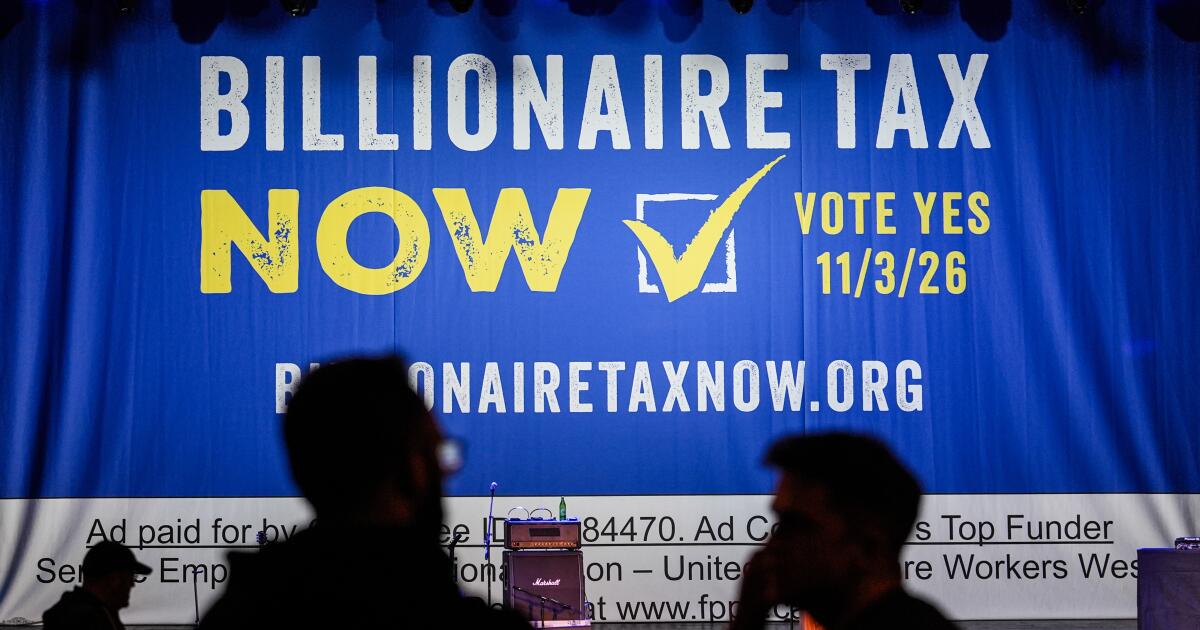
Billionaire tax proposal faces hurdles as it moves closer to November ballot
-
 Science37 minutes ago
Here’s why the Lincoln Memorial Reflecting Pool went green so fast
-
 Sports40 minutes ago
Shohei Ohtani out of Dodgers’ lineup vs. Orioles for birth of his second child

