Science
A cracked heat shield rattled NASA after Artemis I. Now, Artemis II will put the fix to the test

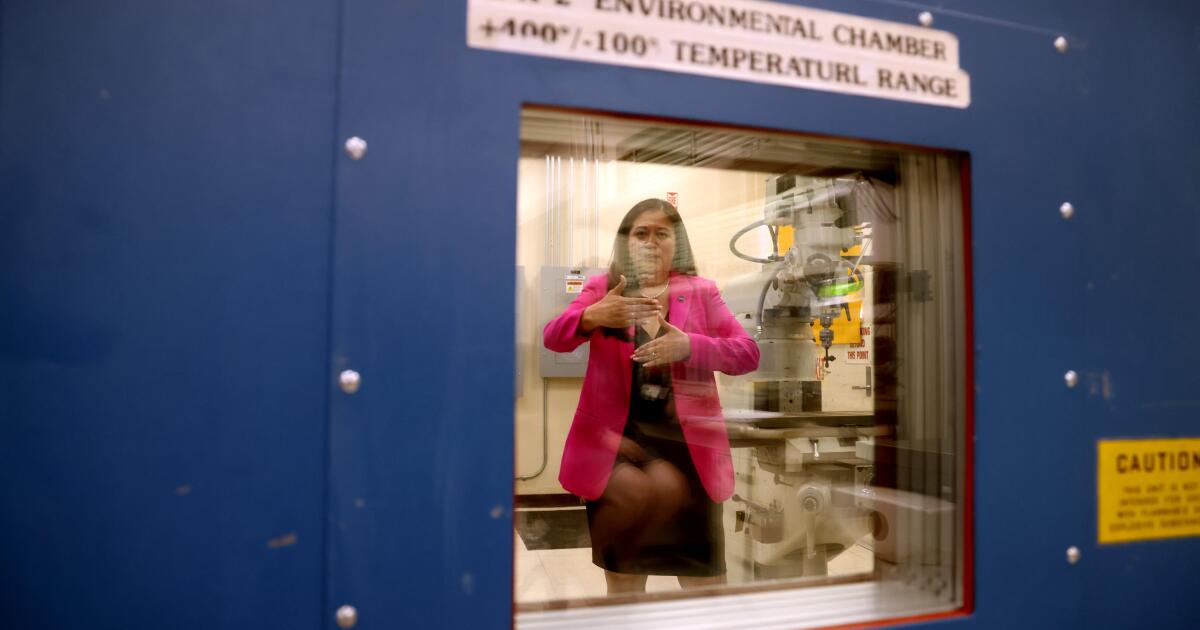
EDWARDS, Calif. — The Artemis II astronauts are scheduled to return Friday from their trip to the moon. When they do, they will slam into Earth’s atmosphere at over 32 times the speed of sound — and will do so using a reentry technique that has yet to be tested in real-world scenarios.
In 2022, NASA sent the uncrewed Artemis I test mission to the moon. As it pierced through the Earth’s atmosphere on return, the capsule suffered unexpected damage to its heat shield, prompting NASA scientists to rethink what’s needed to keep the homeward-bound Artemis II astronauts safe.
There’s been a ton of work done to prepare for this moment — but the reality is, scientists won’t know exactly how the heat shield will behave until they test it in a bona fide reentry.
-
Share via
That’s why a team of NASA and Department of Defense scientists and test pilots stand at the ready to collect detailed data on how the heat shield performs as the capsule streaks through the sky, turning the atmosphere around it into a bright fireball about half as hot as the surface of the sun before splashing down off the coast of San Diego.
Test pilots stationed at Southern California military bases will take turns chasing the capsule in a complex, high-speed relay: first a NASA business jet, then a Navy surveillance aircraft, followed by another NASA jet, and finally a NASA weather research aircraft. Crews on the ground will monitor the Artemis II capsule and send those test pilots precise speeds and coordinates to hit as they follow the fireball in the sky. Meanwhile, researchers in the back of the planes will track the capsule with telescopes and sensors.

Center Director Bradley C. Flick, left, gives project manager Robert Navarro a high five at the NASA Armstrong Flight Research Center on Edwards Air Force Base on March 18.
(Genaro Molina / Los Angeles Times)
“It’s an exciting job threading the needle multiple times,” said Robert Navarro, project manager at NASA’s Armstrong Flight Research Center in Edwards, Calif., which is in charge of the critical third segment of the relay. “It has to be precise, simply because of the short window of time that they need to collect that data. They have to be exactly right on the mark.”
After splashdown, a separate Armstrong Flight Research Center team will collect a fortified sensor affixed to the exterior of the capsule that is designed to study the heat shield up close.
“I’m really excited that my team is a part of such an important mission,” said Patty Ortiz, deputy project manager for the capsule sensor project at the center. “Having worked on it since 2019, it’s definitely a full-circle moment for me.”
The center has pushed the limits of human flight for decades — and collected a lot of data doing so.
“We consider our airplanes flying labs — we’re going to go do things that maybe haven’t been done before,” said Brad Flick, who retired as director of the center March 20 after nearly four decades at the research facility.

Armstrong Flight Research Center project manager Robert Navarro walks past a Gulfstream III airplane that will be used in the Artemis II mission.
(Genaro Molina / Los Angeles Times)
In the 1960s, engineers at the Flight Research Center helped design and test a mock-up of the Apollo lunar landing vehicle that Neil Armstrong used for landing practice on Earth before he flew to the moon. (The center was later renamed after him, the first person to walk on the lunar surface.)
The center has been preparing to study the Artemis II reentry for years, but the work became even more important after NASA discovered issues with the heat shield after the Artemis I test mission.
NASA guided the Artemis I capsule to first only graze the Earth’s atmosphere before briefly popping back up into space, then completing the final reentry. This novel approach reduced the forces that astronauts would experience on reentry and helped NASA to more precisely maneuver the capsule to its landing point in the Pacific — regardless of where or when it comes back from the moon.
That mission seemed like a success, but when crews began inspecting the heat shield on the bottom of the uncrewed capsule after splashdown, they noticed a problem.

After NASA’s Orion spacecraft was recovered at the conclusion of the Artemis I test flight and transported to NASA’s Kennedy Space Center in Florida, its heat shield was removed from the crew module inside the Operations and Checkout Building and rotated for inspection.
(NASA)
The heat shield is designed to slowly erode (or “ablate,” in NASA parlance) away during reentry to keep conditions in the capsule livable while the air a few inches away can reach nearly 5,000 degrees Fahrenheit: The outside layer of the shield routinely heats up, then sloughs off in the form of gas and pieces of char, which carry that heat away from the capsule as they disperse into the atmosphere around the capsule.
The problem with Artemis I was that the new reentry approach NASA had attempted seemed to disrupt this ablation process.
Because Artemis I went back into space between the first dip into the atmosphere and the final reentry, there was a brief respite in its heat exposure — that meant that the hot interior of the heat shield kept producing gases, but the exterior was no longer shedding material fast enough to allow those gases to escape. Pressure built up, which cracked the heat shield and ultimately resulted in larger pieces chipping off during the final reentry.
NASA scientists determined that had a crew been onboard, they would have survived — but they didn’t want to expose the Artemis II astronauts to unnecessary risk.
That left two options: First, replace the already-built Artemis II heat shield with a new design in the works that could handle the reentry path attempted with Artemis I. Second, change the reentry path to skip the first dip into the atmosphere and just go straight in to eliminate the conditions that created the problem in the first place.
The agency ultimately deemed replacing the Artemis II heat shield too much of a logistical headache and opted for the latter, simpler approach. On Friday, NASA astronauts will put that decision to the test. Armstrong Flight Research Center scientists are standing by to watch.


The U.S. Environmental Protection Agency is ramping up its enforcement of illegal pesticides smuggled through the ports of Long Beach and Los Angeles, officials said during a visit to L.A. on Thursday.
Since President Trump began his second term in January 2025, EPA has blocked more than 2.4 million pounds of illegal pesticides from entering the country, said Lee Zeldin, the agency’s administrator. Much of it comes from China, but some comes from Mexico and, on the East Coast, from Africa.
“We’re very alarmed by any chemical that anyone would seek to bring into this country that our own government hasn’t had the opportunity to vet, to research to fully understand,” Zeldin said. “That’s why it’s so important that these products get stopped at the border.”
The announcement came just hours after the Supreme Court handed a major victory to the makers of the weedkiller Roundup, shielding it from thousands of lawsuits from states alleging the company failed to warn people the product could cause cancer.
Speaking from a U.S. Customs and Border Protection warehouse in Carson, Zeldin pointed to a white bottle with a yellow label reading “SNIPER” — an illegal pesticide product commonly imported from abroad and sold online — that was recently intercepted at the Port of L.A. complex. Sniper contains dichlorvos, or DDVP, a highly toxic insecticide that is not registered or approved for use in the U.S. It is known to cause neurological problems, convulsions and comas, with children particularly at risk.
Illegal pesticides are cause for concern in California, where they are often associated with illegal cannabis operations. Last year, Siskiyou County declared a local emergency in response to the “escalating threat” posed by illegal pesticides, often fumigants, in illicit cannabis operations.
“These chemicals, when burned, create thick, poisonous smoke that presents serious risks to public health, the environment, waterways, and first responder safety,” the county said.
A 2024 Los Angeles Times investigation found that contraband Chinese pesticides used on cannabis farms is a growing problem in the state.
Customs and Border Protection seized containers of an illegal pesticide from China that were packed with legitimate items.
(Myung J. Chun/Los Angeles Times)
Much of the illegal product comes through the ports of L.A. and Long Beach, which together handle more than 30% of the nation’s container traffic, officials said. EPA works closely with Border Patrol officials, who flag suspicious cargo containers at the port for further inspection.
CBP spokesman Jaime Ruiz said the agency is using artificial intelligence tools to help scan incoming cargo manifests for potentially illegal items. Thousands of containers are flagged for inspection each year, although that number also includes drugs, counterfeit goods and other contraband in addition to pesticides, he said. He could not immediately say what percentage were illegal pesticides.
Illegal pesticides have at times been found in California agriculture and the California Department of Pesticide Regulation has taken enforcement action against violators. The DPR operates one of the nation’s largest pesticide residue testing programs, analyzing some 3,500 produce samples each year from wholesale and retail stores and other outlets. The state produces about half of the nation’s fruits and vegetables.
Jeff Hall, assistant administrator of EPA’s Office of Enforcement and Compliance, said the issue should be bipartisan.
“We cannot allow foreign actors to profit by sending toxic and poisonous products into the United States and poisoning American communities,” he said. “This is a message that we should all be able to agree on, especially for pesticides.”
However, the agency’s visit to L.A. arrived at a fractured moment for U.S. pesticide regulation and for the Trump-aligned Make America Healthy Again movement.
On Thursday, the Supreme Court ruled 7-2 in favor of Bayer’s Monsanto, the maker of the powerful weedkiller Roundup, shielding it from thousands of state lawsuits that allege the company failed to warn people the product could cause cancer.
Roundup contains glyphosate, which was classified by the World Health Organization as “probably carcinogenic” in 2015. But the Supreme Court found that the company can’t be sued in state courts because federal agencies — including the EPA — have determined that it’s not likely to cause cancer in humans when used as directed. The EPA has repeatedly approved a label for the product without a cancer warning.
“When people are exposed to pesticides, they deserve honest warnings about the risks,” said Bill Jordan, former deputy director of EPA’s Office of Pesticide Programs, in a statement. “The Court’s decision leaves families, workers, and communities with fewer tools to protect themselves and to recover damages when they are injured by a pesticide.”

For the third year in a row, accidental drug-related overdose and poisoning deaths have dropped in Los Angeles County, a decline officials attribute to ongoing investments in prevention and harm reduction resources countywide.
There were 2,298 accidental drug overdose and poisoning deaths in 2025, down 6%, a relatively small drop from 2,438 the prior year but an overall substantial reduction from the all-time high of 3,220 deaths countywide in 2022, according to a recent report from the Los Angeles County Department of Public Health.
Drug overdoses continue to be the leading cause of accidental deaths countywide — surpassing the deaths due to vehicle crashes and firearms in 2017 combined — with methamphetamine and fentanyl most often involved in the overdoses.
The problem reached a historic high in 2022 when fentanyl surpassed methamphetamine as the most common drug listed as a cause of overdose deaths. At the time, the number of overdoses in general had increased across the board.
However, these accidental deaths have been on a downward trend, with a nearly 30% overall decrease in drug-related overdoses from 2022 to 2025. Fentanyl-related deaths dropped by 40% and methamphetamine-related deaths declined by 25% in that period.
Officials said in the report that the numbers are more modest compared with 2024, when accidental overdose deaths plunged overall by 22%, which they said “demonstrates sustained progress in the County’s efforts to address the overdose crisis.”
“Three consecutive years of fewer overdose deaths in LA County is proof that sustained investments in prevention, harm reduction, treatment, and recovery services saves lives,” Barbara Ferrer, director of the Los Angeles County Department of Public Health, said in a statement.
Ferrer credited the continued reduction to outreach workers and community partners who “are working every day to connect people to treatment, distribute lifesaving naloxone and meet people where they are without judgment.”
The department continues to invest in a coordinated spectrum of community-based overdose prevention efforts that include the Fentanyl Frontline — a multimedia campaign focused on the widespread distribution of naloxone — and ByLAforLA.org, a community-powered platform that connects residents to lifesaving services with an aim to reduce stigma.
The health department report also found:
- Los Angeles County overdose deaths declined across most age groups in 2025 but deaths among adults 65 and older increased by 14%.
- Although older adults accounted for only 11% of all overdose deaths, this increase contrasts with the broader downward trend observed across other age groups, according to the report.
- Those aged 40 to 64 remained the most affected group, accounting for 53% of overdose deaths last year.
- Communities with 30% of residents living below the federal poverty level had a higher rate of drug overdose deaths than areas with less than 10% of families living below the federal poverty level.
- By race, Black residents continued to experience the highest overdose death rates in 2025.
- By gender, a persistent disparity remains, with men accounting for most overdose deaths, nearly 1,800 compared with more than 500 deaths among women.
Nationwide, opioid overdose deaths have been on the decline since mid-2023, driven largely by decreases in fentanyl-related deaths, but the numbers remain above pre-pandemic levels, according to a recent report by KFF, a national health policy organization.
KFF said multiple policy actions have contributed to the decline, including efforts to expand access to treatment as well as overdose-reversal drugs and public awareness campaigns. At the federal level, there have been some efforts to mitigate the crisis including improving fentanyl detection at ports and borders.
“Despite progress, a range of more recent federal policy actions may affect future trends, including federal budget cuts, federal staffing reductions, and cuts to federal grants that support state and local programs; reduced Medicaid and Marketplace coverage; and a shift toward a more enforcement-focused approach, including the designation of illicit fentanyl as a ‘Weapon of Mass Destruction,’” according to the report.
Los Angeles County residents can access assistance for substance-use services 24 hours a day, seven days a week by calling (800) 854-7771, select Option 2 after the language prompt.

Tens of thousands of people in southeast Los Angeles County have been engulfed in a dense cloud of smoke for nearly a week as a fire continues to tear through a massive refrigerated warehouse in Boyle Heights. Toxic air has covered the San Gabriel Valley and beyond at times, as the fire continues to burn and the wind shifts the pall in different directions.
People have reason to be concerned about their loved ones breathing in the plume, experts say.
“There’s no safe level of exposure to particle pollution,” said Will Barrett, assistant vice president for nationwide clean air policy at the American Lung Assn.
Soot can be deadly. The charred microscopic particles can travel deep into a person’s lungs and bloodstream, causing swelling and triggering heart attacks and strokes.
People aren’t just being exposed for hours. They’ve been exposed for days in Boyle Heights, unincorporated East Los Angeles, Maywood, Montebello and Bell, according to the South Coast Air Quality Management District.
“There are some pollutants where just breathing in a little bit of it can cause some serious issues for people,” said Dr. Afif El-Hasan, a pediatrician with Kaiser Permanente. He said he’s most concerned about particles, carbon monoxide, volatile organic compounds and chemical gases from incinerated insulation, plastics and paint in the smoke.
“Those chemicals can cause irritation in the lungs, they can cause long-term lung damage, and sometimes they can even cause cancer,” he said. “I also worry about children, because children breathe in more air per volume of their body than adults do and they tend to be more active.”
“People also need to remember that even if you are healthy, these chemicals are going to put you at risk. It’s not just people who are vulnerable, anyone is in danger.”
The fact that the smoke continues to billow into the sky for a sixth day matters, said Jill Johnston, associate professor of environmental and occupational health at UC Irvine. “The longer the exposure time, the more dose you’re getting, or the more potential chemicals that you’re inhaling. So you’re gonna be increasing a potential risk,” she said.
Pregnant women and their babies in utero are known to be vulnerable to smoke from wildfires, she said. But less is known about city fires. “We see increased risk of low birth weight and preterm birth connected to exposure to wildfire smoke. This isn’t exactly the same composition of smoke, but would anticipate … there could be potentially similar risk.”
A fire like this can leave people with no good choices. They can stay home with an air filter if they have one. But homes need “fresh” air, and a fire can make getting that impossible.
For that reason, some people believe that the official response to the gravity of the fire at Lineage Logistics has been inadequate. Jane Williams, executive director of California Communities Against Toxics, is among several activists who criticized the Los Angeles Fire Department and city officials who appeared to downplay health risks from prolonged smoke, and ultimately decided against evacuating these areas. They think many more people should have been evacuated.
“They always under-warn, they under-evacuate, they bring people back too fast,” Williams said. “I get that there’s a societal desire to return to normalcy.”
Local officials have opened a pair of shelters to house residents who want to temporarily relocate. The Los Angeles Unified School District also canceled summer programming for schools in the smoke-affected communities.
But “there is nothing in the air that is so dangerous that we have to do evacuations or even shelter in place,” LAFD Chief Jaime Moore said. Asked at a recent news conference whether the air was dangerous, Mayor Karen Bass said, “not to the extent that required a mandatory evacuation.”
Yet Williams pointed to the burning chemical-laden insulation foam inside the building, which could release several other highly toxic gases, including hydrogen cyanide, an asphyxiating gas, and isocyanates, chemical vapors that can cause serious lung damage.
“It’s about what you value and who you value,” Williams said. “If you value truth, you cannot sit there in front of a burning building and say the air is safe.”
A Fire Department spokesperson declined to comment when asked why the department considered a shelter-in-place order more appropriate than issuing an evacuation. It’s not clear that evacuation would have been purely a city responsibility. Lineage Logistics sits along the city boundary, with unincorporated Los Angeles County and other cities nearby.
mark! Lopez, a community organizer with East Yard Communities for Environmental Justice, also said the recently lifted shelter-in-place orders were not enough to protect residents from the heavy smoke and potential chemical releases. Residents, he said, have complained about smoke seeping into homes through cracks in doorways and windows, giving them sore throats and breathing problems.
Lopez said many of the smoke-affected communities have long suffered from poor air quality from decades of heavy polluting industrial facilities, highway traffic and rail yards. He said the public statements from Fire Department and elected officials that cast doubt on the risks from smoke were unacceptable.
“This is what happens when the Fire Department says there’s not a threat to human health. … The LAFD, they aren’t public health experts.”
Times staff writer David Zahniser contributed to this report.
-

 Los Angeles, Ca1 hour ago
About 20 detained after armed suspect call sparks LAPD response in Koreatown
-

 Detroit, MI2 hours ago
With Jack Flaherty returning, AJ Hinch ponders Tigers’ starting rotation
-
 San Francisco, CA2 hours ago
Serving up a slice of Palestine at Old Jerusalem in the Mission District
-

 Dallas, TX2 hours ago
All-day restaurant and patio coming to Dallas’ Knox and more top stories
-

 Miami, FL2 hours ago
Bugtopia takes center stage at Zoo Miami
-

 Boston, MA2 hours ago
What JJ Peterka Will Add to the Bruins’ Roster, ‘He’s Got an Elite Shot’ | Boston Bruins
-

 Denver, CO2 hours ago
This Boulder farm dinner serves up midsummer Slavic vibes with James Beard-worthy fare
-

 Videos2 hours ago
Destruction in Venezuela after deadly earthquakes | BBC News

