Northeast
New Jersey Republican calls for action from Mayorkas, Austin over mysterious drones: 'Bring them down'

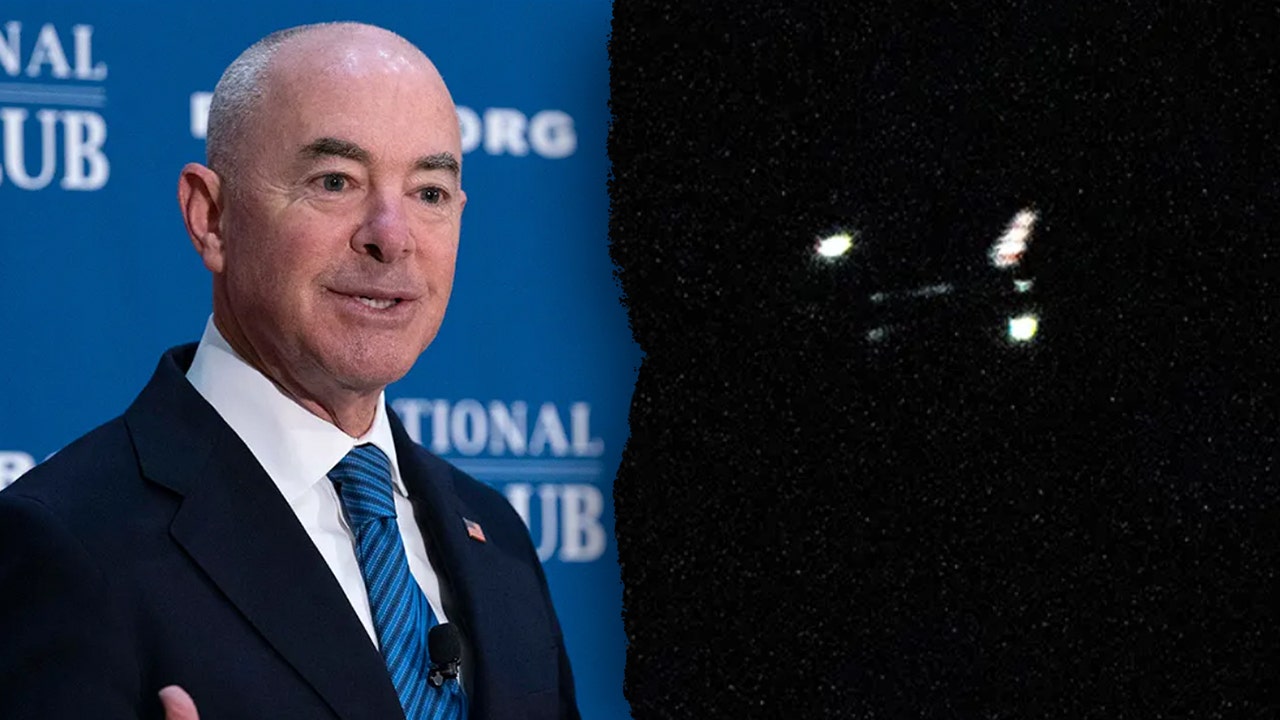
Rep. Chris Smith, R-N.J., called out the Biden administration during a press conference Saturday about the recent drone sightings that have stumped U.S. officials.
The unidentified drone sightings, which have been observed flying above U.S. military installations and New Jersey homes since mid-November, have caused concern in the Garden State.
The aircraft have also been spotted in Connecticut. On Thursday, Sen. Richard Blumenthal, D-Conn., called for the drones to be “shot down” if necessary.
On Saturday, U.S. officials held a phone conference with reporters and appeared to downplay concerns about the drones, saying there was no evidence linking the aircraft to foreign adversaries.
MORE THAN 20 DAYS INTO PHENOMENON, PENTAGON STILL HAS NO ANSWERS ABOUT ORIGINS OF MYSTERIOUS NJ DRONES
Alejandro Mayorkas was recently called out during a press conference about the sightings of drones in New Jersey. (AP Images/Doug Hood/Asbury Park Press)
Speaking from Seaside Heights, New Jersey, Smith said he asked DHS Secretary Alejandro Mayorkas why the drones’ origins are still unknown.
“I asked Secretary Mayorkas at a briefing, a Zoom briefing, why we can’t follow them, find out where they’re going,” the Republican told reporters. “They’re coming from somewhere. … You can’t seem to do that.
“Why can’t we follow them and find what their origin is? Many of them seem to be coming from the ocean.”
The representative also mentioned that he contacted Defense Secretary Lloyd J. Austin to ask the U.S. military to authorize the use of force against the unusual drones.
DRONE MYSTERY: NEW JERSEY HOMEOWNERS THREATEN TO TAKE MATTERS INTO THEIR OWN HANDS IF GOVERNMENT DOESN’T ACT
Authorities are investigating unusual drone activity in northern New Jersey, including the area of Trump National Golf Club in Bedminster. (Getty Images)
“I’ve written Defense Secretary Lloyd Austin asking the Pentagon to authorize the use of force to down one or more of these unmanned threats to uncover the mystery, bring them down over the ocean, over an area where there’s no population,” Smith said. “Bring them down and find out who’s doing it.”
The New Jersey politician also expressed the belief the drones may be tied to at least one foreign government.
A map showing some of the locations where mystery drones have been spotted in New Jersey in December 2024. (Fox News)
“The elusive maneuvering of these drones, I would suggest, suggests a major military power sophistication,” the Republican said. “That begs the question whether they have been deployed to test our defense capabilities or worse, by violent dictatorships, perhaps maybe Russia or China or Iran or North Korea.
“I mean, they had the capability, and they certainly have the motive,” Smith added. “The Pentagon has said the drones are not ours.”
Read the full article from Here



Now just six months before the midterm elections in November, U.S. Rep. Rosa DeLauro said affordability and cost-of-living issues are still at the front of voters’ minds.
But the New Haven Democrat argued that the challenges to democracy that could threaten those elections should also be top of mind, whether it’s undermining the legitimacy of elections or intimidating local election workers.
“The cost of living crisis is the biggest problem on Americans’ minds today, and Congress should rightly be focused on how we’re trying to bring down those soaring costs of healthcare, of food, of housing, gas prices,” DeLauro said at a Monday forum. “But the survival of our democracy, our great American experiment in government of, by, and for the people, is also at stake.”
“Congress can and must focus on both — tackling the affordability crisis and securing the future of our democracy,” she added.
While Congress is on a week-long recess, the top Democrats who sit on three congressional committees held a meeting in New Haven on Monday known as a “shadow hearing,” which are convened by the minority party. They are largely symbolic but give Democrats a chance to steer the conversation and choose all of the witnesses that testified about voting in America and the way states conduct elections.
Instead of sitting in one of the many wood-paneled hearing room in the U.S. Capitol complex, they gathered at Gateway Community College in New Haven to hear from a panel of experts on elections that consisted of a current and former secretary of the state, a Yale Law School professor, a member of the nonpartisan League of Women Voters of Connecticut and two voting advocacy groups.
DeLauro helped convene the meeting alongside U.S. Rep. Jim Himes, D-4th District, and U.S. Rep. Joe Morelle, D-N.Y., who serves as the ranking member of the House Administration Committee, which has jurisdiction over federal election oversight.
They argued that Republicans’ legislative push to change voting and the recent Supreme Court ruling that dilutes part of the Voting Rights Act could lead to the disenfranchisement of voters, particularly voters of color, in the 2026 midterm elections and create barriers for local elections administrators.
One of the main concerns that came up throughout the hearing was cuts to funding that help states and localities with election security.
Lawmakers and the panelists pointed to President Donald Trump’s latest budget proposal that would make steep cuts to an election security program that’s part of the Cybersecurity and Infrastructure Security Agency (CISA).
Himes, who serves as the ranking member of the House Intelligence Committee, noted the importance of securing elections from foreign interference and importance of such federal funding.
“This is not a new problem, and every American should be alert to signs of malign interference by our adversaries,” Himes said. “But rather than using the awesome capacity of our intelligence community to bolster election security infrastructure, the administration over the course of these last 16 months has consistently pivoted resources away from this cause, dismantling institutions that were specifically designed to combat efforts by our adversaries, foreign and domestic, to interfere in U.S. elections.”
During her testimony, Connecticut Secretary of the State Stephanie Thomas said her office relied on CISA’s funding and other federal resources during the 2024 elections. She said the cybersecurity agency gave them regular security briefings on foreign interference, and CISA and the FBI provided de-escalation training for their workforce.
“This is not unique to Connecticut. This is the nation,” Thomas said. “Those services are now no longer in existence, or the funding has been cut so much that the election community is concerned about what 2026 looks like.”
As the top Democrat on the House Appropriations Committee, DeLauro said she’d work on bringing those requests or changes to her fellow congressional appropriators when they negotiate federal funding for fiscal year 2027 in the coming months.
“We need funding to make sure that states can get messaging out to assure American voters that polls are safe and they can show up,” Thomas said. “Essentially we need funding. We don’t need more hoops.”
Monday’s hearing comes on the backdrop of Congress weighing Republican-led legislation that would have implement major changes to voting if enacted. But the bill is unlikely to become law and faces significant hurdles.
The SAVE America Act has been a top priority for Trump and congressional Republicans. But it has effectively stalled in the U.S. Senate since it doesn’t have the votes to clear the 60-vote threshold to bypass a filibuster — something Senate Majority Leader John Thune, R-S.D., has repeatedly cited amid Republican fury over it.
The bill would require documentation to prove people are U.S.-born citizens or naturalized citizens in order to register to vote. Proper ID would also be needed for those who are moving to a new address or switching party affiliation. Documentation to prove citizenship would include a birth certificate, a U.S. passport or a naturalization certificate. A driver’s license wouldn’t qualify.
Trump has also signed an executive order that would limit mail-in voting, which has become a popular form of voting that the president has also used in past elections. Connecticut was one of nearly two dozen states to sue over this order.
If enacted, the SAVE America Act would make major changes to how people vote in Connecticut. The state doesn’t require documentation to prove citizenship when registering to vote. Instead, they must attest that they are a citizen and sign a form. If they lie, they would face criminal prosecution.
Thomas previously warned against the SAVE America Act in late March alongside Gov. Ned Lamont and Lt. Gov. Susan Bysiewicz.
At the time, Connecticut Republicans pushed back, citing allegations of voter fraud in the state. Bridgeport has been the most noticeable case where people have been criminally charged with violating absentee ballot rules.
“The reason why this is happening is because of blue states like Connecticut that have refused to address real, live examples of election fraud,” state Sen. Rob Sampson, R-Wolcott, said back in March. “The whole point of the SAVE America Act is to make elections honest.”
Trump reiterated his calls to get rid of the filibuster so the Senate can pass it. That would allow the upper chamber to pass it with a simple majority, and Republicans control 53 seats. Thune has also pushed back against this, saying he doesn’t have the votes among Republicans to ax the filibuster.
In a Truth Social post last week, Trump argued that failing to pass the SAVE America Act would lead to “the worst results for a political party in the HISTORY of the United States Senate,” in addition to a plea to “terminate” the filibuster.
As states like Connecticut continue to weigh their own changes, Ann Reed of the League of Women Voters of Connecticut said she hopes no-excuse absentee voting will get taken up in the final days of the General Assembly’s session, which ends on Wednesday.
And she said she’s worried about the misinformation around voting and the lack of trust among people just months out from a major election.
“This conversation is a national one, but the election battles are being fought in every state,” Reed said. “People are rightfully concerned about election security.”
CT Mirror reporter Andrew Brown contributed to this story.

WATERVILLE, Maine (WABI) – Sen. Susan Collins, R-ME, traveled to Waterville Monday to tour the Mid-Maine Technical Center.
At MMTC, high school students from four districts get hands-on experience in job-focused classrooms across 15 different programs.
Collins toured several of those programs, including nursing, media, and culinary arts.
She highlighted the more than seven hundred thousand dollars she secured in federal funding in 2024 for machine tooling and 3D printing equipment.
Also adding the importance of schools like this to not only fill critical workforce gaps, but do so right here in the state.
“Programs like this help encourage students to stay in the state of Maine once they’ve finished their education,” answered Collins. “It gives them a real boost if they’re going on to higher education, but it also equips them with the skills that they need if they’re going directly into the workforce.”
Collins also mentioned cooperative agreements in some programs that allow students to start earning college credit. Many students she spoke with also spend part of the week working for local businesses in their field.
Copyright 2026 WABI. All rights reserved.
-

 Indianapolis, IN3 minutes ago
Authorities brace for retaliation in wake of after-prom party shooting in Indianapolis
-

 Pittsburg, PA9 minutes ago
Brandon McGinley: What is the story of a city?
-

 Augusta, GA15 minutes ago
Augusta Mayor candidates: Eric Gaines
-

 Cleveland, OH27 minutes ago
2026 NBA Playoffs: Cavaliers vs. Pistons series prediction, pick for the second round
-

 Austin, TX33 minutes ago
Dell Technologies board approves changing legal home to Texas
-

 Alabama39 minutes ago
LIVE: Alabama GOP Senate candidates take part in forum
-
Alaska45 minutes ago
White House Issues Letter of Support for Gov. Dunleavy’s Alaska LNG Tax Reform Bills – Mike Dunleavy
-

 Arizona51 minutes ago
Bobcat killed by dog in Arizona after attacking multiple people