Northeast
Federal judge pushes back on parents calling trans athlete 'a boy' in legal battle over pro-girls protests

New Hampshire Judge Steven McAuliffe presided over a case involving parents in the state who wore pro-girl armbands at a high school girls soccer game that included a transgender athlete. During the case, McAuliffe pushed back on the parents for repeatedly referring to the athlete as a boy.
“You seem to go out of your way to suggest there’s no such thing as a trans girl,” McAuliffe said during the hearing.
McAuliffe’s federal judicial service dates back to 1992, when he was appointed by former President George H.W. Bush. On Thursday, McAuliffe heard arguments in a case in which plaintiffs Kyle Fellers and Anthony Foote sued the Bow School District after being banned from school grounds for wearing the wristbands at their daughters’ soccer game in September.
THE PRONOUN POLICE HAVE ARRIVED AND ARE COMING FOR YOU NEXT
The wristbands said “XX” in reference to the natural female chromosomes. The “XX” logo has become an unspoken symbol of the ongoing legal and political battle against transgender inclusion in girls and women’s sports across the country. Many consider it a women’s rights phenomenon.
The no-trespass orders have since expired, but McAuliffe is deciding whether the plaintiffs should be allowed to wear the wristbands and carry signs at upcoming school events, including basketball games, swim meets and a music concert, while the case proceeds.
A protester outside the Kansas Statehouse holds a sign after a rally for transgender rights on the Transgender Day of Visibility, March 31, 2023, in Topeka, Kan. (AP Photo/John Hanna)
They wore the wristbands because another federal judge in New Hampshire, Landya McCafferty, who was appointed to her seat by President Obama in 2013, ruled two transgender athletes would be allowed to play on high school girls soccer teams, overruling a state law in place to prevent that from happening.
Fifteen-year-old Parker Tirrell, a transgender athlete, was allowed to compete for Plymouth Regional High School. In a lawsuit filed by Fellers and Foote, they alleged they were told by school officials to remove the armbands or they would have to leave the game.
TRANS VOLLEYBALL PLAYER LEGAL HEARING OPENED WITH LONG AND HEATED DEBATE OVER WHAT PRONOUNS TO USE
Both of the fathers say the intention of the armband was not to protest Tirrell, but to support their own daughters in a game that featured a biological male.
McAuliffe questioned the notion that the wristbands were in support of their own daughters.
“Sometimes the message you think you’re sending might not be the message that is being sent,” he said.
McAuliffe asked Foote whether it occurred to him that a transgender person might interpret the pink XX wristbands as an attempt to invalidate their existence.
“If he’s a trans female, pink might be a color he likes,” Foote responded.
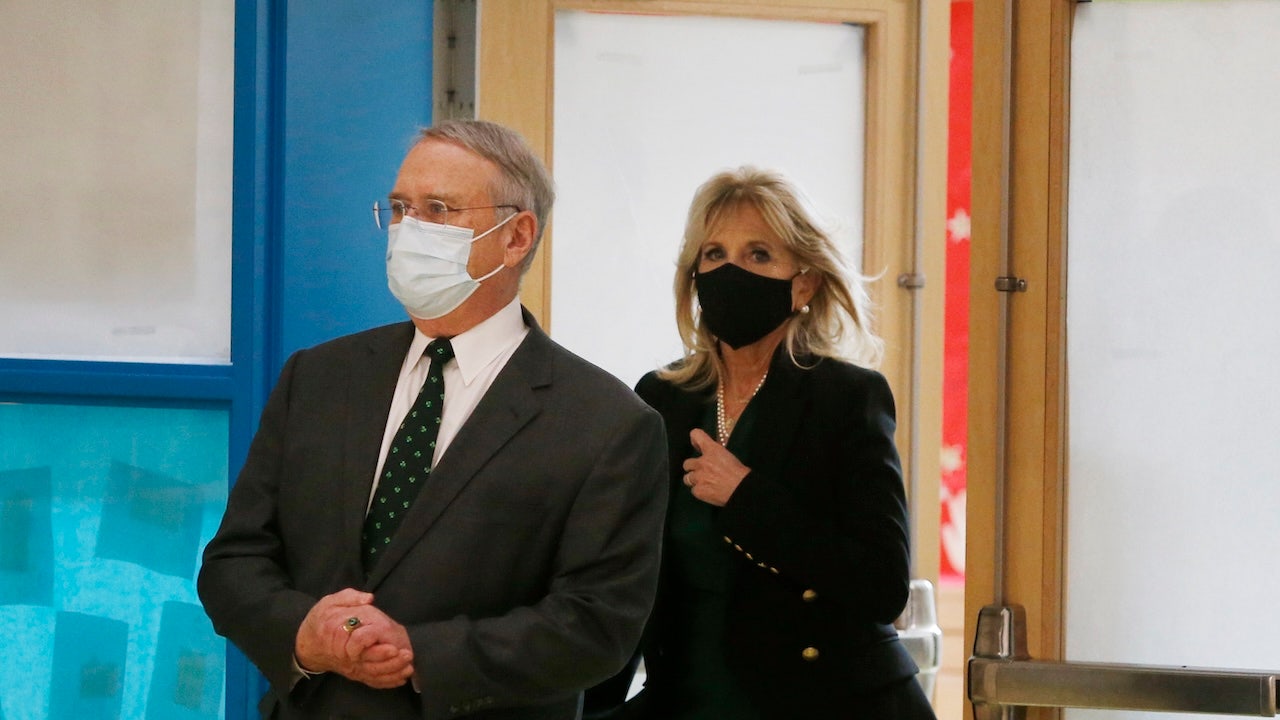
First lady Jill Biden, right, and Steven J. McAuliffe, widower of Christa McAuliffe, arrive at the Christa McAuliffe School in Concord, N.H., March 17, 2021. (Jessica Rinaldi/The Boston Globe via Getty Images)
Transgender inclusion in girls’ and women’s sports emerged as a mainstream political issue in the last few years. Instances of athletes discovered to be male and then legally protected to continue playing have emerged in rapid succession since the start of the Biden administration.
This includes instances like those involving Tirrell in New Hampshire and others in Virginia and California. At the college level, a situation at San Jose State University involving a transgender volleyball player has prompted multiple lawsuits and a media firestorm. It became a talking point of Donald Trump’s presidential campaign before his recent election win.
Trump and even his wife, Melania, who has admitted to disagreeing with Republicans on issues of LGBT rights, each announced they are opposed to letting biological males compete in girls and women’s sports. Trump advocated for a blanket ban during a Fox News town hall event on the campaign trail.
Multiple states filed lawsuits and enacted their own laws to address the issue after the Biden-Harris administration issued a sweeping rule that clarified that Title IX’s ban on “sex” discrimination in schools covers discrimination based on gender identity, sexual orientation and “pregnancy or related conditions,” in April.
The administration insisted the regulation does not address athletic eligibility. However, multiple experts presented evidence to Fox News Digital in June that it would ultimately put more biological men in women’s sports.
The Supreme Court then voted 5-4 in August to reject an emergency request by the Biden administration to enforce portions of that new rule after more than two dozen Republican attorneys general sued to block the Title IX changes in their own states.
During the most recent election cycle, multiple Democrats, including Texas Rep. Collin Allred backtracked on past support for transgender inclusion in women’s sports.
That trend continued after the election when Massachusetts Democratic Rep. Seth Moulton spoke out against his party’s stance and actions in enabling transgender inclusion in multiple interviews, inciting fierce backlash and even a massive pro-transgender rally outside his office.
Now, multiple judges like McAuliffe across the country are presiding over cases about the eligibility of transgender athletes in sports.
The Associated Press contributed to this report.
Follow Fox News Digital’s sports coverage on X, and subscribe to the Fox News Sports Huddle newsletter.
Read the full article from Here


Rudolph W. Giuliani, the former mayor of New York City, is in a Florida hospital in critical condition, his spokesman said Sunday.
The spokesman, Ted Goodman, would not specify which hospital and said that the former mayor “remains in critical but stable condition.”
“Mayor Giuliani is a fighter who has faced every challenge in his life with unwavering strength, and he’s fighting with that same level of strength as we speak,” he said, before asking “that you join us in prayer” for the former mayor.
It is unclear when Mr. Giuliani, 81, was taken to the hospital.
President Trump, in a post on Truth Social, called Mr. Giuliani a “True Warrior, and the Best Mayor in the History of New York City, BY FAR.”
He used the occasion to again advance his false claim that Democrats “cheated” in the 2020 election.
“They cheated on the Elections, fabricated hundreds of stories, did anything possible to destroy our Nation, and now, look at Rudy. So sad!” he said.
Mr. Giuliani has struggled with legal and financial problems in recent years, and in the summer of 2025, he was involved in a car crash in New Hampshire in which he suffered a fractured vertebra. After that, Mr. Giuliani made at least one public appearance in a wheelchair.
Mr. Giuliani became mayor in January 1994 after he defeated Mayor David N. Dinkins, who was running for a second term. He remained in office until December 2001 and helped lead the city in the aftermath of the Sept. 11 terrorist attacks.
Later, he became a personal lawyer to Mr. Trump during the president’s first term and quickly became embroiled in a number of investigations related to the presidency.
Mr. Giuliani was a crucial part of the team that helped Mr. Trump advance the claim that he won the 2020 election. After Mr. Trump left office, Mr. Giuliani was indicted multiple times and contended with a number of costly defamation suits related to those efforts. Now disbarred, he has kept a far lower profile during Mr. Trump’s second term in office.
Maggie Haberman contributed reporting.

Gunshots were fired in a daytime armed home invasion in Saugus, Massachusetts, on Sunday, police say, and the two suspects are in custody.
No one was hurt in the shooting on Oakwood Avenue about noon, Saugus police said. Two Boston men, Derek Matarazzo and Timothy Gregory, are facing felony charges including home invasion after their arrest shortly after the 911 calls came in.
The calls reported two men in masks, dressed in black, armed with guns, breaking into a house, police said. They didn’t share what led to the gunfire or how the men were tracked down, saying only that the department wasn’t speculating on their motivation.
Matarazzo and Gregory are believed to be the only people directly involved in the home invasion, police said, and it’s believed to be an isolated incident, so there’s no danger to the public.
Neighbors who spoke with NBC10 Boston say they are shaken up by what occurred, describing a shootout right outside their homes in the middle of the day.
Ring camera video from a nearby home shows the aftermath, as neighbors say you can see the homeowner running into the middle of the street with a phone pressed to his ear, desperately flagging down police — after the chaos.
A neighbor tells us his family first heard what sounded like a pop — something they thought could’ve been a lawn mower backfiring, until they realized it was gunfire. That neighbor says one of his daughters then saw a man carrying a safe — dropping it in their front yard — while shots were being fired.
“I saw somebody come out of the house shooting and then we all hit the deck, because you didn’t want a stray bullet to ricochet off something and come through the window or anything like that,” George Benn said.
“I saw the shots. I saw a man go down. I thought he was going to be dead but apparently he just flipped on that hill,” Tom Bushee said.
The investigation is ongoing.

This year’s Pittsburgh Marathon is one for the record books. More than 52,000 runners crossed the finish line, with more than 300,000 spectators cheering them on.
“We’re welcoming people from around the world,” P3R CEO Troy Schooley said. “This event has turned into an international event for our city. We’re going to show it off today. The runners will run through 14 neighborhoods. We have 33 different countries represented today and all 50 states.”
Advertisement
Mohammed El Youssfi claimed the men’s division of the Pittsburgh Half Marathon, crossing the finish line and immediately wrapping himself in the Moroccan flag.
“This is my first time in Pittsburgh, but the special moment for me today is the people here cheering me on,” El Youssfi said. “That helped me to win the race.”
Emotions ran high for Pittsburgh’s very own Will Loevner. The Winchester Thurston graduate has run the Pittsburgh Marathon multiple times, finishing as the runner-up in 2024 and fifth in 2025. But in 2026, he took home top honors, crossing the finish line first at 2:14.
“I’ve now won the Philadelphia marathon, the Cleveland marathon twice,” Loevner said. “To win Pittsburgh, I feel like it was the trifecta and the most special one for me. I mean, being in the hometown, nothing even compares.”
Advertisement
Buze Diriba Kejela is 2026’s women’s Pittsburgh Half Marathon champion, setting a course record for women and crossing the finish line at 1:08:39.
“I’m happy to set the course record. I like it,” she said.
Before the runners crossed the start line, the handcyclists got a head start. Marshall Tempest of Monroeville came out on top in the Pittsburgh Marathon Handcycle Division, finishing at 1:40:16.
“I’ve done 13 Pittsburgh marathons, and this is my 5th time winning it, in a row,” he said. “It feels good. It was a rough one, but I was determined to get that 5th one.”
“I love running,” said Will Henry Lawrence, who ran the half-marathon. “I love being able to have breath in my lungs and let my feet hit the pavement. I had a stroke six years ago, and so I give all glory to God for being able to get out and exercise.”
Advertisement
Tickets for the 2027 Pittsburgh Marathon are on sale for 48 hours, starting at 3 p.m. on May 3, 2026. You can register at thepittsburghmarathon.com
Download the FREE WPXI News app for breaking news alerts.
Follow Channel 11 News on Facebook and Twitter. | Watch WPXI NOW
-
 News26 minutes ago
Gas prices went up more than 30 cents a gallon last week. How high could they go?
-

 New York2 hours ago
Rudy Giuliani Hospitalized in Florida in ‘Critical Condition’
-

 Detroit, MI2 hours ago
How Detroit Pistons Completed Playoff Series Comeback With Game 7 Win Over Magic
-

 San Francisco, CA3 hours ago
The San Francisco Giants Have Never Cast A Smaller Shadow | Defector
-

 Dallas, TX3 hours ago
FC Dallas ended its winless streak and one new scorer made it sweeter
-

 Miami, FL3 hours ago
Winners and losers from F1’s eventful Miami Grand Prix
-

 Boston, MA3 hours ago
2 men arrested after armed home invasion with shots fired in Saugus, police say
-

 Denver, CO3 hours ago
WATCH THE PENULTIMATE SUPERCROSS IN DENVER IN UNDER 24 MINUTES – Motocross Action Magazine