Northeast
DAVID MARCUS: Election shenanigans show Dems' fear of Pennsylvania turning red

NEWYou can now listen to Fox News articles!
DOYLESTOWN, Pa. – The crowd lined up waiting for the meeting of the Bucks County Election Commission earlier this week was angry. The only thing missing was the pitchforks.
The hullabaloo was caused when one of the commissioners, Diane Ellis-Marseglia, announced the week before that state Supreme Court rulings don’t actually matter, and she was going to count illegal ballots in the Keystone State’s U.S. Senate race, anyway.
DAVID MARCUS: PENNSYLVANIA VOTERS TO SEN. CASEY: ‘IT’S OVER, BOB’
On Wednesday, she sort of apologized to the frothing crowd demanding her resignation, then on Thursday Democratic Sen. Bob Casey conceded his loss to challenger Dave McCormick. For all intents and purposes the controversy was over, but why had it happened in the first place?
“This is all about 2026,” Nick told me outside the government offices.
In his late 20s or early 30s, Nick is one of those Gen Z conservative men you keep hearing so much about, hair slicked back, sunglasses just so. “Casey isn’t gonna be the senator, but they want these ballots to count next time,” he said.
A crowd gathers ahead of a meeting of the Bucks County Election Commission in Doylestown, Pennsylvania. (David Marcus/Fox News Digital)
This all speaks to a warranted fear among Democrats that Pennsylvania, long the swingingest of the swing states, could be moving, like Ohio and Florida before it, solidly into the Republican column.
While the race between McCormick and Casey was supposedly close enough to merit a recount, the race atop the ticket between Donald Trump and Kamala Harris was not. It wasn’t a blowout, but like the national tally, at about a two-point lead, Trump’s win was decisive.
Even in Philadelphia, the bluest corner of the commonwealth, Trump improved upon his 2020 vote totals while turnout lagged for Harris and the Democrats. That is a loud warning alarm for what used to be the party of Jefferson and Jackson.
Swing states don’t tend to stay swing states forever. Oregon, for example, which is now so far left that Chairman Mao would say, “tone it down a bit,” was a toss-up 30 years ago, but times and parties change.
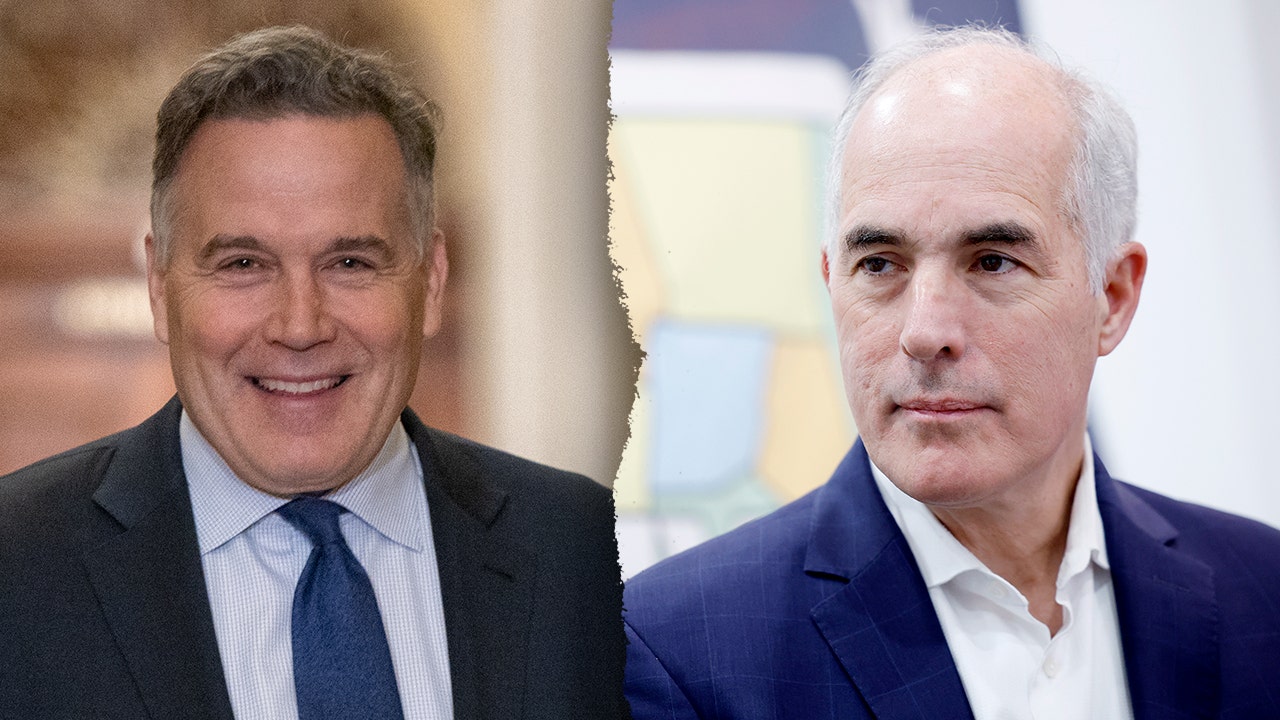
Sen. Bob Casey and Sen.-elect Dave McCormick (AP/ Reuters)
For now, Pennsylvania still has one Democratic senator in John Fetterman, who at times seems to chart his own centrist course against the leftist headwinds of his national party, and Democrat Gov. Josh Shapiro, who also seems circumspect about abject progressivism.
But if the Democrats nationally fail to see what Fetterman and Shapiro see, that unchecked wokeness and far-left policies are roundly and soundly rejected by the voters, then even they won’t be able to keep Pennsylvania purple.
“If it wasn’t for double standards, the Democrats would have no standards at all,” one man with a Trump sign shouted outside the election commissioner’s meeting on Wednesday, and his point was easily taken.
For four years we heard little else about Trump other than his election denialism, and we were told it was a grave and grievous threat to the country. Yet here was an elected Democratic official promising to break the law and count illegal ballots, just to put one of her own in office.
Democrats in Pennsylvania face a dangerous crossroad looking forward. Fetterman and Shapiro can continue to at least gesture towards a more centrist approach, but if the national party continues its lurch to the far left, it might not matter much.
CLICK HERE FOR MORE FOX NEWS OPINION
If in four years the Democrats once again nominate a far-left San Francisco liberal such as Gavin Newsom, there is every reason to believe that Pennsylvanians will continue their march to the right.
These were always Joe Biden and Ed Rendell Democrats, they were never Nancy Pelosi Democrats.
For Republicans, the lesson of Pennsylvania couldn’t be simpler. Just stay the course, simply embody what President-elect Trump rightly refers to as common sense.
If Republicans can turn Pennsylvania reliably red, it will be a sea change in national politics, the kind that fundamentally transforms what our political parties advocate and stand for.
That is really why Casey tilted at the impossible windmill of a recount. It’s not about him, it’s not about now, it’s about next time. It’s about maintaining that wiggle room in ballot counting that so often nudges Democrats across the finish line.
But this time, the people noticed, this time they came out to protest, and next time, they may be poised to hand Republicans the key to generational power.
CLICK HERE TO READ MORE FROM DAVID MARCUS
Read the full article from Here


PORTLAND, Maine (WGME) — It’s graduation season, and 37 medical school grads received their degrees Saturday at USM.
The students graduated from the MaineHealth Maine Track program, which is a part of Tufts Univeristy in Boston.
Program leaders say students specifically trained in community-based medical practices across Maine.
BE THE FIRST TO COMMENT
Eleven of the graduates will begin their residencies at MaineHealth Maine Medical Center in Portland.

A science-based, mission-driven beekeeping company dedicated to improving pollinator health, Best Bees installs and manages professionally maintained hives for homes, businesses, and institutions.
Host Rachel Holt visits with their team to learn how urban beekeeping is helping strengthen biodiversity.

The preliminary injunction ordering SchoolCare to continue paying Dover educators’ health care claims may have implications for the 89 other school districts that paid SchoolCare’s special assessment, according to Anthony Carr of Shaheen and Gordon.
“This could be significant for those 89 other towns and districts,” said Carr, who is representing Superintendent Christine Boston in the lawsuit against SchoolCare.
SchoolCare threatened to stop paying claims on May 1 if Dover failed to pay a special assessment of $1.7 million above and beyond its normal monthly premium in order to cover the insurance risk pool’s losses. Dover refused to pay the special assessment, arguing that it was illegal.
Superior Court Judge John Curran, finding that school employees covered by SchoolCare could face “irreparable harm,” ordered SchoolCare to continue to pay “covered healthcare claims of Dover employees, spouses, dependents, and retirees.”
Curran also found that if the case went to trial, Dover would “likely succeed on the merits” of its case.
Whether the case will go to trial remains an open question, as the judge has not ruled on the claims of SchoolCare and the New Hampshire Secretary of State that the court is not the proper jurisdiction for Dover’s complaint.
“The court will duly consider the important jurisdictional question this case presents in ruling upon those pending motions to dismiss …,” Judge Curran wrote. “For the purposes of this motion, the court finds that the plaintiffs have a sufficient likelihood of establishing jurisdiction at this stage.”
Carr said the order for the preliminary injunction is “very helpful, very favorable.” However, the only “asterisk” is that there is a pending motion to dismiss for lack of jurisdiction.
Favorable ruling hinges on pending jurisdictional argument
Both New Hampshire Secretary of State David Scanlan, through the New Hampshire Bureau of Securities Regulation and its counsel, which intervened, and SchoolCare, have filed motions to dismiss the case with jurisdictional arguments.
“The Bureau respectfully asks this Court to dismiss the District’s Complaint in its entirety because the claims contained therein fall under the Bureau’s exclusive jurisdiction and authority and are best submitted to the Bureau’s administrative enforcement mechanism,” according to court documents.
SchoolCare has argued the plaintiffs can’t show a “likelihood of success on the merits” as the matter needs to be brought before the secretary of state, not the Superior Court.
“Basically, SchoolCare and the Secretary of State are trying to argue that none of these claims brought by Dover, none of these claims brought by Dr. Boston, should be in any court in the state, and these are all issues that should be squarely and solely resolved by the Secretary of State. So that’s really the only lingering issue in that regard,” said Carr.
The lawyer said they’re “hopeful,” based on their comprehension of the law, that a “favorable ruling” will soon come out on the jurisdiction argument.
“Once the jurisdictional issue is resolved, it will be much more clear that the 89 towns and districts likely have causes of action, similar breach of contract actions against SchoolCare to recoup the funds that they were forced to pay under duress, and SchoolCare may not have had a lawful basis to request or receive those funds,” Carr said.
89 members who paid assessment could follow Dover’s lead
Carr explained what the preliminary injunction could mean to the other districts and towns.
“If the jurisdiction were to get resolved favorably, then what those 89 towns and districts would be able to do is piggyback this order, which although it’s directly granting a preliminary injunction, what it’s inherently doing as part of that is saying that we are likely to succeed on the merits of our claim. And one of those claims is the breach of contract claims. So, if we were to be successful on jurisdiction, those other 89 towns and districts would be pretty wise to say that they very well may have viable claims as well,” said Carr.
“This order recognizes that all 89 of those towns and districts may have legal rights to recoup those funds and redeploy them for the betterment of their communities and children, including going toward educational services and staffing. I hope that other towns and school districts will follow the lead of Dover and Dr. Boston and stand up to SchoolCare and demand what’s right,” Carr said in a press release.
He called the judge’s ruling a “huge win for Dover.”
He highlighted one of the immediate results being that district teachers and staff “don’t have to worry about coverage stopping in the middle of a policy period. That’s amazing. We heard stories about a kid who was scheduled to have heart surgery. I believe a staff member needed a kidney transplant. And so, the stakes are very high. And these are people, real humans in Dover, who were worried about how this might go,” said Carr.
“On the flip side, if Dover was forced to pay the ransom, we offered testimony that $1.7 million is the equivalent of about 16 and a half full-time salaries. And we’ve seen in other towns and districts, not just the budget being thrown into crisis, but again, real humans with families being laid off. So it both preserves the status quo for the health coverage for all the fantastic teachers and staff in Dover. And it also, at least for the time being, precludes great teachers and staff within Dover from being laid off,” Carr said.
“I would not want to be the 89th or the 88th town or district that pursues recourse. I think it’s important to act urgently,” said Carr. “I guess I’m on a bit of a personal mission to kind of see all these issues through and to make sure that SchoolCare does not benefit from its own improper conduct. So, we will see what the future holds, but I may very well be representing some of these towns and districts. I would say there’s really no need for any of the towns and districts to wait (for the jurisdictional issue),” said Carr.
Portsmouth agreed to pay assessment ‘under protest’
Trevor McCourt, Portsmouth’s deputy city attorney, said “the city of Portsmouth has not made payment on the $1.57 million assessment at this time. We’ve made arrangement to make that payment by July 15th of this year, and the City Council’s vote was specifically to authorize that payment under protest.”
McCourt said “the last act of the City Council was to agree to make that payment under protest. Certainly, I don’t know what the plan will be moving forward. We plan to make the payment. We continue to make our monthly payments.”
He said they’re “certainly encouraged” by the ruling out of the Strafford Superior Court, and that he personally has already commented “pretty publicly, I agree with the position that Dover is taking.”
What’s next for the case?
Carr said right now, they have “a laser focus on an order on the jurisdictional issue, just so we can make sure that we’ve got the green light to keep these claims in court where we feel like they belong.”
Carr said if they receive a favorable ruling on jurisdiction, they’re attention will be on prosecuting their case and going to trial if needed.
“One of the elements of getting a preliminary injunction is the court has to find a likelihood of succeeding on the merits, meaning that the court is not quite, but kind of pre-adjudicating whether our claims are going to win or not,” said Carr. “So, for the court to find at this early stage that we’ve met that threshold is a great indication, but it doesn’t necessarily mean game over. What it means game over for is that Dover does not have to pay the $1.7 million now. The case will proceed on a 12-month trial track after this, and whether it’s through a jury trial or through pre-trial briefing, we will be hopeful to get a result saying that we never have to pay the $1.7 million.”
-

 Iowa6 minutes ago
Ford’s walk-off slam lifts Cyclones in must-win thriller
-

 Kansas12 minutes ago
Three Potential Bench Pieces Bill Self Can Bolster Kansas’ Roster With
-

 Kentucky18 minutes ago
Kentucky makes the final three for 2027 offensive lineman
-

 Louisiana24 minutes ago
Louisiana baseball claims doubleheader sweep over GSU
-

 Maine30 minutes ago
USM awards degrees to MaineHealth Maine Track medical school graduates
-

 Maryland35 minutes ago
Maryland Gov. Wes Moore’s Army records show training delays, gaps
-

 Michigan42 minutes ago
Diesel fuel posts record high in Michigan on Sunday
-

 Massachusetts48 minutes ago
Why backyard beekeeping in Massachusetts is so important