Northeast
Trump announces plan to hold rally in Pennsylvania town of failed assassination attempt

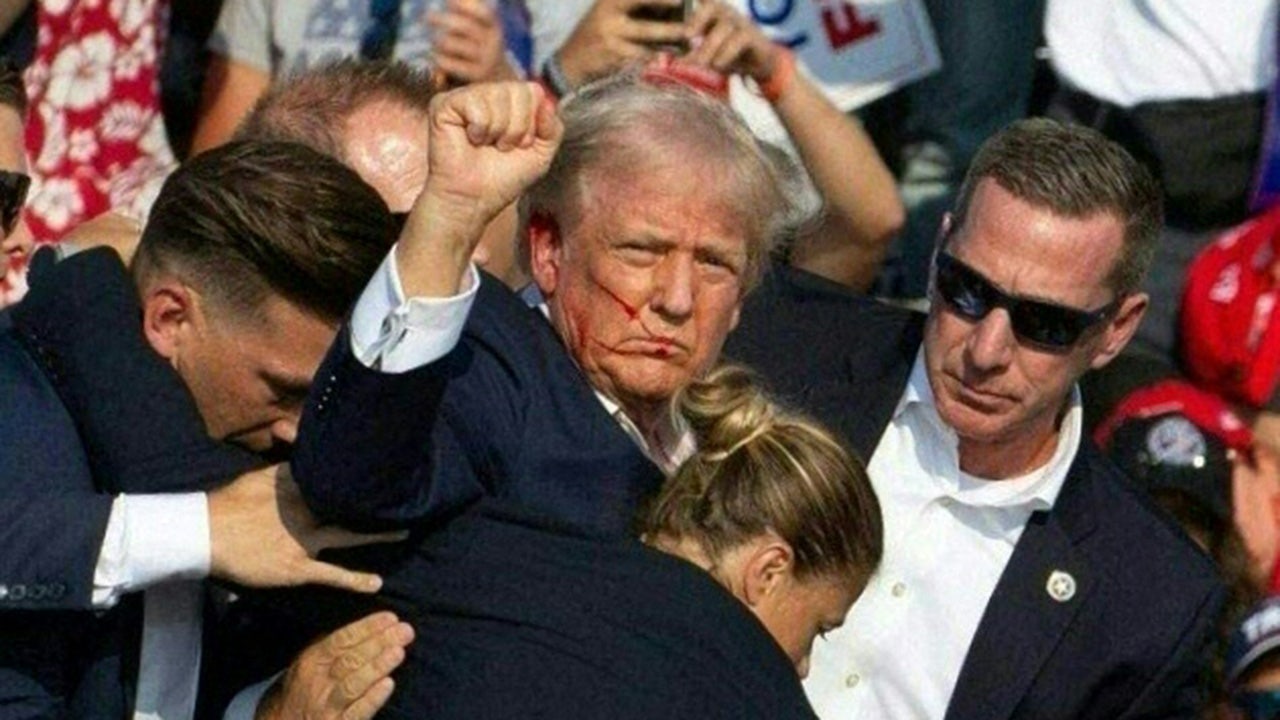
Former President Trump said he plans to hold a campaign rally in the same Pennsylvania town where he was shot earlier this month in a failed assassination attempt.
Trump was shot on the ear in Butler while speaking to supporters during a July 13 campaign event. The shooter, Thomas Matthew Crooks, was shot and killed by a U.S. Secret Service sniper moments after opening fire.
FBI WANTS TO INTERVIEW TRUMP AFTER ASSASSINATION ATTEMPT: SOURCE
Former President Donald Trump speaks during the Independence Day Spectacular on Friday, June 30, 2023, in Pickens, S.C. (Sam Wolfe for The Washington Post via Getty Images)
“I WILL BE GOING BACK TO BUTLER, PENNSYLVANIA, FOR A BIG AND BEAUTIFUL RALLY, HONORING THE SOUL OF OUR BELOVED FIREFIGHTING HERO, COREY, AND THOSE BRAVE PATRIOTS INJURED TWO WEEKS AGO,” Trump wrote Friday on Truth Social. “WHAT A DAY IT WILL BE — FIGHT, FIGHT, FIGHT! STAY TUNED FOR DETAILS.”
The shooting shocked rallygoers as bullets flew while Trump was speaking about President Biden’s immigration record. The shooter got off eight shots with an AR-style rifle in just a few seconds before he was shot and killed.
Crooks opened fire from the roof of a nearby building near the event. One spectator was killed and two others were critically injured.
FBI WANTS TO INTERVIEW TRUMP AFTER ASSASSINATION ATTEMPT: SOURCE
Republican presidential candidate former President Donald Trump is rushed offstage during a rally on July 13 in Butler, Pennsylvania. (Anna Moneymaker/Getty Images)
The shooting highlighted security lapses and prompted a slew of criticism of the Secret Service and its leadership over how Crooks was able to get so close to Trump. Kimberly Cheatle resigned as director of the agency this week amid calls from lawmakers for her to step down.
“The Secret Service’s solemn mission is to protect our nation’s leaders. On July 13th, we failed,” she told lawmakers on the House Oversight and Accountability Committee this week.
Cheatle said she apologized to Trump during a phone call with the presumptive Republican nominee.
Blood is seen in the stands after guns were fired at Republican candidate Donald Trump at a campaign event at Butler Farm Show Inc. in Butler, Pennsylvania, July 13, 2024. The suspected shooter who wounded Republican presidential candidate Donald Trump at a rally is dead, US media reported Saturday, along with one bystander. (Rebecca Droke/AFP via Getty Images)
The Secret Service has encouraged the Trump campaign to not to hold large outdoor rallies in certain situations following the failed assassination attempt.
This story is breaking. Please check back for updates.
Read the full article from Here


NASHUA, N.H. — A Nashua resident is facing felony charges after police say a CyberTip flagged the individual’s alleged interest in sexually abusing a child, leading investigators to uncover child sexual abuse material on his electronic devices.
According to a complaint filed in court by the Nashua Police Department, 23-year-old Dean Jackson — who is transgender and uses they/them pronouns — had previously been trespassed from a Nashua middle school after allegedly loitering there.
Police said a National Center for Missing and Exploited Children CyberTip, forwarded on June 18 by the New Hampshire Internet Crimes Against Children Task Force, prompted investigators in the department’s Cybercrimes Against Children Unit to quickly identify Jackson as the individual involved.
The CyberTip originated from Discord — a communication platform — which reported a chat in which Jackson and another user allegedly discussed going to parks and other locations, including schools, to gain access to children.
Police said they made contact with Jackson and later executed a court‑ordered search warrant at his residence, where they seized electronic devices. During the interaction, Jackson allegedly attempted to delete images from his phone, police said.
According to police, investigators reported finding evidence of both possession and distribution of child sexual abuse images on the seized devices. The complaint states that Jackson gave verbal consent to view an album on their phone titled “Pedo,” which contained 555 files, several of which were identifiable as child sexual abuse images.
The complaint states the Discord chat included Jackson saying they wished they lived “in the era where you told your eight‑year‑old to go off and play … without any sort of supervision,” and that they had been “caught loitering around a school” and trespassed as a result.
Jackson also allegedly wrote that they “look like a stereotypical pedo,” and discussed wanting to get a job at a day care, work as a babysitter or even adopt children to gain access to them.
A Nashua police detective confirmed in the complaint that Jackson had been the subject of a March 2022 call for service near a middle school, where juveniles chased Jackson and alleged to police that Jackson had been known to loiter and ask female students for nude photographs. This resulted in the no-trespass order.
During an interview with police, Jackson allegedly admitted they were “likely subconsciously a pedophile,” had participated in explicit chats on multiple devices, and later told detectives they had been lying earlier and did possess and seek out child sexual abuse images. Jackson also allegedly admitted to photographing their neighbor’s 4‑ or 5‑year‑old children.
Jackson was charged with three counts of possession of child sexual abuse images, a Class A felony; three counts of distribution of child sexual abuse images, a special felony; and one count of falsifying physical evidence, a Class B felony.
Jackson was held without bail following their arrest and again ordered held on preventive detention during their arraignment Monday in the 9th Circuit Nashua District Court, after a judge ruled they posed a danger to the public. No plea was entered on any of the seven charges during Jackson’s arraignment.
Jackson is scheduled to return to court for a probable cause hearing at 10 a.m. July 1.
Police said the investigation remains active. Anyone with information is asked to contact the Nashua Police Department Crime Line at 603‑589‑1665.
Follow Aaron Curtis on X @aselahcurtis, or on Bluesky @aaronscurtis.bsky.social.

Police have located all three boys who vanished from a New Jersey train station on Friday in Stamford, Connecticut.
Montville Township Police Department Chief Andrew Caggiano told Fox News Digital that Brayden Morrissey, 14, Dominic Diliberto, 14, and William Connolly, 17, initially left an undisclosed location in Montville Township, New Jersey, on Thursday night.
After an extensive initial search using K-9s and drones, authorities shifted to a missing persons investigation when they realized the boys had left the area.
The trio was seen at the Denville Train Station at about 5:30 p.m. Friday, before later being spotted by the Metropolitan Transportation Authority (MTA) at a train station in Stamford on Saturday afternoon.
When MTA officers made contact in Stamford, they took Connolly into protective custody, but the two 14-year-olds fled.
Caggiano told Fox News Digital just after 8 p.m. Saturday those two boys were located in Stamford.
Caggiano noted the boys appeared to have left on their own accord.
It is unclear when they will be reunited with their parents.
Pennsylvania
America250 history trail: Visit Pennsylvania’s overlooked sites that helped win the American Revolution

As the nation marks its 250th anniversary, Pennsylvania’s role in the American story extends far beyond the iconic landmarks of Independence Hall and Valley Forge.
From Reading, where George Washington’s mobile headquarters tent — known today as the “First Oval Office” — was crafted, to a little-known Montgomery County encampment where exhausted Continental soldiers regrouped before becoming the formidable Grand American Army, local history reveals the people and places that quietly altered the course of the Revolution. Berks County riflemen armed with the Pennsylvania long rifle earned Washington’s praise, while southeastern Pennsylvania iron furnaces overcame early failures to forge the cannons needed to defend the fledgling nation.
Here is how you can step back in time to explore the remarkable stories of ingenuity, sacrifice and perseverance that helped secure American independence and continue to shape the nation’s identity 250 years later.
The First Oval Office: Reading
In early 1778, as Gen. George Washington endured the brutal Valley Forge winter, a new field headquarters tent — his mobile command center for the remainder of the Revolutionary War — was crafted in Reading.
Long overshadowed by the larger drama of the encampment, the tent’s origins in Reading reveal a local contribution to the nation’s founding that has only recently received the recognition it deserves, historians say.
“Washington’s tent was his command center during the Revolutionary War, and tells the story of his inspiring leadership, unyielding determination, and steadfast devotion to his troops,” Michael Quinn, then-president and CEO of the Museum of the American Revolution, said during the 2017 opening of the museum in Philadelphia. “It is a powerful symbol of American freedom, and one that we are thrilled to be able to preserve for future generations.”
The 23-by-14-foot tent, made of linen canvas, served as Washington’s office, sleeping quarters, and strategic hub from 1778 to 1783. It traveled with him through the war’s most consequential moments. The structure was a sophisticated, multichambered canvas marquee divided into an office, Washington’s sleeping area, and a space for his enslaved valet, William Lee. Inside these linen walls, Washington drafted dispatches, met with aides such as Alexander Hamilton, and shaped the military decisions that would ultimately secure American independence.
Today, Washington’s tent is the signature artifact of the Museum of the American Revolution. Installed after a years-long conservation effort, the tent is displayed in a dedicated 100-seat theater as part of a 10-minute presentation. More than 1 million visitors have viewed it since its installation.
(COURTESY OF MUSEUM OF THE AMERICAN REVOLUTION)
The battlefield tent Gen. George Washington featurd three rooms and was made in Reading and delivered to the Continental Army campment at Valley Forge in 1778, according to the Museum of hte American Revolution where the restored tent has served as the featured exhibit since it opened in 2017. (COURTESY OF MUSEUM OF THE AMERICAN REVOLUTION)
Plan your visit: The First Oval Office
Location: Museum of the American Revolution, 101 South Third Street, Philadelphia
The vibe: An intimate look at the mobile command center where George Washington strategized the war and secured American independence.
Must-see: The 23-by-14-foot tent, originally crafted in Reading, displayed in a dedicated 100-seat theater.
Tip: The tent presentation is a popular 10-minute immersive theater experience. Be sure to check the museum’s daily schedule upon arrival to secure your spot.

The Grand American Army Encampment: Towamencin Twp.
Montgomery County’s place in the nation’s founding is well documented in Revolutionary War history, from the winter at Valley Forge to nearby battles at Whitemarsh, Paoli, and Brandywine.
What is lesser known is an encampment by Washington and his troops in the hills and woods of Towamencin Twp. that transformed his army into the Grand American Army of 11,000 soldiers.
“They walked in as the Continental Army, and they walked out as the Grand American Army,” said historian Victor Verbeke, describing the Colonial soldiers’ encampment located between what are now the boroughs of Lansdale and Souderton.
Several Revolutionary War veterans are buried in Tennis-Lukens Cemetery in the township, and the township’s Morgan Log House dates back to the early 1700s. But there is not yet a marker that notes the site of the army’s encampment that “refreshed” their abilities, according to historians.
Last summer, two local historians made a request to the state’s Historic Preservation Office for a marker to indicate the location that proved so key to the young nation in the fall of 1777.
“General Washington and 11,000 Continental soldiers spent eight whole days here, from October 8 to October 16 of 1777,” Verbeke said. “There were no battles fought here, but there were some significant events that this township can be proud of. The residents, back in the day, on both sides of the Skippack Creek, welcomed these soldiers, most importantly fed these soldiers, and provided them with what General Washington specifically told John Hancock: ‘Rest and refresh my men.’”

shillings and six pence for the inconvenience of his house used as military headquarters. (Image courtesy of Brian Hagey, original document via U.S. Library of Congress)
Plan your visit: The Grand American Army Encampment
Location: Detwiler Road near Delp Drive in Towamencin Township (Montgomery County)
The vibe: A quiet, historically rich exploration of the grounds where 11,000 Continental soldiers rested and reformed after brutal campaigns.
Must-see: The historic Morgan Log House dating back to the early 1700s, and the Tennis-Lukens Cemetery, the final resting place of several Revolutionary War veterans.
Tip: Keep an eye out for future historical markers. Local historians are actively petitioning the state to officially recognize the exact locations of the encampment.

The Pennsylvania Long Rifle: Berks and Lancaster Counties
What most distinguished Revolutionary War soldiers from Berks County and Pennsylvania was their weapon of choice: the Pennsylvania long rifle.
That weapon played a decisive role in the regions included in Congress’ call to form an army, said Gregory Kreitz, a former Reading Eagle reporter and local history buff. Thompson’s Rifle Battalion drew recruits from counties including Bedford, Cumberland, York, Northumberland, Northampton, Lancaster, and Berks.
After the battles at Lexington and Concord in 1775, Kreitz noted it’s likely America’s founders were wishing for some kind of silver bullet. That silver bullet was a lead ball shot from a Pennsylvania long rifle with deadly accuracy up to 300 yards.
The rifle was first made in the early to mid-1700s by German immigrant gunsmiths in Lancaster and along the Wyomissing Creek in Berks County. Its greater range came from patched balls and spiral grooves inside a lengthy barrel, which spun the balls as they shot.
The congressional war resolution on June 14, 1775, was the first time an army was officially drafted — and it was solely riflemen. The resolution called for riflemen from Pennsylvania, Maryland, and Virginia, all areas along the Great Wagon Road — running from Philadelphia to the Shenandoah Valley — where long rifle gunsmiths had settled and sold their wares.
After major victories at Trenton, Assunpink Creek, and Princeton, Washington moved all his riflemen into one corps, commanded by Col. Daniel Morgan.

Plan your visit: The Pennsylvania Long Rifle
Location: Landis Valley Village & Farm Museum, 2451 Kissel Hill Road, Lancaster, and Berks History Center, 940 Centre Ave, Reading
The vibe: An authentic look into the meticulous craftsmanship of the 18th-century German immigrant gunsmiths who forged the frontier’s most decisive weapon.
Must-see: The collections of beautifully preserved, original Pennsylvania long rifles. Look closely for the intricate woodwork and imagine the spiral grooves inside the lengthy barrels that gave the weapon its deadly 300-yard accuracy.
Tip: Landis Valley is a living history museum that frequently hosts historical demonstrations. Check their seasonal schedule before you go to see if you can catch a glimpse of early blacksmithing and gunsmithing techniques in action.

The Revolutionary Iron Furnaces: Berks, Lebanon, and Chester Counties
After the battles at Lexington and Concord kicked off the war, Pennsylvania leaders decided they needed to protect Philadelphia’s port. To defend the waterways leading into the city, they devised a plan to create a navy and line the shores with cannons.
A cannon committee organized by Benjamin Franklin was tasked with answering a crucial question: Were the people and facilities needed to make cannons available locally? The answer was yes, historian Dan Graham said. Southeastern Pennsylvania had several working iron furnaces, including Hopewell in Berks County, Cornwall in Lebanon County, and Warwick and Reading in Chester County.
The forge operators got to work in the spring of 1776, but there was a catch: They had never made cannons before. Their early efforts were a mess, Graham noted.
Eventually, an expert was brought in to help the locals figure out the pervasive kinks. For about 18 months, local furnaces successfully produced working weapons — 12-pound cannons at Hopewell and Cornwall, and 18-pound cannons at Warwick and Reading.
Once France entered the war effort in late 1777 and began providing weapons, local cannon production fell by the wayside. However, remnants of this early weapon manufacturing era remain. Graham said half of a cannon is still on display at Hopewell, while a fully preserved cannon can be found at Cornwall.
Plan your visit: The Revolutionary Iron Furnaces
Location: Hopewell Furnace, 2 Mark Bird Lane in Elverson (Berks County), and Cornwall Iron Furnace, 94 Rexmont Rd, Cornwall (Lebanon County)
The vibe: Early American industrial ingenuity on display, highlighting the local forges that scrambled to build the cannons needed to defend Philadelphia’s port.
Must-see: A fully preserved cannon from the era at Cornwall, and the historic half-cannon remaining at Hopewell.
Tip: Because the sites are spread across two counties, plan a scenic drive to see how the local landscape supported these vital early ironworks.
-

 Minnesota2 minutes ago
Anti-ICE organizers shift focus to defend democracy from Trump assault
-
Mississippi5 minutes ago
A new law could create a list of immigrants illegally living in Mississippi. Advocates are alarmed
-

 Missouri10 minutes ago
Missouri parent groups organize with school funding concerns
-
Montana17 minutes ago
Montana Lottery Powerball, Lotto America results for June 27, 2026
-

 Nebraska20 minutes ago
Five-Star Forward Dawson Battie Returning to Nebraska for Official Visit
-

 Nevada25 minutes ago
Nevada National Security Site Museum hosts Cold War history presentation
-

 New Hampshire32 minutes ago
Nashua resident charged over chats seeking access to children
-

 New Jersey35 minutes ago
3 missing teens located after vanishing from New Jersey train station


