California
Millions of Californians live near oil and gas wells that are in the path of wildfires

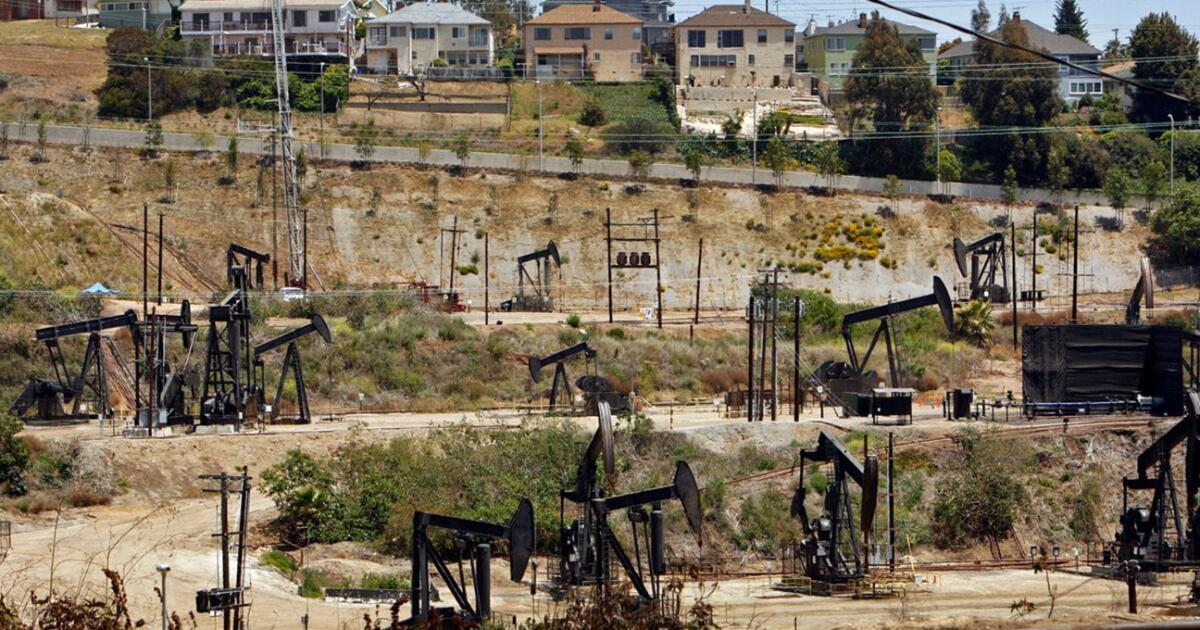
As firefighters continue to battle more than two dozen active wildfires in California, new research has found that millions of people are living in close proximity to oil and gas wells that are in the potential path of flames.
More than 100,000 wells in 19 states west of the Mississippi River are in areas that have burned in recent decades and face a high risk of burning in the future, with the vast majority in California, according to a study published recently in the journal One Earth.
What’s more, nearly 3 million Americans live within 3,200 feet of those wells, putting them at heightened risk of explosions, air and water pollution, infrastructure damage and other hazards.
“One of the things that surprised me was just the extent of how many oil wells had been in wildfire burn areas in the past, and how much this was impacting people in California — and is likely to in the coming century,” said David J.X. González, the study’s lead author and an assistant professor of environmental health sciences at UC Berkeley.
Aggressive and impactful reporting on climate change, the environment, health and science.
California is particularly vulnerable to the threat. Of the roughly 118,000 western oil wells in high fire risk areas, 103,878 of them — more than 87% — are in California, with 2.6 million residents living in close proximity to them, according to the study, which was described as the first to investigate historic and projected wildfire threats to oil and gas infrastructure in the United States.
The researchers examined active and inactive oil wells because some inactive wells continue to leak methane and other harmful or combustible emissions, González said. In California, the danger is particularly high in Los Angeles, Fresno, Kern and Orange counties, which are high fire risk areas that are also home to large populations and numerous wells.
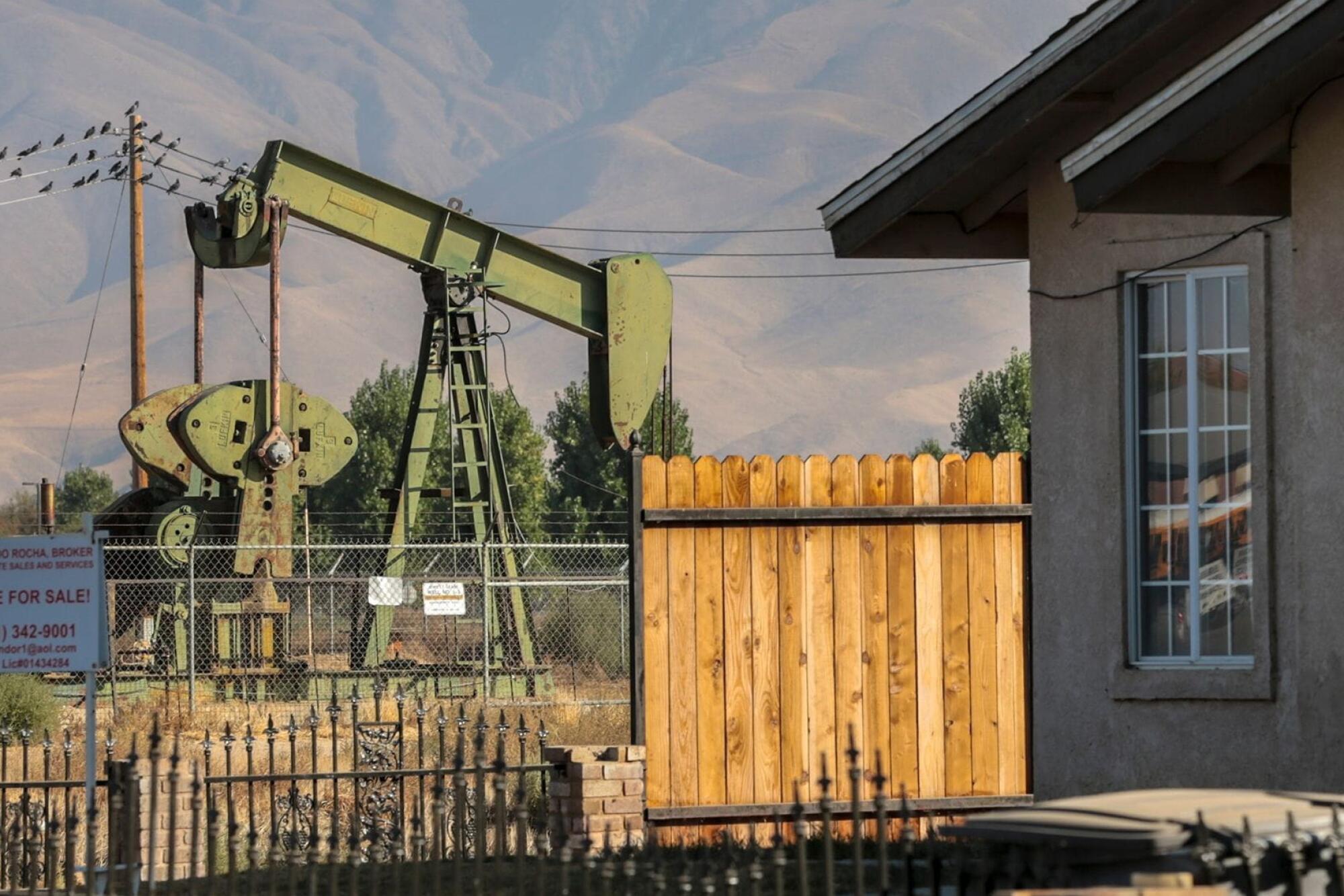
A pump station sits idle near homes in Arvin, Calif., where toxic fumes from a nearby well made residents sick and forced evacuations in November 2019.
(Robert Gauthier / Los Angeles Times)
Many Angelenos have already experienced the perils of living near oil and gas infrastructure. In 1985, methane linked to a long-abandoned oil field fed an explosion at a Ross Dress for Less store in Fairfax, injuring more than 20 people.
In 2015, a massive gas leak from the Aliso Canyon underground storage facility near Porter Ranch released about 100,000 tons of methane, ethane and other chemicals into the air, forcing more than 8,000 families to flee their homes and prompting reports of nausea, skin rashes, nosebleeds and other health issues.
Four years later, a 90-year-old well erupted beneath a construction site in Marina del Rey and spewed oil, gas and other debris into the air for several days.
And in 2017, the Thomas fire burned through areas of Santa Barbara and Ventura counties that contained more than 2,100 oil and gas wells — the long-term effects of which have yet to be studied.
It’s not only California that is at risk however. Texas, Oklahoma and New Mexico also host wells in high fire risk areas, the study says. The U.S., in general, has been the top global producer of crude oil and natural gas since 2014, with the majority of production concentrated in the West.
Additionally, oil drilling continues across the country, despite federal and state efforts to curb new wells and cap old ones. One of the provisions included in President Biden’s landmark climate bill, the Inflation Reduction Act, allows for new oil leases to be auctioned on federally managed lands, which means California and other states could see more new wells in the future.
But the California Department of Geologic Energy Management, which oversees oil and gas wells in the state, said production here has been steadily declining since its peak in 1985.
“Presently, CalGEM approves far more permitting applications from operators to plug oil wells than it does to drill new wells,” agency spokeswoman Janice Mackey said in an email. She noted that over the last 12 months, the state agency approved 5,059 permits to permanently plug oil and gas wells while approving only 56 new drills.
Mackey said most of the nearly 250,000 wells under the state agency’s jurisdiction are in the San Joaquin Valley, “but there are also many others in high fire threat areas such as Santa Barbara, Ventura, and Los Angeles counties.”
That could prove to be a problem as wildfire activity continues to worsen, even in the face of slowing oil production. One recent study found that wildfire burn areas in California could increase 50% or more by midcentury, due largely to climate change. Eighteen of the state’s 20 largest wildfires have occurred since 2000.
Additionally, Mackey said the placement of new wells — which are determined by oil and gas operators who seek permits from local governments — has little to do with fire risk.
“California’s oil fields are well established from decades to [over a] century old,” she said. “Operators continue to drill in areas where oil and gas is known to exist.”
Estimates included in the study indicate the hazards will get worse in the decades ahead as population and wildfire activity expand. Between 1984 and 2019, the researchers documented a five-fold increase in the number of wells located in wildfire burn areas, and a doubling of the population living within 3,200 feet of those wells.
By midcentury, more than 122,000 wells are expected to be in high wildfire risk areas, and by late century that number will grow to more than 205,000, according to the study. Both projections are significantly higher when also accounting for moderate wildfire risk areas, and both show that California will continue to experience the lion’s share.
“Wildfires are increasingly burning in oil fields over the past four decades, and it’s a trend that’s very likely to continue throughout the rest of the century, including near some densely populated parts of California,” González said.
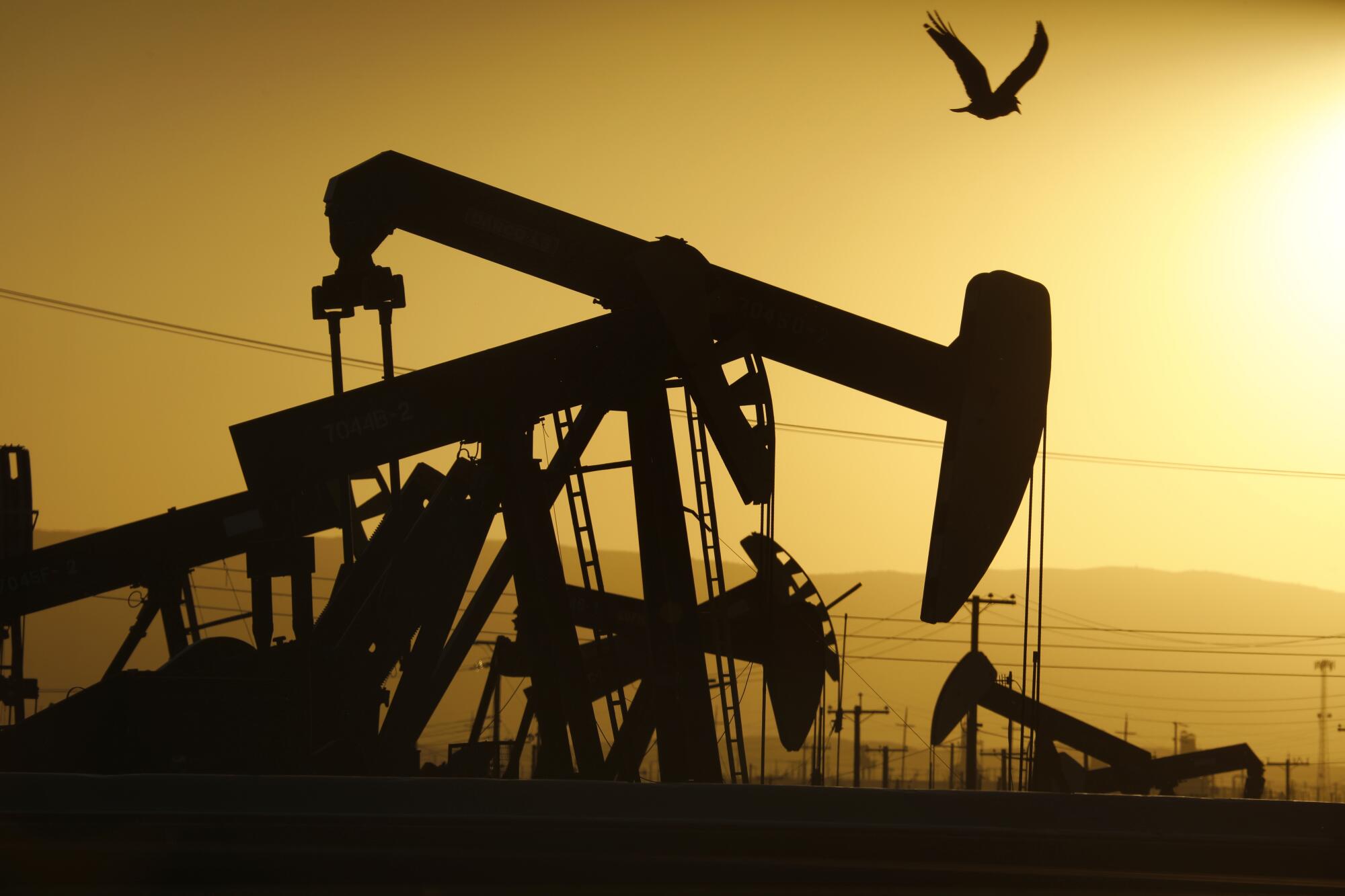
A 2020 photo shows one of more than 1,100 producing oil wells in the McKittrick oil field, just north of McKittrick, Calif., on State Route 33.
(Carolyn Cole/Los Angeles Times)
He added that estimates for the number of wells and people in harm’s way are likely conservative, as the study assessed wells drilled before 2020. That same year was California’s worst wildfire year on record, and saw more than 4.3 million acres burn.
The researchers also found that exposure to oil wells in the path of wildfires was unevenly distributed. Black, Latino and Native American people faced disproportionate risk.
The reasons for this are myriad, according to González.
For one, an estimated 350,000 new houses are constructed each year in the wildland urban interface, or the area where human development meets forestland and other natural landscapes. Such areas often draw people seeking lower costs of living, but face significant wildfire risks because of their remoteness and high vegetation content.
In urban areas, research has found that oil wells are more likely to be sited in neighborhoods that were historically redlined, or racially segregated. New wells are also disproportionately drilled in areas where Black and Latino people live.
There are solutions, however — or at least recommendations to help mitigate the risks of oil wells in populated, wildfire-prone regions. California recently approved legislation that prohibits new oil and gas wells within 3,200 feet of homes, schools, healthcare facilities and other sensitive sites.
The state will also receive more than $35 million in federal funding to help plug and remediate more than 200 high-risk orphaned oil and gas wells, and plans to invest more than a quarter of a billion state and federal dollars into orphan well plugging in the coming years.
The researchers also recommended limiting or eliminating drilling in high wildfire risk areas, and investing in better technology for monitoring wells for leaks of flammable gases.
“There’s a strong base of evidence that active wells are harmful for people that live nearby — even in the absence of wildfires,” González said. “So I think from a public health perspective, additional protections are well justified.”
Mackey, of the California Department of Geologic Energy Management, said oil and gas operators in the state are subject to multiple layers of regulation, including requirements that well pads and tanks be kept free of vegetation, and that wells within specified distances of homes and public rights-of-way have fire prevention devices, sensors and alarm systems.
“In the event of a fire, CalGEM will contact affected field operators to warn them of the possible risk and discuss strategies to prevent damage to wells and equipment,” she said. “Operators are directed to close pipelines and tanks and shut off power to wells if they are not already doing so. Operators also have fire suppression capabilities they deploy during emergencies.”
During the Thomas fire, which was the largest in California at the time, the operators in Santa Barbara and Ventura counties shut down their wells, pipelines and rig work as part of their emergency response to mitigate the risk of fire-related incidents, she said.
Despite such efforts, the study also highlighted what it referred to as a “pernicious feedback loop.” The production and consumption of fossil fuels are driving global warming, which is in turn increasing the frequency and intensity of wildfires, it says. Greenhouse gases emitted by fires are also exacerbating climate change and contributing to the cycle.
González said he hopes the study will prompt more action to not only reduce wildfires, but also to better protect people living in or near the oil wells in their paths.
“We have an opportunity now to take action to prevent future disasters,” he said.

California
CDFW News | California Fish and Game Commission Takes Emergency Action to Prevent White Shark Take and Reduce Potential Interactions Between Hooked Sharks and Swimmers

Prosecutors Honored for Their Work to Protect Wildlife; Southern Resident Killer Whale Named CESA Candidate
Anticipating a larger presence of white sharks in Southern California as a result of warmer El Niño ocean conditions, the California Fish and Game Commission (Commission) adopted emergency regulations at its June 17-18, 2026 meeting to further protect the large ocean predator and reduce the potential for dangerous interactions with ocean users. These regulations will prohibit the use of certain fishing gear from beaches and nearshore that are used to hook large sharks and could create hazards for nearby beachgoers.
Forecasted warmer waters shift the preferred range for juvenile white sharks northward from Mexico and lead them to stay in California nearshore areas later in the year. The emergency regulations protect not only white sharks but also people recreating in the ocean, decreasing the risk of dangerous human encounters with sharks that are hooked with wire leaders from piers and beaches.
Specific gear types used to target large sharks, including hooks greater than 1.5 inches in maximum inside measurement and wire or metallic lines and leaders, will be prohibited when recreational fishing from shore or within 1,000 yards of shore from Pigeon Point (San Mateo County) south to the U.S.-Mexico border. Shore fishing includes beaches, banks, piers, jetties, breakwaters, docks and other man-made structures connected to the shore. Unless extended, the emergency regulations will expire 180 days after being filed with the secretary of state. The Commission may pursue up to two 90-day extensions of the emergency action and, ultimately, may propose continuing the restrictions through a regular rulemaking if the regulations prove to be effective.
Prosecutor of the Year
Commissioners recognized two deputy district attorneys who have demonstrated their dedication to protecting California’s natural resources and have effectively collaborated with the California Department of Fish and Wildlife (CDFW) to prosecute wildlife crimes. San Luis Obispo County Deputy District Attorney Ken Jorgensen and San Diego County Deputy District Attorney Michael McCann were presented with the Prosecutor of the Year Award for 2025.
Jorgenson’s work resulted in a landmark $165,000 settlement and injunctions in a case involving rare plant habitat destruction, and in another case a $12,500 fine and five years of probation for often under-prosecuted commercial fishing violations.
McCann assisted in the prosecution and investigation surrounding a global wildlife trafficking ring connected to illegal drug and firearm trade. The investigation disrupted a sophisticated trafficking network and resulted in multiple felony and misdemeanor charges, with more anticipated.
Southern Resident Killer Whale
The Commission named the southern resident killer whale (orca) a candidate species for listing under the California Endangered Species Act (CESA). This population of orcas inhabits ocean waters from British Columbia to California and is estimated to now number as few as 75.
Orcas face threats such as limited availability of prey; Chinook salmon are a primary food source and have experienced population decline across the entire West Coast range of orcas. The species’ abundance has also been impacted by past practices of capture for live display.
CDFW will have one year to complete a review on the status of orcas, of the best available science, before the Commission can make a final decision on CESA listing. Orca is currently listed as endangered under the federal Endangered Species Act and is considered depleted under the federal Marine Mammal Protection Act.
Western Spadefoot
Continued from the Commission’s April meeting, a decision to consider CESA candidacy for western spadefoot frog was postponed to the August meeting to give environmental advocates and the solar industry additional time to collaborate on proposing exceptions to CESA protections that would be allowed under Fish and Game Code Section 2084.
Meeting Participation and Next Meeting
Commission President Eric Sklar, Vice President Darius Anderson and Commissioners Samantha Murray and Erica Zavaleta were in attendance for both days of the June Commission meeting. Commissioner Jacque Hostler-Carmesin was in attendance for the first day. The meeting was held in Sacramento.
The complete agenda for the meeting, along with supporting information, is available on the Commission website. Archived video of past Commission meetings is available online. The next regularly scheduled meeting of the Commission is scheduled for Aug. 12-13, 2026, at the California Natural Resources Agency building in Sacramento. Participants are encouraged to attend in person, with options available for Zoom or phone; for more information visit the Commission website.
The Commission authorized public notice of upcoming potential regulation changes related to:
Harpoons and Flying Gaffs Allowance: A discussion hearing is scheduled for Aug. 12-13 and an adoption hearing Oct. 14-15 on amendments to regulations related to allowing use of harpoons and flying gaffs in the recreational tuna fishery.
###
Media Contacts:
Krysten Kellum, CDFW Communications, (916) 825-7120
Alicia de la Garza, CDFW Communications, (916) 754-7237
California
Bug infestation found at California Department of Education headquarters, employees sent home

Bugs have once again been found inside the California Department of Education headquarters in downtown Sacramento, prompting employees to leave the building and raising concerns among workers about returning to the office.
Employees were instructed to go home after bugs were detected in the building, according to state workers and union representatives.
They say it’s not the first time. Union representatives and employees confirmed to CBS News Sacramento that this is the second bug-related incident at the headquarters in the past two years.
“If they’re in one place, it’s very easy for them to be throughout the entire building,” said Anica Walls, president of SEIU Local 100.
The discovery has renewed concerns about workplace safety, particularly as state employees prepare for expanded return-to-office requirements.
“Let’s do what’s necessary and make sure that our employees stay safe and that when they are in the building, they’re not contracting or taking home anything that they don’t need to be,” Walls said.
The California Department of Education confirmed the building experienced a bed bug incident in 2024. However, officials said they are still awaiting pest control reports to determine whether the insects recently discovered are bed bugs or another species.
State workers say they want a permanent solution rather than temporary fixes.
“It’s smart to fix the problem the correct way rather than trying to just mitigate the issue and shut down certain floors,” Walls said.
While most state agencies are scheduled to move to a four-day-a-week, in-office schedule beginning next week, California Department of Education employees will continue their current hybrid schedule of two in-office days per week through the end of the year.
In a statement, the department said it is working with the Department of General Services and pest control specialists to inspect the entire building.
“As stated in the message to our employees, we are actively coordinating follow-up inspections and remediation efforts and will provide updates as soon as additional information becomes available,” the department said.
Union representatives said the department was responsive during the previous infestation and expressed hope for a quicker resolution this time.
“Last time, they were really receptive to the conversations with employees, which was good. We’re hoping for another good outcome, hopefully just a little more expedient this time,” Walls said.
CBS News Sacramento also spoke with a local pest control company, which said that if the insects are confirmed to be bed bugs, treatment could take several months.
The process typically involves repeated inspections and treatments every one to two weeks, including high-heat treatments reaching approximately 160 degrees and extensive cleaning to prevent the infestation from returning.
California
First look: Space Shuttle Endeavour in ready-to-launch position at California Science Center


LOS ANGELES – This fall, space fans will get to see the Space Shuttle Endeavour like never before in its new permanent home at the California Science Center in the Exposition Park area.
What we know:
The new Samuel Oschin Air and Space Center at the California Science Center officially opens on November 13.
Also, an introductory film includes footage from Endeavour’s final launch before being retired in 2011.
“We felt from the beginning this is the most impressive way to see the space shuttle and it gives people views that almost no one ever got a chance to see,” said Jeff Rudolph, President & CEO of the California Science Center.
What they’re saying:
Since 2012, Los Angeles has been home to the Space Shuttle Endeavour. It has been on display horizontally at the California Science Center.
But the vision was always to have it on display upright.
“It’s really exciting and everyone who sees it is in awe and that’s really what we were trying to do was create that real sense of emotional high and inspire people to learn more,” said Rudolph.
This is the only display of its kind and it can’t be duplicated. The orange tank attached to the shuttle is the last mission-ready one in existence.
“I think what we’ve done is present something that is going to be a truly life-changing and transformative experience for education,” said Kenneth Phillips, Curator for Aerospace Sciences at the California Science Center.
Visitors will also be able to see inside the space craft that carried astronauts to space 25 times, including Mae Jemison, the first Black woman to go to space and now-Arizona Senator Mark Kelly.
When the exhibit opens to the public in November, visitors will be able to ride up an elevator alongside the space shuttle and view it from the top.
“That’s the view that nobody but the crew saw. That was a very special vantage point. Nobody got to do that,” said Phillips.
What’s next:
The California Science Center expects the exhibit to be popular. Tickets will go on sale well before the opening.
-

 California7 seconds ago
CDFW News | California Fish and Game Commission Takes Emergency Action to Prevent White Shark Take and Reduce Potential Interactions Between Hooked Sharks and Swimmers
-

 Colorado5 minutes ago
Kids escape unscathed after van slips off Colorado mountain road and down Blue River embankment
-

 Connecticut12 minutes ago
Workers say violent disturbances followed staffing shortages at CT youth psychiatric facility
-

 Delaware15 minutes ago
Thousands moving to Delaware County fuels need for more housing
-

 Florida20 minutes ago
Aerial photos show sprawling algal blooms. What causes them in Florida?
-

 Georgia27 minutes ago
Georgia election bill deadlines: New law delays ballot QR code removal
-

 Hawaii30 minutes ago
Hawaii overpays SNAP benefits by nearly 10% in 2025
-

 Idaho35 minutes ago
Idaho woman finds love on reality TV’s ‘Farmer Wants a Wife’

