West
California Gov. Gavin Newsom signs bill banning schools from notifying parents of child's gender identity
California Gov. Gavin Newsom on Monday signed a new law banning school districts from notifying parents if their child uses different pronouns or identifies as a gender that’s different from what’s on their school record.
AB 1955 has won praise from LGBTQ+ advocacy groups who say the ban will help protect transgender and gender-nonconforming students who live in unwelcoming households.
Tony Hoang, executive director of LGBTQ+ advocacy group Equality California, called the legislation “critical” for strengthening protections for LGBTQ+ youth against forced outing policies,
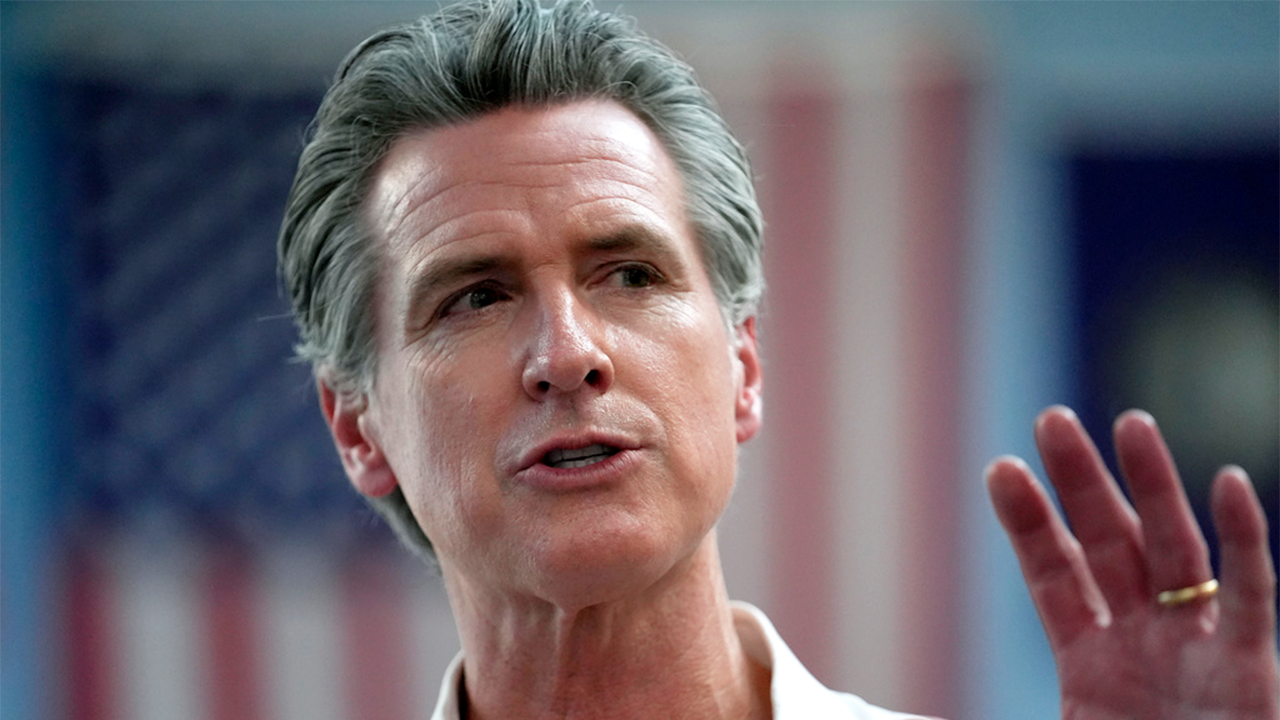
California Gov. Gavin Newsom greets people, Monday, July 8, 2024, near the Common Man Roadside Market and Deli, in Hooksett, N.H. (AP Photo/Steven Senne)
“[AB 1955] provides resources for parents and families of LGBTQ+ students to support them as they have conversations on their terms, and creates critical safeguards to prevent retaliation against teachers and school staff who foster a safe and supportive school environment for all students,” Hoang said.
But the bill has had plenty of detractors.
The conservative group, the California Family Council, said the law violates parents’ rights.
“This bill undermines their fundamental role and places boys and girls in potential jeopardy,” Jonathan Keller, the council’s president, said in a statement. “Moms and dads have both a constitutional and divine mandate to guide and protect their kids, and AB 1955 egregiously violates this sacred trust.”
NEWSOM ATTACKS DEMOCRACY IN CALIFORNIA, BUT WANTS TO TAKE THAT NATIONAL
Elon Musk even weighed in, saying he would move the headquarters of SpaceX and the social media platform X to Texas from California in part because of the new law.
“This is the final straw. Because of this law and the many others that preceded it, attacking both families and companies, SpaceX will now move its HQ from Hawthorne, California, to Starbase, Texas,” Musk wrote in a post on X.
Tesla, where Musk is CEO, moved its headquarters to Austin from Palo Alto, California, in 2021.
The new law comes after several school districts in California passed policies requiring that parents be notified if a child requests to change their gender identification. That led to pushback by Democratic state officials, who say students have a right to privacy.
Newsom spokesperson Brandon Richards said the new California law will “keep children safe while protecting the critical role of parents.”
“It protects the child-parent relationship by preventing politicians and school staff from inappropriately intervening in family matters and attempting to control if, when, and how families have deeply personal conversations,” Richards said.
AB 1955 also requires the state Department of Education to develop resources for families of LGBTQ+ students in grade 7 through high school. The law will take effect in January.
The Associated Press contributed to this report.
Read the full article from Here

California
California’s Voter ID Initiative is Way More Chill Than Trump’s SAVE Act
Sources: California Voter ID Initiative text (proposed); H.R. 7296, Safeguard American Voter Eligibility Act, 119th Congress, 2d Session (introduced January 30, 2026); Congressional Research Service Bill Summary; California Secretary of State; National Conference of State Legislatures (NCSL).
Background: How California Currently Handles Voter Identification
Under current California law, U.S. citizenship is required to vote, but the state relies on voters to simply attest to their citizenship when registering. California does not generally require voters to show identification at the polls. The limited exceptions apply only to first-time federal election voters who registered by mail or online without providing a California ID or Social Security number, and even then, the state allows a broad range of documents, including utility bills, bank statements, paychecks, or official government mail.
In 2024, Governor Gavin Newsom signed legislation explicitly banning local jurisdictions from requiring voter ID, following Huntington Beach voters’ approval of a local measure to do so. California currently has among the most permissive voter identification rules in the nation.
The California Initiative: A Targeted, Inclusive Reform
A proposed California ballot initiative would amend the state constitution to add a new Section 3.1 to Article II. The initiative states three purposes: to “promote public confidence and trust in the electoral process,” to “deter and detect voter fraud by maintaining accurate voter registration records and confirming eligibility to vote,” and to “minimize the risk of voter impersonation by requiring proof of identity to vote.”
The measure is notable for what it does and, just as importantly, for what it does not do.
For in-person voting, the initiative requires that “each time a voter casts a ballot in person in any election in the State, the voter shall present government-issued identification.” The initiative defines government-issued identification as “documentation that allows conclusive verification of the voter’s identity.”
For mail voting, the requirement is far more limited. The voter needs only to provide “the last four digits of a unique identifying number from government-issued identification that matches the one designated solely by the voter for their voter registration.” Importantly, the type of ID designated by each voter “must be indicated in their voter registration record, noted on the mail ballot envelope provided to them, and available to them on request by phone or electronically,” so voters are never caught off guard.
On the question of cost, the initiative is explicit: “Upon request by an eligible voter, the state shall provide, at no charge, a voter ID card for use in casting a ballot.” This is perhaps the most important provision in the measure. One of the most common and legitimate criticisms of voter ID laws is that they can function as a de facto poll tax. This initiative addresses that concern directly by guaranteeing that the means of compliance are freely available to every eligible voter.
On citizenship verification, the initiative directs the Secretary of State and county elections officials to “use best efforts to verify citizenship attestations using government data” and to “annually report what percentage of each county’s voter rolls have been citizenship-verified.” This is a transparency measure, not a documentation barrier.
On accountability, the initiative requires that “during every odd-numbered year, the State Auditor shall audit the State’s and each county’s compliance with this section and report its findings and recommendations for improving the integrity of elections to the public.” Citizens may also “seek judicial review and remedy of the State’s or any county’s compliance with this section.”
What the initiative does not do is equally important. It does not require documentary proof of citizenship to register to vote. It does not require voters to submit citizenship documents with mail ballots beyond the last four digits of an ID number. It does not impose criminal penalties on election officials. It does not create unfunded mandates. It does not establish a private right of action against election workers.
In short, the California initiative is a narrowly drawn measure. It asks voters to confirm who they are while ensuring that the tools to do so are freely available to all.
The Federal SAVE Act (H.R. 7296): A Sweeping and Problematic Mandate
Introduced in the House on January 30, 2026, by Rep. Chip Roy and referred to the Committee on House Administration, the Safeguard American Voter Eligibility Act amends the National Voter Registration Act of 1993. Unlike the California initiative, which works within existing systems, the SAVE Act would fundamentally restructure how Americans register to vote and cast ballots in federal elections, with requirements that, in many cases, are practically impossible for millions of eligible citizens to meet.
Here is what the bill actually requires, provision by provision, and why each raises serious concerns.
1. Documentary Proof of Citizenship Required to Register
The bill is unambiguous on this point. It states that “a State may not register an individual to vote in elections for Federal office held in the State unless, at the time the individual applies to register to vote, the individual provides documentary proof of United States citizenship.”
The bill defines acceptable proof narrowly. It includes a REAL ID-compliant document “that indicates the applicant is a citizen of the United States,” a valid U.S. passport, or a military ID combined with “a United States military record of service showing that the applicant’s place of birth was in the United States.” For voters who cannot provide those documents, the bill allows a government photo ID paired with a certified birth certificate, but that birth certificate must meet an exacting list of requirements: it must include “the full name, date of birth, and place of birth of the applicant,” must list “the full names of one or both of the parents of the applicant,” must carry “the signature of an individual who is authorized to sign birth certificates,” must include “the date that the certificate was filed with the office responsible for keeping vital records in the State,” and must bear “the seal of the State, unit of local government, or Tribal government that issued the birth certificate.”
This is an extraordinarily demanding standard. Birth certificates are lost, damaged, or were never properly recorded, particularly for older Americans, rural residents, and low-income citizens.
The bill does include a fallback process for applicants who cannot produce these documents. They may “sign an attestation under penalty of perjury that the applicant is a citizen of the United States” and “submit such other evidence to the appropriate State or local official demonstrating that the applicant is a citizen.” The official then makes a personal judgment and must sign a sworn affidavit “swearing or affirming the applicant sufficiently established United States citizenship.” This places an unusual and significant legal burden on individual election workers who are simply trying to help voters register.
2. A Photo ID Requirement That Specifies Citizenship on the Face of the Document
The bill requires that every voter in a federal election present an “eligible photo identification document.” The bill defines that document as one containing “a photograph of the individual identified on the document,” “an indication on the front of the document that the individual identified on the document is a United States citizen,” and either an ID number or “the last four digits of the social security number of the individual identified on the document.”
The citizenship indicator requirement is the critical problem. Currently, only a handful of states denote citizenship status directly on driver’s licenses. Even REAL ID-compliant cards display the same gold star insignia for citizens and lawfully present non-citizens alike. The bill does include a limited workaround: a voter may present a non-compliant ID “together with another identification document that indicates the individual is a United States citizen.” But requiring two documents at the polls is itself a significant additional burden, and it would disqualify the standard ID held by the vast majority of Americans unless paired with a second document.
The bill also specifies that for in-person voting, the eligible photo identification document “shall be a tangible (not digital) document,” closing off the possibility of using a digital ID on a smartphone, a technology that several states have begun adopting.
3. Double Documentation Required for Absentee Voting
For voters casting absentee ballots, the bill requires that a copy of the eligible photo identification document be submitted both “with the request for an absentee ballot” and again “with the submission of the absentee ballot.” This double documentation requirement, which most states do not currently impose at any stage, would add substantial friction to the process that millions of Americans, including elderly, disabled, and overseas military voters, rely upon as their primary means of voting.
4. Immediate Effective Date, No Funding, No Phase-In
The bill states plainly that its provisions “shall take effect on the date of the enactment of this section.” There is no phase-in period. There is no federal funding provided to help states implement new documentation systems, train election workers, update voter registration forms and databases, or communicate requirements to the public. The Election Assistance Commission is given just 10 days after enactment to “adopt and transmit to the chief State election official of each State guidance with respect to the implementation of the requirements.” States are given 30 days to “establish a program” for identifying non-citizens on voter rolls. These are the conditions under which states would be expected to overhaul their entire voter registration and election administration infrastructure.
5. The Risk of Bifurcated Elections
States that cannot comply with the law’s requirements could be forced to maintain two separate voter rolls: one for voters who have provided documentary proof of citizenship and are eligible to vote in federal elections, and one for voters who have not. Arizona has operated under just such a bifurcated system since 2004, resulting in nearly two decades of continuous litigation. The SAVE Act would risk spreading that legal and administrative chaos to all 50 states simultaneously, with no funding and no preparation time.
6. Mandatory Federal Database Cross-Checks and Data Sharing
The bill requires states to establish programs to identify non-citizens on voter rolls using information from the Department of Homeland Security’s SAVE system, the Social Security Administration, and state driver’s license agencies. Federal agencies must respond to state requests within 24 hours and are directed to “share information with each other with respect to an individual who is the subject of a request.”
The bill goes further: it directs the Secretary of Homeland Security to “conduct an investigation to determine whether to initiate removal proceedings” against any non-citizen found to be registered to vote. This means voter registration data would become a direct input into federal immigration enforcement. The scope of personal voter information flowing between state election systems and federal agencies raises significant privacy concerns that the bill does not address.
7. Criminal Penalties for Election Officials
The bill amends the existing criminal penalties section of the National Voter Registration Act to make it a federal crime for an election official to register “an applicant to vote in an election for Federal office who fails to present documentary proof of United States citizenship.” The bill also criminalizes “providing material assistance to a noncitizen in attempting to register to vote or vote in an election for Federal office” for executive branch officers and employees.
Critically, the bill does not limit criminal liability to knowing or willful violations. An election official who makes an honest administrative mistake could face federal criminal prosecution. This provision could have a severe chilling effect on election administration, discouraging qualified people from serving as election officials and causing those who do serve to deny registration to borderline applicants out of fear of personal legal consequences.
8. A Private Right of Action Against Election Officials
The bill expands private right of action provisions under the National Voter Registration Act to include “the act of an election official who registers an applicant to vote in an election for Federal office who fails to present documentary proof of United States citizenship.” This means private individuals may sue election officials directly for compliance failures, compounding the chilling effect of the criminal penalties and creating a hostile legal environment around the routine work of election administration.
Side-by-Side Comparison
The Bottom Line
Both proposals share a stated goal: ensuring that only eligible U.S. citizens cast ballots in American elections. But they represent fundamentally different visions of how to pursue that goal, and the differences matter enormously for millions of American voters.
The California initiative works within existing systems. It asks voters to confirm who they are, provides free IDs to those who need them, and builds in transparency and accountability through annual audits and public reporting. Its requirements are clearly defined, its burdens are modest, and its protections for voters are explicit.
The SAVE Act, as written in H.R. 7296, would impose requirements that tens of millions of eligible American citizens cannot currently meet, without providing a dollar in funding, a meaningful period of preparation, or protection for the election officials expected to carry it out. It takes effect the day it is signed. It gives states 30 days to overhaul their voter rolls. It exposes election workers to both criminal prosecution and private lawsuits for honest mistakes. It routes voter registration data into federal immigration enforcement. And it threatens to force all 50 states into the kind of bifurcated election chaos that Arizona has lived with for two decades.
Reasonable people can disagree about whether voter ID requirements are necessary or wise as a matter of policy. But the contrast between these two proposals is instructive. One is a carefully drawn, incremental reform that takes eligible voters’ concerns seriously. The other is a sweeping federal mandate that, as written, would make voting harder for millions of lawful American citizens while creating new legal and administrative burdens that states are given neither the time nor the resources to meet.
Colorado
An Evening Against Edmonton | Colorado Avalanche
Edmonton Oilers (31-25-8) @ Colorado Avalanche (43-10-9)
8 p.m. MT | Ball Arena | Watch: TNT, truTV, HBO Max | Listen: Altitude Sports Radio (92.5 FM)
After back-to-back shootout victories, the Avalanche concludes its two-game homestand on Tuesday against the Edmonton Oilers. This game is an Avalanche Cup Classic, presented by KeyBank, which will honor the 2022 Avs team that won the Stanley Cup and defeated the Oilers in the Western Conference Final. Tuesday’s game is the second of three regular-season meetings between the teams, as the Avalanche won 9-1 in Edmonton on November 8th, and they’ll play in Alberta on April 13th.
Latest Result (COL): MIN 2, COL 3 (SO)
Latest Result (EDM): EDM 4, VGK 2
Sunday Success
The Avalanche defeated the Minnesota Wild 3-2 in a shootout on Sunday at Ball Arena. Nathan MacKinnon and Nicolas Roy both scored for Colorado while Nazem Kadri posted an assist in his second Avs debut. In net for Colorado, Scott Wedgewood stopped 32 of the 34 shots he faced. MacKinnon opened the scoring at 12:19 of the second period with his 43rd goal of the season via a right-circle one-timer set up by Kadri, who began the play with an interception below the offensive-zone goal line. Kirill Kaprizov tied the game for Minnesota with a power-play goal at 4:17 of the third period when his pass from the right circle deflected into the net. The Wild took a 2-1 lead at 7:01 of the third period when Nico Sturm scored a shorthanded breakaway. Colorado tied the game at 12:39 of the third period when Nicolas Roy scored his first goal as an Av and sixth of the season via a net-front deflection on Brett Kulak’s slap shot. In the shootout, Valeri Nichushkin scored for Colorado in the first round, Matt Boldy scored for Minnesota in the second round and MacKinnon tallied the winner in the fourth round.
Leading the Way
Nate the Great
MacKinnon leads the NHL in goals (43) while ranking second in points (104) and third in assists (61).
All Hail Cale
Among NHL defensemen, Cale Makar is tied for second in points (66) while ranking fourth in goals (19) and assists (47).
Marty Party
Martin Necas is tied for seventh in the NHL in points (76).
Series History
In 135 regular-season games against the Oilers, the Avalanche has a record of 74-49-6-6. The teams have met three times in the playoffs, with the Avs winning the 1997 Western Conference Semifinals in five games and the 2022 Western Conference Final in four contests.
Sunday in Sin City
The Oilers defeated the Vegas Golden Knights 4-2 at T-Mobile Arena on Sunday. In the second period, Trent Frederic opened the scoring for Edmonton at 3:21 before Vegas’ Noah Hanifin tied the game at 13:09. The Oilers took a 3-1 third-period lead after goals from Vasily Podkolzin at 2:34 and Leon Draisaitl at 11:53. Jack Eichel cut the Golden Knights’ deficit to one with a shorthanded goal at 16:43 of the third period. Edmonton took a 4-2 lead when Kasperi Kapanen scored an empty-net goal at 18:03 of the third period.
Producing Offense Against the Oilers
MacKinnon has posted 39 points (13g/26a) in 29 regular-season games against the Oilers, in addition to five points (3g/2a) in four playoff contests.
Makar has registered 13 points (5g/8a) in 13 regular-season contests against Edmonton, in addition to nine points (2g/7a) in four playoff games.
Kadri has recorded 25 points (12g/13a) in 30 regular-season games against the Oilers, in addition to four points (1g/3a) in three playoff contests.
Edmonton’s Elite
Connor McDavid leads the Oilers in points (108), goals (35) and assists (73).
Draisaitl is second on the Oilers in points (92), goals (34) and assists (58).
Evan Bouchard is third on the Oilers in points (73) and assists (55) while ranking fourth in goals (18).
A Numbers Game
34
The Avalanche are 34-0-0 when leading after the second period this season.
85
Colorado leads the NHL with 85 second-period goals this campaign.
.806
The Avalanche’s .806 points percentage at home this season is the best in the NHL.
Quote That Left a Mark
“Emotional seeing the support I get here. It’s absolutely incredible. It makes me want to play harder for these fans and this team.”
— Nazem Kadri on the support he received from Avalanche fans at Sunday’s game
Hawaii
Hawaii pilot program aims to curb evictions | Honolulu Star-Advertiser
A new statewide pre-eviction mediation law that went into effect last month has already had success in keeping Hawaii tenants in their homes.
The two-year pilot program requires landlords to participate in mediation talks before filing residential eviction notices for nonpayment of rent. It’s intended to prevent unnecessary evictions and help ease court congestion by resolving landlord-tenant disputes before they escalate.
The legal basis for the program comes from Hawaii State Legislature Act 278 passed last year and was signed into law on July 2.
This builds on the success of earlier mediation initiatives in Hawaii like Act 57, which was passed by the state House of Representatives in 2021 during the height of the COVID-19 pandemic to curtail a surge in eviction cases. That law required landlords to engage in mandatory, pre-eviction mediation with their tenants and attempt to find mutually agreeable solutions to settle rent disputes before going to court.
Act 57 ran out of funding and subsequently expired in August 2022. But while it was on the books it boasted an impressive success rate: Out of 1,379 rent mediations conducted by the Mediation Centers of Hawaii (MCH) — an Oahu-based umbrella organization directing cases to local mediation centers — 87% of parties reached an agreement. It is credited with diverting more than 1,200 eviction cases away from the court system.
State lawmakers have praised the new pilot program as an offshoot of the most effective parts of the now-defunct COVID-era bill.
Don’t miss out on what’s happening!
Stay in touch with breaking news, as it happens, conveniently in your email inbox. It’s FREE!
“We are taking the lessons learned during COVID and testing a professionalized, pre-eviction framework through this pilot program,” state Sen. Troy Hashimoto of Maui said in a news release. “Instead of relying on limited resources in the courts, this data-driven approach encourages early dialogue and allows us to measure how effectively professional mediation can reduce court backlog and resolve disputes.”
Under the new program rules, landlords must give tenants a 10 calendar-day window to seek mediation services before starting eviction proceedings, and must upload eviction notices to MCH’s website. The organization will then direct cases to one of five local mediation centers in Honolulu, Kailua-Kona, Hilo, Lihue (Kauai) or Wailuku (Maui).
If the tenant opts to schedule mediation within that 10-day period, an additional 10 days is afforded for talks to take place before the case can be brought to court. Mediation services are free for both parties, funded with state money appropriated in Act 278 and directed to organizations like MCH.
However, attorney costs accrued by landlords or tenants will not be funded by the state, and if a tenant cancels or fails to attend a scheduled mediation, landlords are allowed to request tenants pay for their attorney fees.
The mediation center contracted to provide services to East Hawaii Island landlords and tenants is Ku‘ikahi Mediation Center, where Executive Director Julie Mitchell has seen the efficacy of the new program firsthand.
Data is slim because the law has only been in effect for one month, but even early on Mitchell has seen four out of four cases assigned to the center thus far be successfully resolved, with three tenants able to stay in their rentals and one moving out without eviction. The West Hawaii Mediation Center serving Kona-side has successfully mediated five tenants to stay, and one amicable move-out.
Part of this success, Mitchell believes, is commencing talks between parties before back rent builds up and animosity and hopelessness start to grow.
“The idea behind this program is having early conversation and early communication,” she said. “It’s trying to prevent eviction as a preventative measure, to preserve housing, to prevent homelessness. It’s much easier to have a conversation when you’re one month behind on rent than when you’re 10 months behind on rent.”
Although these types of initiatives are often assumed to be more beneficial to tenants, Mitchell contends that landlords have also expressed appreciation at having access to mediation.
“I think it’s a sense of relief,” she said. “For landlords, they usually are a business and want to make sure they can get the money they need to live, oftentimes to pay a mortgage. Eviction is obviously not good for the tenant … but it’s also not good for landlords. It’s very costly to take people to court and to have to renovate and get the property ready for the next person.”
Ideally, she said, negotiations that the center facilitates will be a win-win for everyone, including the courts.
“When I’m reading the agreements, it seems like it’s advantageous to both parties,” she said. “If the landlords are trying to recoup back rent, they can do that. We want to find solutions that are going to be best for everybody … and the courts are swamped, the judges have a lot of cases on the docket, so this is a way to alleviate those impacts on the courts as well.”
The pilot program will track its success through annual reports to the Hawaii State Judiciary, supplying data that will influence other statewide eviction prevention measures in the future.
-
Wisconsin1 week agoSetting sail on iceboats across a frozen lake in Wisconsin
-
Massachusetts1 week agoMassachusetts man awaits word from family in Iran after attacks
-
Maryland1 week agoAM showers Sunday in Maryland
-
Florida1 week agoFlorida man rescued after being stuck in shoulder-deep mud for days
-
Pennsylvania5 days agoPa. man found guilty of raping teen girl who he took to Mexico
-
News1 week ago2 Survivors Describe the Terror and Tragedy of the Tahoe Avalanche
-
Sports5 days agoKeith Olbermann under fire for calling Lou Holtz a ‘scumbag’ after legendary coach’s death
-
Virginia6 days agoGiants will hold 2026 training camp in West Virginia