West
Crisis in California: Migrant chaos on San Diego area beaches 'pretty scary,' local officials say
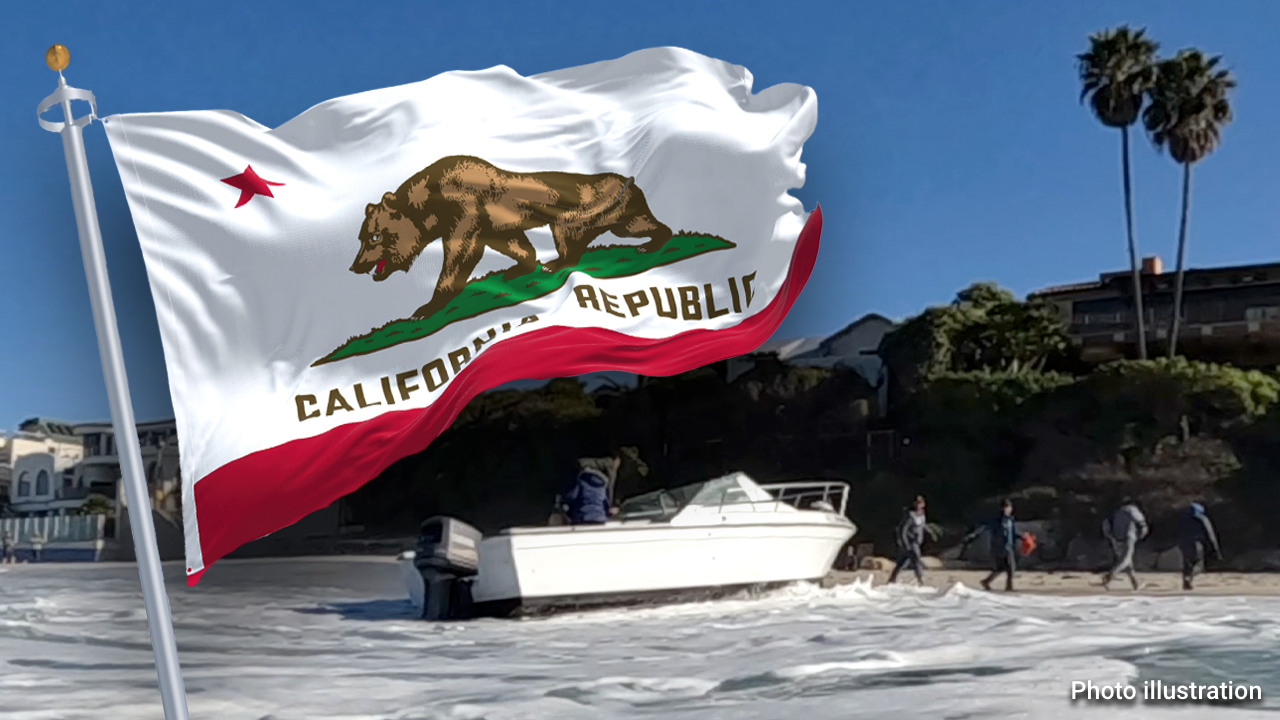
Leaders in the San Diego area called for stronger border enforcement Monday evening after a motorboat loaded with suspected illegal immigrants ran ashore on a Carlsbad beach over the weekend.
“We have no idea who they are, we have no idea where they are, and these people were not vetted at all,” San Diego County Supervisor Jim Desmond said at a press conference Monday evening, calling the boat landing a “coordinated effort.”
Video shared widely on social media showed a boat speeding between surfers before running ashore on Saturday. More than a dozen people jumped off the boat and ran into the city, with some hopping into waiting cars.
CBP’s Air and Marine Operations use radar and cameras to detect migrant vessels in the Pacific Ocean near San Diego. Crews in the air coordinate with the Coast Guard and land-based Border Patrol agents to interdict boats. (U.S. Customs and Border Protection)
CRISIS IN CALIFORNIA: A $6,500 CARTEL TICKET AND A DREAM OF DRIVING FOR DOORDASH
Migrants have long sneaked into the U.S. by way of the Pacific Ocean, but over the last three years, California has seen an “exponential increase in maritime smuggling,” Brandon Tucker, director of Customs and Border Protection’s Air and Marine Operations in San Diego, said.
Since fiscal year 2020, maritime smuggling events — which can also include trafficking drugs and other contraband — in California have increased nearly 140%, according to CBP.
CRISIS IN CALIFORNIA: SURGE IN MIGRANT BOAT LANDINGS BRINGS ‘CHAOS’ TO SEASIDE COMMUNITIES
“That happens all the time,” El Cajon Mayor and congressional candidate Bill Wells told Fox News Digital. While out sailing, Wells said he and his family had to throw life preservers to a group of suspected migrants whose boat had capsized.
“If I’m seeing that in the harbor on the one time a year that I go out … you know it’s happening every single day,” he said.
Desmond previously told Fox News it is “untenable and unsustainable to have people just coming in and walking into neighborhoods from another country.”
“Quite frankly, it’s pretty scary I would think, for the people living right along the coast,” he said.
‘IT WAS JUST CHAOS’: SAN DIEGO RESIDENT WITNESSES MIGRANT BOAT LANDING:
WATCH MORE FOX NEWS DIGITAL ORIGINALS HERE
During Monday’s press conference, Desmond and other leaders called for federal authorities to bolster border security.
“The chaos at the border and the fact that many of these crossers know there’ll be no consequences here encourages this, and it makes our cities less safe,” Oceanside Deputy Mayor Ryan Keim said, according to local news reports.
California state law bars local police from working with Border Patrol and other federal agencies to enforce immigration laws. Desmond said the latest viral boat landing shows that it’s time to end “incentives” and sanctuary for illegal immigration.
SUPREME COURT DECIDES CASE OF CALIFORNIA MAN CHARGED $23,000 BY COUNTY TO BUILD ON HIS OWN LAND
“The fact that many people have come here is primarily because we put out the red carpet,” he said.
Also on Monday, Democratic Rep. Mike Levin, whose district includes Carlsbad, called on House Speaker Mike Johnson to bring to a vote a resolution doubling the range in which Customs and Border Protection agents can operate along the coast, from 12 to 24 nautical miles.
Approximately 30 migrants lined up in an empty parking lot near Jacumba Hot Springs, California, on March 27, 2024. Border Patrol agents have encountered record numbers of illegal immigrants in the San Diego area in recent years, straining both federal and local resources. (Hannah Ray Lambert/Fox News Digital)
CLICK TO GET THE FOX NEWS APP
Land border encounters in Southern California have also increased dramatically in recent years.
So far, the San Diego sector has seen more than 185,000 encounters in fiscal year 2024, up nearly 70% from the same period in 2023, according to CBP data.
Ramiro Vargas contributed to the accompanying video.
Read the full article from Here

Colorado
Colorado landfill emission rules could force mountain counties to hike trash fees. Lawmakers are seeking a solution.
Local officials in Colorado’s mountain counties are warning that new state emission regulations for landfills could force them to raise residents’ trash collection fees.
The rules, which were passed last year by the Colorado Air Quality Control Commission, require public and private landfills that meet certain thresholds for methane emissions to install new pollutant control and monitoring systems, end open flare burning of methane and be equipped with biofilters.
Those rules go into effect in 2029, but certain landfills have up to three years after that to install the emission capture and monitoring technology.
Rural counties with publicly-owned landfills say the measure, while well-intentioned, will be expensive to implement, and could force officials to hike trash collection, commonly called tipping fees, to help cover the costs.
“Several of these counties would be looking at many millions of dollars to buy this equipment in order to be compliant,” said Kelly Flenniken, executive director for Colorado Counties, Inc., which represents all 64 of the state’s counties. “While compliance is something we do want to do, we are really struggling with how we best do that and how we balance that requirement with all of the rest of the requirements that counties have to deliver.”
In Garfield County, officials estimated last year that the regulations could cost $2 million to $2.5 million in upfront costs, with upwards of $100,000 in annual operating costs, though they will now need to reexamine the cost impacts since the rules have been finalized. The county’s landfill director, Deb Fiscus, said in an email that those costs will mean an increase in tipping fees, though the county doesn’t yet know how much.
The same could be true in Pitkin County, home to Aspen, where infrastructure costs could be around $3.5 million, with an additional $200,000 to $400,000 in yearly operating expenses, and Summit County, where officials are projecting $3 million in upfront costs, with an additional $200,000 to $500,000 each year for compliance.
Summit County Commissioner Tamara Pogue said the county’s landfill is already operating at a roughly $3 million deficit, and officials are now looking to borrow money from one of its enterprise funds to help cover the landfill’s costs.
Pogue said even without the new state regulations, “We have been concerned that we will already have to do a tipping fee increase.”
“As someone who has worked so hard in every way possible to try and create some fiscal relief for Summit County residents, and believes deeply that affordability is incredibly difficult for so many Summit County residents, that is not something that I feel comfortable doing,” she said.
Bill seeks to help with counties’ costs
State lawmakers are racing to pass a funding solution this legislative session.
Senate Bill 101 would allow landfill owners to tap money in the state’s community impact cash fund to help pay for new methane capture and monitoring infrastructure. The cash fund, created by lawmakers in 2022, is generated by fines on air polluters and primarily goes toward environmental projects in communities affected by air pollution. The bill would prioritize publicly-owned landfills for the dollars over private ones.
The bipartisan measure is sponsored by Sens. Byron Pelton, R-Sterling, and Dylan Roberts, D-Frisco, as well as Rep. Chris Richardson, R-Elbert County. It passed the Senate unanimously on April 20 and is now being considered in the House.
“I think we have a responsibility as a state to control methane and keep our air clean and do what we can to combat climate change,” Roberts said during the bill’s first committee hearing on April 13. “But the reality on the ground is that counties have to grapple with the costs of that.”
The bill represents a heavily watered-down version of its original self. Initially, the legislation included a provision requiring the Air Quality Control Commission to create a waiver process for operators to request more time for compliance. It also would have shielded operators from penalties for noncompliance if they could show that the reason was purely due to financial inability.
Those provisions were stripped after facing pushback from environmental groups, who felt the original bill would allow landfill owners to skirt the state’s clean air rules and could jeopardize climate goals.
Landfills are the third-largest emitter of methane in Colorado, according to state data, and the greenhouse gas is the second-largest driver of climate change after carbon dioxide. While methane has a shorter lifespan than carbon dioxide, it is also more potent, with a warming effect that is 86 times stronger than carbon dioxide over a 20–year-period, according to the Climate and Clean Air Coalition.
Some of the bill’s environmental opponents were groups that had advocated for the new methane rules last year, which they said had already been negotiated with local governments and landfill operators to reach a compromise.
“The final rule is the most cost-effective means to achieve the necessary and desired results in reduction in air pollution,” said Megan Kemp, Colorado policy representative for Earthjustice, during the bill’s April 13 committee hearing.
Mounting pressures
Local officials say they’re hopeful the bill, in its current state, will unlock desperately needed funding opportunities for landfills that can help mitigate the cost impacts on residents.
Still, some are disappointed that key elements were dropped from the legislation.
“I absolutely understand and appreciate the concern of the environmental community and their advocacy,” Pogue said, “but a little more flexibility would have been fair given the budget constraints that local governments have right now.”
Pogue added that counties like hers have already invested heavily in programs meant to make their landfills cleaner. Several Western Slope communities were lauded in a report last year by environmental advocates that highlighted recycling and waste diversion programs, which it said help lower emissions and reduce pollution.
“Most of the landfills out here in western Colorado want to do the right thing,” Tyler Carvell, Pitkin County’s landfill director, said of the state’s new methane regulations. “No one wants to expose their population to more methane than they need to. But they just need time to make it happen.”

Carvell said he wishes lawmakers had provided a pathway in their bill to give local governments more time to comply as they scramble to identify funding.
While lawmakers’ bill gives landfill operators another avenue to receive state dollars through the community impact cash fund, it does not inject any new funding into that account, and counties will have to compete with other entities and projects to receive the money.
Like most publicly-owned waste facilities, Pitkin County’s landfill is funded through enterprise dollars, which usually means fees for services, rather than general tax revenue. Carvell said that will almost certainly mean raising trash fees for residents to help pay for the new costs.
“I’m not really sure without some additional funding sources that there’s a way around it,” he said.
Carvell said that while the county projects that infrastructure costs will be around $3.5 million, those estimates are in today’s dollars, and inflation will likely push those figures even higher by the time counties actually have to implement the new systems.
Another concern for Carvell is ensuring the county has the personnel to maintain the new landfill systems, given the staffing pressures already facing high-cost-of-living resort areas. With those new systems also come rules for how quickly landfill operators must respond to issues.
“Most of my staff don’t even live within an hour of the landfill,” he said, adding, “It’s going to be really hard to find qualified people and have the budget to pay them enough in a certain range where they can actually deal with these problems.”
Hawaii
Las Vegas community rallies for Hawaii storm victims
HENDERSON. Nev. – A fundraiser was held at Liberty High School on Saturday to support victims in Hawaii still struggling to get back on their feet after Kona Low storms in March battered parts of O’ahu.
Shai Walter, owner of 2 Scoops of Aloha and one of the fundraiser’s organizers, said several businesses across the valley donated food, drinks, plates, and more for the fundraiser.
“We know the situation that they’re in. We’re far away, but we want to make sure we help from the Ninth Island,” Walter said. “All these businesses came together to actually do a fundraiser for our people.”
2 Scoops of Aloha, Grindz 2 Da Max, Shaka on Point, Al Pono Café, Ono Manju, Fresh Off the Boat, Mongos Hood, Leilani’s Attic, Ninth Island, Le Umu, Da Hawaiian Snack Man, Hapahoales, Noms, Maui Goddess, Sweet Kings, and Str8 Twisted are some of the businesses, organizations, and friends of the fundraiser’s organizers that made some form of donation to the fundraiser.
Cathi Minami, founder of Ninth Island Aunties, helped organize Saturday’s fundraiser. She said she moved to Las Vegas in 2001, but like many Hawaiians, never lost touch with the community on the Islands.
“We’re just trying to show that you know they’re thought of. They’re not forgotten. Our hearts are still with them, and Hawaii will always be our home,” Minami said. “So we wanted to see what we can do.”
Minami said that although her family was not severely impacted by the March storms and flooding, the tight-knit inner circles she is a part of tie her to a lot of families who are struggling to get back on their feet from the storms.
“Over 70 families, two of which have lost their homes. So we’re just trying to show that they’re thought of. They’re not forgotten. Our hearts are still with them and Hawaii will always be our home,” Minami said.
Minami said funds raised from Saturday’s event will go towards Vibrant Hawaii, a non-profit that is currently working to help impacted families directly in Hawaii.
The 9th Island Cultural Club of Las Vegas is hosting a breakfast fundraiser for the victims on Sunday, April 26, at the North Rainbow Boulevard Applebee’s Location between 8 am and 10 am.
Another breakfast fundraiser is planned on May 2.
Idaho
Idaho regular gas averages $4.33 a gallon, eighth-highest in U.S., AAA says
BOISE, Idaho (CBS2) — According to AAA, the average cost of a gallon of regular in Idaho is $4.33, two cents higher than a week ago, seven cents more than a month ago and $1.03 more than a year ago.
The national average currently sits at $4.11 per gallon, which is seven cents more than a week ago, 14 cents more than a month ago and 96 cents more than a year ago.
Today, Idaho again ranks eighth in the country for the most expensive fuel, with California leading at $5.95 per gallon and Oklahoma the cheapest at $3.50 per gallon.
A barrel of crude trades in the futures market for $96, about $36 more than a year ago.
Idaho gas prices as of April 27, 2026:
- Boise – $4.35
- Coeur d’Alene – $4.16
- Franklin – $4.11
- Idaho Falls – $4.29
- Lewiston – $4.11
- Pocatello – $4.35
- Rexburg – $4.26
- Twin Falls – $4.37
-
Colorado5 minutes agoColorado landfill emission rules could force mountain counties to hike trash fees. Lawmakers are seeking a solution.
-
Connecticut11 minutes ago6 Little-Known Towns In Connecticut
-
Delaware17 minutes ago‘Great sign of things to come’: Major rooftop solar project launches in Delaware
-
Florida23 minutes agoSickness, cold killed nearly 30 sloths at a Florida import warehouse in 2024 and 2025
-
Georgia29 minutes agoThis Is The Friendliest Small Town in Georgia
-
Hawaii35 minutes agoLas Vegas community rallies for Hawaii storm victims
-
Idaho41 minutes agoIdaho regular gas averages $4.33 a gallon, eighth-highest in U.S., AAA says
-
Illinois47 minutes agoPHOTOS: Severe weather leaves behind damage across central Illinois