World
Top Senegalese opposition leader freed from jail as election nears


Senegal’s top opposition leader, Ousmane Sonko, was released from jail late Thursday ahead of the country’s presidential election scheduled for March 24, his lawyer said.
Sonko and his key ally, Bassirou Diomaye Faye, were both set free, his lawyer Bamba Cisse told The Associated Press.
Supporters gathered at Sonko’s house and at other locations in the capital Dakar to celebrate his release. Drivers tooted their horns in celebration.
It wasn’t immediately clear how their releases would impact the election.
SENEGAL SETS MARCH 24 ELECTION DATE AFTER CONTROVERSIAL DELAY
Sonko had been in prison since July and has fought a prolonged legal battle to run for president in the upcoming election. Faye was named as the opposition’s election candidate after Sonko was barred from running.
Sonko, who finished third in the country’s 2019 presidential election, is widely seen as the main challenger to President Macky Sall’s ruling party. Sall himself ultimately decided not to seek a third term in office after Sonko’s supporters launched months of protests that at times turned deadly.
FILE – Senegalese opposition leader Ousmane Sonko addresses journalists following his release from police custody in Dakar, Senegal, on March 8, 2021.
(AP Photo/Sylvain Cherkaoui, File)
The protests have rocked Senegal’s image as a pillar of stability West Africa, a region that has seen dozens of coups and attempted coups in recent decades.
Sonko’s presidential bid has faced a prolonged legal battle that started when he was accused of rape in 2021. He was acquitted of the rape charges but was convicted of corrupting youth and sentenced to two years in prison last summer, which ignited deadly protests across the country.
Sonko was disqualified from the ballot because he faces a six-month suspended sentence following his conviction for defamation, Senegal’s highest election authority, the Constitutional Council, said in January.
His supporters maintain his legal troubles are part of a government effort to derail his candidacy in the 2024 presidential election.
His release follows Sall’s decree to exonerate political prisoners, including hundreds that were arrested in the violent protests last year.
Presidential candidates in Senegal kicked off their election campaigns on Saturday, following weeks of violent protests across the African country after the vote was delayed.
Sall tried to postpone the election last month, just weeks before it was to take place on Feb. 25. His announcement that the vote would instead be held 10 months from now plunged Senegal into uncertainty and drew protesters to the streets again. But the Constitutional Council, rejected Sall’s postponement and ordered the government to set a new date as soon as possible.


Storm-1516, a Russia-linked influence operation — which routinely disseminates fabricated claims about Europe and the West — comes in all shapes and sizes.
ADVERTISEMENT

ADVERTISEMENT
This time round, researchers say it could be behind a social media video in which alleged militants from Hezbollah — an Iran-backed Lebanese militant group — threatened to carry out attacks on French soil ahead of Bastille Day celebrations on 14 July.
In the video, three hooded men wearing military uniforms pose in front of a dummy of a French Foreign Legion soldier, whose face had the French flag painted on.
They threaten to “shed blood” on 14 July if France continues to “supply weapons” to the “Zionist regime”, in an apparent reference to Israel.
At the end of the clip, one man uses a knife to decapitate the dummy.
What do we know about this video?
The clip first spread on Telegram before moving to X and Facebook, gaining almost one million views across X posts.
In the content analysed by Euronews’s verification team, The Cube, the men don’t make an explicit reference to the group they belong to. However, the arm patch on the men’s uniform resembles Hezbollah, whose armed wing is classified as a terrorist organisation by the European Union.
In addition, social media posts also refer to them as Hezbollah.
However, there is a series of clues which suggest the video is fake. To begin, the video does not bear the group’s logo, which is typically included in content disseminated on its official channels.
Colleagues from Euronews Arabic-speaking service also told us that the accent resembled Levantine Arabic but not a Lebanese Arabic accent, adding that the speaker made multiple grammatical mistakes. This suggests that the video does not belong to Hezbollah.
Fact-checkers from AFP reported that the video spread through a series of posts published on the same day by a network of accounts that regularly use pro-Russian narratives.
They include accounts that are favourable to the Alliance of Sahel States, a group of countries that includes Mali, Niger and Burkina Faso, has ties to Iran and is openly anti-Western.
Fact-checkers have also reported that the video was picked up by anti-Israel accounts, as well as by users who regularly reshare conspiracy theories.
Storm-1516’s changing faces
The video bears similarities to other content connected to the Storm-1516 disinformation campaign, as well as fake content targeting Ukraine and Western countries.
The network produces a wide variety of content, which includes impersonating European journalists and news outlets, paying actors to pose as fake whistleblowers, and increasingly incorporating AI-generated content into its operations.
Researchers have highlighted similarities between the latest fake Hezbollah clip and other Russia-linked content — including a clip flagged by the Gnida project, an anonymous research group tracking Russian influence operations, which was published in January 2025.
The video in question showed individuals claiming to belong to HTS — the Islamist group formerly led by Syria’s current president, Ahmed al-Sharaa — threaten to burn down Paris’ Notre Dame Cathedral, unless French authorities release Brahim Aouissaoui. The latter, a Tunisian citizen, killed three people during a terror attack he carried out in Nice in 2020.
Another example was a video purporting to show Hamas threatening attacks in France ahead of the Paris 2024 Olympics. Microsoft’s Threat Analysis Center examined the clip and deemed it to be consistent with Storm-1516’s tactics, while Hamas denied producing the video.

The 2026 World Cup final is set. A match between the reigning world champions versus the reigning European champions. Between the sport’s greatest player in history, Lionel Messi, versus its ascendant teenage prodigy, Lamine Yamal. It will be Argentina versus Spain, Sunday in East Rutherford, N.J.
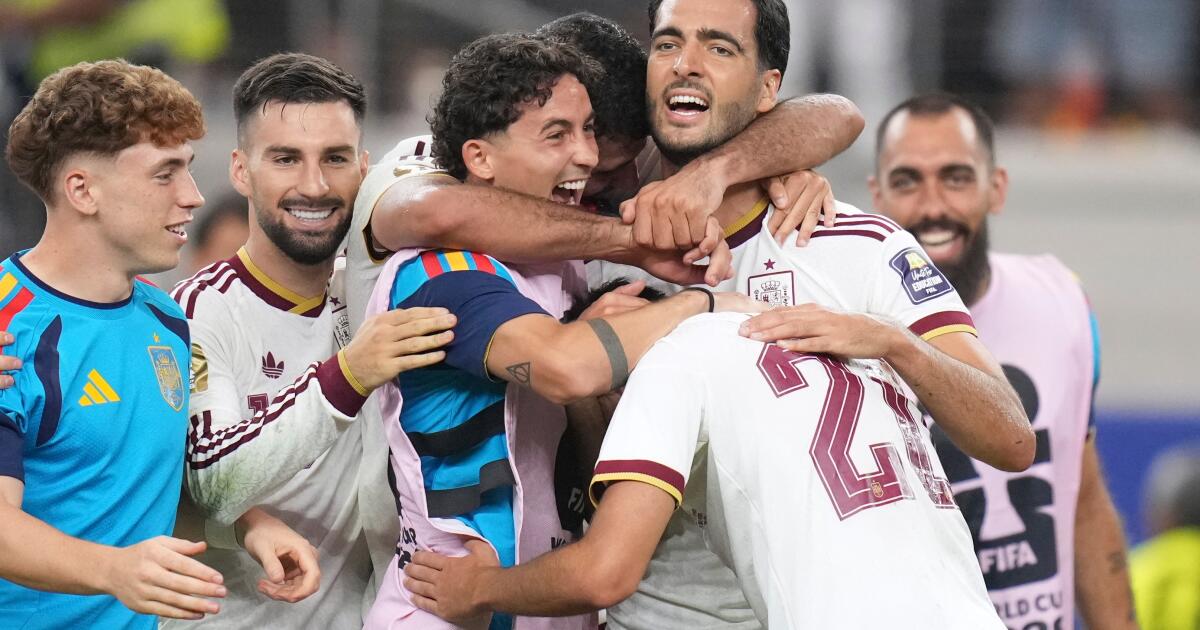
The irrepressible Albiceleste overcame a 1-0 deficit against England in Wednesday’s semifinal, equalizing in the 85th minute and knocking in a go-ahead goal in extra time to send Argentina to its second consecutive World Cup final. Spain, meanwhile, is seeking to add a second star to its national jersey and first since 2010.
At stake in global soccer’s greatest match is more than just sporting history, however. Below, four takeaways for the business of soccer based on the Argentina-Spain matchup.
A battle of the high rollers
Lionel Messi, at 39, remains soccer’s best-paid endorser, raking in $70 million in off-pitch earnings for the current season, according to Sportico estimates. With his annual contract at Inter Miami earning him an additional $70 million, he is the sport’s second-highest paid player in the entire World Cup field behind only Cristiano Ronaldo. Overall, Messi is the fifth-highest paid athlete of all time, with $1.99 billion in career earnings.
But Lamine Yamal, the 19-year-old wunderkind from Spain, is no slouch: He’s earned $33 million this past year from Barcelona, and an additional $10 million from sponsors like Adidas and American Eagle. Currently ranked No. 10 among Sportico’s highest paid World Cup footballers, Yamal could leapfrog a few places higher by the next World Cup, particularly if he burnishes his already impressive resumé with a strong showing and a Spain victory on Sunday.
A knockout victory for Adidas
Sunday’s final will be an all-Adidas affair, with the company outfitting both Spain and Argentina and pitting two of its marquee stars against one another.
The last Adidas vs. Adidas World Cup final was Germany against Argentina in 2014. That year, Adidas saw currency-neutral sales of soccer products rise by 20% to $2.4 billion (€2.1 billion).
An Adidas spokeswoman declined to specify sales projections for the 2026 World Cup but said in a statement that the company is “proud” to outfit both finalists at this year’s tournament.
Archrival Nike made a splashy entrance into this year’s World Cup, with a star-studded commercial honoring stars like Kylian Mbappé and Erling Haaland, the latter of whom became a breakout hit in the U.S. But instead of the World Cup trophy, Nike walks away from the 2026 tournament with the rights to Germany’s national team.
FIFA’s ticket pricing
As of Wednesday evening, get-in prices for Sunday’s final started at $8,900 in the nosebleeds, per Ticketmaster, while lower-bowl seats ran as high as $24,000.
But unlike the lead-up to the tournament’s group stage matches, where the sticker shock for four-figure ticket prices led to large blocks of seats going unsold until the last minute, only a handful of seats to Sunday’s final were available for resale on Ticketmaster.
The result is a reflection of FIFA’s ticket pricing strategy for the North American-hosted World Cup: set prices eye-poppingly high from the jump and limit the flow of cash into reseller’s hands.
Soccer’s Hottest Clubs: La Liga and MLS
A Spain and Argentina final reflects well on Spain’s LaLiga after the professional men’s league failed to put a representative in the Champions League final for a second year in a row. A whopping 17 players on La Roja’s roster come from the domestic top-flight league– of whom eight play for Barcelona, while the lion’s share of players for Argentina (7) also play within LaLiga.
And while MLS can’t compete on quantity of players taking the pitch on Sunday, the ability to market around Inter Miami star Messi into and through the final match is the dream scenario for the U.S. league. This week, MLS launched a new campaign aimed at converting World Cup fans to year-round club supporters, anchored by Messi and ubiquitous pitchman and England legend David Beckham. Some 22 of the league’s 30 clubs are offering complimentary single-game tickets to first-time MLS match attendees.

NEWYou can now listen to Fox News articles!
President Donald Trump said he believes Russian President Vladimir Putin is ready to reach an agreement to end the war in Ukraine, even as Moscow warned Wednesday that Western troops deployed to enforce any eventual peace deal would become Russian military targets.
“I say, ‘Vladimir, it’s time for you to stop. It’s time for this war to end,’” Trump told Fox News chief foreign correspondent Trey Yingst in an interview released Tuesday.
Trump said he believed Putin was “ready to make a deal” to end the fighting.
ANOTHER NATO ALLY SIGNS ONTO EUROPEAN NUCLEAR UMBRELLA AS CONTINENT BOOSTS SELF-DEFENSE
Meanwhile, fighting continued across Ukraine and Russian-occupied territory.
The intensifying drone war has forced both militaries to search for additional ways to intercept unmanned aircraft, sometimes using weapons designed decades before modern drones emerged.
A video supplied by East2West shows a Russian soldier apparently losing control of a Soviet-era YakB-12.7 rotary machine gun mounted on an improvised ground platform.
Russian President Vladimir Putin and President Donald Trump meet in 2019, before their relationship began to sour. (Brendan Smialowski/AFP via Getty Images)
The weapon begins spinning violently, dragging the service member around before throwing him several yards from the mounting. Another soldier ducks as the gun swings in his direction.
East2West reported that no one was injured, though Fox News Digital has not independently verified the location, date or circumstances of the footage.
The four-barrel machine gun was originally developed for use aboard the Soviet-designed Mi-24 Hind attack helicopter. Russian forces have reportedly attempted to repurpose such weapons as ground-based defenses against Ukrainian drones, East2West news reported.
TRUMP SAYS US WILL LET UKRAINE MAKE PATRIOT MISSILES IN MAJOR POLICY SHIFT
An explosion lights up the sky over the city during a Russian missile and drone strike amid Russia’s attack on Ukraine in Kyiv July 2, 2026. (Gleb Garanich/Reuters)
On Wednesday, Russian Foreign Ministry spokeswoman Maria Zakharova said any multinational force deployed by Ukraine’s allies after a ceasefire would be unacceptable to Moscow.
“We would regard such units as legitimate military targets,” Zakharova said, according to a Reuters report published Wednesday.
Members of the Western “coalition of the willing” reaffirmed at a meeting in Paris this week that they intend to deploy a multinational force after hostilities end. The proposed force would seek to reassure Ukraine and help Kyiv rebuild its military.
CLICK HERE TO DOWNLOAD THE FOX NEWS APP
Ukraine’s military said Wednesday that its forces struck the Balaklava thermal power station in Russian-occupied Crimea, a facility that accounts for nearly half of the peninsula’s electricity generation, according to Reuters.
Russia, meanwhile, launched another major drone and missile attack against Ukraine’s southern Odesa region, killing three people, regional Governor Oleh Kiper said. He said civilian, industrial and port infrastructure had been targeted during five consecutive days of Russian attacks.
Emergency services personnel work to extinguish a vehicle fire after a Russian drone attack in the Kyiv region, Ukraine, May 5, 2026. (Ukrainian Emergency Service/AP)
Ukrainian President Volodymyr Zelenskyy also said Wednesday that Ukraine expects to develop the technical capability to manufacture missiles for U.S.-made Patriot air-defense systems by the end of 2026.
Reuters contributed to this story.
-

 Health5 minutes ago
Game-changing cholesterol pill wins FDA approval after cutting LDL nearly 60%
-

 Sports11 minutes ago
2026 AL, NL MVP Odds: Ohtani Favored; Alvarez Holding Off Challengers
-

 Technology17 minutes ago
Tesla helped save a driver. Is your car ready?
-
 Business23 minutes ago
SpaceX stock erases all its gains and slides below IPO price in intraday trading
-
 Entertainment29 minutes ago
Contributor: Hollywood will stop fueling racism when audiences demand better
-
 Politics41 minutes ago
Trump seeks prime-time spotlight for election claims, sparking concerns he’ll intervene
-
 Science47 minutes ago
California employer health premiums will cost as much as a new car in 2027
-
 Sports53 minutes ago
How Spain ‘recaptured the spirit of 2010’ in its run to the World Cup final

