World
Jake Sullivan, Biden discussed possibility of hitting Iran nuclear program: report


In a top meeting with National Security Adviser Jake Sullivan roughly a month ago, President Biden was presented with a series of strike options should Iran make a move to develop a nuclear weapon, reported Axios on Friday.
The White House did not immediately respond to Fox News Digital’s questions regarding the strike options, but according to the report, Biden has not signed off on any plans to hit Iran’s nuclear program.
Biden has vowed not to let Iran develop a nuclear weapon on his watch, but it remains unclear what steps Iran would have to take in order for the Biden administration to respond with direct hits, given that Tehran has already been reported to have stockpiled near-weapons-grade uranium and to be bolstering its weaponization capabilities.
A big banner depicting Iran’s Supreme Leader Ayatollah Ali Khamenei is placed next to a ballistic missile in Baharestan Square in Tehran, Iran, on September 26, 2024, on the sideline of an exhibition that marks the 44th anniversary of the start of Iran-Iraq war. (Photo by Hossein Beris / Middle East Images / Middle East Images via AFP via Getty Images)
IRAN EXPANDS WEAPONIZATION CAPABILITIES CRITICAL FOR EMPLOYING NUCLEAR BOMB
The president was reportedly presented with a series of scenarios and response options during the meeting, though sources told the outlet that Biden has not made any final decisions regarding the information he was given.
Another source reportedly said that currently there are no active discussions on militarily hitting Iran’s program.
Biden repeatedly warned Israel against hitting Tehran’s nuclear program as tensions between the two nations reached a boiling point last year amid the conflict with Hamas and Hezbollah – both of which had the backing of Iran.
But some aides close to the president have reportedly argued that the U.S. has the “imperative” and the “opportunity” to strike Tehran’s nuclear ambitions given its efforts to accelerate its program and its weakened position given the significantly degraded standing of Iran’s proxy forces.
Sources told Axios that Sullivan did not advise the president to take action either way but merely presented him with scenarios.
U.S. President Joe Biden confers with his National Security Adviser Jake Sullivan during a roundtable with Jewish community leaders in the Indian Treaty Room of the Eisenhower Executive Office Building October 11, 2023, in Washington, D.C. (Photo by Drew Angerer/Getty Images)
IRAN LAUNCHES ROCKET WITH HEAVIEST-EVER PAYLOAD INTO SPACE AMID HEIGHTENED CONCERN OVER NUCLEAR PROGRAM
The report also noted that the National Security Adviser, along with other aides to the president, believed that the degraded nature of Iran’s air defenses and missile capabilities and weakened proxy forces could improve the likelihood of a successful strike and decrease the chance of Iranian retaliation.
Biden reportedly focused on the issue of urgency and whether Iran had taken specific steps to justify a potentially conflict-inducing military strike just weeks before a new administration takes office – though it remains unclear what those steps would include.
“You can look at the public statements of Iranian officials, which have changed in the last few months as they have been dealt these strategic blows, to raise the question: Do we have to change our doctrine at some point? The fact that that’s coming out publicly is something that has to be looked at extremely carefully,” Sullivan said during remarks in New York just one week before Christmas Day.
Iranian protesters carry flowers while standing in front of a giant banner depicting a portrait of Lebanon’s Hezbollah Secretary General, Hassan Nasrallah, during a protest gathering to condemn an Israeli air strike against Hezbollah’s headquarters in the suburb of Beirut, and the killing of Hassan Nasrallah and an Islamic Revolutionary Guard Corps’ (IRGC) Quds Force commander, General Abbas Nilforoushan, in Tehran, Iran, on September 30, 2024. (Morteza Nikoubazl/NurPhoto via Getty Images)
He also pointed to the blows Iran has seen this year and argued that they could push Iran to develop a nuclear weapon rather than deter it.
“It generates choices for that adversary that can be quite dangerous, and that’s something we have to remain extremely vigilant about as we go forward,” Sullivan said.



Published on
After two years of strong performance driven by a shift to a war economy, Russia’s economic situation is weakening, IMF Managing Director Kristalina Georgieva told Euronews.
ADVERTISEMENT

ADVERTISEMENT
And although the IMF raised its forecast for Russia’s 2026 growth in its April outlook from 0.8% to 1.1%, Georgieva told Euronews this did not reflect the full picture of the economic weakening.
“The higher oil prices do give a breather to Russia,” Georgieva said, arguing the hike cannot offset the bigger hit to Russia’s economy.
“They have depleted their buffers dramatically,” Georgieva said. The oil price windfall “appears to be used to rebuild buffers rather than to inject more investment into the economy,” she explained.
“Growth has slowed down significantly. Now we are projecting 1%. Before the war, their potential growth was 1.6%,” Georgieva pointed out.
The IMF managing director also told Euronews that it is important to consider other economic indicators to better understand Russia’s current economic situation.
“Inflation is high. That means that interest rates are high, almost 15%.”
The IMF does not expect to see “material impact on growth in Russia,” Georgieva said. “It is a country whose medium (and) long-term prospects have worsened significantly.”
She listed three grounds on which the prospects have worsened. The first is losing people.
“A country that was in a demographic decline to begin with now lost so many young people for a terrible reason,” Georgieva explained.
The second factor is the sanctions, specifically the way they “bite a lot on the technology front.”
“What we see in the oil and gas sector in Russia, there is a tremendous problem with lack of technological renewal that is restricting the ability of the sector to expand,” she said.
And the third is the fact that “Russia lost standing.”
“That translates into many tangible and non-tangible losses. I mean, just think of the young Russians that could have built relations with Europeans and others and did not because of the war,” Georgieva stated.
“So, on the whole, Russia is coming crippled,” she concluded.

Not even the professionals inside the New York Knicks press conference room could contain themselves as the clock neared 1 a.m. Thursday morning. Some clapped when Knicks head coach Mike Brown hailed reserve guard Jose Alvarado’s performance—8 points, 2 rebounds and 3 assists, all in the fourth quarter—during the largest comeback in NBA Finals history, which put the Knicks one win away from their first title since 1973.
“I know a lot of you guys can’t (clap) because you’re in the media, and you have to stay neutral,” Brown said, before doing something he wasn’t supposed to do. “I’m going to f—king clap for Jose,” he said. “Sorry, mom.”
It was that kind of night. None of this—erasing a 29-point deficit, these Knicks being one game away from hoisting the Larry O’Brien trophy—was supposed to happen.
A few yards from the pressers, some of the world’s biggest celebrities partied in the bowels of Madison Square Garden, denying gentle requests to climb into the private cars waiting to whisk them away.
Other fans, still in disbelief, had gone from second-guessing why they’d spent thousands of dollars to see their team get blown out in the NBA Finals to wondering how they got away with such a bargain to see Knicks’ history. They belted Knicks in five! down the escalators, slowly leaving the building before massing outside, where scores of police officers sought to maintain order. Or maybe to re-establish it, after what transpired inside MSG during the second half of Game 4.
As the press conferences continued, players consistently reminded writers that there was still one more game to win. But if New York completes its Finals quest, Wednesday’s game will go down in the city’s sports lore.
New York is used to playing the role of top dog. Ensconced in midtown, with their multi-thousand-dollar tickets and A-list supporters, playing in “The World’s Most Famous Arena,” the Knicks are worth $9.85 billion, the third-most valuable team in the NBA. Its billionaire owner James Dolan shared a box with President Donald Trump on Monday night.
In the last few decades, the Knicks have more often represented flash than fight. But this team—assembled via free agency, trades and second-round picks, led by a coach on his fourth stop—has bucked that stereotype. Trailing by 27 at half, they were used to being down and doubted. They chipped away at their deficit, holding the Spurs to 30 second-half points as the gap narrowed and narrowed. Fans in the packed arena, famous or not, remained engaged throughout. Their thunderous yells surely contributed to Spurs star Victor Wembanyama clanking two late free throws with the Knicks down one.
In the waning moments, Jalen Brunson missed a three-pointer to take the lead, but OG Anunoby glided to the hoop in time to get just enough of his hand on the ball to direct it basket-ward.
Brown called Anunoby’s game-winning tip-in with 1.2 seconds left “the most iconic shot in the history of New York basketball.” Images of that two-finger tap feel destined to adorn childhood bedrooms, subway cars and billboards for decades. One is already on a trading card, with a nickname to boot.
“Right hand of God,” Karl-Anthony Towns dubbed the play. A piece of the net will be inserted into one of Topps’ cards. The ball and OG’s jersey will likely be museum pieces, if not auction-house items, one day. Mike Breen’s triple “It’s good!” call on ESPN is certain to play over and over and over again.
OMG!, Thursday morning’s New York Post blared. Meanwhile more than 40 commemorative physical tickets handed out to attendees on Wednesday were bought on eBay by 10 a.m. Thursday. The cheapest ticket for a potential Game 6 on the secondary market now? It’s more than $12,000.
History sells.
The Knicks had already been credited with bringing New Yorkers together. Trump and Mayor Zohran Mamdani cheered for the same side in Game 3. Taylor Swift, sitting in a packed celebrity row, shared the same euphoria being projected on brownstones across NYC’s five boroughs and beamed from its street-corner Wi-Fi terminals. For the time being, the fighting between the Knicks and the city over watch parties has been forgotten.
“If there’s one thing Knicks fans don’t need permission for, it’s showing up for our team wherever we may be,” Mamdani posted on X earlier in the day after a watch party outside the team’s venue was scrapped.
When the final buzzer sounded, and the players, celebrities, crowds and city streets seemingly rose in unison, palms aloft, “You could just feel the abundance of joy,” Towns said.
By 2 a.m., with ears still ringing, fans were finally making their way home. It was pitch black on Gotham’s quieter streets. It felt more like dawn.

NEWYou can now listen to Fox News articles!
JERUSALEM: The International Christian Embassy Jerusalem (ICEJ) convened an emergency summit this week amid growing concern over the global rise in antisemitism following the Hamas-led Oct. 7 massacre in 2023.
The three-day conference in the Israeli capital comes at a time when social media influencers are consistently pushing antisemitic hate to their millions of followers.
“Attacking the Jews means attacking the very roots of one’s own faith. It means fighting against the people who gave us the Bible. Jesus was Jewish,” ICEJ President Dr. Jürgen Bühler told Fox News Digital.
CANADA’S CARNEY PLEDGES ACTION ON ANTISEMITISM AMID BACKLASH OVER NEW ANTI-HATE COUNCIL MEMBERS
Christian leaders attend the ICEJ’s emergency summit on antisemitism on Wednesday, June 10th, 2026 at the Vert hotel in Jerusalem, Israel. (Amelie Botbol for Fox News Digital)
“If you don’t fight antisemitism, you are sawing off the branch you sit on. For the church to survive, we need to connect to our roots, fighting antisemitism needs to be at the forefront of every pastor and every leader around the world,” he added.
One of the central themes of the conference is Replacement Theology, a doctrine that holds the Church has replaced the Jewish people in God’s plan.
“The Bible is full of God’s eternal plan which includes the Jewish people. Paul’s statement in Romans 11 that ‘the gifts and the calling of God are irrevocable’ relates to Israel. This is a doctrine that goes contrary to what the New and Old Testament are teaching and that’s why we need to have this conference,” Bühler said.
“One cannot deny the Jewishness of the Bible. The most frequent word in the Bible is the name of God and the second most used name is Israel. Jesus was born in Bethlehem, he died in Jerusalem, resurrected in Jerusalem, rose to heaven from Jerusalem and he is coming back to Jerusalem. If you read the Bible it is so easy to see the connection to Israel,” he added.
HUCKABEE CONDEMNS EFFORTS TO ERASE JEWISH HISTORY TO THE HOLY LAND AS ‘ABSURD’
U.S. Ambassador to Israel Mike Huckabee places a note in the Western Wall as Holy Week and Passover come to a close. (@USAmbIsrael/X)
Israel’s newly appointed Special Envoy to the Christian world, George Deek, addressed the meeting on Wednesday, while Foreign Minister Gideon Sa’ar and U.S. Ambassador to Israel Mike Huckabee are scheduled to attend the summit’s closing event on Thursday at the foreign ministry as keynote speakers.
In a recorded message broadcast at the summit, Israeli President Isaac Herzog thanked Christian leaders for mobilizing against antisemitism.
“We are witnessing a very disturbing surge of antisemitism all over the world. This is a major challenge for humanity. This is the age-old, perhaps the oldest plague in humanity, and we have to stand up together — thought leaders and religious leaders — and say, ‘No more,’ and teach people about the sources of this evil and how to counter antisemitism,” Herzog said.
“I believe that countering antisemitism requires a combination of three major elements: law enforcement, adjudication and education,” he said.
Vice President JD Vance, left, and Israeli President Isaac Herzog shake hands during a meeting at the presidential residence, in Jerusalem, on Wednesday, Oct. 22, 2025. (Leo Correa/AP)
“You, dear leaders, have a huge capability of fighting back, and I bless you. Truly, I bless you as the president of Israel for coming here and fighting back, for coming here and discussing how to fight back,” Herzog concluded.
Dr. Andrew J. Nolte, who launched Regent University’s Israel Institute in 2024, said students often repeat antisemitic claims, including the accusation that Jews killed Jesus.
“The answer from a Christian theological perspective is that we all killed Jesus, he died for our sins. There is a theological understanding of the guilt we bear for Jesus’s blood,” Nolte told Fox News Digital.
ISRAEL LOOKING FOR ‘SOLUTIONS’ TO OPEN CHRISTIAN SITES AFTER BARRING CHURCH LEADER ON PALM SUNDAY DUE TO WAR
The Church of the Holy Sepulchre dates back to the fourth century. (Archivio Università di Roma Sapienza)
While Israel has faced recent criticism over treatment of Christians – mostly at the hands of a few extremists – the country is seen as a beacon of freedom of religion in the Middle East.
According to Israel’s Central Bureau of Statistics, as of December 2025, Israel’s Christian population stood at approximately 184,200 people, representing 1.9% of the country’s total population. The community grew by 0.7% over the previous year.
Arab Christians account for 78.7% of Israel’s Christian population and comprise 6.8% of the country’s overall Arab population.
Most Arab Christians reside in northern Israel. Among non-Arab Christians, 42% live in the Tel Aviv and Central districts, compared to 33.9% in the Northern and Haifa districts.
Christian pilgrims carrying wooden crosses walk through Jerusalem’s Old City towards the Holy Sepulcre church during the Orthodox Good Friday procession on May 3, 2024. (Photo by AHMAD GHARABLI/AFP via Getty Images)
Nolte said that Christians in Israel hold prominent positions, noting that the provost of the University of Haifa is a Maronite Christian and that Christian communities in the country report relatively high income levels. He also said that, in most cases involving civil rights and religious freedom brought by Christians in Israel, the outcomes have been decided in their favor.
“If you are comparing Israel to any Muslim country in the Middle East, the status of Christians is much higher. As a Christian, you are better off here than anywhere else in the region,” he added.
CHRISTOPHER RUFO: THE POLITICAL RIGHT AND THE ANTISEMITIC INFLUENCER PROBLEM
Israeli Christians in Nazareth hold a Christmas parade on Dec. 24, 2025. (Eitan Elhadez-Barak/TPS-IL)
Christopher Kuehl, founder of Present Witness and co-host of the One New Man podcast, emphasized that biblical illiteracy among younger generations is fueling confusion about Israel.
He opened his remarks at the conference by citing a recent U.S. study on Gen Z’s alignment with biblical teachings and how closely their worldview corresponds with scripture, noting that only about 5% demonstrated strong adherence.
“Israel gets thrown into that ignorance, that biblical ignorance. Social media is what teaches children and Gen Z; they spend eight hours a day on it and go to church once a week for 20 minutes. How does one create a message in 20 minutes that will overcome spending eight hours on social media every day?” Kuehl told Fox News Digital.
FAITH UNDER FIRE: NETANYAHU CALLS OUT EFFORTS TO DIVIDE CHRISTIANS AND ISRAEL IN US
One Israeli pastor says one of the biggest challenges facing Israel’s Christian community is a low birth rate. Jesus King Church in Nazareth, Israel. (Photo: Pastor Saleem Shalash)
Pastor Matthew Earls joined the summit as part of Eagles’ Wings Ministries’ Israel Christian Nexus program, which focuses on young Christian leaders and gives them the opportunity to experience Israel early in their careers and build a well-rounded perspective.
“We want to teach biblical truth so that the church does not look completely different in the next generation,” Earls told Fox News Digital. “The greater mission is one of solidarity with the people of Israel, and of equipping people with talking points in the hope that dialogue can take place and lead to greater understanding, or at least mutual respect for one another’s positions,” he said.
Sacha Roytman, CEO of the Combat Antisemitism Movement, told Fox News Digital that Christians and Jews face many of the same challenges in defending their faith, history, and future, adding that those who reject Jews and Zionism also reject the Christian worldview because the two are aligned.
Orthodox Christians carry wooden crosses along the Via Dolorosa (Way of Suffering) in the Old City of Jerusalem during the Orthodox Good Friday procession before Holy Saturday. (Saeed Qaq/SOPA Images/LightRocket via Getty Images)
“I’m here to share this message with Christian leaders who go back to their communities empowered with more knowledge, more energy, and different tools to fight this battle,” Roytman said.
CLICK HERE TO DOWNLOAD THE FOX NEWS APP
As part of its research, CAM has examined how social media algorithms amplify antisemitic content and conspiracy theories. “We discovered that the algorithms are trained to deliver engaging content that upsets people and keeps them hooked. Often, it is anti-establishment content and conspiracy theories that fuel antisemitism,” Roytman said.
More than 200 theologians, pastors and ministry leaders from over 30 countries are attending in person, alongside approximately 3,000 online participants.
-

 Sports30 seconds ago
2026 World Cup Odds: How Far Will Team USA Go?
-

 Technology3 minutes ago
Grandparents are identity theft’s biggest payday
-
Business9 minutes ago
Legal brawl that helped tank Jeff Shell’s Paramount career ends
-
Entertainment15 minutes ago
Todd and Julie Chrisley sue law firm for $25 million, say legal flub led to conviction
-
 Lifestyle18 minutes ago
Want to experience the World Cup for $10? Head to the FIFA Fan Festival
-
 Politics23 minutes ago
Commentary: In Orange County, a progressive Latina pol beats back well-funded haters — again
-
 Sports33 minutes ago
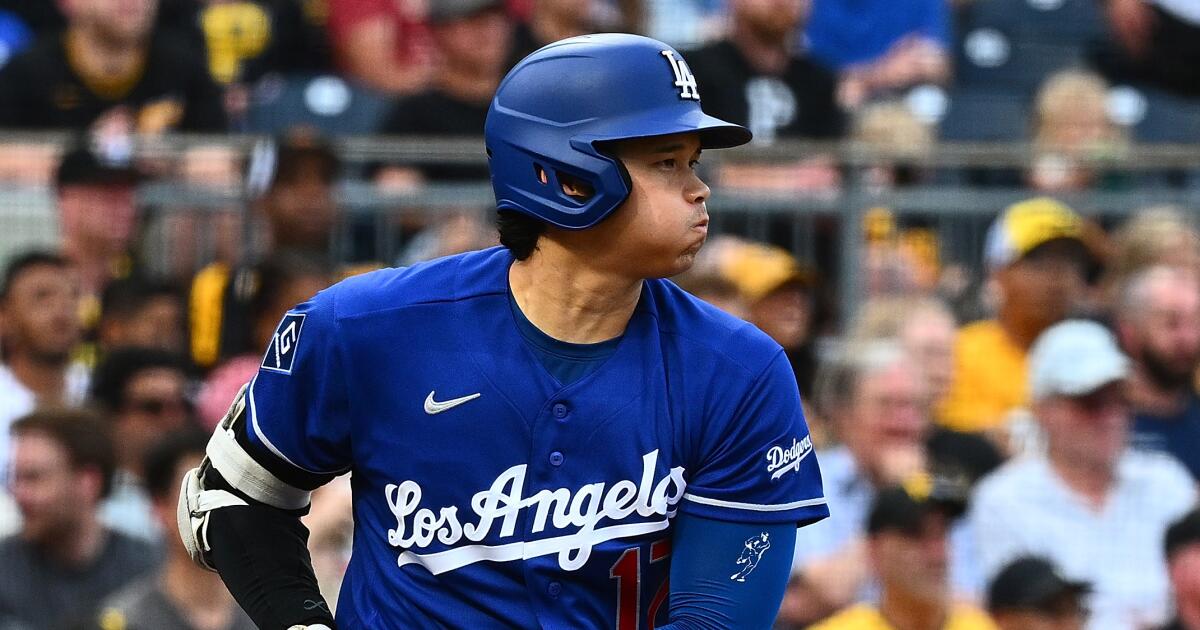
Shohei Ohtani, Justin Wrobleski sustain injuries, exit early for Dodgers vs. Pirates
-

 World45 minutes ago
Russia ‘lost standing’ despite ‘a breather’ from higher oil prices, IMF chief says

